You've finally found a practical test date, then a work shift changes, your instructor's car is unavailable, or your theory-test certificate is approaching expiry. The obvious answer seems to be a quick driving test reschedule, but the DVSA system now gives you very little room for trial and error. A slot can disappear while you're checking your diary, and an unsuitable change can leave you with fewer options than you had before.
The safest approach is to treat an earlier appointment as an opportunity, not a guaranteed improvement. Check the rules, confirm that you can attend, keep track of your remaining changes and make the final booking action yourself through the official GOV.UK service.
Table of Contents
- Why Changing Your Driving Test Booking Feels Complicated
- Understanding the 2026 DVSA Rule Changes
- How to Cancel and Rebook on the Official DVSA Site
- Managing the 10-Day Refund Window and Fee Risks
- Using Monitoring Services to Find Earlier Slots
- Streamlining Schedules for Multiple Learners
Why Changing Your Driving Test Booking Feels Complicated
Your phone shows an earlier test date. It looks like a win until you check the time, the centre, your instructor's diary and whether you can get there. That is why a driving test reschedule feels harder than it should.
The pressure starts with availability. A learner in England might already be waiting nearly 21 weeks for a car practical test, while the average wait is more than 15 weeks in Scotland and 13 weeks in Wales, according to the DVSA statement on practical driving-test waiting times. With waits at that level, learners often treat any earlier slot as too good to miss. In practice, a date that does not fit your real schedule can create a bigger problem than the one you were trying to solve.
I see this regularly with pupils who move a test first and check the details second. The new appointment may clash with work, college, childcare, a holiday, the instructor's availability or access to a suitable car. Once you have used a permitted change on a slot you cannot attend properly, getting back to something workable may mean cancelling and rebooking, not just tidying up the booking later.
Practical rule: Never accept an earlier slot until you've checked the date, time, centre, vehicle and instructor availability.
The system also feels complicated because supply and usable supply are not the same thing. The DVSA provided more than 2 million car driving tests between April 2023 and March 2024, and more than 500,000 tests were already booked within the following 24-week booking window, according to the same DVSA statement. Cancellation appointments sit on top of that main flow. They appear when another learner changes or cancels, so they can show up at odd times and in places that do not suit your route plan, travel time or instructor coverage.
Why repeated refreshing isn't a plan
Refreshing the booking page can still uncover a useful slot, but it is an unreliable way to manage something with real cost attached.
There is no official waiting list, and availability moves by centre, by day and sometimes by the hour. One search may show nothing, then a single cancellation appears and goes before you have checked your calendar. That is the operational reality learners and ADIs are dealing with.
The tightest pinch is felt by learners with limited options. If you can only attend at certain times, need one centre for work or transport reasons, or rely on one instructor and one car, many visible appointments are not genuine options. Start with the conditions you can meet. Write down the centres, days and time ranges you could accept, then check how many changes you have left before you touch the booking.
Understanding the 2026 DVSA Rule Changes
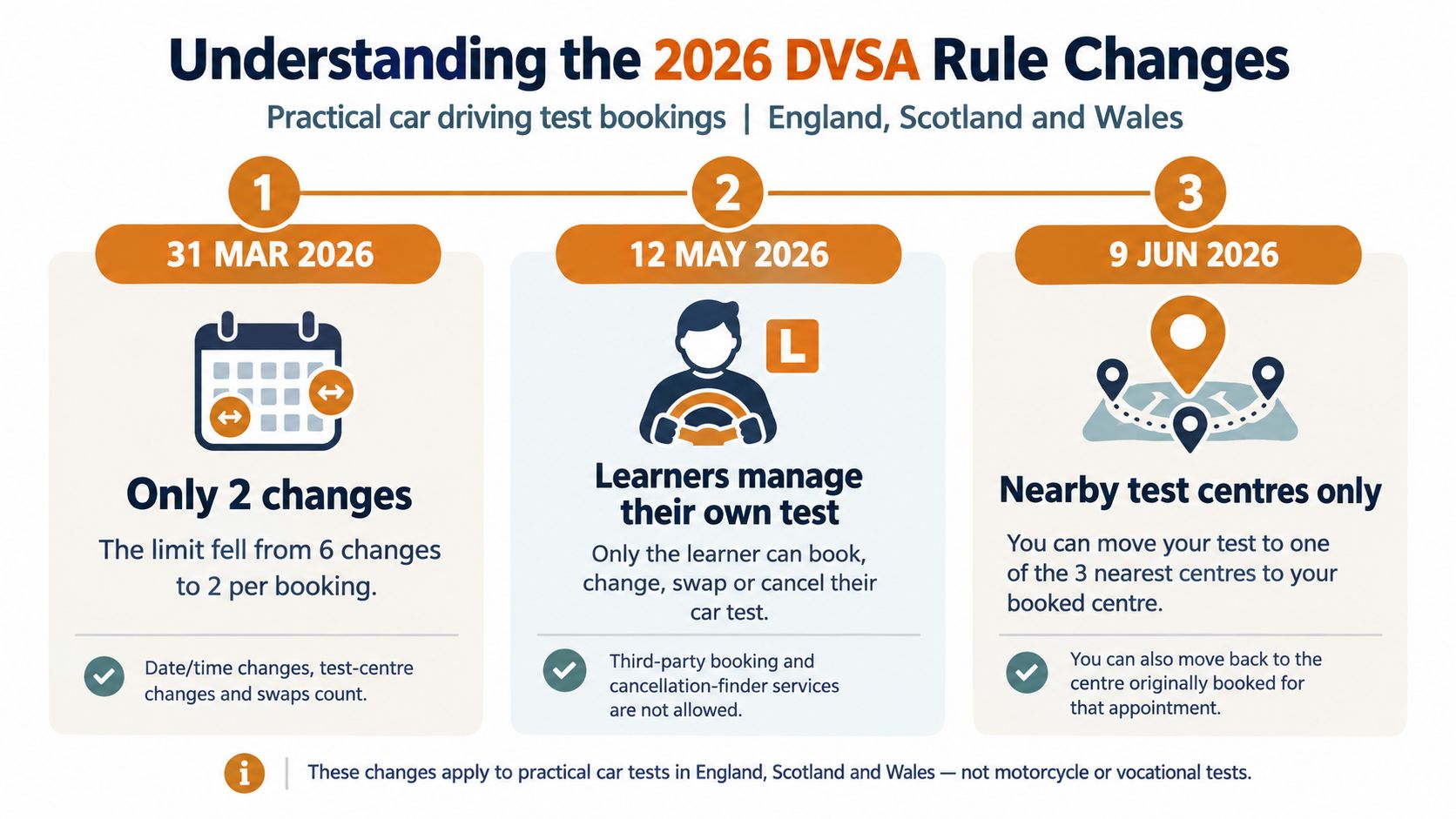
The 2026 changes make personal control and careful timing central to any car-test reschedule. From 31 March 2026, the permitted number of changes fell from six to two. A change includes moving the date, time or test centre, and swapping an appointment with another learner. The official explanation is set out in the DVSA guidance on changes to driving-test booking rules.
From 12 May 2026, only the learner taking the test can book or manage it. An instructor, parent or other helper can provide support, but they can't complete the booking, change, cancellation or swap on the learner's behalf. From 9 June 2026, a learner moving a test is restricted to one of the three nearest driving-test centres.
These restrictions matter because the backlog is already substantial. The National Audit Office findings reported by RAC Drive recorded an average practical-test wait in Great Britain of 22 weeks in September 2025, compared with just over five weeks in February 2020. The same source reported that 70% of permanent DVSA test centres were at the 24-week maximum, and that DVSA's forecast for returning to a seven-week target had moved to November 2027.
A learner may therefore spend considerable time searching for a cancellation, but must still make a disciplined decision once an opening appears. If both changes have been used, the learner must cancel the existing appointment and book a new one. That makes the refund deadline and the suitability of the replacement date especially important.
You can find a plain-English explanation of the restrictions in this guide to the new DVSA driving-test rules.
The distinction between monitoring and booking is also significant. A notification service can tell you that a slot may be available, but it cannot reserve it or complete the change for you. The learner must log in, select the appointment and confirm the transaction personally through the DVSA system.
The regulatory framework is designed to separate availability information from the booking action. That means a compliant service can help you react faster, but it can't remove the need for judgement, a valid booking reference and a remaining change.
The video below provides another visual explanation of the booking-rule changes.
How to Cancel and Rebook on the Official DVSA Site
A learner gets the alert, logs in late, sees a better slot, then loses it while checking whether the instructor can cover it. That is how rescheduling usually goes wrong. Use the official GOV.UK service for driving-test appointments, and treat every alert as a prompt to act, not as a reservation. The appointment only changes when the DVSA system accepts it and shows the replacement booking on screen.
Prepare before you search
Get your booking reference and licence details ready first. Decide in advance which test centres, dates and time windows you can take. If your instructor's car is part of the plan, check availability before you start clicking. An earlier date that leaves you without a car, cover, or enough notice is not a practical win.
The booking service runs from 6:00am to 11:40pm. If a notification lands outside those hours, you may have to wait and accept that the slot could go. New standard appointments are released 24 weeks ahead at 6:00am on Mondays, while cancellations can appear at any time when another learner changes or cancels.
Follow the booking sequence
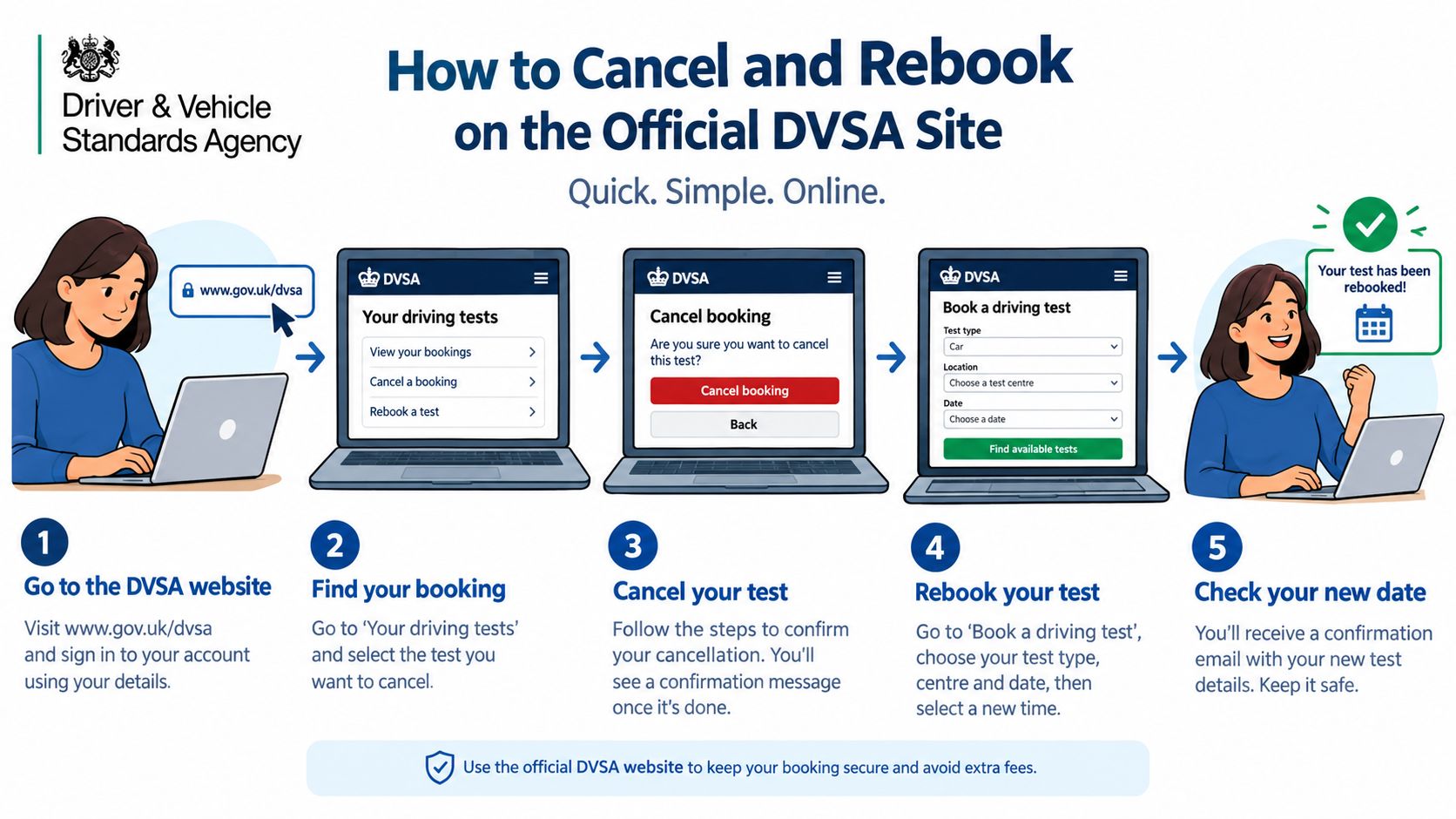
Open the official DVSA booking service. Go straight to GOV.UK, not a page asking you to hand over the booking process.
Log in and review the current appointment. Check the existing date, centre and details before searching. That gives you a clear reference point if nothing suitable appears.
Search within the limits you already agreed. Look for a slot you can attend in reality, not one that only looks good on the screen. If another centre appears, make sure it fits the current rules and your travel plan.
Choose the replacement carefully. Recheck the date, time and centre before you commit. Selecting a slot is only part of the process.
Confirm the change yourself and save the result. Wait until the DVSA system shows the new booking, then keep the confirmation details and tell your instructor at once so the diary, lesson timing and vehicle use can be updated.
If you want a plain explanation of the booking flow, this DVSA practical-test booking guide is useful background. The booking action still has to be completed by the learner in the official system.
An alert identifies a possible opening. It doesn't hold the appointment while you decide.
If the slot disappears before confirmation, go back to search and start again. Do not assume your original appointment has changed. If you have already used one change, slow down and check every detail before confirming another. Under the current rules, a rushed choice can leave you with fewer options than you thought.
Managing the 10-Day Refund Window and Fee Risks
A learner sees an earlier slot, cancels in a hurry, then finds the replacement has gone. That is how a simple reschedule turns into a lost appointment and, in some cases, a lost fee.
Start with the refund deadline before you touch the booking. Since 8 April 2025, learners generally need to give DVSA 10 full working days' notice to change or cancel a car practical test without losing the test fee. A full refund is available when cancellation takes place at least 10 full working days before the test date, as set out in the official DVSA cancellation guidance.
Monday through Saturday count, while Sundays and public holidays do not. In practice, I tell learners and ADIs to rely on the deadline shown in the booking record rather than trying to count back quickly on a phone calendar. That reduces avoidable mistakes, especially where a bank holiday changes the calculation.
Comparing the two choices
| Choice | Advantage | Main risk |
|---|---|---|
| Use a permitted change | You keep the existing booking live and move straight to a suitable slot | You use one of only two changes |
| Cancel and book again | It may be the only route if both changes have already been used | You can lose the original appointment and run into the refund deadline |
| Keep the current test | You keep a confirmed date and avoid transaction risk | You may miss a better slot that genuinely fits |
The trade-off is operational, not just administrative. If a workable earlier appointment appears and you still have a permitted change available, changing the booking is usually the cleaner option. If both changes have been used, cancellation and a fresh booking may be the only route left, but that route carries more risk under the current rules because the original slot is no longer protected once you give it up.
Car practical test fees vary by appointment type. The financial hit may be manageable for some learners, but the bigger problem is often losing a date, a school or work arrangement, an instructor's car booking, or the only test centre that fits the plan.
Calculate before pressing confirm
Check three things together: the refund deadline, the number of changes left on the booking, and whether the new appointment works in real life. A slot is only useful if the learner can attend, the instructor can cover it, and the vehicle plan still stands. The DVSA practical driving-test booking service explains the official process for appointments and earlier tests.
Illness or injury, bereavement, a school or college examination, and a stolen driving licence may qualify for exceptions where the evidence is accepted, but those are not routine planning tools.
If you are already inside the 10-full-working-day window, pause before cancelling because an alert has appeared. Check the decision path first, then act. This guide to cancelling a practical driving test gives a plain explanation of how to weigh that choice.
Using Monitoring Services to Find Earlier Slots
Manual checking has one weakness: you need to be looking at the right centre at the moment a cancellation becomes available. That's difficult when you're working, studying, taking lessons or trying to protect a narrow set of acceptable appointment times.
A compliant monitoring service changes the search task, not the booking rules. It checks the DVSA availability system and sends an alert when a possible earlier appointment matches the centres or preferences you've selected. You still open the official service, assess the slot and complete the reschedule yourself.
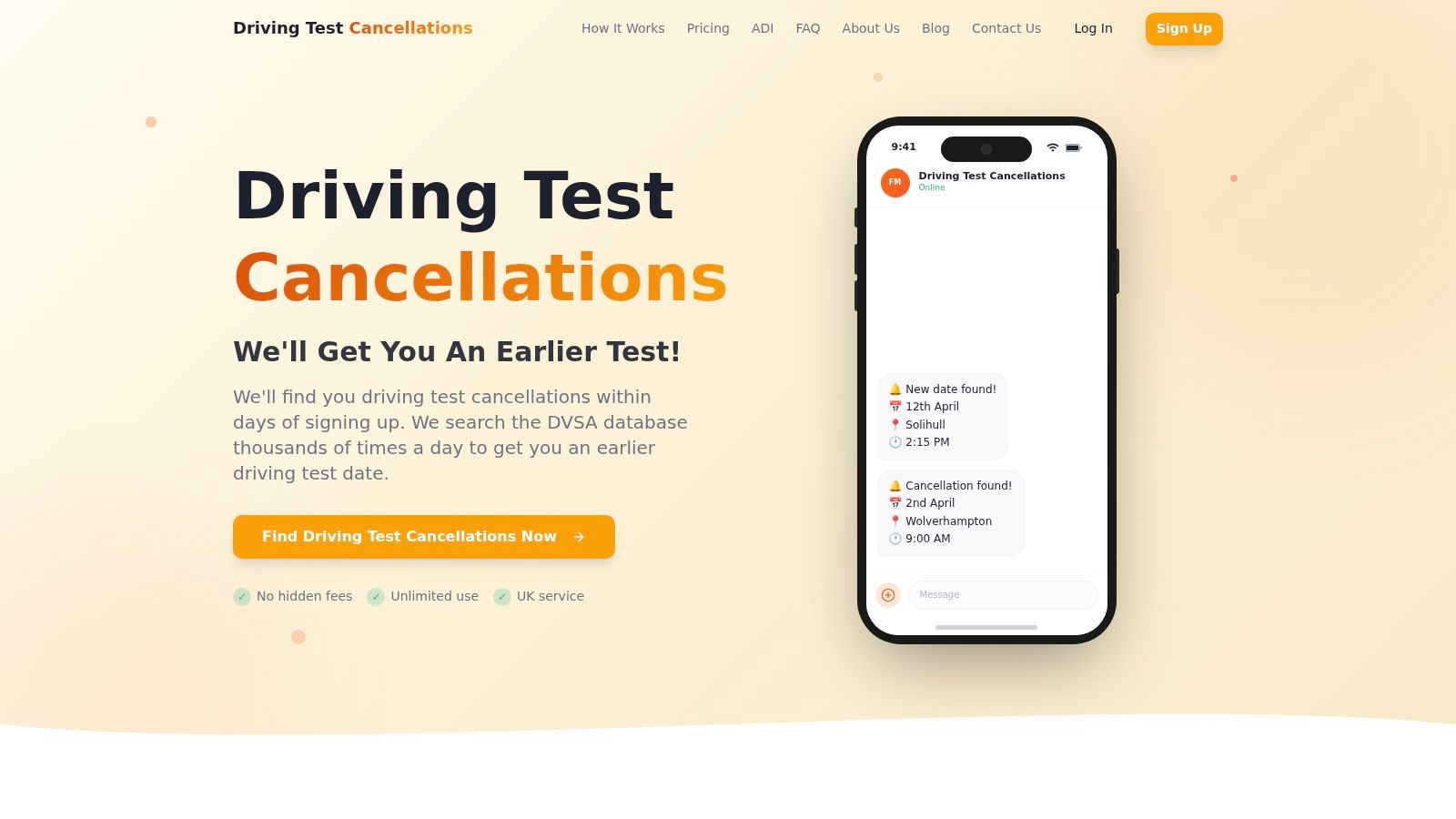
Driving Test Cancellations is one notification-only option. It monitors DVSA practical-test availability, sends time-stamped SMS alerts containing the date, time and centre, and allows users to monitor up to three preferred test centres. It doesn't provide the initial test booking and doesn't book, change, cancel or swap an appointment for the learner.
That distinction matters under the 2026 rules. A service that promises to complete the transaction for you is not the same as a tool that reports availability and leaves the learner in control. Before using any monitoring tool, check exactly what it does, what information it requests and whether you'll be directed back to GOV.UK for the final action.
Make alerts useful rather than disruptive
Set your search criteria before alerts begin. Include only centres you can reach, times your instructor can support and dates that leave enough preparation time. If your theory-test validity is approaching its end, factor that deadline into the decision, but don't accept a slot that leaves you unable to prepare properly.
Keep your booking reference ready and agree a response plan with your instructor. When an alert arrives, check the booking service, remaining changes, centre restrictions and refund position in that order. A fast response is helpful, but speed without a suitability check can turn an earlier appointment into an avoidable problem.
Streamlining Schedules for Multiple Learners
An ADI supporting several pupils needs a clear division of responsibility. The instructor can help each learner agree acceptable centres, time windows and preparation conditions, but the learner must complete the booking action personally under the 2026 rules.
A workable routine starts with a shared record for each pupil. Keep the current test date, centre, booking reference, remaining changes, instructor availability and any key theory-test deadline together. When an alert arrives, the learner can decide quickly without asking the instructor to reconstruct the whole situation.
For multiple pupils, a dashboard can reduce duplicated checking by bringing monitored centres and alerts into one view. Driving Test Cancellations provides an ADI dashboard for managing multiple learners, while each learner still completes the final change through the official DVSA website.
ADI practice: Agree the acceptable appointment conditions before a cancellation appears. That prevents a pupil from using a limited change on a date the school can't support.
Instructors should also leave realistic space around possible test times in the diary. A cancellation may be useful only if the vehicle, instructor and learner are all available. Centralised monitoring helps with visibility, but it doesn't replace pupil readiness or the learner's legal responsibility to confirm the appointment.
If you want earlier-slot alerts without handing control of the booking to a third party, visit Driving Test Cancellations to see how its DVSA monitoring and SMS notifications work. Set your preferred centres, review each alert against your remaining changes and complete any reschedule personally through GOV.UK.