Your instructor has just texted, the test's still on the calendar, and now the car's booked, the school diary's changed, or you've realised you can't make the slot after all. Don't sit on it. Cancel a practical driving test properly and you can save the fee, but miss the deadline and you'll pay again.
The mistake learners make is treating cancellation like admin. It isn't. It's a money decision, and the deadline is stricter than many realize. The DVSA's rule is 10 full working days for a full refund, with Monday to Saturday counted as working days and Sundays and public holidays excluded (GOV.UK cancellation guidance, GOV.UK change guidance).
If you've got a test coming up, act on three things straight away. Check the date, check the booking reference, and count backwards on a working-day calendar before you do anything else. If the slot is still salvageable, a rearrangement may suit you. If not, cancelling cleanly is better than hoping it sorts itself out.
Table of Contents
- Realising You Need to Cancel
- The 10 Working Day Refund Rule Explained
- How to Cancel Online or by Phone
- Refunds, Forfeits and the New Short-Notice Threshold
- The May 2026 Third-Party Booking Change
- Common Mistakes That Cost Learners Money
- Quick Reference Before You Cancel
Realising You Need to Cancel
A learner gets a text on Tuesday evening. Their Friday test no longer works, and the first instinct is to panic, then click whatever looks fastest. That's how people lose money. Stop there, open the confirmation email, and confirm the exact date, time, and booking reference before you touch the DVSA system.
Then decide whether the slot is unusable or just inconvenient. If you can still attend, even with a bit of hassle, keep it. If not, you're choosing between cancelling, changing the date, or doing nothing and risking a lost fee. Those are the only real outcomes that matter.
Count the deadline before you act
The deadline is not based on your diary, your lesson plan, or how long ago you booked it. It's based on full working days. That means the test day itself does not count, Sundays do not count, and public holidays do not count either (GOV.UK cancellation guidance).
Practical rule: if you're anywhere near the 10-working-day mark, treat the deadline as money on the table.
If you're unsure, use a proper working-day calendar rather than guessing. A lot of learners miss the cut-off because they count the calendar days and assume they're safe when they aren't. That's the point where the rest of this gets useful, because the timing rule decides whether you still keep the fee.
The 10 Working Day Refund Rule Explained
The deadline that protects your money is simple. If you cancel or change your car test with at least 10 full working days' notice, you keep the fee. If you act inside that window, you normally lose it and must pay again to rebook. For the official rule, use GOV.UK cancellation guidance.
How to count it properly
Count back from the test date itself. The test day does not count, and neither do Sundays or public holidays. If your test is on a Thursday, you work back through the previous working days until you reach the cutoff.
That is the part learners get wrong. They count calendar days, feel safe, then find they are already inside the fee-loss window.
For a standard car test, the booking fee is £62 in the reporting on these rule changes, so the deadline is a real money line. The same GOV.UK rule has been in place for years, so do not treat it like a flexible booking policy that might bend for convenience.
A common question is what happens if the reason is serious. Family emergencies, illness, or other hardship do not automatically wipe out the fee. You may still need to make a claim with evidence, but that is a separate process from an ordinary cancellation.
| When You Cancel | Working Days Before Test | Refund Result | Fee Returned |
|---|---|---|---|
| Early enough | 10 or more | Full refund | Full test fee returned |
| Right on the boundary | 10 full working days or more | Full refund | Full test fee returned |
| Too late | Fewer than 10 full working days | Fee normally lost | No automatic refund |
If you want a plain-English comparison of how refunds are handled, the refund policy explanation is useful, but the DVSA deadline is the one that decides whether you keep the fee.
One more thing matters now. Learners who use unofficial booking services need to pay close attention to the 12 May 2026 third-party booking rule, because that is where a lot of confusion, and lost money, will start. If you are cancelling through DVSA, the amount paid back is the main test fee when you are inside the safe window, not an open-ended promise that every extra cost disappears with it.
The moment you are inside 10 full working days, you are protecting no money at all.
How to Cancel Online or by Phone
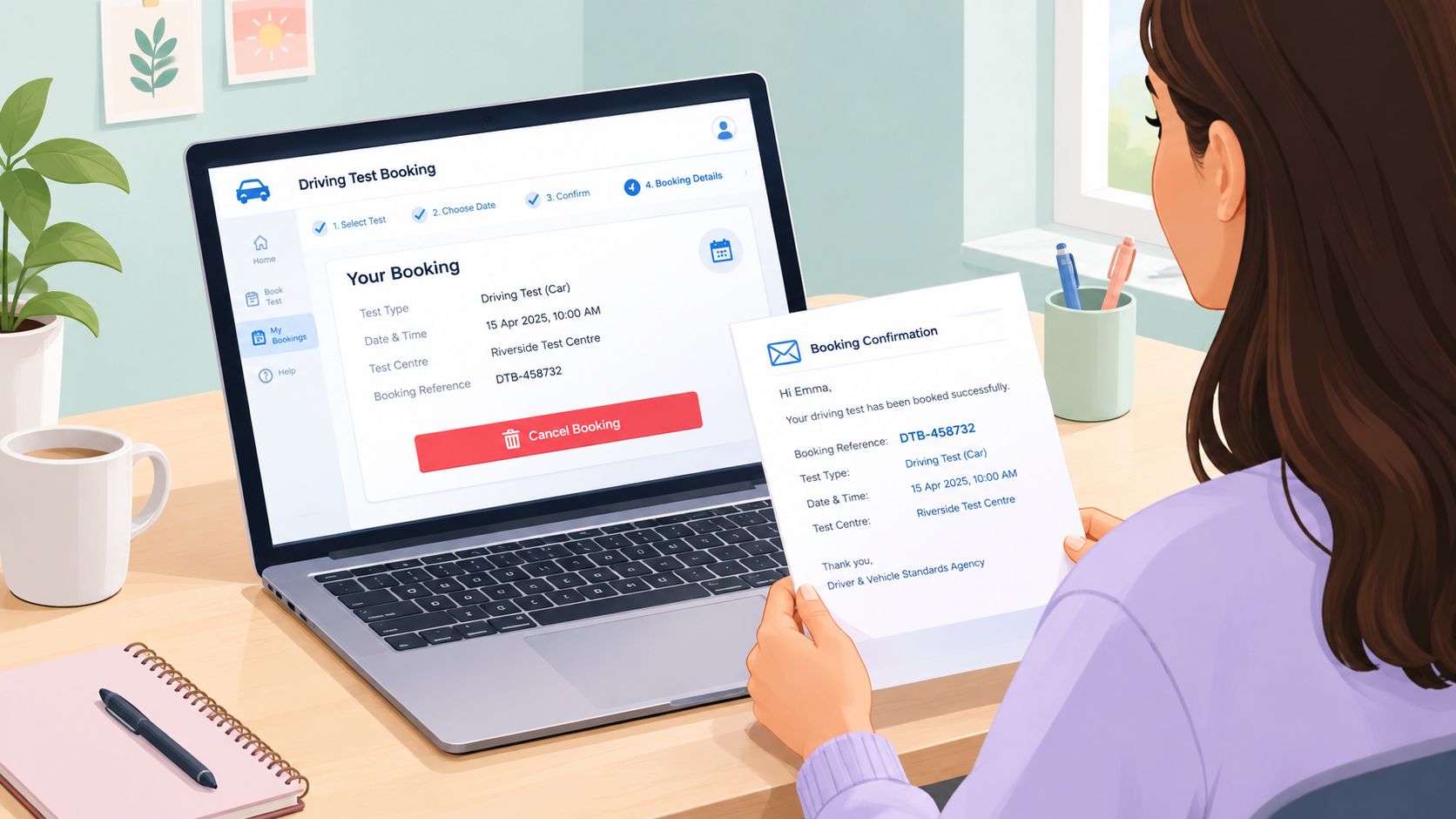
You need to act as soon as you know you cannot take the test. If you are still outside the 10 full working days window, cancel through the DVSA booking service straight away and protect the fee. If you leave it too late, you are usually paying again. Start with the online route, using your driving licence number and the booking reference from your confirmation email, then open Manage Booking and choose Cancel Test. The GOV.UK cancellation guidance shows the same process and is the authority learners should follow.
The page tells you the refund outcome before you confirm, so you can see whether you are still in time. Keep in mind that any extra service charge on the booking is separate from the main test fee, and it may not come back with the refund. Save proof the moment the cancellation goes through. A screenshot of the final confirmation page is enough.
Use the phone line if the website won't cooperate
If the site is misbehaving, call 0300 200 1122 with your booking reference and payment card ready. The result should match the online route if the cancellation is logged properly. Do not assume the call alone is enough.
Get the verbal reference number, then wait for the follow-up email confirming the cancellation. If nothing arrives, check spam first, then ring DVSA back and make sure the slot was released. That is the difference between a clean cancellation and a fee you lose because the system never recorded it.
For a clearer picture of the wider process, the how it works guide explains how booked slots move through the system.
Refunds, Forfeits and the New Short-Notice Threshold
You book a practical test, then realise you need to cancel. The money question is simple. If you still have 10 full working days' notice, your test fee is returned. Miss that window and you usually lose the fee, then pay again when you rebook. That is the deadline learners need to protect (GOV.UK cancellation guidance).
The payment outcome depends on who cancelled
If you cancel in time, the fee comes back. If you cancel too late, it does not. If DVSA cancels the test for an operational reason close to the date, the outcome is different again, and any expenses claim follows the DVSA route rather than the normal refund route. Keep those two cases separate.
| Cancellation Timing | Fee Returned | Action Required |
|---|---|---|
| 10+ full working days before test | Full refund | Cancel through GOV.UK or by phone |
| Inside the 10-working-day window | No automatic refund | Expect to lose the booking fee |
| DVSA cancellation in a genuine emergency or short-notice situation | Possible expenses claim | Keep evidence and follow DVSA process |
DVSA changed the short-notice cancellation period from 3 full working days to 10 full working days from 8 April 2025 (DVSA announcement). Older guides still quote the old rule, and that is how learners lose money. If a guide still tells you three days is enough for an ordinary car test cancellation, ignore it.
The same logic matters if you use a service that handles cancellations for you. Read the cancellation policy breakdown before you rely on anyone else, because a helper cannot bend the deadline. Ten full working days protects your money. Anything less usually does not.
The May 2026 Third-Party Booking Change
From 12 May 2026, the learner driver has to handle their own car test booking. Third parties can no longer use the official online business service to book, change, cancel, or swap tests on a pupil's behalf, and that restriction also catches unofficial booking and cancellation-finder services (DVSA notice).
If your instructor has been sorting the admin for you, that stops there. They can still advise, but the action itself has to come from you. Do not rely on a service that says it can still cancel or move a test for you after that date.
What you need to do yourself
Have these details ready before you sign in or call:
- Your driving licence number, because DVSA uses it to identify the booking.
- Your booking reference, because without it you're wasting time.
- Your theory test pass details, if the booking system asks for them during management.
- Your own confirmation declaration, because DVSA says learners must confirm it when managing a test online.
Keep your own login details, your own email access, and your own record of every change. That is the safe habit now.
For cancellations, the money question stays the same: if you miss the 10 full working day deadline, you risk losing the fee. If DVSA cancels for an operational reason close to the test, the refund or expenses route is different again. The booking rule changes who can press the button, but it does not soften the deadline.
Common Mistakes That Cost Learners Money
A learner spots a problem on Sunday evening and thinks there is still time until Friday. That is how the fee gets lost. Sunday does not count as a working day, and the test day does not count either, so the refund deadline is tighter than it first appears.
The mistakes I see most often
One pupil cancels after work and assumes it still counts because the day is nearly over. It does not matter how late it feels, what matters is whether DVSA gets the cancellation inside the 10 full working day window. Leave it until the day before and you can be inside the loss zone by a few hours.
Another common mistake is trusting a phone call with no proof. I would not rely on memory here. You need the cancellation confirmation, the reference number, and a record of what was done. If the email does not arrive, check spam, then follow it up straight away.
Keep proof, not assumptions. Save the confirmation email and a screenshot until you know the booking has been released.
Double-cancelling causes its own mess. If you cancel online and then ring up as well, you can create confusion about whether the slot has gone. Use one route and finish it properly. After the 12 May 2026 change, letting a third party handle it is another mistake. The learner has to manage their own booking.
For the money side, the trade-off is simple. A DVSA-side cancellation can give you your fee back if you are inside the refund rules, and the official cancellation guidance explains the deadline in detail. Miss that window, and the fee is usually gone.
Quick Reference Before You Cancel
You need the decision in one place when the test is close and money is on the line.
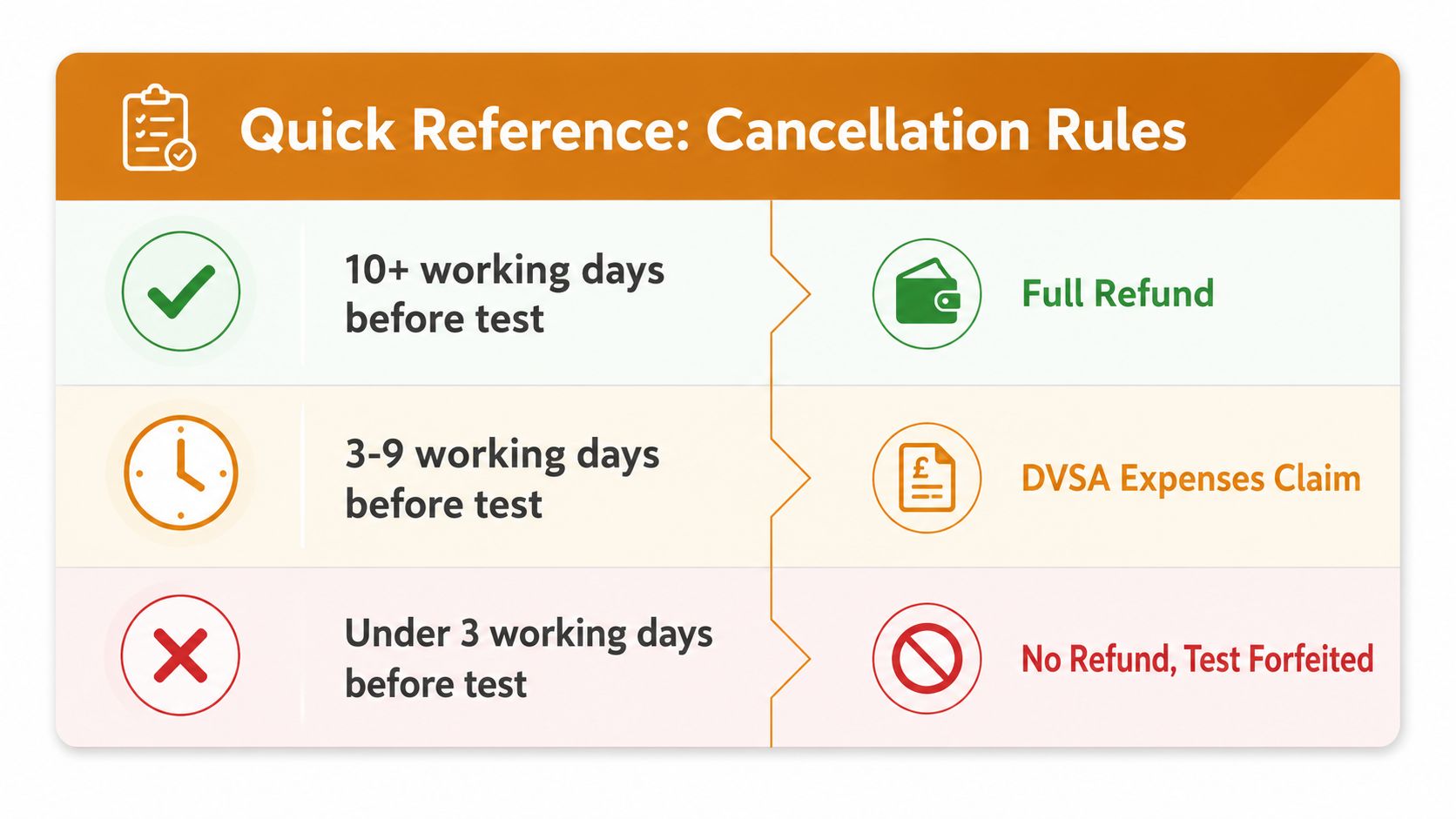
- 10 or more working days before the test: full refund.
- 3 to 9 working days before the test: DVSA expenses claim may apply in the right circumstances.
- Under 3 working days before the test or a no-show: the fee is normally lost.
Only the person who booked the test can cancel it through GOV.UK or 0300 200 1122. From 12 May 2026, unofficial cancellation services should be ignored. They will not control the booking for you (DVSA notice).
Check the date against a proper working-day calendar before you act. Then save the confirmation email and take a screenshot straight away.
If you want earlier slots without refreshing the DVSA site all day, Driving Test Cancellations monitors test availability and sends alerts when new appointments appear. Use it alongside the official cancellation rules, not instead of them, and keep control of the booking in your own hands.