You've finally reached the point where you're ready for a practical test, only to find the next available appointment sitting weeks away. You check again after work, ask your instructor to look, and hear about cancellation services that promise to grab an earlier slot for you. Under the DVSA driving test new rules, that last option has changed completely.
From 12 May 2026, the learner must book and manage their own practical car test. The rules also limit how many times a booking can be changed and, from 9 June 2026, restrict moves to the three nearest test centres. Here's what those changes mean in real situations, and what learners and ADIs should do differently.
Table of Contents
- The Long Wait and the New DVSA Rules
- What Changed on 12 May 2026
- Change Limits, Refunds and Test Fees
- Why Waiting Times Still Drive the Conversation
- How Earlier Test Alerts Stay Within the Rules
- Old Third-Party Booking Versus Notification Services
- What ADIs and Driving Schools Need to Do Differently
- Common Questions From Learners
The Long Wait and the New DVSA Rules
You are ready for your practical test, but the next suitable appointment is weeks away. Your instructor spots a cancellation, yet cannot move your test for you. Under the DVSA driving test new rules, a compliant notification-only service can alert you to an earlier slot, while you must complete the booking change yourself.
As of September 2026, the average wait for a practical test was about 20 weeks, and the median time from booking to taking the test was 11.1 weeks across Great Britain, according to September reporting on practical test waiting times. These figures measure different parts of the queue, but they show the same problem. Learners can reach test standard long before a suitable appointment becomes available.
The 2026 reforms affect four areas:
- Control: the learner books and manages their own test.
- Changes: the permitted changes have fallen from six to two.
- Location: from 9 June, a learner can move a test only to one of the three nearest centres.
- Cost and cancellation: the official practical car test fee is £62 on weekdays and £75 on evenings, weekends and bank holidays. The full refund rule depends on giving sufficient notice. The DVSA announcement on unofficial driving test booking services sets out these requirements.
A real-world example makes the boundary clear. An ADI can explain the booking screen, help a pupil with a disability or language barrier, and recommend suitable centres. A notification service can send an alert when a cancellation appears. The learner must still sign in, choose the appointment and confirm the change. An instructor, parent or unofficial service cannot do that on the learner's behalf.
Practical rule: Keep the booking reference, email address and test details under the learner's control, even when an instructor helps organise the process.
Book carefully, protect the two available changes, monitor the learner's local centres, and treat alerts as prompts rather than automatic bookings. The candidate must take the final action.
What Changed on 12 May 2026
The headline rule is easy to remember: only the person taking the test can book and manage it. That includes booking a first appointment, changing its date or time, moving its centre, and cancelling it. An instructor or parent can provide support, but the learner must complete the action themselves.
This matters when a school has traditionally handled bookings for several pupils. An ADI might still sit beside a learner and explain which details to enter, but the learner must be the person using the booking system and accepting the terms. Third-party services that took control of accounts or changed tests for candidates are no longer a compliant route.
The second major change arrived on 31 March 2026, when the number of permitted changes to a car test was cut from six to two. The change limit therefore needs to be considered before the May rule change, not treated as a completely separate issue.
From 9 June 2026, the location rule became tighter. A learner can move a test only to one of the three nearest driving test centres linked to their registered address. That makes a distant centre a poor fallback if the candidate later wants to change the appointment.
| Rule area | Before 2026 | From 12 May or 9 June 2026 |
|---|---|---|
| Booking and management | Instructors and other third parties could be involved in booking arrangements | The learner must book and manage their own practical test |
| Changes to a car test | Up to 6 changes | Up to 2 changes |
| Centre movement | Wider movement was possible under the previous arrangement | From 9 June, movement is limited to the 3 nearest centres |
| Unofficial cancellation services | Some services attempted to book or change tests for learners | Third parties can't book, change, swap or cancel on the learner's behalf |
| Standard car test fee | Previous fee structure | £62 on weekdays, £75 on evenings, weekends and bank holidays |
| Refund protection | Governed by the previous booking rules | A full refund requires cancellation at least 10 full working days before the test |
The rule isn't aimed at stopping pupils from receiving help. It draws a firm line between support and control. An instructor can say, “Choose this centre because it suits your lessons,” but can't log in and take the slot for the pupil.
Change Limits, Refunds and Test Fees
The two-change limit is where careless planning becomes expensive. From 31 March 2026, a candidate can change an existing car practical test booking only twice. A date change counts as one change, and a later time change counts as another. Once both changes have been used, the learner can't keep moving the same booking.
The safer approach is to book only when the learner has a realistic test plan. Check the instructor's diary, the learner's readiness and the likely centre before using the first change. Don't spend a change on a date that was never going to work.
The location restriction adds another layer. From 9 June 2026, a learner can move the appointment only to one of the three nearest centres associated with their registered address. A candidate who books far away because it looks available shouldn't assume that the booking can later be moved freely to a preferred local centre.
The official car test fees are straightforward:
| Slot type | Fee | Refund window |
|---|---|---|
| Weekday | £62 | Full refund if cancelled at least 10 full working days before the test |
| Evening, weekend or bank holiday | £75 | Full refund if cancelled at least 10 full working days before the test |
The GOV.UK guidance on 2026 driving test booking changes confirms the two-change limit and the notice period for a full refund. It doesn't support adding an extra slot-reduction charge to the figures above, so learners should rely on the fee shown in their official booking rather than unverified claims about additional charges.
A late cancellation can mean losing the fee. That makes a last-minute diary change a financial decision, not just an administrative one. Front-desk staff should explain the deadline in full working days and check the actual test date before promising that money will be returned.
For a more detailed consumer explanation of the current amounts, see this guide to practical driving test prices. It should supplement, not replace, the fee and refund information shown by GOV.UK during the booking process.
Why Waiting Times Still Drive the Conversation
Changing the booking rules has not cleared the backlog. The national median was 11.1 weeks, while the average wait was about 20 weeks in September 2026, according to the BBC's reporting on practical test delays. A learner who accepts the first available date should treat it as the anchor for final training, not as a temporary placeholder. Lessons, work and vehicle access must be organised around that appointment.
Local queues tell a different story. DVSA data showed Darlington had an existing measure of 13 weeks in May 2026, while its median waiting time was 6.7 weeks. By July, the number of centres showing 24-week waits had fallen from 182 to 143, even though the national median rose from 9.0 to 11.1 weeks, as described in DVSA's regional commentary on the booking changes.
For centre-by-centre context, read our analysis of driving test waiting times before choosing where to book.
| DVSA centre | Median wait | Peak wait |
|---|---|---|
| Darlington | 6.7 weeks in May 2026 | Not stated in the verified data |
Darlington shows why a national average cannot predict a learner's actual queue. A nearby centre may offer a different date, yet the three-centre restriction limits how freely the candidate can change course after booking. Choose the local shortlist before committing.
| What the figures tell you | Practical consequence |
|---|---|
| National waits remain long | Book before the learner reaches the final stage of training |
| Centre-level waits vary | Check local data, not only national headlines |
| Some centres show very long waits | Keep lessons and diaries flexible |
| Centre moves are restricted | Select the local shortlist before booking |
Waiting times remain the main issue because the reforms improve control without instantly reducing queues. Use a notification-only service to spot an earlier slot, then let the learner change the booking through DVSA. A third-party booking service should no longer make that change for them.
How Earlier Test Alerts Stay Within the Rules
A compliant notification service performs one job: it tells the learner when a potentially earlier appointment appears. It doesn't book the test, pay the DVSA fee, cancel the existing appointment or move the learner to another centre.
The sequence should look like this:
- Set the search: the learner provides their driving licence details and chooses preferred centres.
- Start monitoring: the service checks published DVSA availability for matching slots.
- Receive the alert: an SMS or app notification gives the available date, time and centre.
- Open the official site: the learner logs in to the DVSA booking system themselves.
- Make the decision: the learner checks the details, confirms the change and accepts responsibility for the booking.
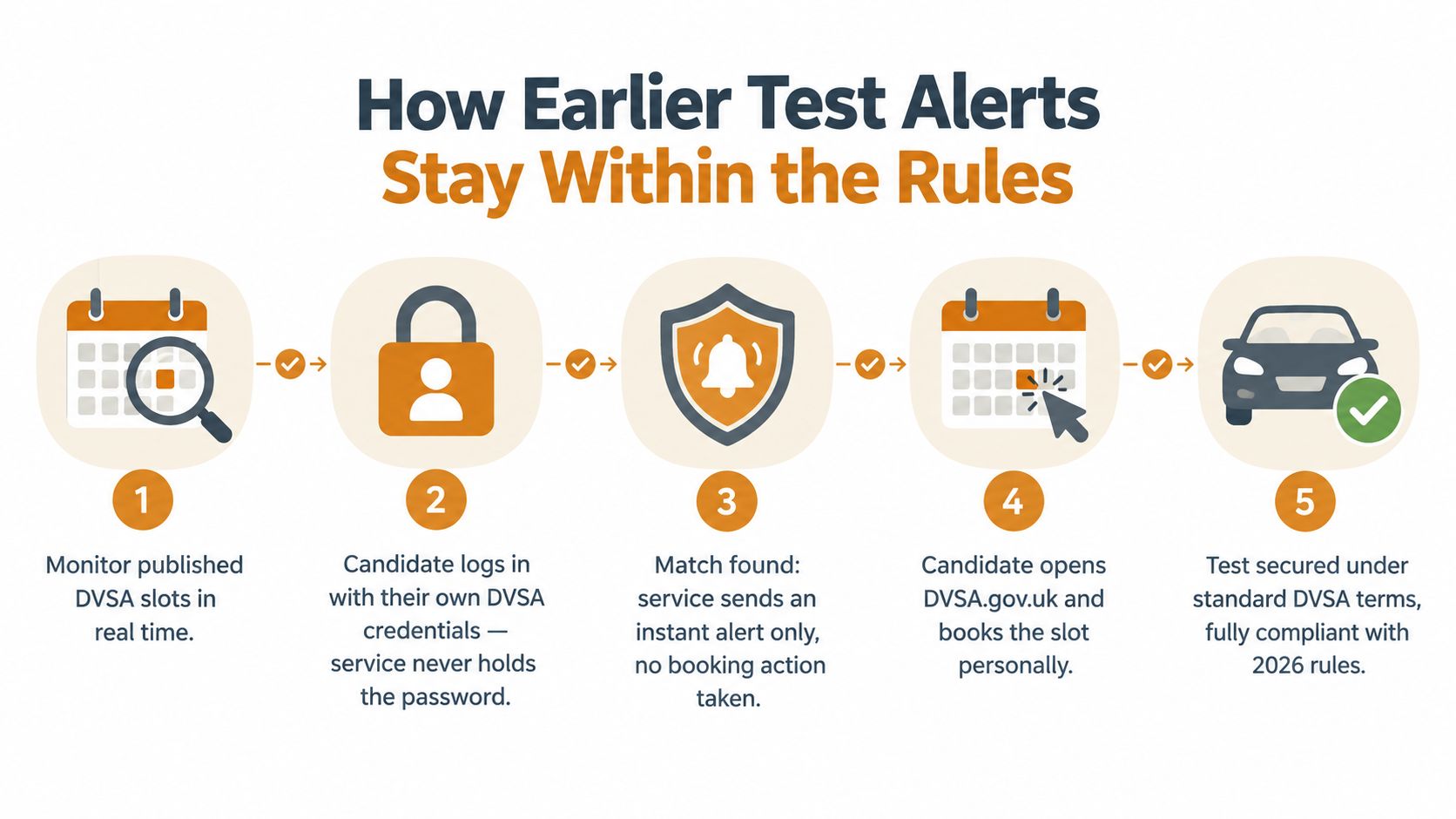
The distinction is more than wording. An alert doesn't consume one of the learner's changes until the learner changes the booking. The candidate can ignore a slot that clashes with work, lessons or the instructor's availability.
A notification-only tool should also make its limits clear. It mustn't suggest that it can guarantee a cancellation, reserve a slot, or complete a rebooking automatically. The learner should never be asked to let a third party take over the account to secure an appointment.
An alert saves you from repeated checking. It doesn't remove your responsibility for the booking.
Driving Test Cancellations describes its service as a UK monitoring platform that sends time-stamped notifications so candidates can rebook directly through DVSA. Its free app for driving test cancellations is relevant to this model because the candidate remains the person who completes the official change.
Keep the official DVSA page open or saved on your phone, check every alert against your current appointment, and don't cancel the existing test until the new booking is confirmed.
Old Third-Party Booking Versus Notification Services
Learners often use “cancellation finder” to describe two completely different services. One model takes control of the account and attempts to book an earlier test. The other watches for availability and sends a message, leaving the candidate to complete the booking.
The first model is the problem under the new rules. From 12 May 2026, a third party can't book, change, swap or cancel a practical test for someone else. An automated service that logs in and grabs a slot isn't made compliant just because it calls itself a finder.
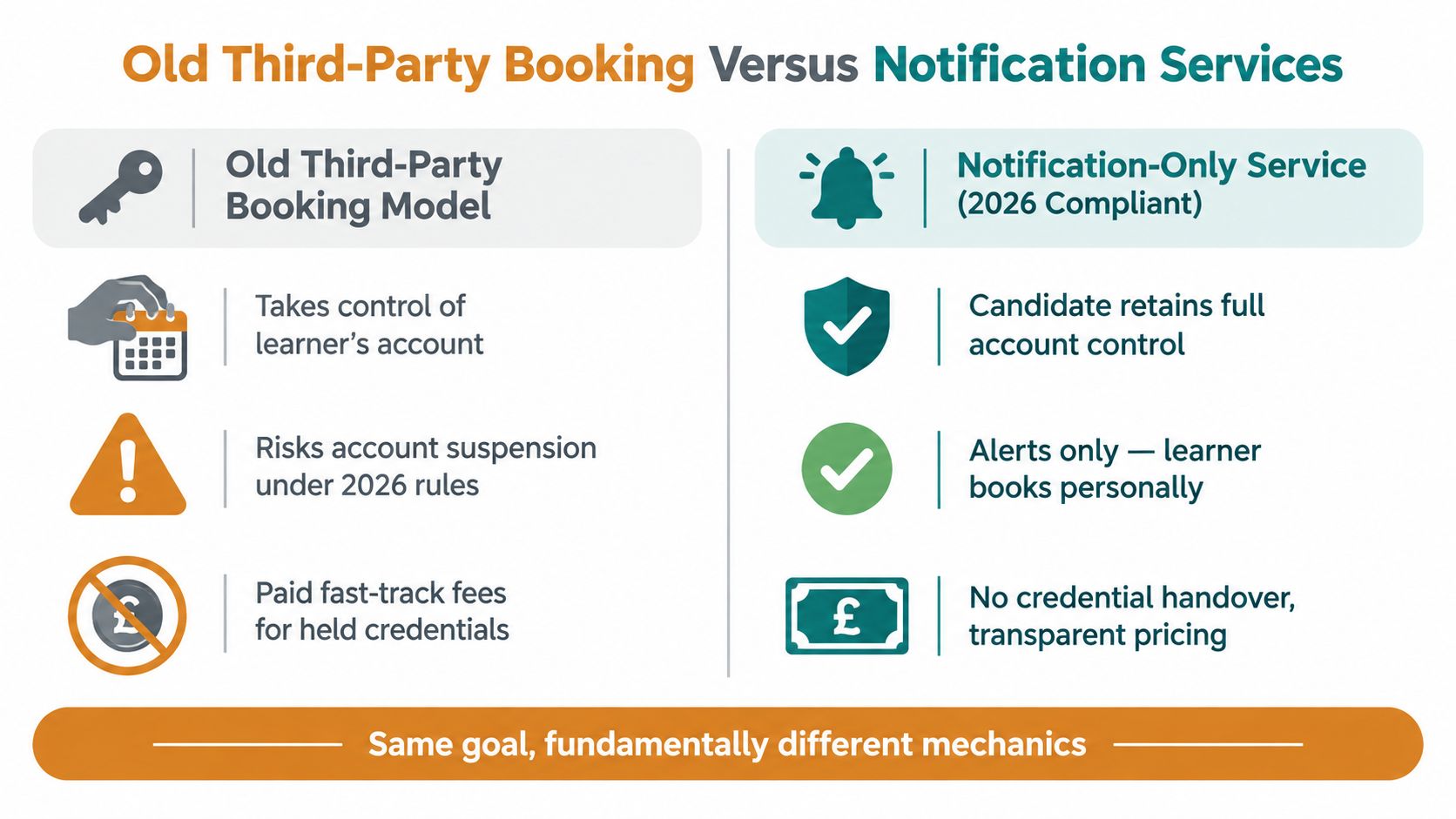
| Question | Old third-party booking model | Notification-only model |
|---|---|---|
| Who logs in? | The service attempts to control the learner's account | The learner logs in |
| Who pays DVSA? | The service may handle the booking process | The learner pays through the official booking system |
| Who triggers the change? | The third party | The learner |
| Does the model fit the 2026 rules? | No, not when it books or manages the test | Yes, when it only monitors and alerts |
The three-nearest-centre rule makes account-based multi-centre sweeps even less useful. A learner needs a local plan, not an operator making rapid decisions across centres that may not be eligible for a later move.
The practical test is simple. Ask a provider whether it will book, change, cancel, swap or pay on your behalf. If the answer is yes, avoid it. If it sends an alert and directs you back to GOV.UK, the learner retains control and can decide whether the slot is suitable.
What ADIs and Driving Schools Need to Do Differently
ADIs should stop treating test bookings as a back-office task. The learner owns the booking now, so the school's system must give each pupil the information and reminders needed to manage it correctly.
Start with the pupil's constraints. Check the theory test expiry, confirm the instructor's likely availability, and agree which three local centres make sense under the post-9 June rule. Then book early enough to allow preparation for a long wait, rather than waiting until the pupil feels completely test-ready.
A workable school process is:
- Check the theory date: make sure the learner won't lose the practical booking window through an overlooked expiry.
- Confirm the local shortlist: record the three nearest suitable centres linked to the pupil's address.
- Book with the pupil present: explain every field and let the learner complete the booking.
- Protect the two changes: don't move a test casually because a slightly better date appears.
- Use alerts as prompts: a notification-only service can flag earlier slots, but the pupil must rebook personally.
- Record references: keep the DVSA booking reference and test location in the school's admin system.
- Plan lessons around the appointment: if the wait is long, schedule mock tests nearer to the actual date rather than front-loading every assessment.
The national median wait of 11.1 weeks and the approximately 20-week average reported in September 2026 should shape diary planning, but they aren't a substitute for checking the pupil's centre. Local conditions can be shorter or longer.
For ADIs: You can coordinate the decision, but the learner must own the action. Put that distinction into your staff process and your pupil communications.
Front-desk staff also need a consistent refund answer. A full refund depends on cancellation at least 10 full working days before the test. Staff should avoid promising money back for a late cancellation and direct the learner to the official booking record when the circumstances are unclear.
Common Questions From Learners
Does the practical test fee change under the new rules?
The standard car practical test fee remains £62 on weekdays and £75 on evenings, weekends and bank holidays. The exact charge appears on the official booking screen before you confirm the appointment, so check it rather than relying on an old message or screenshot.
Can I get a full refund if I cancel?
Yes, provided you cancel at least 10 full working days before the test date. Cancelling later does not meet the full-refund condition. Check the booking record before cancelling, particularly if illness, work or a family commitment has changed your plans.
What if DVSA cancels my test because of examiner illness?
DVSA handles that rearrangement separately from the learner's permitted changes. Follow the instructions sent by DVSA and check the replacement booking details. Do not cancel your own appointment first unless the official guidance tells you to do so.
Does my theory test still matter after I book?
Yes. Your passed theory test must remain valid through the practical test booking window. Check its expiry date before changing an appointment. With only two changes available, speak to your instructor first if the theory pass is nearing expiry.
Can I move to any centre I want?
From 9 June 2026, a learner can move a test only to one of the three nearest centres connected with the registered address. A centre near your workplace or university may fall outside that group. Check the permitted centres before booking, rather than choosing a convenient location that cannot be used later.
Are notification-only services still allowed?
Yes. A compliant service monitors published DVSA availability and sends an alert, leaving you to log in and change the booking yourself. It can help when a learner is waiting for a suitable local slot, but it cannot lawfully book, swap or cancel on the learner's behalf. Avoid any provider that promises to complete those actions for you.
Use alerts as prompts, not as a substitute for control. Keep your booking reference, check the centre restriction, protect your two changes and make the final booking action yourself.
Driving Test Cancellations monitors DVSA practical test availability and sends alerts with earlier dates, times and centres. You complete the rebooking directly through DVSA. Visit Driving Test Cancellations to set up cancellation notifications and spend less time refreshing the booking page.