Free alerts, free downloads, free tiers and free trials are not the same thing. That's the first thing most advice on a free app for driving test cancellations gets wrong.
In the UK, these tools usually watch for earlier DVSA practical test slots after you've already booked a test. But the useful question isn't just “is the app free?” It's “what can I do without paying, how fast will I hear about a slot, and do I still complete the change myself on GOV.UK?” That last point matters because the safest workflow is still to receive an alert, check the slot, then rebook personally through the official service.
The pressure to do that quickly is real. UK practical test delays have stayed stubbornly high. One official and media-reported summary put the average wait to book a practical car test at 22 weeks in September 2025, compared with just over five weeks in early 2020, while the National Audit Office said 70% of DVSA test centres were at the maximum waiting time of 24 weeks and DVSA did not expect to reach its seven-week target until November 2027 (DVSA waiting times report summary).
That's why star ratings don't tell the whole story. Centre demand, notification speed, app permissions, how many centres you can watch and how fast you can act matter more. The comparison below focuses on genuine free access, alert channels, centre coverage, upgrade limits, pricing clarity, everyday usability and whether the wording stays on the right side of current DVSA rules.
Table of Contents
- 1. Testi – Driving Test Cancellations
- 2. Test Hunter – Driving Test Cancellations UK
- 3. Find A Driving Test
- 4. DrivingTests.co.uk – Cancellation Finder + Swap Community
- 5. TestShift
- 6. DriveSooner
- 7. Test Hopper
- 8. DriveAhead.app
- 9. EarlierDrivingTest.co.uk
- 10. Driving Test Cancellations UK
- Top 10 Free Driving Test Cancellation Apps, Comparison
- Choose the Alert Method You Can Act On
1. Testi – Driving Test Cancellations
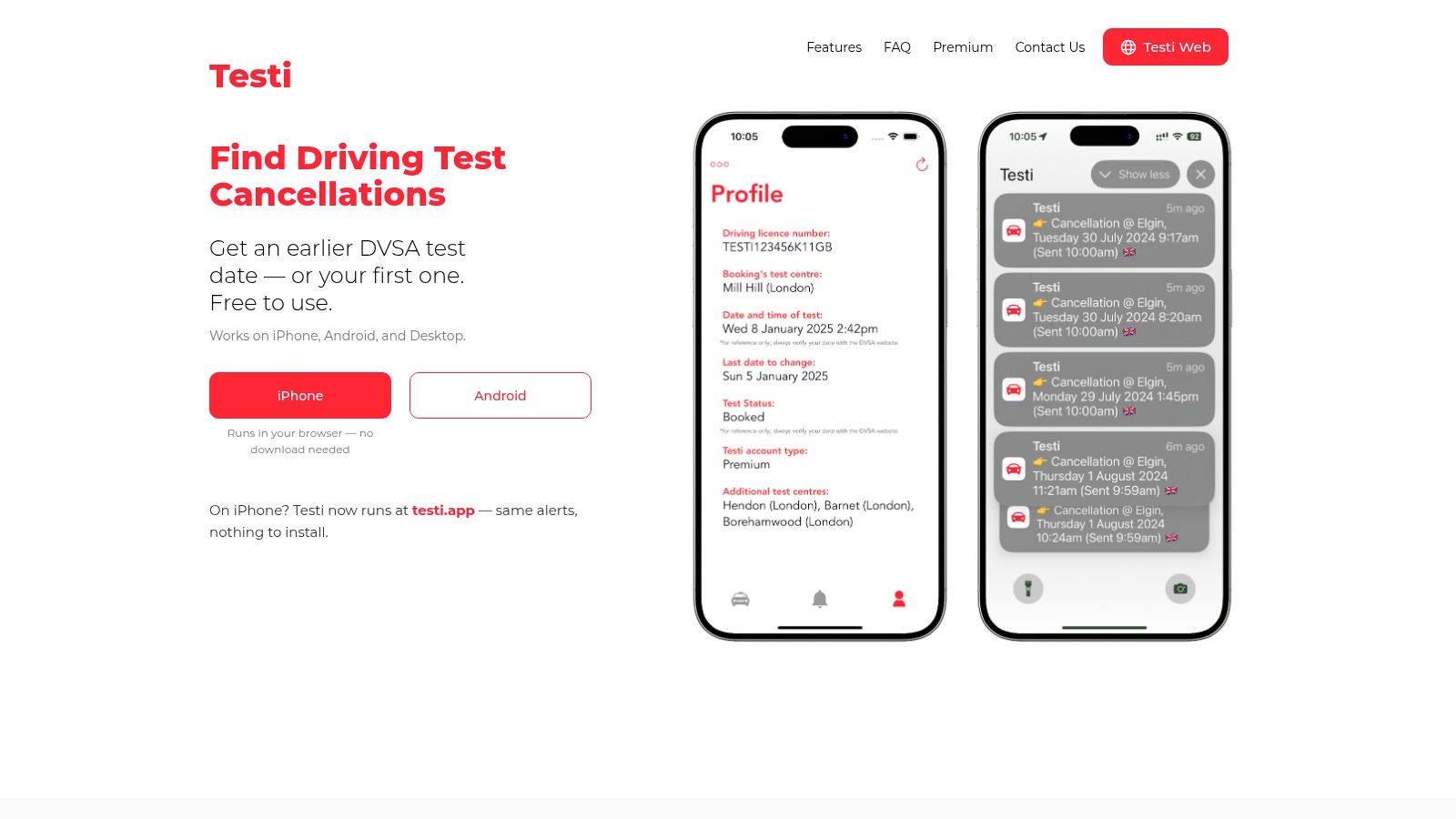
Testi is one of the names most learners already know, and that familiarity matters because a big user base usually means plenty of real-world feedback about how the app behaves at busy centres.
Its best trait is the basic workflow. You monitor for earlier practical test slots, get a push alert when a match appears, then move across to the official booking flow yourself rather than handing the whole process to a third party. For a lot of learners, that's the cleanest setup.
What you get for free
Testi is free to download and usable without a compulsory subscription, which puts it in the genuine freemium camp rather than the fake “free app” camp. The trade-off is that the most valuable extras, especially faster alerts and finer filters, sit behind an in-app purchase.
- Free access: You can install it and use the core service without signing up to a recurring paid plan first.
- Alert method: Push notifications are the main mechanism, so your phone settings matter almost as much as the app itself.
- Upgrade pressure: The stronger the competition at your chosen centre, the more the paid priority features start to matter.
At crowded centres, free alerts can still be enough if you're quick, flexible on times and willing to check as soon as your phone pings. At the busiest ones, the free version can feel more like proof that cancellations exist than a reliable way to catch them first.
Practical rule: If you use Testi, turn off battery-saving restrictions for the app. A late notification is often the difference between “slot found” and “slot gone”.
2. Test Hunter – Driving Test Cancellations UK
Test Hunter takes a slightly different pitch. The key promise is that the free version will remain available, which is helpful because some apps use “free” mainly as a short-lived route into an upgrade screen.
That doesn't make it feature-rich at no cost. It means there is a real free entry point, and then a one-time purchase if you want broader scanning and extra controls. For learners who dislike subscriptions, that structure may suit them better than a monthly upsell.
Where the free tier stops
The app's setup is straightforward, and the cloud-notification model should work well for people who don't want to keep checking manually. But the free tier is still limited compared with the paid version, particularly around multi-centre coverage and additional filters.
A service like this makes the most sense when you already know your priorities. If you're only willing to sit the test at one centre and you can take a fairly wide range of dates, the free tier may be enough to test the water. If you need several centres monitored at once, the paid path becomes more relevant quickly.
If your area has long waits but a nearby second-choice centre is easier to reach, multi-centre monitoring can matter more than any single app feature.
That's not a small issue in the current market. DVSA-derived regional figures show the median wait ranged from 7.3 weeks in Wales to 11.9 weeks in the East of England, and the published “to 10% free” windows stretched much further in some areas, including 34.4 weeks in the East of England and 23.4 weeks in the East Midlands (regional DVSA wait analysis).
3. Find A Driving Test
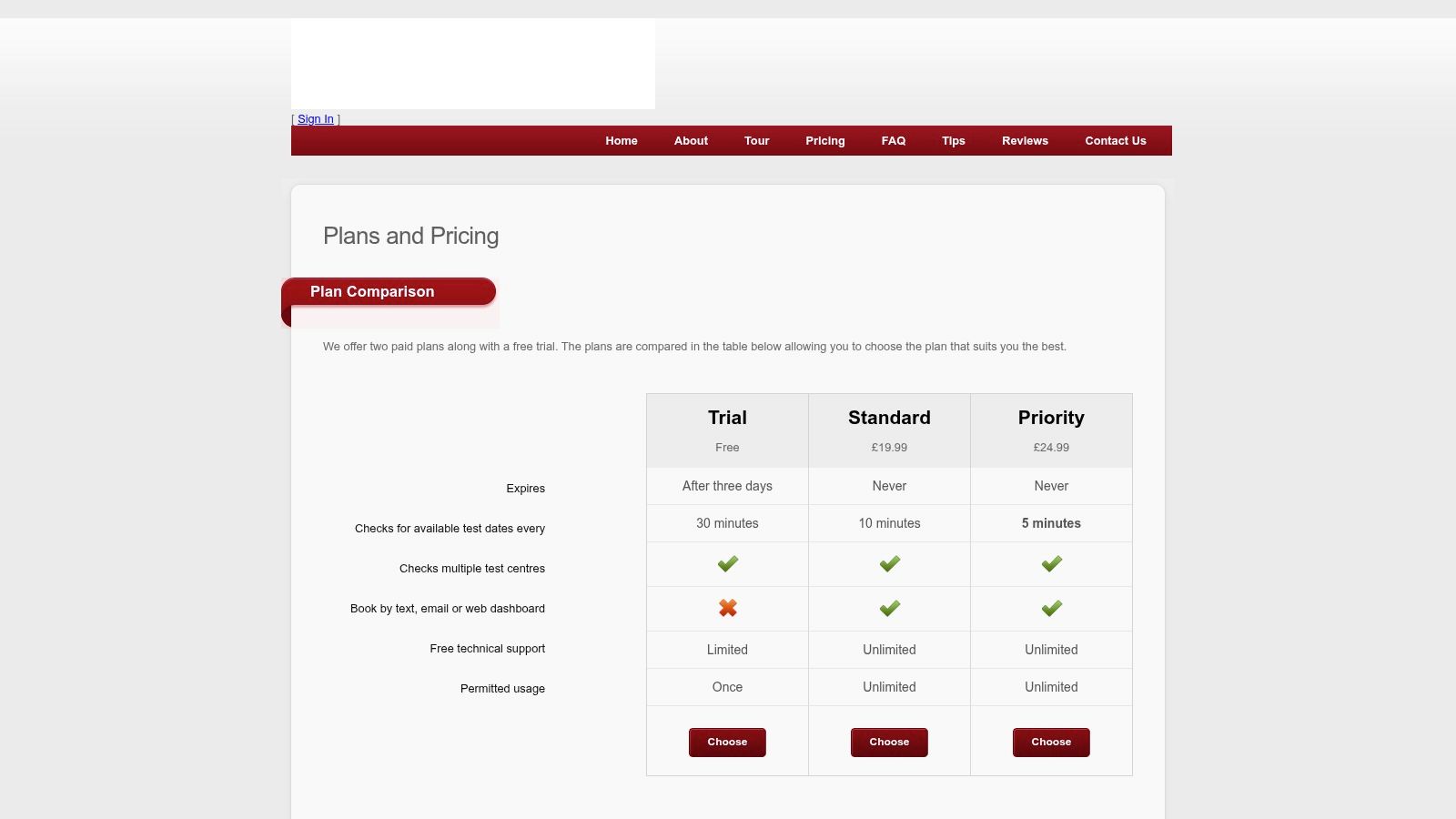
Free access here means trial access, not an ongoing no-cost checker. That sounds obvious, but plenty of driving test cancellation services blur that line.
Find A Driving Test is a browser-based service rather than a native app, and its pricing page makes the split relatively plain. On the trial, you get email alerts. Paid plans add SMS and faster checking. For anyone comparing “free apps”, that places it in the free-to-test camp rather than the free-to-use group.
The practical question is what you can do without paying. In this case, you can set the service up, monitor whether your chosen centre produces any movement, and judge whether the alerts arrive often enough to matter. You cannot treat the free tier as a full-strength alert setup if you need speed.
Email changes the equation. An email alert can still be useful if cancellations at your centre last long enough to act on, but it is a weaker format than a text or push alert for high-demand areas where slots disappear quickly.
There is also a compliance point to check. The service language focuses on finding earlier tests and alerting the learner, which is the safer framing. Learners should still confirm that rebooking stays under their control through the official booking flow, rather than assuming any third party is completing the change on GOV.UK for them.
One advantage here is clarity. You can see the step up from trial to paid service before committing, instead of discovering the limits after setup.
For a learner who wants to test one centre with minimal effort, that is useful. For a learner trying to cover several centres or act within minutes, the free access is better viewed as a diagnostic tool than a lasting solution.
4. DrivingTests.co.uk – Cancellation Finder + Swap Community
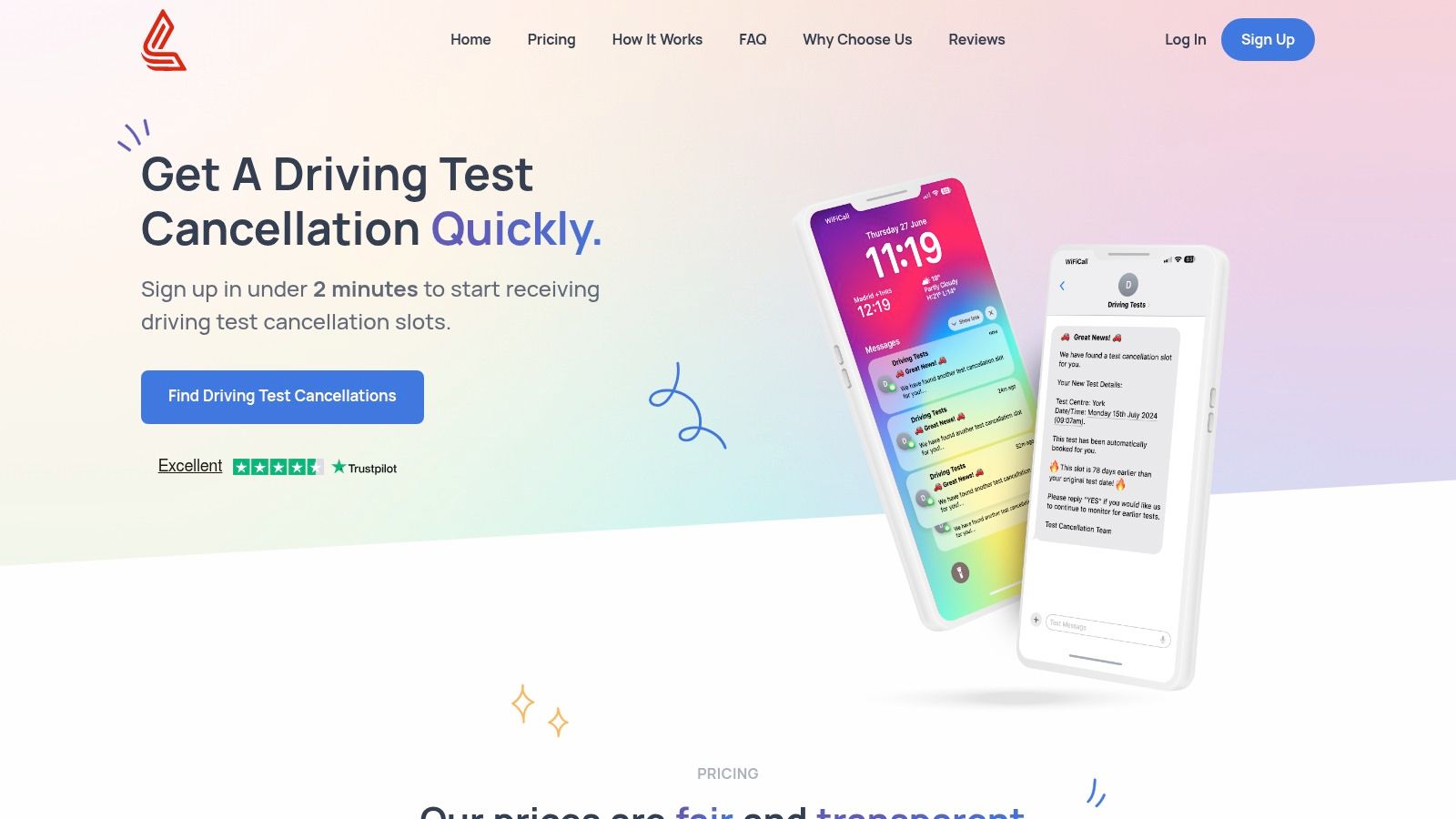
DrivingTests.co.uk Cancellation Finder isn't a free cancellation checker in the usual sense. The core finder is paid, but it also has a separate free test-swap community. That makes it one of the more unusual entries here.
The split is worth understanding before you sign up. One part is a standard monitoring product with SMS and email alerts. The other depends on other learners being available to exchange dates in a way that suits both parties.
The free bit isn't the main bit
For some learners, the swap community will be too dependent on chance. You need another member with the right centre, a suitable date and the willingness to exchange. That's a very different proposition from a scanner that watches for fresh availability.
Still, it does offer one genuine free path, and some people may prefer that to paying upfront. If you're curious how third-party monitoring services generally frame their alert process and handoff, the Driving Test Cancellations service explainer gives a useful point of comparison with a notification-led model.
A standard paid alert service usually gives more predictable odds than a swap forum, because it depends on system availability rather than another learner's matching needs. The flip side is obvious. You pay for certainty of monitoring, not certainty of success.
This distinction matters because practical access is still structurally tight. Government guidance says there is no waiting list or cancellation list at most test centres, while DVSA reporting showed a Great Britain median wait of 11.1 weeks for learners who took their car practical test in August 2026 (official guidance on release dates and finding earlier tests).
5. TestShift
TestShift looks more modern than some older rivals, and the no-install browser option lowers the barrier to trying it. For many people, that's appealing. Open a browser, set your centres, wait for alerts.
The part that needs a more careful read is the language around “reserving” a slot for up to 15 minutes. That may sound convenient, but it's exactly the kind of wording that should make you stop and ask what the service is doing behind the scenes.
Compliance check
A notification service is simple to understand. It spots a slot and tells you. You then log in and make the change yourself. “Reservation” or “managed change” language is more ambiguous, and ambiguity is not what you want around DVSA booking rules.
That doesn't automatically make the service unsuitable. It just means you should check whether the tool is merely surfacing an available slot to you, or suggesting a level of control over the booking process that belongs on GOV.UK rather than a third-party platform.
“Reserve it for you” is not the same thing as “alert you to it”. In this market, that difference matters.
The app and browser options are practical, and scanning up to three centres is useful. The weaker point is pricing visibility. If a service asks you to commit time before clearly showing what paid access involves, it becomes harder to compare with better-signposted alternatives.
6. DriveSooner
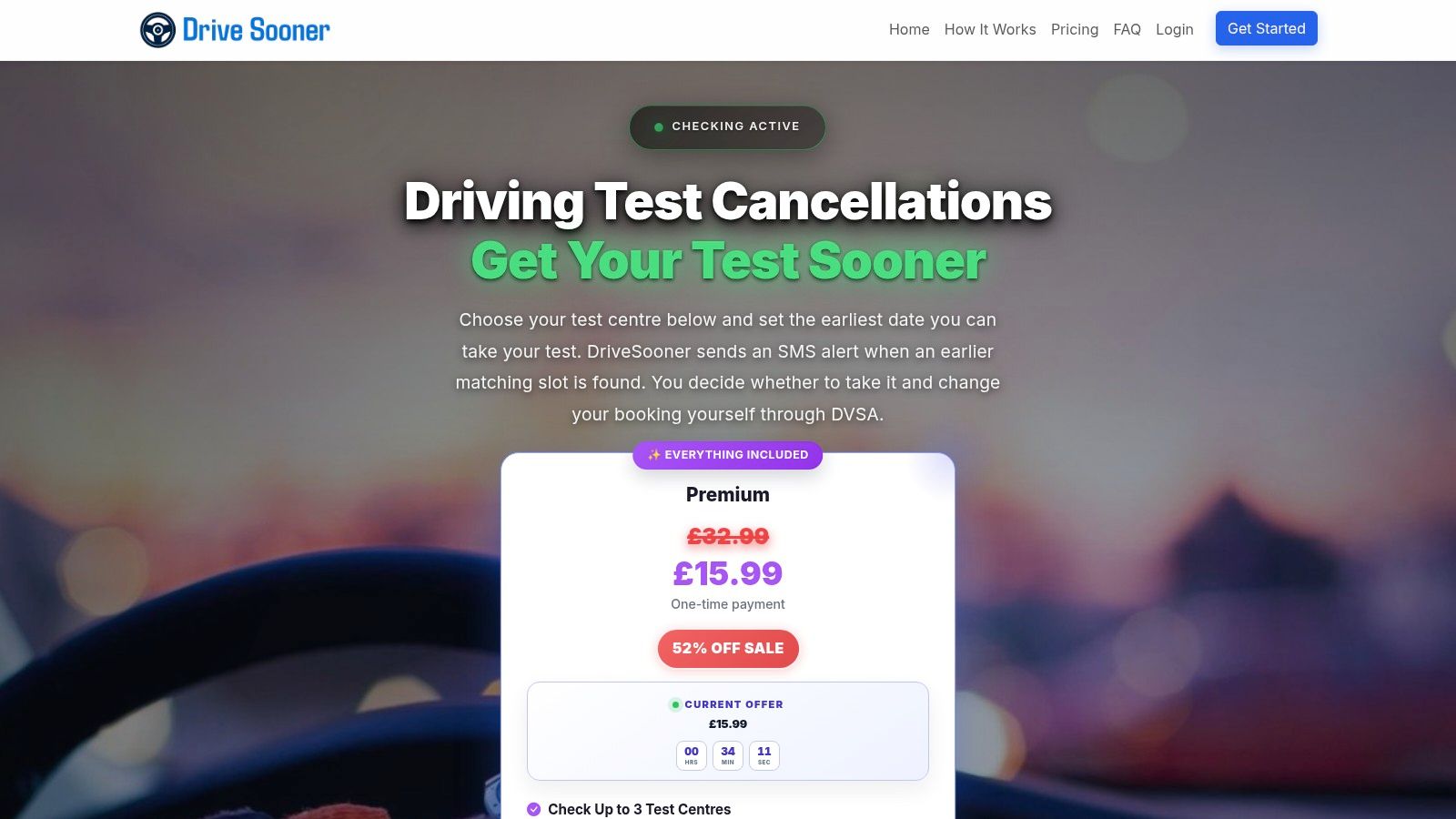
Free-app shoppers can rule this one out quickly. DriveSooner is a paid alert service from the start, with no free tier to test before spending.
That makes the comparison simpler, not harder. The useful question is whether the paid offer is clearer than rivals about what you are buying.
On that point, DriveSooner does better than many services in this category. Its wording keeps the workflow with the learner on GOV.UK rather than hinting that a third party will take control of the booking for you. If you are trying to separate straightforward notifications from anything that sounds like automated rebooking, that is a practical advantage.
A quick compliance sense-check helps here. “We alert you, you log in and change the test yourself” is easy to assess. Language about holding, securing or managing a booking on your behalf needs more scrutiny. DriveSooner appears to sit on the simpler side of that line.
The trade-off is obvious. You are paying without a free trial, so the value depends on whether its alert setup matches how you can respond during the day. SMS and email are both offered, which is more usable than email-only services if you are away from a desk. It also supports searches across up to three centres, giving you more room to cast a wider net in congested areas.
One caveat remains. Pricing visibility and feature clarity still matter more for a paid-only service than for a freemium app. If you cannot inspect the cost and limits quickly, comparison gets harder, even if the compliance wording is cleaner than average.
For learners who want something free, DriveSooner does not qualify. For learners who have already decided to pay, the stronger point is not extra automation. It is the narrower, easier-to-check promise of alerts first and rebooking kept with the candidate.
7. Test Hopper
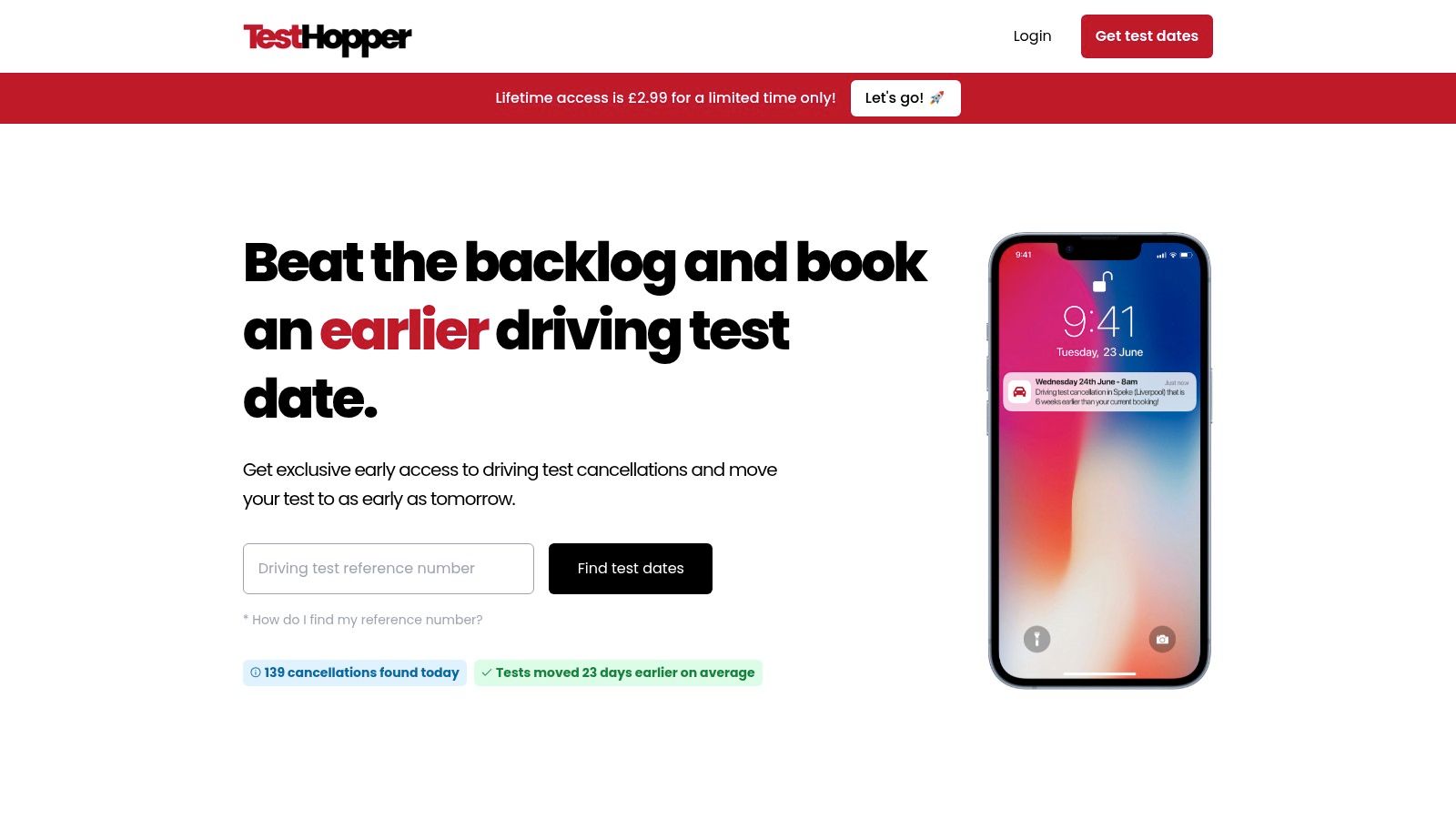
Test Hopper sits in the lightweight end of the market. The pitch is simple. Get push or browser notifications when earlier slots appear, and choose whether you want an app-based or browser-based setup.
That flexibility is handy if you don't want yet another app installed. Browser alerts can be enough, especially if you work at a desktop for much of the day and can react immediately.
Best suited to low-friction users
The appeal here is convenience rather than complexity. You're not buying into a heavy dashboard. You're using a cleaner alert layer and then handling the official booking change yourself.
For some learners, that's ideal. For others, it will feel too sparse if they want lots of controls, detailed filtering or a very established brand with a larger review history.
Pricing also isn't obvious from the landing page, which weakens it as a first recommendation for comparison shoppers. In this category, hidden or delayed pricing usually means more digging before you can decide whether the service is realistically “cheap enough to try”.
There's another practical limit to keep in mind. DVSA rules on changing a driving test mean you can cancel or change without losing the fee only if you give at least 10 full working days' notice, and Monday to Saturday count as working days while Sundays and public holidays don't (official 2026 booking rule guidance). So a fast alert is useful only if the replacement date is one you can move to within the rules.
8. DriveAhead.app
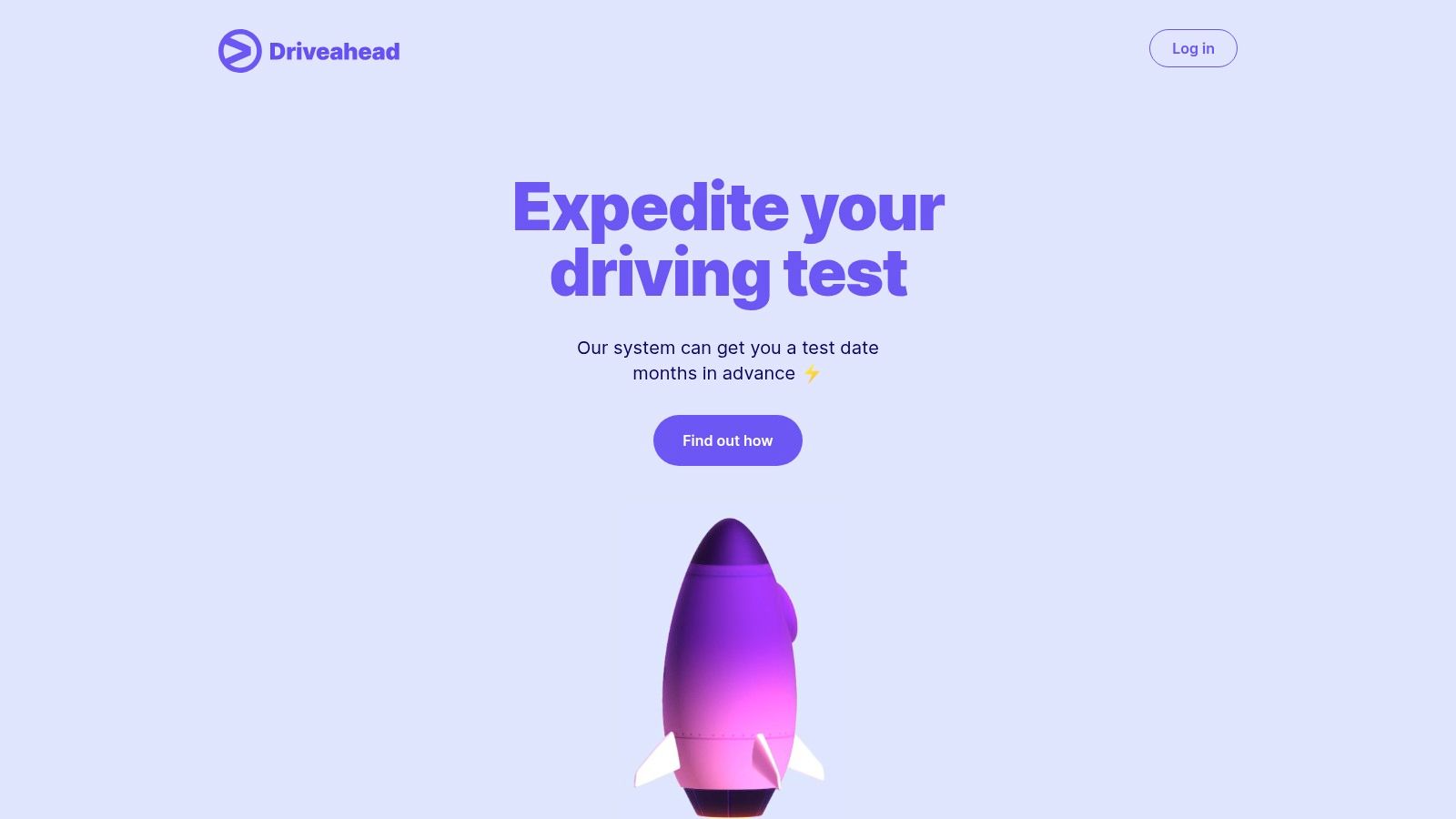
DriveAhead.app is another service that sidesteps the “app or not?” debate by working through the web. That makes it easy to try from any device, particularly if you're helping someone else manage a booking and don't want to log into an app on their phone.
Its setup sounds sensible for ordinary learners. Choose centres, choose a date range, wait for alerts, then complete the actual change on GOV.UK yourself.
Useful if you want a simple browser-first setup
The built-in explainer content is a good sign because a lot of confusion in this market isn't technical. It's procedural. People don't always know whether these services can book for them, whether they should share login details, or whether every alert is actionable.
DriveAhead's lower profile cuts both ways. A smaller footprint can mean a simpler experience. It can also mean less outside feedback from other learners, which matters in a category where responsiveness and reliability are central.
The location question is especially important here. DVSA-based reporting shows the value of cancellation tools varies sharply by area. One 2026 breakdown noted a Great Britain median wait of 11.1 weeks, an average wait around 20 weeks, and wide centre-level variation including Bedford at 27.1 weeks and Crieff at 31.4 weeks, while Scotland's regional median was 15.6 weeks and Wales only 7.6 weeks (PassRates guide to 2026 wait times). In a short-wait area, a browser alert tool may be enough. In a long-wait one, speed and breadth matter much more.
9. EarlierDrivingTest.co.uk
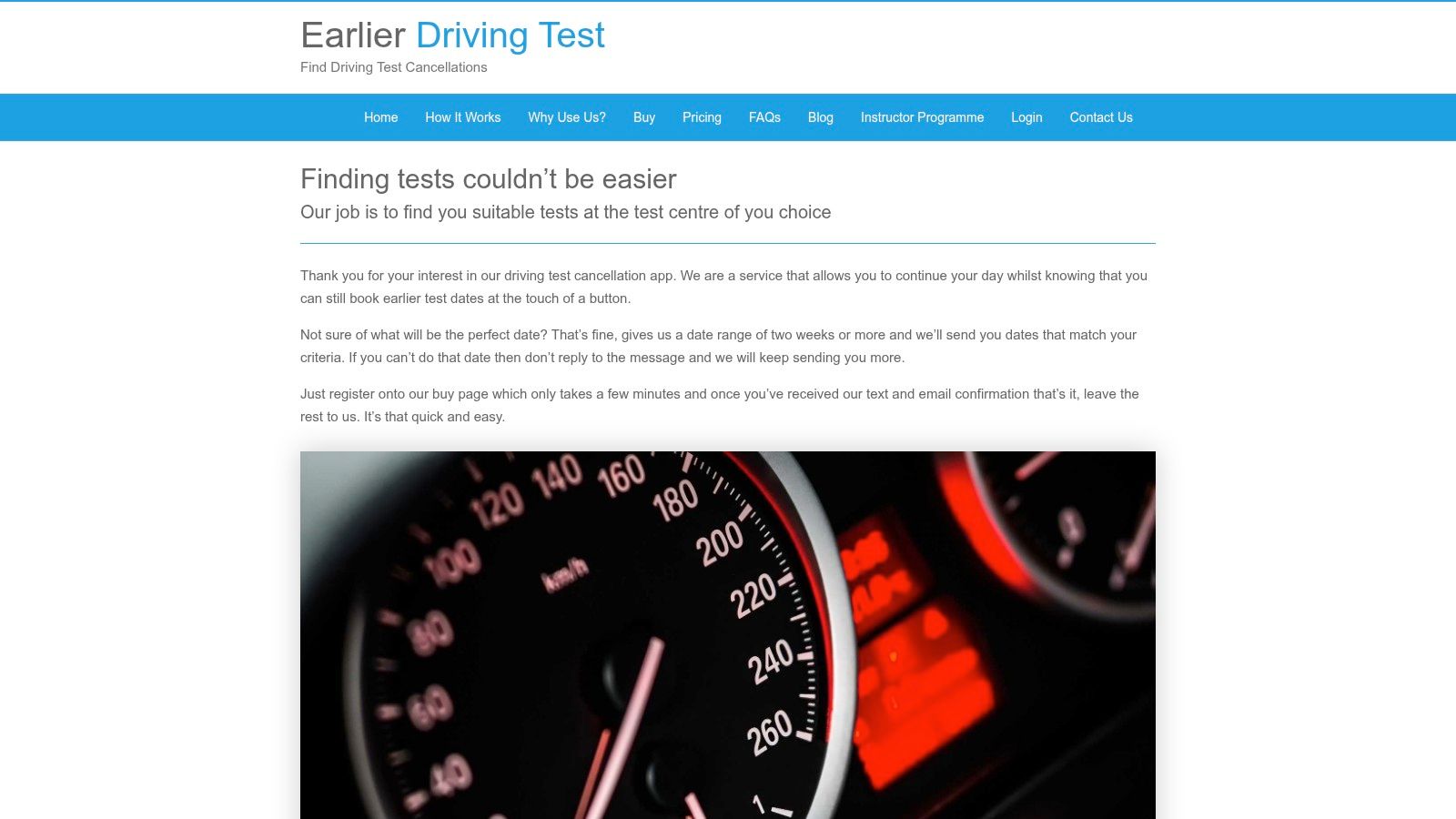
EarlierDrivingTest.co.uk is a long-running brand, and that longevity will reassure some learners. It offers SMS and email alerts, which is a practical combination, and the site uses money-back promise messaging.
The complication is the optional automated booking language. Under current DVSA conditions, that's the wrong part of the service to focus on.
Use the alert path, not any booking-by-proxy promise
If a service suggests it can automatically book or change your test on your behalf, treat that as a compliance question, not a convenience feature. The safer approach is to use any provider like this strictly as a notifier and keep the actual rebooking in your own hands through the official channel.
That caution has become more relevant as enforcement has tightened. BBC reporting in June 2026 said average waits were 22.7 weeks in England, 22.9 weeks in Scotland and 17.3 weeks in Wales, and noted tighter booking rules after thousands of no-shows (BBC reporting on waits and rule tightening).
For comparison purposes, EarlierDrivingTest's strengths are experience and multi-channel alerts. Its weaknesses are clarity and wording. If the site page you're reading leaves you unsure whether you're buying alerts or third-party booking intervention, that's not a small issue. In this market, plain language is part of the product.
10. Driving Test Cancellations UK
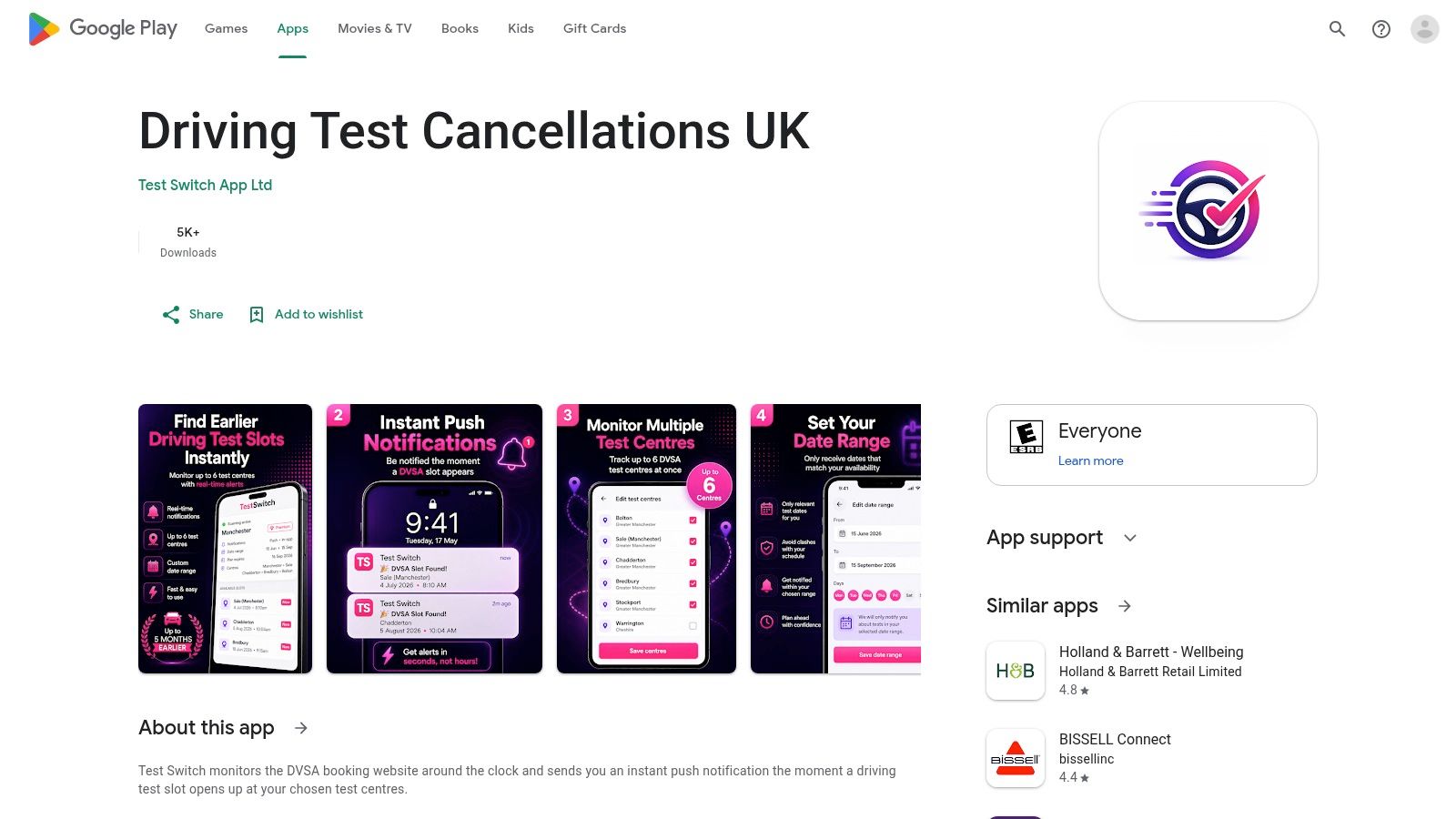
Free to install is not the same as free to use well. That distinction matters more with Driving Test Cancellations UK on Google Play than with some broader web-based rivals.
What stands out here is the workflow. This is an Android-centred app with in-app preference setting and optional purchases, so the practical question is not whether the download costs £0. The practical question is what a learner can do before paying, how alerts reach them, and whether the final change still happens under the learner's control on GOV.UK.
On those points, the app looks relatively clear in one respect and less clear in another. It appears to sit in the notification camp rather than openly promising to book on a learner's behalf, which is the safer position from a compliance perspective. Yet pricing and feature boundaries are not especially legible from a distance, so a cautious buyer should check the purchase screens and recent reviews before committing.
A useful way to assess this app is to treat it as a mobile alert utility first, not a full cancellation strategy.
What you can verify before paying
- Access model: free download, then optional paid extras.
- Alert route: app-based mobile notifications appear to be the core method.
- Best fit: Android users who want a phone-led setup rather than a desktop service.
- Main uncertainty: limited upfront clarity on exactly which filters or alert advantages sit behind payment.
That creates a different trade-off from the services above. You may get a simpler, app-native experience, but you also get less public evidence on alert performance and less certainty on value before purchase. For a smaller provider, that does not make the app poor. It means the burden of checking falls more heavily on the user.
The compliance check is straightforward. If any wording in-app or on the store page suggests the service can change bookings for you automatically, treat that as a warning sign and keep the actual rebooking step in your own hands through the official GOV.UK process. If you use it purely as an alert layer, the proposition is easier to assess: are the notifications fast enough, are they relevant to your centre choices, and can you act on them quickly from your phone?
Top 10 Free Driving Test Cancellation Apps, Comparison
| Service | Core features | Quality (★) | Price/value (💰) | Target (👥) | Unique selling point (✨ / 🏆) |
|---|---|---|---|---|---|
| Driving Test Cancellations 🏆 | 24/7 high‑freq DVSA scans; SMS timestamps; monitor up to 3 centres; ADI dashboard | ★★★★☆ | 💰 from £21.89 · unlimited alerts · money‑back | 👥 Learners & ADIs | ✨ DVSA‑aligned notification‑only; ADI workflows; published performance metrics |
| Testi – Driving Test Cancellations | Push alerts; one‑tap GOV.UK handoff; multi‑centre (premium filters) | ★★★★☆ | 💰 Free to download · IAP for priority/filters | 👥 Learners (community) | ✨ Large user base; simple rebook handoff |
| Test Hunter – Driving Test Cancellations UK | Alerts across UK centres; cloud notifications; paid unlock for extra centres | ★★★☆☆ | 💰 Free tier + one‑time upgrade | 👥 Learners | ✨ Free tier guaranteed; clear upgrade path |
| Find A Driving Test (web‑based) | Automated centre scans; email free trial; paid SMS & faster checks | ★★★★☆ | 💰 Free email trial → paid SMS/high‑freq plans | 👥 Learners | ✨ Genuine try‑before‑buy; staged plans |
| DrivingTests.co.uk – Finder + Swap | Continuous scanning + SMS/email; multi‑centre; free swap community | ★★★★☆ | 💰 Paid finder; free swap community | 👥 Learners & swap community | ✨ Dual approach: paid alerts + peer‑to‑peer swaps |
| TestShift | Real‑time alerts; scan up to 3 centres; browser & app alerts | ★★★★☆ | 💰 Pricing not clearly promoted | 👥 Learners & casual users | ✨ Browser‑based alerts; “reserve” window (verify compliance) |
| DriveSooner (notification‑only) | Frequent manual checks; SMS/email; monitor 3 centres; clear compliance | ★★★★☆ | 💰 Paid (one‑time) · transparent promos | 👥 Learners & ADIs seeking compliant tool | ✨ Explicit DVSA‑aligned notification‑only model |
| Test Hopper | UK‑wide push/browser notifications; app or browser alerts | ★★★☆☆ | 💰 Pricing not visible on landing | 👥 Browser/app users | ✨ Minimal setup friction; app‑optional alerts |
| DriveAhead.app | Web‑based alerts (no install); centre/date filters; explainer content | ★★★☆☆ | 💰 Pricing not prominent | 👥 Learners preferring web | ✨ No‑install web alerts + helpful explainers |
| EarlierDrivingTest.co.uk | SMS/email alerts; advertised optional automated booking; money‑back messaging | ★★★☆☆ | 💰 Paid (details not clear) · refund messaging | 👥 Established market users | ✨ Long‑running provider; multiple alert channels |
| Driving Test Cancellations UK (Test Switch App Ltd) | Mobile alerts; Android‑first app; planning tools | ★★★☆☆ | 💰 Free to download · optional IAP | 👥 Android users | ✨ Android‑focused UI; simple mobile alerts |
Choose the Alert Method You Can Act On
The best choice here depends less on branding and more on how you plan to respond when an alert lands.
If you want to spend nothing at first, use a genuine free tier or trial to test your own centre before paying. That's the most sensible approach because practical test pressure is uneven across the country, and a service that feels essential in one area may add very little in another. Free email-only trials can still be useful as a reality check. They tell you whether your chosen centre is producing earlier slots often enough to justify a faster paid setup.
If you already know your area is difficult, the decision becomes less about “free app for driving test cancellations” and more about alert speed and channel. Push notifications can work well if your phone allows them through instantly. SMS can be stronger if you need something harder to miss. Browser alerts are perfectly reasonable if you're usually at a laptop and don't want another app on your phone.
There's also a clean divide between models. Some services are usable for free. Some are freemium and become worthwhile only after an upgrade. Some are really paid products with either no free access or only a short trial. That doesn't make the paid ones bad. It just means they shouldn't be confused with fully free services.
Keep the workflow simple. Allow notifications. Keep your DVSA sign-in details ready. Check the alert carefully before acting, including the test centre and date. Then complete the change yourself through GOV.UK. That's the safest route and the easiest one to understand later if anything goes wrong.
Be realistic about what these tools can and can't do. None can guarantee an earlier slot. They're dependent on local cancellations, your flexibility, your device settings and how fast you respond. If your centre has comparatively short waits, free tools may be enough. If your centre is badly congested, extra filters, wider centre coverage and faster notifications may justify paying.
It's also worth checking whether you really need an installed app. Browser-first tools can do the job if the alerts are reliable. For learners or ADIs who need broader monitoring and SMS-based notifications, Driving Test Cancellations is another notification-only option in this market. It focuses on DVSA practical test availability, keeps rebooking with the candidate and supports multi-centre monitoring, which can be useful when one local centre rarely opens up.
The sensible way to use any of these services is not to chase a universal “best app”. It's to pick the alert method you're most likely to notice and act on quickly, then test whether your chosen centre produces opportunities often enough to matter.
If you want a notification-only service that keeps the actual rebooking with you, Driving Test Cancellations monitors DVSA practical test availability, sends alerts when earlier appointments appear and supports up to three preferred centres. It also has a free trial and options for both individual learners and ADIs, so it's worth a look if you need broader monitoring than a basic free app offers.