The standard weekday car practical test costs £62, and the DVSA charges £75 for evening and weekend slots. That's the baseline, but the final bill can be higher, because delays, extra lessons and unofficial booking mark-ups can push the practical test price far above the official rate.
Table of Contents
- What the DVSA Actually Charges for a Car Practical Test
- How Practical Test Prices Vary by Region and Test Centre
- Hidden Costs That Push the Real Price Above £62
- Payment Methods and DVSA Reschedule Rules
- Why a Cheap Test Is Rarely Just the DVSA Fee
- Practical Ways to Keep the Total Cost Down
- The Real Number to Budget for in 2026
What the DVSA Actually Charges for a Car Practical Test
The official practical test price for a car in Great Britain is straightforward on paper. DVSA sets the weekday fee at £62, and the higher rate of £75 applies to evening, weekend or bank-holiday appointments, with the surcharge triggered by the slot start time, not how long the test lasts. So a 4:35pm appointment can cost more even though the driving test itself is unchanged. GOV.UK's driving test cost page sets out that structure clearly.
That matters because the headline price is only the floor. If you book directly through the official system, that's the amount you pay for the test itself. If you're comparing practical test prices, start here, because anything else is either an extra service, a delay cost, or a reseller mark-up.
Other vehicle categories at a glance
DVSA uses separate fees for different tests. Lorry and bus practical tests are £115 each, a tractor practical test is £62, motorcycle Module 1 is £15.50, motorcycle Module 2 is £75, and ADI Part 2 is £111. Those figures are the published official rates, not marketplace prices.
Practical rule: if a seller quotes anything above the DVSA fee and says it is the test price, treat that as a resale charge, not the official booking cost.
| DVSA Practical Test Fees by Category (2026) | Weekday Fee | Evening/Weekend Fee | Notes |
|---|---|---|---|
| Car practical test | £62 | £75 | Evening, weekend and bank-holiday slots cost more |
| Lorry (LGV) | £115 | £115 | Official DVSA fee |
| Bus (PCV) | £115 | £115 | Official DVSA fee |
| Motorcycle Module 1 | £15.50 | £15.50 | Official DVSA fee |
| Motorcycle Module 2 | £75 | £75 | Official DVSA fee |
| Tractor | £62 | £62 | Official DVSA fee |
| ADI Part 2 | £111 | £111 | Official DVSA fee |
The trap is assuming that official fees tell the whole story. They don't. For most learners, the practical test price becomes meaningful only when you add the cost of waiting, the cost of another lesson, and the cost of getting the slot in the first place.
How Practical Test Prices Vary by Region and Test Centre
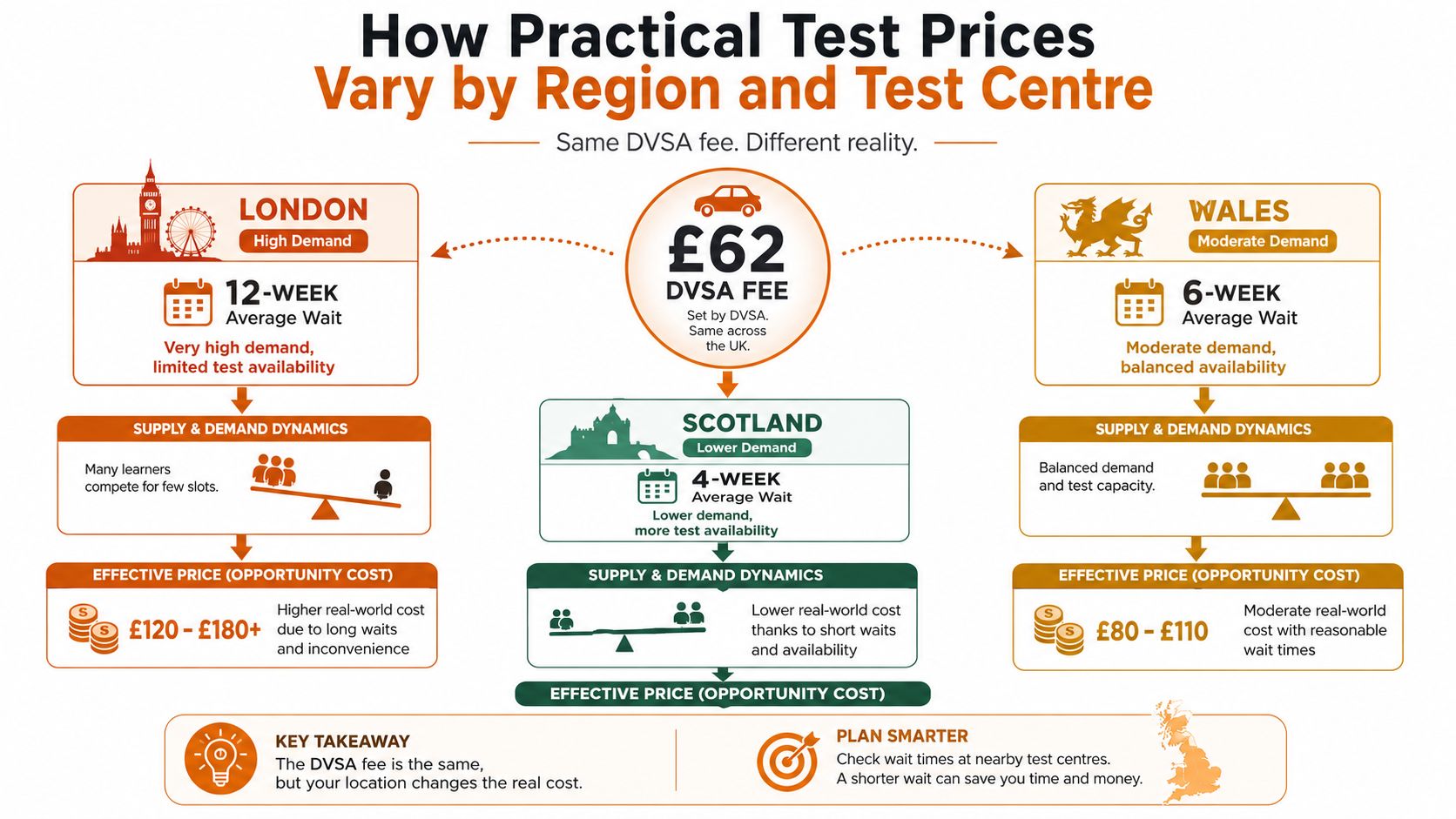
The DVSA fee does not change by region. The cost pressure comes from access. A learner can pay £62 for the test itself and still end up with a much higher bill if the nearest slot is months away, lessons keep ticking over, or a different centre is the only sensible option.
Fixed fee, uneven access
Public wait times show the split clearly. Wales averaged 17.3 weeks in April 2026, compared with 22.7 weeks in England and 22.9 weeks in Scotland. Earlier reporting also showed London under heavy strain, with 28 of 30 centres at the maximum 24-week wait in March 2025, while some Welsh centres moved faster. BBC reporting on DVSA wait times captures that regional divide well.
That is why practical test prices cannot be treated as one flat number. The fee is fixed, but the cost of getting the test varies sharply depending on where you live, where your instructor is based, and how far you are willing to travel. Hendon, Birmingham Bescot and Cardiff Pontypridd are names that come up because availability is uneven from one centre to the next.
A learner in a slow area is often paying for time, not just the booking fee. Extra lessons and awkward travel quickly become the final bill.
For a detailed look at availability by location, see our guide to test centres.
Use availability as part of the price check
The DVSA booking tool shows live availability, so there is no need to guess. Use it properly. If one centre offers a realistic earlier slot and another leaves you waiting for months, the cheaper official fee at both centres does not matter, because the delay itself is what pushes the cost up.
The better question is simple. Where can you get a safe, timely slot without adding extra lessons, wasted travel or avoidable waiting? That is the number that matters when you compare practical test prices by region.
Hidden Costs That Push the Real Price Above £62
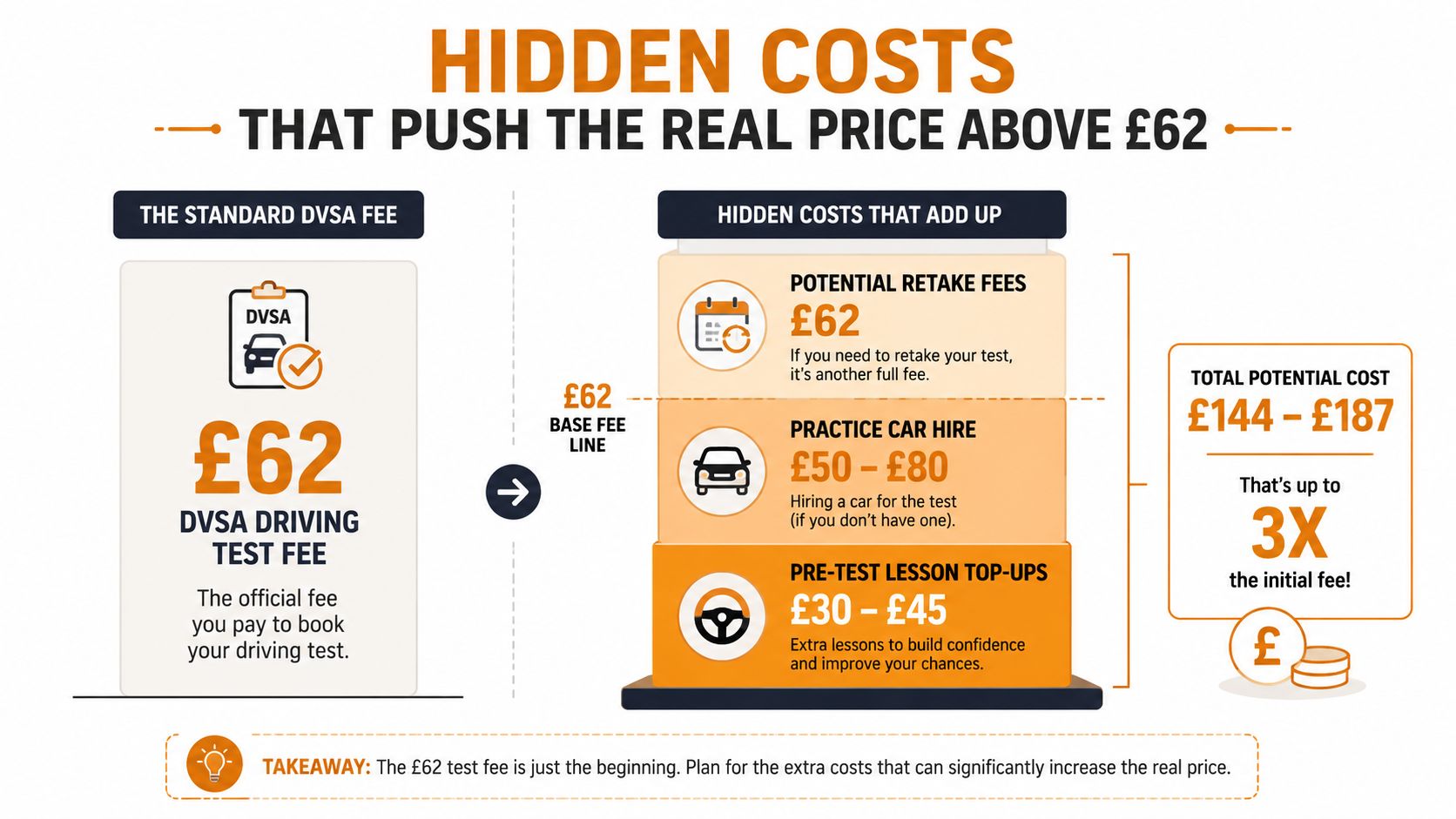
The official fee is only one line in the ledger. The hidden costs are what turn a cheap-looking booking into an expensive one, and they're usually the main reason practical test prices feel inflated.
Lessons, retests and a theory test that can run out
Long waits often mean more lessons. A learner who isn't driving for weeks tends to lose confidence, and instructors usually need to spend time cleaning up those gaps before test day. If the theory certificate expires while the practical test is still pending, the learner has a fresh theory cost to face as well.
Third-party booking sites make the picture worse. The National Audit Office said some people paid as much as £500, and around 31% of DVSA survey respondents used a third party to book a test. That is the clearest sign that scarcity creates a resale market, even when the official fee stays at £62. The NAO's 2025 investigation is blunt on that point.
Travel and time off also bite. If you're sent to a busier centre, you may end up paying for fuel, train fares or a half-day away from work or college. None of that appears on the DVSA receipt, but it's still part of the total cost.
What learners usually underestimate
Practical rule: the sticker price is rarely the amount that matters. The expensive part is waiting, reshuffling diaries and paying for extra practice.
The result is a total cost that can be much higher than the booking fee alone. A learner who needs extra hours, a different centre, or a second attempt is no longer dealing with a £62 problem. They're dealing with a delay problem.
Payment Methods and DVSA Reschedule Rules
The safest way to pay is still the dullest way, through GOV.UK or the official DVSA booking service. DVSA accepts debit card, credit card and PayPal at checkout, and the official guidance says you should treat the government site as the only place that controls the booking. If a site isn't part of that system, it isn't selling you the test itself.
Know the rules before you move anything
DVSA's booking rules changed in 2026. From 31 March 2026, car driving test bookings can only be changed twice, down from six changes before. A change includes moving the date or time, changing the test centre, or swapping the appointment with another learner driver who already has a test booked. DVSA's change-rule guidance sets that out.
There's also a hard boundary on who can manage the booking. From 12 May 2026, only the learner driver can legally book or manage their own car driving test. That means third parties, including unofficial cancellation-finder services and instructors using the business service, cannot book, change, cancel or swap tests on a learner's behalf. DVSA's booking-rules update is explicit.
| DVSA Payment and Reschedule Rules at a Glance | DVSA Rule | Cost or Penalty |
|---|---|---|
| Pay for the test | Use the official DVSA booking service | Official fee only |
| Pay by card or PayPal | Accepted at checkout | Normal payment processing applies |
| Move a test after booking | Must meet DVSA notice rules | Fee risk if you break the rules |
| Change a test booking | Limited to two changes from 31 March 2026 | Further amendments are not allowed |
| Use a third party to manage the booking | Not allowed from 12 May 2026 | No valid official handling by a third party |
The practical takeaway is simple. If a business sells “cancellation cover” or claims it can manage your booking after the official rules change, that is not the same thing as DVSA permission. One service can notify you about slots, another tries to control the booking, and only one of those sits comfortably within the official system.
For a consumer, the safest move is boring but effective. Pay through GOV.UK, keep your booking under your own control, and don't give anyone else the keys to a test you'll be responsible for on the day. Driving Test Cancellations' cancellation policy page is worth reading if you're comparing how notification services describe their role versus the official booking rules.
Why a Cheap Test Is Rarely Just the DVSA Fee
A cheap test is often a false economy. Once the wait gets longer, the extra spending usually comes from lessons, not the booking fee, and that's why the headline price can be so misleading.
Delay is the real cost driver
Each extra week of waiting tends to mean more lessons, and learners often need to keep driving long enough to avoid going rusty. That extra practice is not optional if you want to stay test-ready. If you fail and then face another long wait, the bill grows again before you even think about the next booking.
The official fee is the easy part. Keeping yourself ready for the test is what gets expensive.
Third-party resellers exploit that pressure. They advertise “priority” access and charge far more than the DVSA fee for the same basic appointment. The NAO's figure of prices reaching £500 shows exactly how far a scarce slot can drift from the official rate. The NAO report and the full investigation together underline the same point.
What usually gets added on
- Extra lessons: learners keep paying for instructor time while they wait.
- Repeat practice: confidence slips when a test date keeps moving.
- Travel: busier centres can mean more mileage or transport costs.
- Second attempt risk: one failure can reset the whole timetable.
The pattern is predictable. A learner who thinks they've found a “cheap” test often discovers they've just bought a shorter wait at a much higher price. That's why practical test prices should be judged as a total cost, not a booking sticker.
Video
Practical Ways to Keep the Total Cost Down
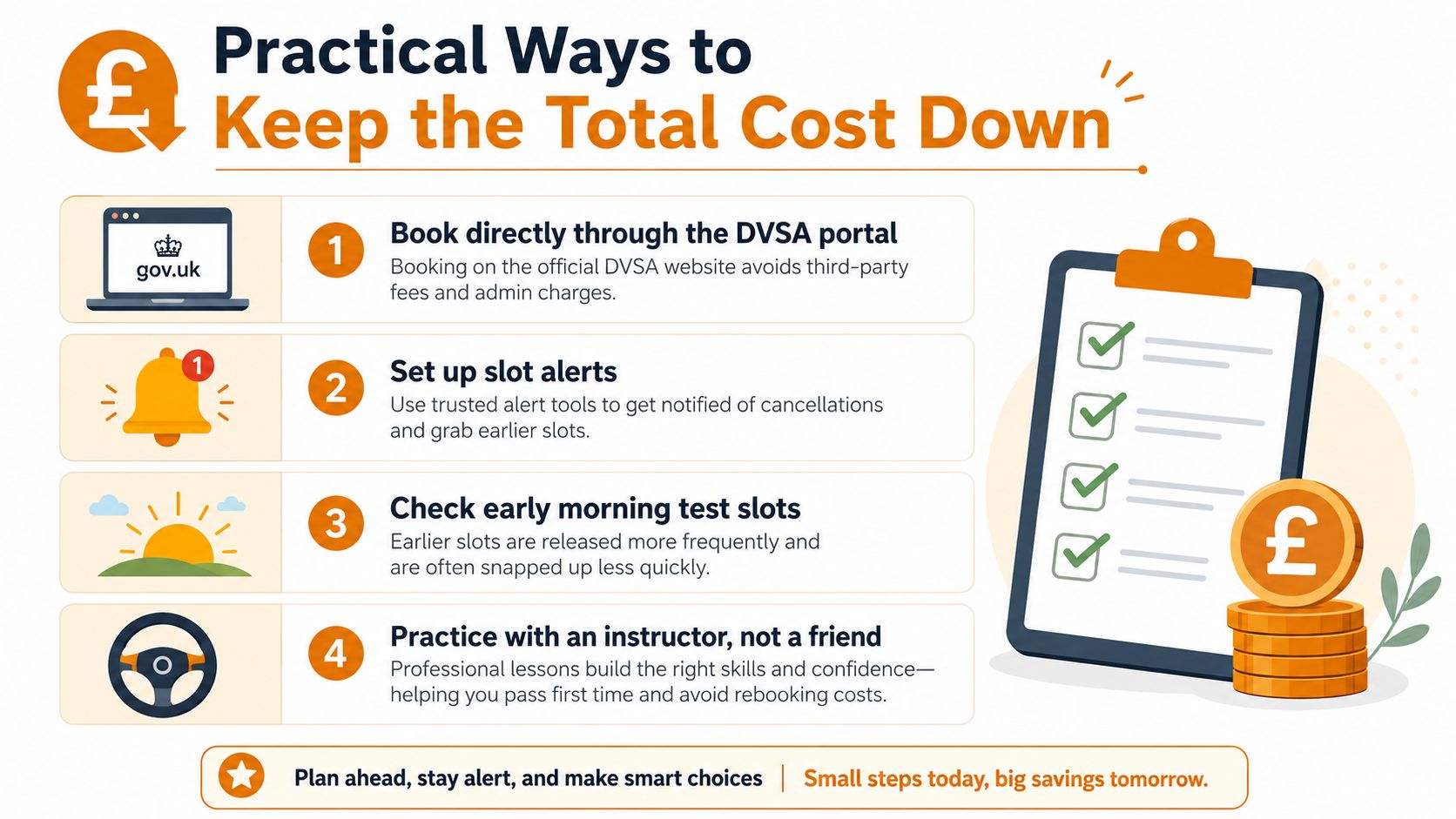
Start with the official route. Book directly through the DVSA portal on GOV.UK, keep the booking in your own name, and don't pay a reseller because they promise speed. If you're after an earlier slot, flexibility helps more than panic ever will.
Use cancellations properly
Check for cancellations early in the morning and at other low-traffic times, because that's when sensible slots are most likely to appear. The DVSA booking system already shows availability, and notification tools can help you spot openings without handing control of the booking to someone else. That matters after the 2026 rule change, because only the learner can manage the booking anyway.
One option in this space is Driving Test Cancellations, which monitors DVSA practical test availability and sends alerts when earlier appointments appear. It is a notification service, not a booking agent, so the distinction matters if you want to stay within the official rules.
Lock in readiness before the date
Take a mock test with your instructor in the week before the appointment. That surfaces weak spots while you can still fix them with a cheaper lesson rather than during a failed attempt. It also stops you wasting the test fee on a day you weren't ready.
A theory pass and practical booking should be planned together. If the practical slot drifts too far, the theory certificate can become another cost problem, so keep both dates in view when you're booking. Use your instructor's school car if it's what you've been practising in, because familiarity often cuts nerves and avoids last-minute vehicle hire stress.
Small habits that save money
- Stay flexible: don't lock yourself emotionally to one date.
- Watch the diary: cancellations often appear when someone else shifts plans.
- Keep lessons regular: long gaps usually mean more catch-up spending.
- Choose the right car: a familiar vehicle can reduce avoidable mistakes.
The point isn't to chase the absolute cheapest test. It's to avoid the expensive routes that look convenient for five minutes and then cost you much more later.
The Real Number to Budget for in 2026
If you want a realistic 2026 budget, £62 is not enough. It's the official weekday fee, but most learners should think in terms of the test, the waiting time and the chance of needing more practice around it.
A sane planning range
For a learner who passes first time in a low-wait area, a working budget of £250 to £400 is a more honest starting point than the bare DVSA price. This includes the official fee plus a small amount of extra practice and the ordinary friction that comes with booking a test properly.
If waits are long or a second attempt is needed, the budget climbs fast. The extra lessons, repeat travel and diary reshuffling can push the total to £600+, especially once delay becomes the main cost driver. The official fee still matters, but it stops being the main event.
| Realistic 2026 Budget Scenarios for a UK Car Practical Test | DVSA Fee | Likely Extras | Total Budget |
|---|---|---|---|
| First-time pass, low-wait region | £62 | A small amount of pre-test practice and travel | £250 to £400 |
| First-time pass, longer wait | £62 | Extra lessons, more travel, more time off | Higher than £400 |
| Second attempt after a fail | £62 | More lessons, another booking cycle, possible regional delay | £600+ |
| Unofficial resale route | £62 official fee, if any | Reseller mark-up and delay pressure | Can be far above the official rate |
A separate risk sits outside normal budgeting entirely. If you use an unofficial booking market, there's no sensible consumer protection if that slot gets cancelled or changes hands, because you've already stepped outside the official system. Driving Test Cancellations' pricing page is a useful reference point for understanding how notification services position their offer without pretending they're the DVSA.
The cleanest approach is plain enough. Book your theory early, keep watching for cancellations, and treat £62 as the starting figure, not the target.
If you want to cut the wait without handing over control of your booking, use Driving Test Cancellations to monitor earlier DVSA appointments and get alerts when a better slot appears. It's a practical way to stay in charge of your test while keeping the total cost of delay down.