Swindon recorded a 51.1% pass rate in 2025–26, almost exactly around the Great Britain average, while its median waiting time was 11.7 weeks, or roughly 12 weeks. That makes cancellation monitoring worth considering for many learners, but only if you understand what the DVSA rules allow you to do once an earlier slot appears.
You've booked the test, told your instructor, and then discovered that the date feels a very long way away. That's the awkward point where learners start searching for “test centre Swindon”, refreshing the booking page, and wondering whether travelling elsewhere would be easier. Swindon is a busy centre with a pass rate close to the national midpoint, so the problem usually isn't that the test is unusually difficult. It's that appointments are in demand and a suitable cancellation can disappear quickly.
The sensible approach is practical rather than hopeful. Learn the route to the centre, keep your existing booking safe, monitor availability within the DVSA rules, and use the waiting period to prepare for the roads you'll meet.
Table of Contents
- Finding Your Way Around the Swindon Driving Test Centre
- Park and Prepare Before the Test Day
- Swindon Test Numbers and What They Mean for Candidates
- How Candidates Get an Earlier Slot
- What Changed for Test Bookings From May 2026
- Changing and Canceling Swindon Tests Without Losing Fees
- What a Smart Waiting Strategy Looks Like in Practice
Finding Your Way Around the Swindon Driving Test Centre
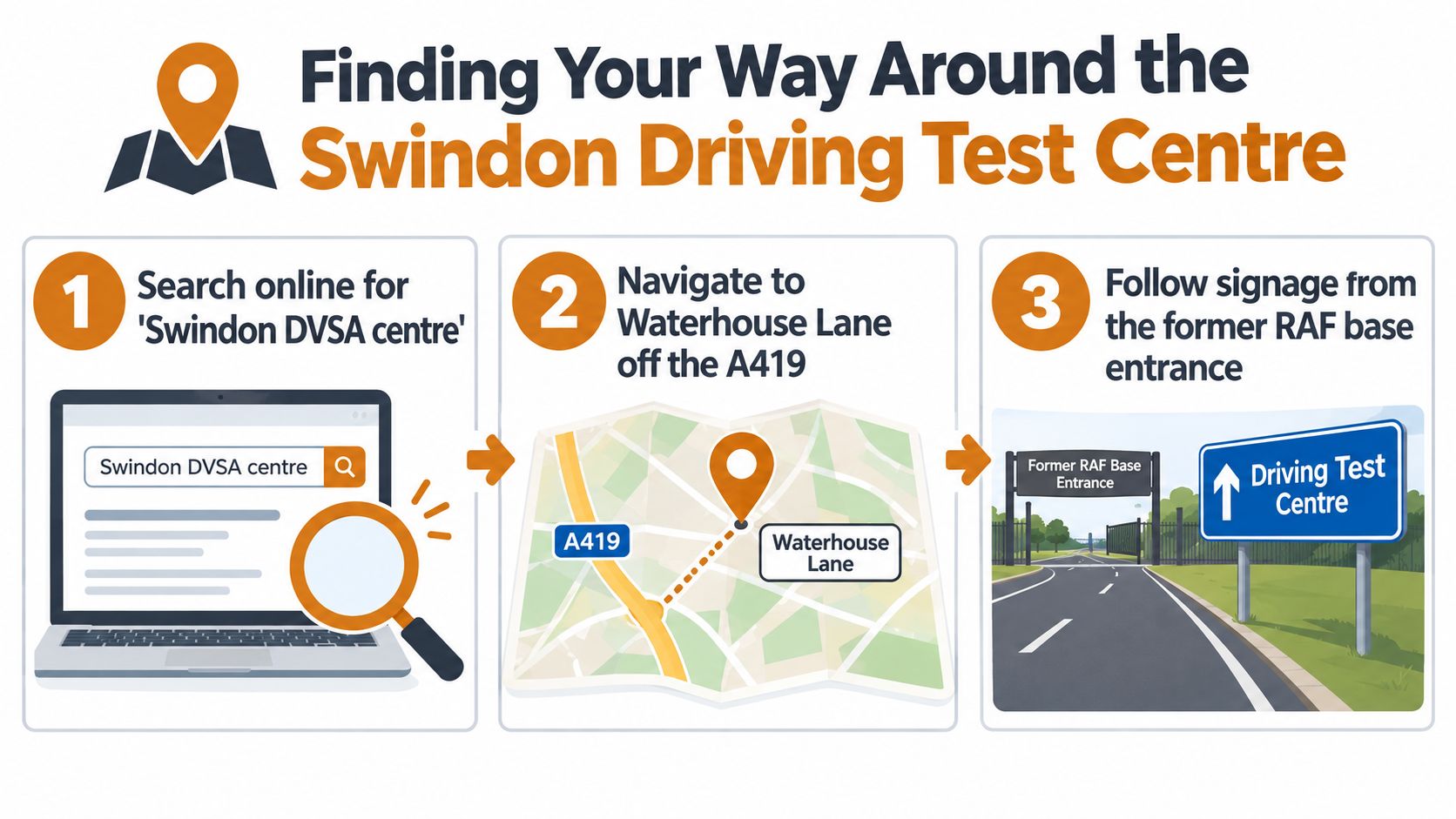
The first time a learner checks the booking confirmation, the address can look deceptively simple. The Swindon test centre is on the former RAF base at Waterhouse Lane, off the A419, but a straightforward address doesn't always produce a straightforward arrival. A missed turn, a slow approach from the M4 or an overconfident sat-nav instruction can leave you circling when you should be parked and composed.
From the M4, allow the route to settle before you reach the A419 rather than relying on a last-minute lane change. Candidates approaching along the A419 should look for the signed access towards Waterhouse Lane and the former RAF base. If you're coming from one of the surrounding towns, rehearse the final approach in daylight, including the entrance and the internal road layout.
The final approach matters
The centre's location means you may feel as though you've arrived before you've found the right staging area. Follow the signs from the former RAF base entrance rather than assuming the first available turning is the test-centre access. A learner who arrives early but parks in the wrong place still creates unnecessary pressure.
Use a route planner before the day and search specifically for the Swindon DVSA centre, not just Waterhouse Lane. It's also sensible to check the route from your instructor's usual lesson area, since the final approach may feel different from the direction you take on test day. The Swindon test centre information page can help you keep the location separate from similarly named local destinations.
Practical rule: Treat the last part of the journey as part of your test preparation. You're not practising the test route, but you are removing one avoidable source of stress.
On arrival, use the designated car park and walk to the initial staging or check-in area without rushing. Don't leave the car in a position that blocks other candidates, and don't spend the first few minutes wandering around looking for the entrance. The aim is simple: arrive, park sensibly, confirm where you need to wait, and give yourself enough quiet time to settle.
Park and Prepare Before the Test Day
Plan to reach the Swindon site with time to spare, but don't turn early arrival into an extra test of your nerves. The car park is the sensible first destination. Once parked, switch off, gather your documents and check the booking details before doing anything else.
The centre handles a substantial flow of candidates, so the atmosphere can change as more cars arrive. Earlier spaces may be easier to use, while nearby streets can become poor alternatives once other candidates and local traffic build up. Parking away from the designated area may also leave you with an unnecessary walk or a confusing return to the check-in point.
A calm arrival routine
Use the same order every time:
- Park securely. Choose a proper space and leave enough room to exit without manoeuvring repeatedly.
- Check your details. Confirm the date, time and centre on your booking information.
- Take your paperwork. Keep your licence and any required booking information together.
- Find the waiting area. Follow the centre signage instead of trailing another candidate and hoping they know where they're going.
- Settle the car and yourself. Put away distractions, use the remaining time to breathe, and avoid a last-minute practice drive around unfamiliar roads.
If your test is later in the day, arriving early doesn't mean you'll be called forward immediately. Wait where the centre directs you and keep your attention on the appointment you've booked. A rushed coffee, frantic phone calls and repeated checks of the sat-nav won't improve your drive.
The best preparation at this point is quiet and boring. Adjust your seat and mirrors if needed, review the basic controls, and let your instructor know you've arrived. You're trying to begin the test alert, not exhausted from managing the morning.
Swindon Test Numbers and What They Mean for Candidates
Swindon is a high-volume centre, not a small location with only occasional appointments. The latest published comparison records 12,857 car practical tests in 2025–26, with 6,567 passes and a 51.1% pass rate. That was 1.1 percentage points above the Great Britain average of 50.0%, although Swindon ranked 186th of 317 centres by pass rate, which places it close to the national midpoint rather than among the clear outliers. These figures come from the published Swindon practical test centre comparison.
The same dataset gives Swindon a median waiting time of 11.7 weeks. That combination matters. A busy centre can offer a steady stream of appointments, but demand can absorb them just as steadily. A cancellation may appear because another learner changes plans, yet that doesn't mean every opening will match your instructor's diary or your work and study commitments.
The longer view
The historical picture is uneven rather than perfectly linear. The table below uses the centre figures published for each financial year, showing why current availability shouldn't be judged from one pass-rate figure alone. The source records 18,940 tests and a 49.3% pass rate in 2024–25, compared with 18,234 tests and 47.5% in 2023–24, while earlier years had different volumes and outcomes. The full figures are available in the Swindon driving test centre data.
| Period | Tests | Pass rate | Notes |
|---|---|---|---|
| 2025–26 | 12,857 | 51.1% | Above the Great Britain comparison average |
| 2024–25 | 18,940 | 49.3% | Close to the Great Britain average |
| 2023–24 | 18,234 | 47.5% | Higher demand than the following published period |
| 2022–23 | 16,020 | 46.7% | Lower pass outcome than later years |
| 2021–22 | 16,876 | 46.6% | High test volume with a lower pass rate |
| 2020–21 | 5,502 | 53.2% | Disrupted period with unusually low volume |
| 2019–20 | 17,226 | 47.5% | Pre-pandemic comparison |
| 2018–19 | 15,842 | 50.6% | Earlier pre-pandemic result |
The lesson isn't that Swindon is easy or difficult. Its results sit broadly alongside national and regional performance, with the South West comparison at 51.7% across 22 centres in the cited dataset. Treat the pass rate as context, not as a reason to book before you're ready or to assume another centre will solve a preparation problem.
How Candidates Get an Earlier Slot
A Swindon cancellation can appear while you are working, teaching or travelling. Getting it depends on two practical routes: checking the official DVSA booking service yourself, or using a notification service that tells you when a possible opening appears. Neither route guarantees a new appointment. The key difference is who monitors availability and who must act when a suitable slot appears.


Manual checking
Manual checking keeps every decision in your hands. Sign in, search the Swindon dates and times you can accept, then make the change yourself if the appointment works. The financial cost is limited to your time, but repeated refreshing becomes tiring. You may also check at the wrong moment, miss a short-lived opening or lose track during a busy day.
This approach suits candidates with flexible diaries who can respond immediately. It is less practical if you are at work, teaching, travelling or trying to match your availability with an instructor who cannot answer every message straight away. A slot that looks good on screen is no use if the lesson time or journey cannot be arranged.
Alerts and personal action
A notification service can monitor for openings and send information when a matching slot is detected. That reduces the need to keep refreshing the booking page. The alert is only a prompt, not a booking. You must sign in to the official DVSA service, check the Swindon centre, date and time, and complete the change yourself.
The post-May 2026 booking rules make that responsibility more important. A notification can save attention, but it cannot transfer control of the booking to an instructor, app or other third party. The guide to getting an earlier driving test date sets out the practical options, provided you treat each notification as a prompt for personal action rather than an automatic rebooking.
The trade-off is clear. Manual checking offers maximum control but demands regular effort. Alerts reduce monitoring work but still require quick, careful action from the learner. Keep the existing appointment until you have checked that the replacement genuinely fits.
A cancellation helps only if you can attend, your instructor can support it and the change will not create a fee problem. Speed matters, but checking first protects a workable booking.
What Changed for Test Bookings From May 2026
From 12 May 2026, the DVSA restricted who can manage practical car test bookings, changing how cancellation monitoring works at Swindon. Only the learner driver can book, change, swap or cancel a category B practical test. The DVSA business service terms confirm that instructors may support learners, while the learner remains responsible for completing the booking action.
For Swindon candidates, that makes an alert part of the process rather than the process itself. A monitoring service can identify a possible earlier appointment and send the details, but the learner must sign in, check the centre, date and time, and complete the change through the official DVSA service.
Support is still possible
Your instructor can help assess whether a date fits your lesson schedule, car access and readiness. They can discuss the route and explain the booking steps if you need assistance. The final change to a practical car test must still be made by you.
DVSA introduced the restriction during its crackdown on unofficial booking services. Breaching the booking-service terms can result in action against the booking or online access. The convenience of an automated change therefore carries a practical risk: a system that acts without your control could leave you with a cancelled booking or restricted access.
That is the trade-off at Swindon. Monitoring can reduce the time spent checking for cancellations, while the learner keeps responsibility for deciding whether an opening works. The updated guidance on DVSA driving test rules helps identify advice written before the restriction took effect.
Use alerts for information, then verify the booking details personally before confirming the replacement date.
Changing and Canceling Swindon Tests Without Losing Fees
An earlier slot can look like an obvious upgrade, but don't click through on instinct. Under the 2026 rules, a learner can change a car practical test up to two times. Once those two changes have been used, the existing appointment needs to be cancelled before a new test is booked.
The fee position depends on notice. GOV.UK says a car test can normally be changed or cancelled without losing the fee when you give at least 10 full working days' notice. Monday to Saturday count as working days, while Sundays and public holidays don't. The DVSA guidance on changes to unofficial booking services sets out the two-change limit and the consequences of reaching it.
Check before accepting
When a Swindon cancellation appears, work through this order:
- Count your previous changes. Don't rely on memory if you've already moved the appointment. Check the booking record.
- Check the new date. Make sure your instructor, car and personal timetable can support it.
- Count full working days. Don't count Sundays or bank holidays when judging whether the original fee is protected.
- Compare the risk. A slightly earlier date may not be worth using one of your two changes if you're unlikely to be ready.
- Confirm on GOV.UK yourself. An alert or message doesn't complete the transaction.
If you've already used both changes and can't find a suitable replacement, DVSA's stated route is to cancel and book a new test. That resets the practical booking process, but it also means giving up the security of the existing appointment, so it isn't a casual decision.
Short-notice exceptions may be considered for unavoidable circumstances such as illness, bereavement or a school examination. You'll need supporting evidence. A cancellation close to the test date isn't automatically fee-protected just because you cancelled before the appointment began.
Before you change: Confirm the number of changes used, the working-day notice and your instructor's availability. Three quick checks can prevent an expensive panic.
What a Smart Waiting Strategy Looks Like in Practice
A sensible Swindon strategy has three parts: keep a viable appointment, monitor for something better, and continue preparing as though the earlier date might never appear. That sounds less exciting than chasing every opening, but it protects you from treating cancellation monitoring as a shortcut.
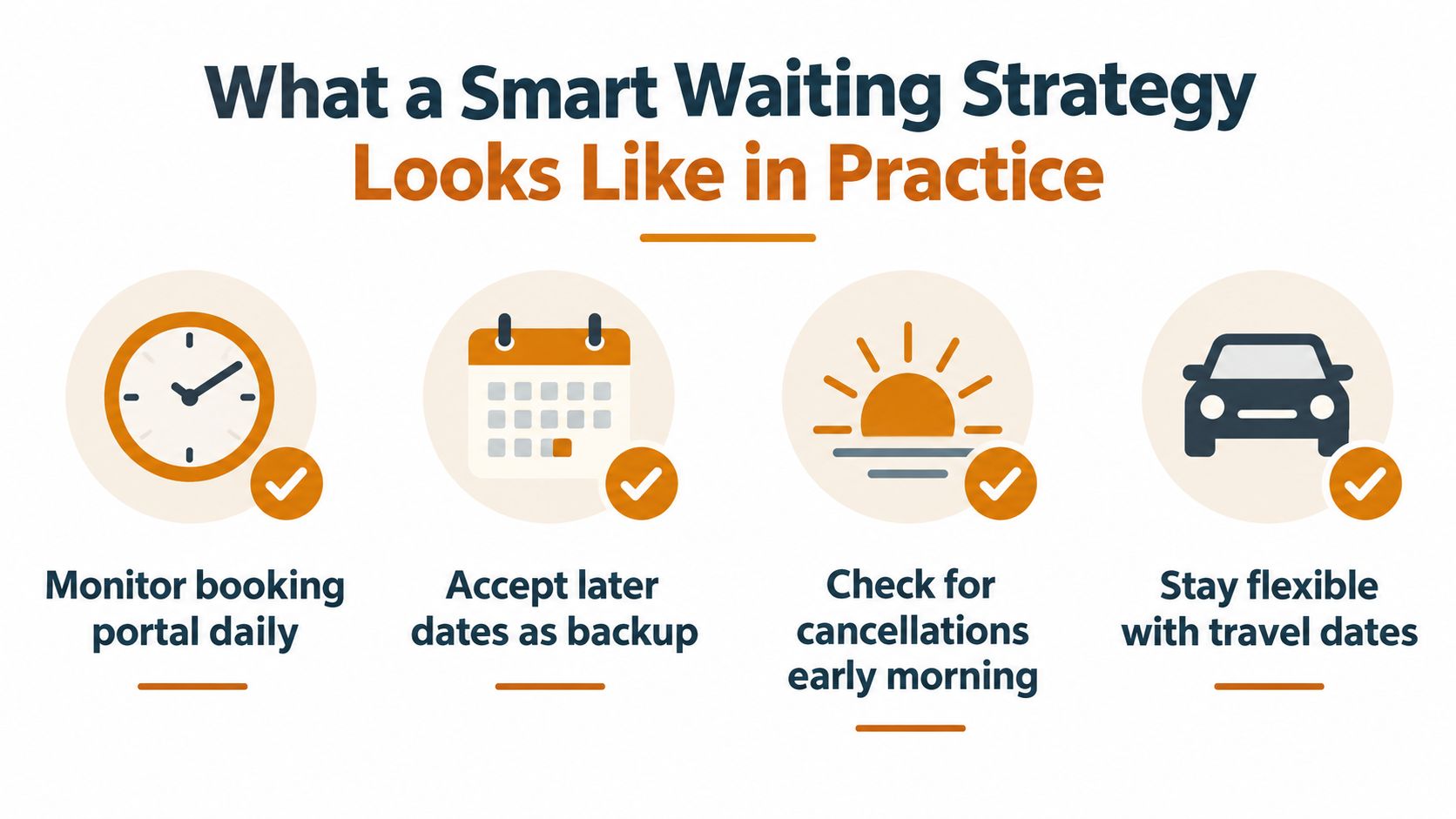
Check the official booking position when you can do so properly, rather than refreshing while distracted. If you receive an alert, pause long enough to confirm the date, centre, time and notice position. The best slot on screen is useless if you can't get the car, your instructor or the time away from work.
Make flexibility useful
Flexibility doesn't mean accepting every date. It means deciding in advance which compromises are realistic. You might accept a different weekday, adjust a lesson schedule or consider a nearby centre, but only if you've discussed the consequences with your instructor and can practise the relevant roads.
Keep a later appointment as a backup until the replacement is confirmed. Don't cancel first because someone has told you that a slot is “probably” available. The DVSA booking system is the place where you verify the appointment and complete the transaction.
Use the waiting period constructively:
- Practise independently where appropriate. Work on the faults your instructor has identified, not just familiar roads.
- Rehearse the journey to Waterhouse Lane. Knowing the final approach removes avoidable pressure.
- Review your readiness objectively. An earlier date is an opportunity only if your driving is test standard.
- Keep your diary current. A notification is easier to use when you already know which dates you can accept.
Swindon's waiting period may feel passive, but preparation gives it a purpose. Monitor for a sensible opening, protect your booking rights and make the final change yourself through DVSA. That combination is less dramatic than relying on a third party to “grab” a test, and it's much less likely to leave you with a problem you didn't anticipate.
Driving Test Cancellations monitors DVSA availability and sends notifications when earlier practical test slots appear, including Swindon, so you can check the details and rebook directly through DVSA. If you want less manual refreshing while keeping control of the booking, visit Driving Test Cancellations and choose the centres and dates that work for you.