You've booked a practical test, told your instructor the date, and then discovered that the next suitable appointment is weeks away. You keep checking the DVSA website, but every earlier slot disappears before you can use it. That's frustrating, but it isn't random. There's a workable method for finding an earlier driving test date, provided you understand how the booking system works and stay within the rules.
Table of Contents
- Why You Are Still Waiting for Your Driving Test
- Choosing the Right Test Centre to Cut Wait Time
- Using Monitoring Services Instead of Manual Refreshing
- Understanding the Rules of Changing or Cancelling
- Timing Your Search for Maximum Success
Why You Are Still Waiting for Your Driving Test
You book the first available test at a busy centre and feel relieved to have a date. Then a cancellation appears, several learners check at once, and the appointment disappears before you can select it. That result is predictable. The system has no hidden queue that you have failed to join.
The DVSA doesn't operate a waiting list or cancellation list at most centres. Earlier tests appear when another learner changes or cancels a booking, or when DVSA adds examiner capacity. Your official option is to monitor the DVSA guidance on finding earlier driving tests and rebook through the booking service yourself.
The backlog explains the speed of the competition. The National Audit Office reported that DVSA estimated it could not provide 1.1 million driving tests because of the COVID-19 pandemic. By September 2025, around 400,000 bookings still represented backlog demand, while approximately 360,000 tests had yet to re-enter the booking system. The average wait for a car practical test in Great Britain was 22 weeks, compared with just over five weeks in February 2020, and 70% of the 240 permanent test centres had reached the 24-week maximum. For the regional picture, use our guide to current driving test waiting times. With roughly 360,000 tests still waiting to return, earlier appointments are contested within minutes, so passive checking rarely works. These figures come from the National Audit Office investigation into car driving test waiting times.
What changed after the 2026 crackdown
The 2026 reforms tightened controls against slot hoarding, resale and unofficial booking methods. DVSA said closing unofficial channels was expected to increase the median wait. Advice based on bots, resale groups or another person managing your booking is outdated and puts the booking at risk.
You must control the appointment yourself. An instructor, parent or friend may advise you, but they cannot change, cancel or swap the test on your behalf. The official booking service operates from 6:00am to 11:40pm, and new appointments may be released up to 24 weeks ahead. Use active monitoring, consider suitable alternative centres, and rebook manually as soon as a workable slot appears.
Practical rule: Book a test you can realistically attend, then search for an earlier one. Keep your current appointment until the replacement is confirmed.
Choosing the Right Test Centre to Cut Wait Time
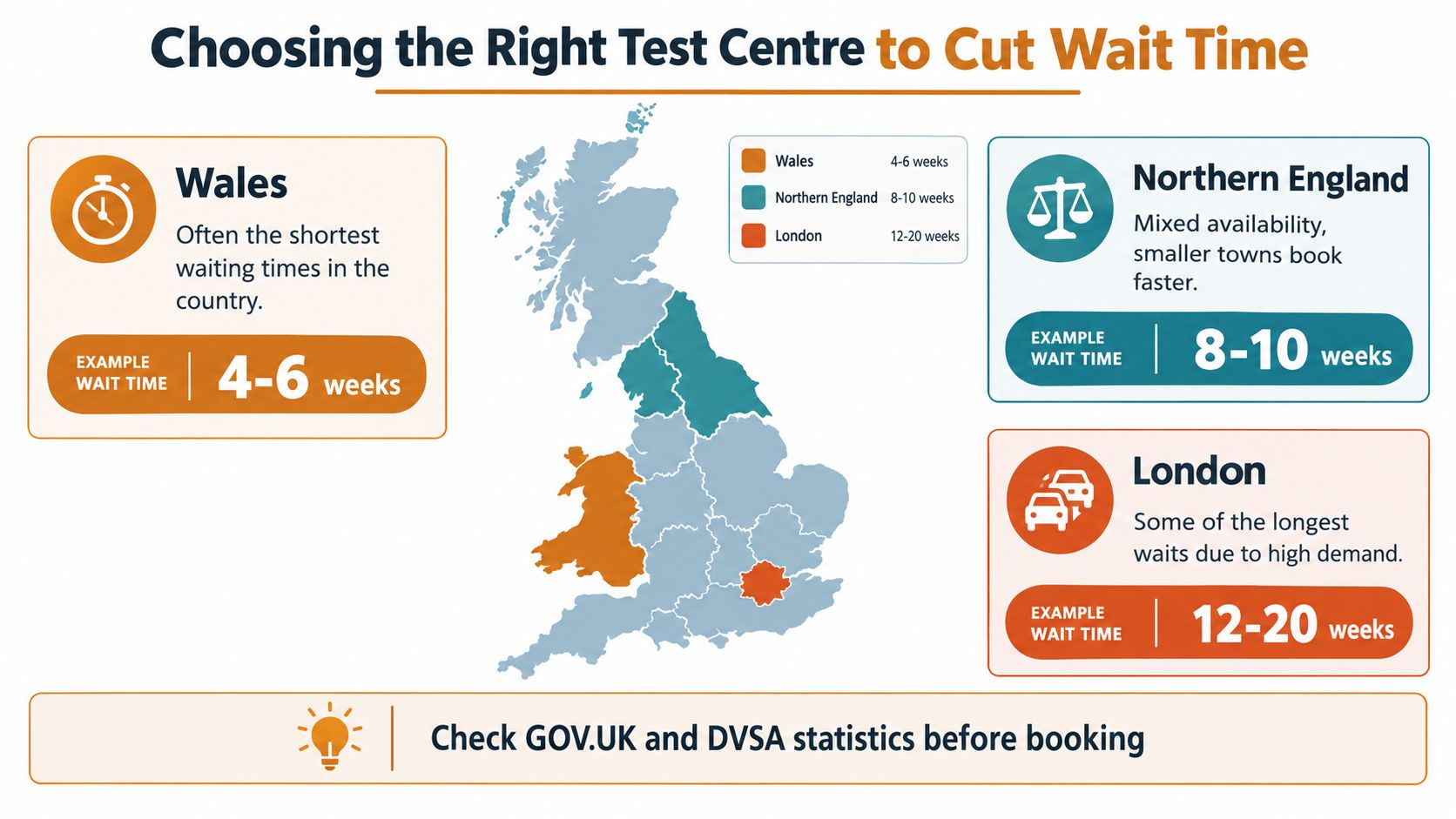
Your choice of centre often matters more than the time of day you search. A learner who checks only one pressured centre may wait far longer than someone prepared to travel to a nearby location with better availability.
The regional differences are substantial. Late-2024 data reported waits of nearly 21 weeks in England, over 15 weeks in Scotland and 13 weeks in Wales, according to DVSA and GOV.UK waiting-time reporting covered by the BBC. More recent figures showed a Great Britain median booking-to-test wait of 11.1 weeks, while London was at 14.7 weeks and the North West at 12.7 weeks. Scotland averaged 15.6 weeks, whereas Wales was at 7.6 weeks.
Compare centres using the right measure
Don't treat a centre's headline waiting time as a promise. DVSA explains that this figure is the point at which at least 10% of weekly appointments remain available, not a straightforward average of every learner's wait. The median booking-to-test figure is separate and often gives a better indication of what completed tests looked like.
Use the data as a screening tool, then check the route and test conditions before committing. A centre with a shorter published wait may involve a long journey, unfamiliar roads or extra lessons. Saving weeks isn't useful if you're underprepared or can't get to the appointment reliably.
Start with your local centre, then add nearby alternatives. Consider:
- Travel time: Include the journey for lessons, not just the test itself.
- Road familiarity: Ask your instructor whether you've practised the centre's typical routes and manoeuvre locations.
- Instructor availability: An earlier date is worthless if your instructor can't take you.
- Search coverage: Monitor several suitable centres instead of relying on one postcode.
The regional evidence supports widening the search. In August 2026, 29.8% of tests took more than 21 weeks after booking, so an earlier opportunity can be valuable when it appears. At the same time, a shorter regional wait doesn't remove the need to prepare for the specific centre.
A good decision is usually a compromise. Choose two or three centres within a journey you can manage, make sure your instructor agrees, and monitor all of them. Don't chase the shortest number on a spreadsheet if the practical arrangements make the test harder.
Using Monitoring Services Instead of Manual Refreshing
Manual refreshing works, but it demands attention at exactly the wrong moments. A cancellation may appear while you're working, travelling, sleeping or taking a lesson. By the time you open the DVSA site, the appointment may have disappeared.
A monitoring service watches the booking system and alerts you when an earlier slot matches your selected centres and preferences. The alert doesn't replace the DVSA booking process. You still need to open the official service, verify the appointment and complete the change yourself.
Set up the search properly
The quality of the result depends on the choices you make before monitoring starts. Keep your current booking active, enter accurate booking details, and select only centres you can reach.
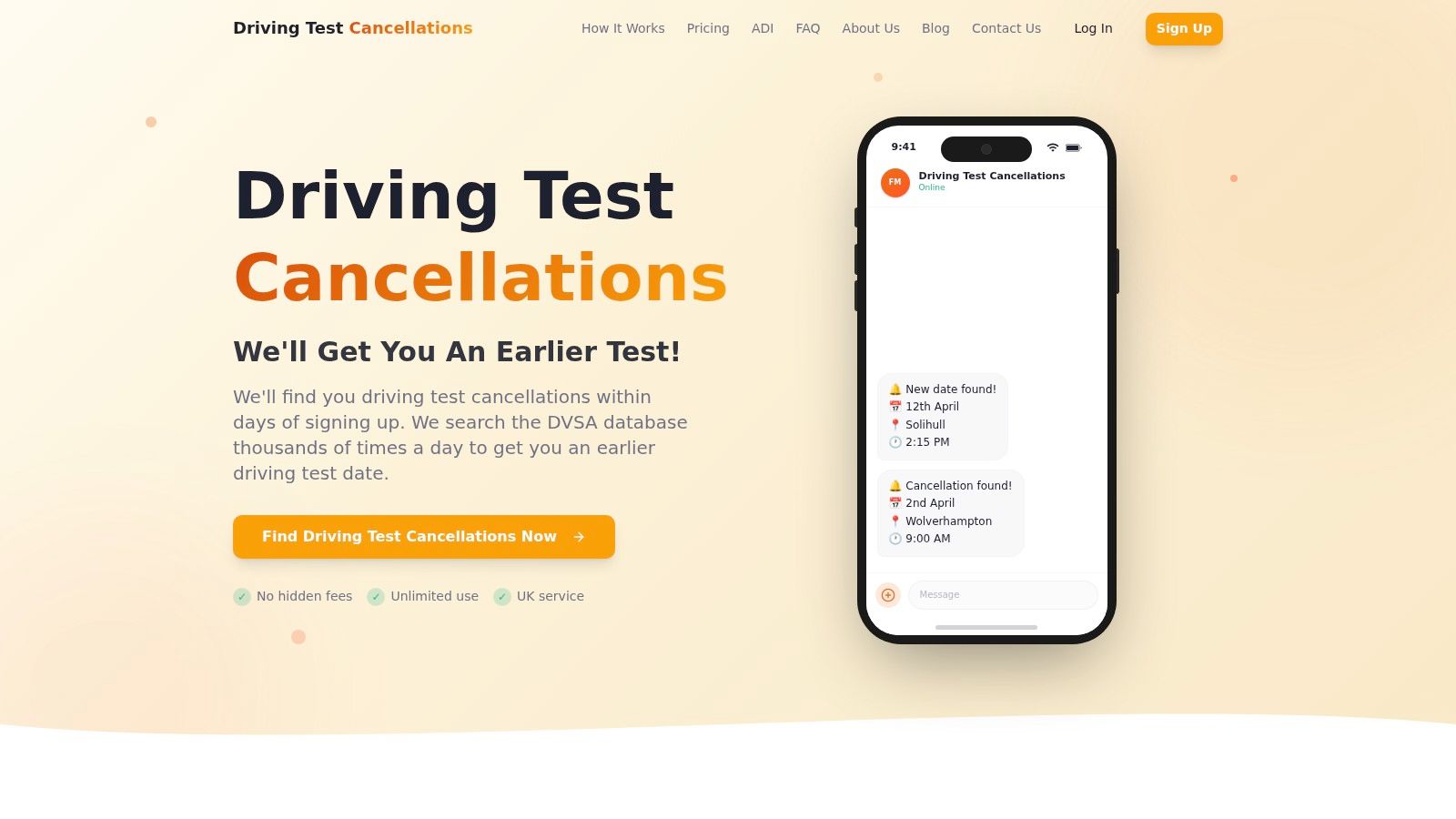
Driving Test Cancellations is a UK-focused example. It monitors DVSA practical-test availability across selected centres, sends SMS notifications with the appointment details, and allows users to monitor up to three preferred test centres simultaneously, according to the publisher's service information. It also provides an ADI dashboard for instructors coordinating multiple pupils. The service provides alerts, not an initial test booking, and the candidate completes the rebooking through DVSA.
You can also use a free trial that sends sample cancellation alerts before deciding whether to purchase. Paid access is described as offering unlimited alerts and a money-back guarantee if no cancellations are found within the stated initial period. Check the service's current terms before paying, because features and pricing can change.
The process is straightforward:
- Keep your existing test: Don't give up a confirmed date while searching.
- Choose realistic centres: Include alternatives only if you can practise and attend there.
- Set your availability: A narrow time preference reduces the number of alerts you can use.
- Respond immediately: Open the official DVSA booking service as soon as an alert arrives.
- Check every detail: Confirm the centre, date, time and your instructor's availability before finalising the change.
Here's a short visual explanation of the monitoring approach:
Alerts don't guarantee that you'll secure every appointment. Someone else may take it first, or the slot may not suit your training. They do remove the biggest weakness in manual searching, which is having to check continuously. For more detail on this approach, see the guide to using a free driving-test cancellation app.
Understanding the Rules of Changing or Cancelling
You spot an earlier slot, click through too quickly and then discover that your instructor cannot attend. That mistake can cost your booking security, your fee or one of your permitted changes. Check the rules before accepting a new appointment.
Only the candidate can change, cancel or swap their own car test. Your instructor can advise you, check a route or assess whether the date is workable, but cannot make the change for you. GOV.UK also states that booking a car driving test for someone else is against the law.
The two-change limit
Under the 2026 rules, you can change your driving test date or location twice. After the second change, you must cancel and book again if you need another change. Read the GOV.UK guidance on the 2026 driving-test booking rules before acting, especially if you have already moved the appointment.
If you have used one change, read our guide to the practice driving test change process before making another move. Treat every change as a decision, not a temporary experiment. Moving repeatedly between centres can use both changes without producing a date you can attend.
Cancelling and making a fresh booking resets the change limit, but cancellation removes the security of your current appointment. Keep that trade-off clear before you release a confirmed slot.
Protect the test fee
For a full refund, cancel a car test at least 10 full working days before the appointment. Other car-test fee-loss situations retain a 3 full working day notice rule, so cancellation outcomes depend on the circumstances. Monday to Saturday count as working days, while Sundays and public holidays do not.
The online service for changes and cancellations runs from 6:00am to 11:40pm. If an unavoidable issue forces you to cancel at short notice, DVSA may request evidence, such as a school exam letter, police crime number or medical proof. The official cancellation guidance explains what evidence may be accepted.
Don't gamble with your booking: An alert is an opportunity, not an instruction to click immediately. Check the notice period, change count and instructor's diary first.
If your theory pass is nearing expiry, include that deadline in your plan. A theory-test pass certificate lasts 2 years, so you must pass the practical test before it expires or take the theory test again. The GOV.UK theory-test cancellation rules also require at least 3 full working days' notice to change or cancel a theory appointment without losing the fee.
Timing Your Search for Maximum Success
There isn't a magic daily release that guarantees an earlier test. DVSA says earlier appointments can appear when candidates cancel or change bookings, and those cancellations can happen throughout the week. Search strategy should therefore combine timing with coverage, rather than relying on one rumoured release hour.
Start monitoring before you need the date. If your theory certificate is nearing its expiry, or your instructor has limited availability, waiting until the final stretch leaves you with fewer workable options. Keep the existing test while you search and decide in advance which centres, days and travel distances you'll accept.
Use a wider search window
A flexible learner has a real advantage. You may not be able to accept every opening, but being willing to travel, test at different times or use more than one centre gives you more chances to find a suitable cancellation.
Create a simple priority order:
- First choice: Your local centre at a time your instructor can attend.
- Second choice: A nearby centre with a manageable route and enough practice time.
- Third choice: A farther centre only if the earlier date justifies the travel and preparation.
Don't select a centre solely because its headline waiting time looks low. Compare the DVSA availability measure with the median where data is available, then ask whether you can practise there. The distinction matters because the headline measure shows when at least 10% of appointments remain available, while the median records the middle booking-to-test experience for completed tests.
Be ready when an alert arrives
An alert is useful only if you can act. Keep your booking reference, driving licence details and instructor's contact information accessible. Agree in advance how quickly your instructor can confirm a slot, but remember that you, not the instructor, must complete the change.
When a notification arrives, use this sequence:
- Open the DVSA service immediately.
- Confirm the appointment is still available.
- Check the centre, date and time.
- Ask yourself whether you can reach the centre and prepare properly.
- Complete the change within the official system.
- Save the confirmation and tell your instructor.
Don't use a cancellation alert as permission to ignore the 2026 rules. Third-party services that notify you are different from services that attempt to book, change, cancel or swap appointments for you. DVSA's stated position is that the candidate must manage the booking, so avoid anything that asks for control of your account or claims it can bypass the official process.
Put timing and geography together
The strongest practical plan is simple. Pick several realistic centres, monitor them continuously or check manually when you can, and respond quickly to suitable openings. A learner who checks one centre occasionally is competing with chance. A learner who monitors several centres and has an agreed rebooking plan is making the odds work harder.
The latest figures also show why you shouldn't judge the situation from one number. Between late March and late July 2026, the proportion of appointments still available to book rose from 7.7% to 11.8%, while the median wait increased to 11.1 weeks, according to DVSA's update for driving instructors at Despatch. More availability doesn't automatically mean a shorter completed wait. Your centre choice, flexibility and speed still matter.
The working formula is: keep a valid booking, widen the centre search, monitor for cancellations and rebook yourself through GOV.UK.
Don't cancel a secure appointment for a vague promise of something sooner. Take an earlier slot only when it works with your preparation, instructor and travel arrangements. That discipline protects your money and gives you the best chance of arriving ready, rather than merely arriving early.
Driving Test Cancellations monitors DVSA practical-test availability across selected UK centres and sends alerts when earlier appointments appear, while you complete the rebooking yourself through the official service. Visit Driving Test Cancellations to review the current monitoring options and start searching more efficiently.