Your test's booked, but the date's wrong for real life. Maybe your theory certificate is getting close to expiry, your instructor can't cover that week, or the centre you've been given is miles from where you drive. In practice, a practice driving test change is often less about convenience and more about stopping the whole plan from slipping.
That pressure's been sharper in 2026 because the DVSA's official figures still show a stretched system, even after changes to improve availability. In July 2026, the DVSA said the median wait between booking and taking a practical car test in Great Britain was 11.1 weeks, while the older availability measure for the same month was 20.2 weeks. It also reported that none of the 11 separately reported regions and nations was at or below the government's seven-week target in July 2026, so this is still a nationwide problem, not just one bad centre.
If you know how to move a booking properly, you can sometimes save weeks without losing the fee. If you get it wrong, you can waste the slot, the money, or both.
Table of Contents
- Introduction Why Changing Your Practical Test Matters Now
- The Rules for Changing Your Practical Driving Test in the UK
- How to Change Your Practical Test on the DVSA System
- Understanding Waiting Times and Choosing Where to Rebook
- Finding an Earlier Date Without Constantly Checking
- Final Checks and Tips Before You Confirm Your New Test
Introduction Why Changing Your Practical Test Matters Now
A learner rings me saying the same thing in different ways. “My test's in three months, but I've got exams,” or “my instructor's fully booked for the first half of next term,” or “I'm worried my theory runs out before my practical date.” Those aren't minor admin issues. They're the exact moments when a practical driving test change stops being optional and starts becoming the only sensible move.
The DVSA's waiting-time picture explains why. In April 2026, BBC reporting based on DVSA figures said average waits were 22.7 weeks in England, 22.9 weeks in Scotland, and 17.3 weeks in Wales, and in June 2026 average waits were reported as nearly 22 weeks. By July 2026, the official DVSA median had improved to 11.1 weeks, but the older availability measure still sat at 20.2 weeks. That gap matters, because it tells you the booking system can look far better on one measure than it does when you're hunting for a workable date.
For learners, that difference shows up in real life as missed lesson cycles, extra refresher lessons, and awkward gaps between practice and test day. A change done at the right time can keep momentum. A change done too late can put you back into a long queue.
Practical rule: Don't judge your chances from the headline alone, judge them from your centre, your instructor's diary, and your theory expiry date.
That's the lens to use throughout this guide. The aim is simple: move the date without breaking the rules, and do it in a way that gives you a better chance of passing.
The Rules for Changing Your Practical Driving Test in the UK
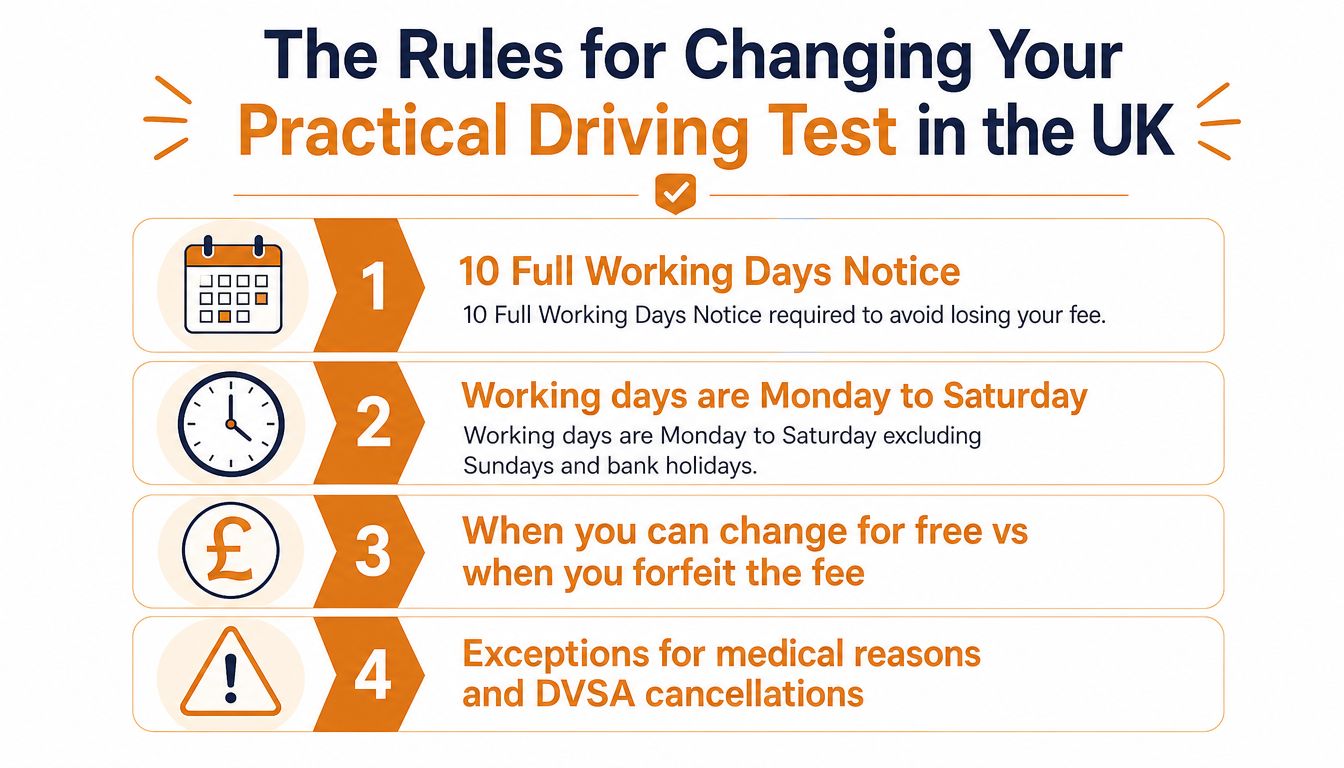
Before you touch the booking system, the notice rules need to be clear. For a car practical test in Great Britain, DVSA says you must give at least 10 full working days' notice to change or cancel without losing the fee. Monday to Saturday count as working days, while Sundays and public holidays do not. DVSA tightened this rule from 8 April 2025 to reduce wasted appointments and help cut waiting times, so the system is stricter than it used to be. The government's change notice confirms that reform on GOV.UK.
What free change means in practice
If you meet the notice window, you can usually change without paying again. If you give less notice, you normally lose the fee and have to pay again for a new booking. That's why the calendar matters more than the clock on the day you decide to move it.
There are exceptions. DVSA says short-notice refunds can be granted for specific reasons such as illness, bereavement, or a school or college exam, but you'll need evidence sent to the agency. The practical message is straightforward, if there's a genuine reason, document it quickly.
The candidate must make the cancellation themselves. An instructor can't do it for them, and for car tests it's against the law to cancel, change or swap a test for someone else.
That legal point trips people up more often than they expect. If you're helping a learner, you can advise and remind them, but the booking action itself has to come from the candidate. DVSA's cancellation guidance is here if you want the official wording on GOV.UK, and a separate cancellation-policy reference is available for comparison here.
Why the rule changed
The April 2025 reform wasn't a cosmetic update. DVSA said it introduced the new notice period to reduce wasted appointments, and that matters because every unnecessary no-show blocks a slot another learner could use. In a system already stretched by long waits, that behaviour has a direct knock-on effect.
One more detail that matters if your date is close. A learner can cancel right up until the test starts, but that doesn't mean they can escape the fee rules. The time of cancellation and the amount of notice are two different things, and they're treated differently by DVSA.
How to Change Your Practical Test on the DVSA System
The actual change process is simple enough once you're logged in, but it rewards care. Start on the DVSA booking service, sign in with the details used for the original booking, and open the current appointment. From there, you're looking for a replacement date, not a fresh booking from scratch. That distinction matters because the system is built around changing an existing test, not inventing a second one.
The safest habit is to check three things before you confirm anything. First, the new date must still leave you inside the 10 full working days notice rule if you want to protect the fee. Second, the new centre should be one you can realistically reach on test day. Third, your instructor, if you're using one, must be able to get you there for a warm-up lesson.
The GOV.UK booking and changing route is the place to work from, and this practical booking guide may help if you're also dealing with the initial setup on the learner driver centre.
The part learners get wrong
The biggest mistake is waiting until the day of the test and then trying to salvage the situation. Yes, DVSA says a learner can cancel right up until the test starts, but that is not the same as being free to move it without consequences. If you're already inside the notice window, don't assume a new slot will be fee-free.
A second mistake is letting someone else try to do it. I still see learners assuming an instructor can “sort it out” for them. DVSA's position is clear, the learner must make the cancellation or change themselves for a car test.

Check the new slot before you confirm, not after. Once you've accepted a date, it's your booking, your diary, and your responsibility.
If you're changing because the test date no longer fits your life, move quickly but don't rush blindly. A convenient date at a faraway centre can be worse than a later date at your normal one if travel, nerves, or lesson timing become a problem. The best change is the one you can prepare for.
Understanding Waiting Times and Choosing Where to Rebook
The waiting-time figures can look contradictory until you know what they measure. In July 2026, DVSA's median wait for Great Britain was 11.1 weeks, but the older slot availability measure was 20.2 weeks. Those aren't competing lies, they're different ways of describing the same overloaded booking system. DVSA's own reporting explains that the monthly tables are updated on the second Wednesday and run to the end of the previous month, so you're always looking at a time-stamped snapshot, not live inventory at the official DVSA guidance page.
| Measure | What it shows | July 2026 figure |
|---|---|---|
| Median wait | The middle point between booking and taking the test in Great Britain | 11.1 weeks |
| Slot availability | The older measure of how far away the booking calendar appears | 20.2 weeks |
That table is useful because it stops you reading too much into a single headline. A national median can look manageable while the centre you want is still effectively booked solid. That's where the geography comes in.
Why centre choice matters
Regional variation was still sharp in July 2026. The DVSA-based data used by industry guidance showed medians ranging from 8.9 weeks in Wales to 14.3 weeks in the North East, with some centres still above 20 weeks. That spread creates genuine room to rebook more quickly if you can travel, even if only for the test itself as shown in the centre-level waiting-time guidance.
The cleanest approach is to monitor a few nearby centres, not just the one you originally booked. If one site is overloaded and another is lighter, you may find a workable earlier slot without waiting for a perfect local cancellation. I've seen learners gain far more by choosing the right centre than by refreshing the same page all day.
If you want a broader explanation of the national picture, this waiting-time overview is useful for context. But the working decision is still local. Your test slot is not national, it's centre-specific.
The useful question is not “Is the UK average improving?” It's “Is my centre, and the one next to it, actually worth checking today?”
Finding an Earlier Date Without Constantly Checking
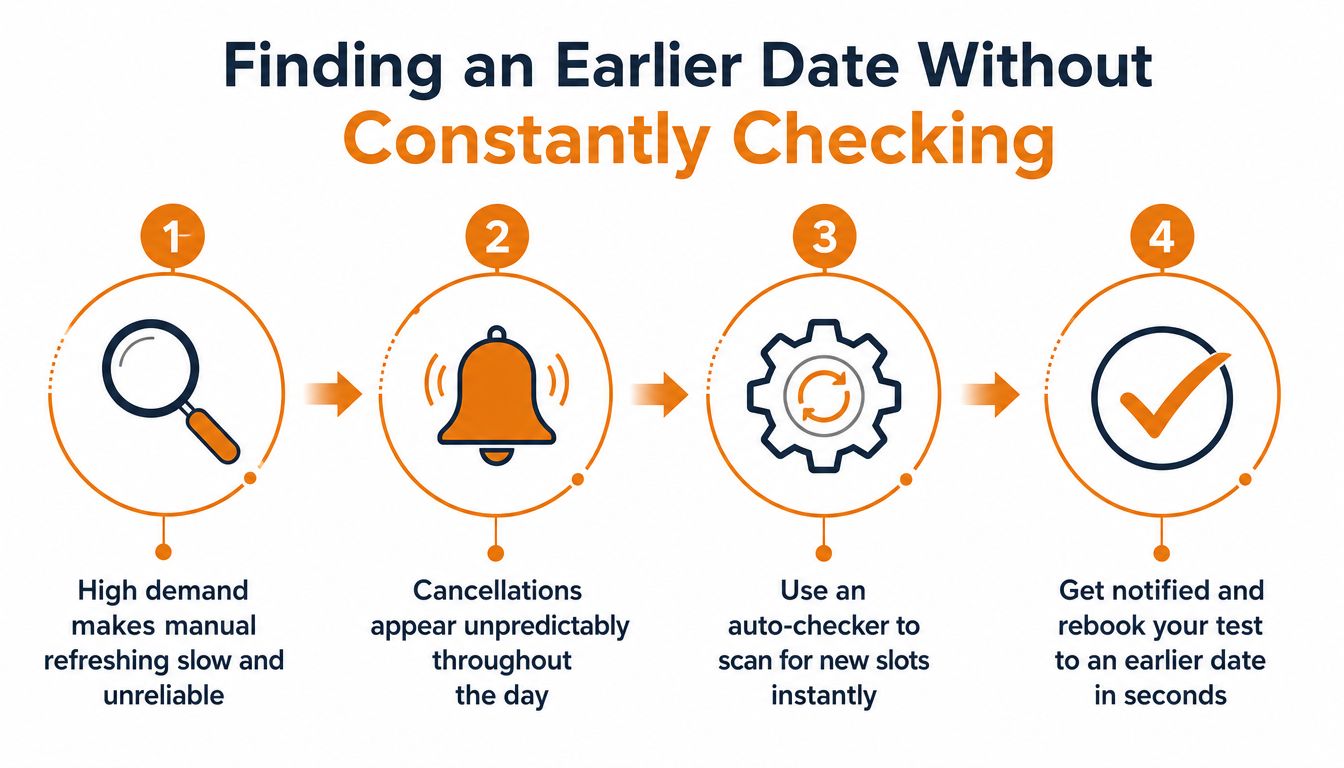
The cancellations don't appear in neat patterns. Regional reporting in August 2026 said 101,423 driving tests were cancelled between April 2025 and March 2026, down from 120,710 in 2024/25, with more than 60,000 attributed to examiner medical absences. That matters because it tells you a lot of cancellations are driven by operational disruption, not just learners shifting their own dates as reported here.
For a learner, that changes the strategy. You're not waiting for a polite, predictable release of slots. You're looking for churn, absences, short-notice gaps and changes elsewhere in the system. Manual refreshing can catch some of it, but not reliably, because the useful slots often disappear quickly.
What actually works
A better setup is simple. Monitor more than one centre, get notified quickly when a slot appears, and then move straight back into the DVSA booking service to rebook yourself. Since the notification-only model introduced in May 2026, tools can alert you to openings, but the candidate still has to complete the actual change on DVSA.
That matters for ADIs as well. If you're managing several pupils, you need a way to know which learner can use a slot before it goes. A single dashboard or alert stream can save time, but only if you treat it as a prompt to act, not as the booking itself.
Driving Test Cancellations is one example of a UK service that monitors DVSA practical-test availability and sends alerts when earlier appointments appear. I'd treat it as one option among others, not magic, because the core work still happens when the learner logs in and confirms the change.
What not to rely on
Don't build your plan around constant manual checking. It's tiring, and it's easy to miss the slot that suits you while chasing one that looks perfect. Don't assume one centre is enough either, especially if your local area is chronically busy.
The better habit is to be ready, with your details, your theory certificate date, and your instructor's availability already checked. Then the alert becomes useful instead of just noisy.
Final Checks and Tips Before You Confirm Your New Test
A changed date only helps if it still fits the rest of your timeline. The first thing I'd check is the theory test certificate, because it's valid for two years from the date you pass. If your practical test slips beyond that period, you'll have to retake the theory before you can book another practical test as explained in this 2026 theory renewal guide.
After that, line up your instructor's diary. A new date that lands when they're away, or when you can't get a proper warm-up lesson, often leads to extra stress and extra lessons. That's where learners lose money, not in the booking fee itself, but in the gaps and catch-up sessions created by poor timing.
The other sensible check is your weak points. DVSA fault data shows the most common minor faults over five years were move-off safety, maintaining progress/speed, and undue hesitation, while the top serious-fault categories were junction observation and mirror use before direction changes. So after a rebook, focus your practice on those basics rather than chasing obscure manoeuvres that rarely decide a test using the published fault data.
A good rebooking checklist is short.
- Confirm your notice window: Make sure you're still inside the DVSA free-change period if you want to protect the fee.
- Check the new centre: Only move it if you can realistically get there, with enough time to settle.
- Match the diary: Make sure your instructor, work, college, or family commitments fit the new date.
- Use the new slot well: Put your practice time into the fault areas that cost tests.
If you do those things, a practice driving test change stops being a gamble and becomes a controlled move. Rebook through DVSA, keep your paperwork straight, and use the extra time well.
If you want earlier-test alerts without sitting and refreshing the DVSA site all day, Driving Test Cancellations monitors practical test availability and sends time-stamped notifications when earlier appointments appear. Visit Driving Test Cancellations to see how it works and decide whether it fits your rebooking plan.