You can technically rebook immediately after cancelling a driving test, but you must give 10 full working days' notice to avoid losing your fee. In practice, the next available appointment is often weeks away because the DVSA booking system has limited live availability.
That difference between the theoretical answer and the practical answer catches many learners out. Cancelling a test doesn't place you in a priority queue, and it doesn't create an instant replacement appointment. You still need to find an available slot yourself, either by checking the DVSA system or responding quickly when an earlier cancellation appears.
The sensible approach is to protect your existing booking until you have found something better, unless you're close to the test date or have another urgent reason to cancel. A missed opportunity can leave you waiting far longer than expected.
Table of Contents
- The Short Answer to Rebooking Your Driving Test
- How the DVSA Booking System Actually Works
- Cancelling vs Changing Your Test Booking
- Finding and Securing an Earlier Slot
- Theory Test Expiry and Rebooking Timelines
- Different Approaches to Rebooking Which Suits You
- Common Myths About Rebooking Driving Tests
The Short Answer to Rebooking Your Driving Test
In September 2025, the average wait for a car practical test reached 22 weeks, compared with just over five weeks in February 2020. 70% of permanent test centres had reached the 24-week maximum wait, according to official DVSA booking information.
You can change an existing booking through GOV.UK, or cancel it and book another test through the official system. To change or cancel without losing your fee, you need at least 10 full working days' notice, according to the DVSA guidance on changing a driving test.
Working days run from Monday to Saturday. Sundays and public holidays do not count. For a Saturday test, count backwards through Monday to Saturday, then continue backwards while skipping Sundays and public holidays. Ten working days is not the same as two calendar weeks.
Practical rule: Check the replacement date, test centre and your instructor's availability before cancelling your current booking.
You can technically rebook as soon as the old booking is cancelled, provided the system shows an available appointment. There is no fixed cooling-off period after a normal cancellation. The restriction is appointment availability, not a required wait before using the website again.
The important distinction is between how soon you can rebook in theory and how soon you can secure a suitable test in practice. In a busy centre, you may wait several weeks unless you secure a cancellation. A replacement slot must also work for your instructor and leave enough time for preparation, so the first available appointment is not always the right one.
The two-change limit can affect your options later, which makes cancelling too early a poor strategy. Keep your existing booking until a suitable replacement is confirmed, unless you have a clear reason to give it up.
How the DVSA Booking System Actually Works
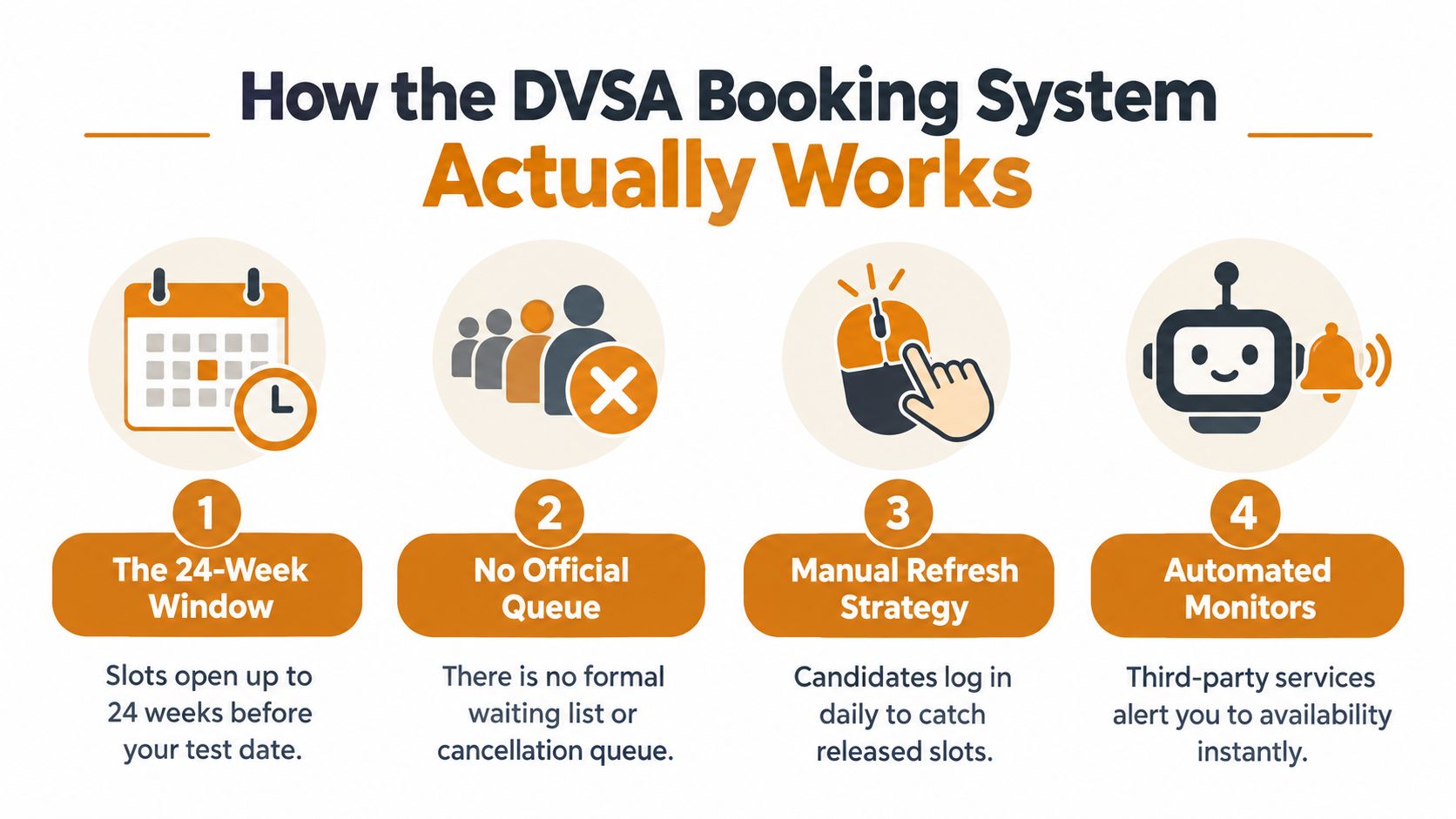
The DVSA releases practical test appointments up to 24 weeks ahead. That window is the basic rule, but it does not create a queue that moves you forward. There is no official waiting list or cancellation list. If you want an earlier test, you must check the system and change the booking yourself when a suitable appointment appears, as set out in the DVSA practical test booking guidance.
Availability is live. A cancellation may appear at your chosen test centre and disappear within moments when another learner books it. Your existing booking does not give you priority, and repeatedly checking does not reserve a slot. The learner who confirms the appointment first gets it.
The booking dashboard can also make waiting-time figures look more precise than they are for an individual learner. DVSA's reporting uses the point at which at least 10% of weekly appointments remain available, rather than the actual wait experienced by every learner. The median wait can therefore be much lower. DVSA explains the difference between these measures in its waiting-time data guidance.
Regional averages tell only part of the story
Waiting times differ by region, test centre and the appointments released that day. Regional DVSA reporting shows why a learner in Wales may see a different opportunity from someone searching in England or Scotland, but regional figures cannot predict the next slot at your local centre. Use the regional DVSA waiting-time reporting for context, not as a promise of your personal rebooking date.
The practical gap is often wide. The system may let you rebook immediately after cancelling, yet a suitable appointment may not appear for weeks. An available slot must also work with your instructor, travel plans and preparation level. The first appointment shown is not automatically the right one.
For a clearer explanation of the booking process, see this DVSA booking system guide for learners. Keep your current test until a workable replacement is confirmed. That approach protects your position while you search the live calendar.
Cancelling vs Changing Your Test Booking
Changing a booking and cancelling a booking aren't interchangeable in practical terms. A change keeps your test appointment within the official booking process, while cancellation removes the appointment and leaves you responsible for finding a replacement.
Suppose your test is several weeks away and you spot an earlier slot at the same centre. Use the official change process if it suits your timetable. If the system won't show a suitable replacement, don't cancel casually. You may lose the original appointment without securing anything better.
The fee protection rule is straightforward. You need 10 full working days' notice to change or cancel without losing the fee, with Monday to Saturday counted as working days and Sundays and public holidays excluded. If you cancel too late, you can end up with no test appointment and no fee refund, so check the calendar carefully before confirming.
A failed test has a separate minimum booking rule. GOV.UK says your new practical test date must be at least 10 working days after the failed test, as set out in the official driving test guidance. That isn't the same as a normal cancellation, where there isn't a fixed post-cancellation cooling-off period. The appointment still has to be available, and any applicable notice rules still matter.
The two-change limit
The 2026 booking rules allow a learner to make only two changes to an existing driving test booking. After using both changes, you need to cancel the test and make a new booking, while retaining the full refund entitlement if you cancel with at least 10 full working days' notice. The 2026 DVSA booking-rule update sets out those limits.
A common mistake is using both changes for minor timetable adjustments, then discovering that a better date or centre requires a complete cancellation and rebooking. Decide what you need before changing the appointment. You also can't assume that moving to another test centre is an informal swap. Follow the official process and don't share your licence details with another learner to arrange a private exchange.
Finding and Securing an Earlier Slot
If you need an earlier test, treat the search like a time-sensitive booking task. Keep your existing appointment while you look, check the centres you can travel to, and make sure your instructor can attend before accepting a slot.


Manual checking costs nothing, but it demands persistence. Log in through the DVSA website, search your chosen centres and check repeatedly rather than assuming one search gives you the full picture. A slot can be unsuitable because of the date, time, centre or your instructor's diary, so decide your acceptable options before you start.
Choose your search method
- Manual checking: Best if you have a flexible schedule and can check regularly. Keep your booking reference available and avoid cancelling the original test merely because you want to search.
- Automated alerts: Useful when you can't keep refreshing the booking system. Look for SMS notifications that include the date, time and centre, support for several preferred centres, and a clear process that leaves you to book directly with DVSA.
- Instructor support: An Approved Driving Instructor may be able to monitor several pupils through an instructor dashboard, but the learner still needs to follow the current booking rules and confirm the appointment works.
A notification service should alert you, not take control of your DVSA account. Be wary of anyone promising to book, change or swap the test on your behalf. The safer model is notification only, followed by manual booking by you through the official DVSA website. Guidance on finding practical test cancellations can help you compare manual searching with alerts.
If you're in a last-minute panic, widen your search only as far as you can realistically travel and ask your instructor about availability before accepting anything. If you have months before your current test, start monitoring early and protect the booking you already hold.
This video shows the kind of booking pressure learners face and why speed matters when a suitable cancellation appears:
Theory Test Expiry and Rebooking Timelines
Your practical test must take place before your theory test expires. That deadline matters as much as the availability of appointments at your chosen test centre.
Check the expiry date before cancelling or changing your booking. If the replacement appointment falls after that date, rebooking does not solve the problem. You must meet the theory requirement again before taking the practical test, creating another delay and another booking task.
The two-change limit makes poor timing more costly. Use one change to move to a workable appointment, not to chase every tempting slot. Before cancelling, ask three questions: can you find a date before your theory expires, can you reach the test centre, and is your instructor available? A date that fits only one of those conditions is not a usable replacement.
For example, if your theory expires in 12 weeks, calculate the remaining booking window before you give up your current appointment. As noted earlier, the general waiting time can be longer than your personal deadline. The key issue is whether a suitable test is available in time, not whether the system shows any appointment at all.
A practical test booking is only useful if your theory result is still valid when you sit it.
Leave a sensible buffer before expiry. A booking close to the deadline gives you little protection if the appointment disappears, needs changing, or becomes unsuitable. It also leaves no room for an unexpected problem with your car, instructor, or travel arrangements.
Put the theory expiry date in your calendar and tell your instructor. If the deadline is approaching, search more than one acceptable centre, but only choose locations you can realistically reach. If you need to arrange the theory requirement again, follow the theory test cancellation checker guidance and plan that appointment before making another practical booking.
Different Approaches to Rebooking Which Suits You
There isn't one correct rebooking method. The right choice depends on your flexibility, your theory expiry date, your instructor's diary and how much time you can spend searching.
| Approach | Best suited to | Main drawback |
|---|---|---|
| Keep the existing test | Learners happy with the current date | You may wait longer than necessary |
| Manual checking | Flexible learners who can search regularly | You must be available when a slot appears |
| Alert service | Learners who need faster notice without constant refreshing | You must check the service's rules and pricing |
| Cancel and start again | Learners with a strong alternative plan | You risk losing a secure appointment |
Keeping your current test is the safest option when the date works and your theory expiry isn't close. There is no reward for changing just because an appointment might appear later. Your existing slot is a known quantity.
Manual checking suits someone who can take lessons at different times and travel to more than one centre. It doesn't suit a learner who works fixed shifts and needs a narrow test window. An alert service can reduce the time spent checking, but it won't remove the need to act quickly or confirm the appointment yourself.
An ADI managing several pupils has a different problem. The issue isn't only finding an appointment. It's matching several dates with lesson progress, car availability and the instructor's working day. A service with multiple-centre monitoring and an ADI dashboard may be more practical than separate manual searches, provided it only sends alerts and doesn't make bookings for pupils.
If your theory expiry is approaching, prioritise the search immediately and widen the acceptable centres if you can. If you have plenty of buffer and a fixed instructor schedule, keep the existing booking and search cautiously. My recommendation is simple: protect a workable test date, monitor for improvements, and cancel only when you understand exactly what you could lose.
Common Myths About Rebooking Driving Tests
Myth: There's a secret DVSA cancellation list.
There is no formal queue that moves you forward automatically. You must find an available appointment and change the booking yourself. The live system determines what you can secure, so checking at the right time matters more than waiting for an invitation.
Myth: You can cancel and rebook the same day for free.
You can make a new booking after cancelling, but fee protection depends on giving at least 10 full working days' notice. Monday to Saturday count as working days, while Sundays and public holidays do not. Check the DVSA change and cancellation rules before giving up a confirmed slot.
Myth: Every test centre has the same wait.
Regional averages are a poor basis for your decision. Waiting times can vary sharply between nearby centres, and each centre may offer different dates. Check the dashboard for the specific centres you can reach, then include travel time, your instructor's availability and your car arrangements. The regional waiting-time reporting illustrates why broad averages cannot predict your appointment.
Myth: An alert service automatically breaks DVSA rules.
A notification-only service can tell you about an opening while you complete the booking yourself. Avoid any service that claims to book, change or swap appointments for you. Confirm what it does before sharing your details.
Myth: You can keep changing until you find the perfect date.
The booking system limits how many times you can change an appointment. Use those changes carefully. A theoretically earlier slot is useless if it clashes with your instructor, car or travel plans.
Myth: Theory expiry does not affect practical rebooking.
It does. Your new practical test must fall within the theory certificate's validity. Check the expiry date before cancelling, because a long local wait can leave you unable to book another practical test.
Myth: The headline waiting-time figure is your personal wait.
It is a broad availability measure, not a promise for your centre. The DVSA waiting-time update explains the distinction. Judge the practical choice using your centre, deadline and support available.
Driving Test Cancellations monitors DVSA availability and sends time-stamped SMS alerts. You still rebook directly yourself.