You've booked the earliest practical test you could find, but it's still months away. Your theory certificate is edging towards expiry, your instructor's diary is filling up, and every few days you hear that somebody else has found a cancellation. In 2026, finding an earlier test is still possible, but the old idea of swapping endlessly between any centre in the country no longer reflects the DVSA booking system.
Cancellations for practical driving test appointments work best when you treat them as compliant monitoring, not a promise of an instant test. You need a suitable centre, a realistic date, an available instructor and enough time to react before another learner takes the slot.
Table of Contents
- Why Cancellations Are Your Best Route to an Earlier Test
- DVSA Rules You Must Follow When Rebooking
- Manual Checks Versus Automated Cancellation Alerts
- What to Do the Moment an Earlier Slot Appears
- Timing and Centre Tactics That Improve Your Chances
- Choosing the Right Approach and Avoiding Costly Mistakes
Why Cancellations Are Your Best Route to an Earlier Test
A learner might book a test in late summer, discover that the next suitable date is far away, then face a difficult choice. They can keep preparing and wait, risk losing momentum, or monitor the system for an appointment that another candidate releases. That last option is often the most practical route, because a cancelled or changed booking can return to the DVSA system as an earlier opportunity.
The scale of the queue explains why a cancellation can matter. In Great Britain, the average waiting time to secure a car practical driving test reached 22 weeks in September 2025, compared with just over five weeks in February 2020, according to the National Audit Office investigation into car driving test waiting times. Of the 240 permanent test centres, only 73 had waiting times below 24 weeks, while 83% were in the 19 to 24-week band.
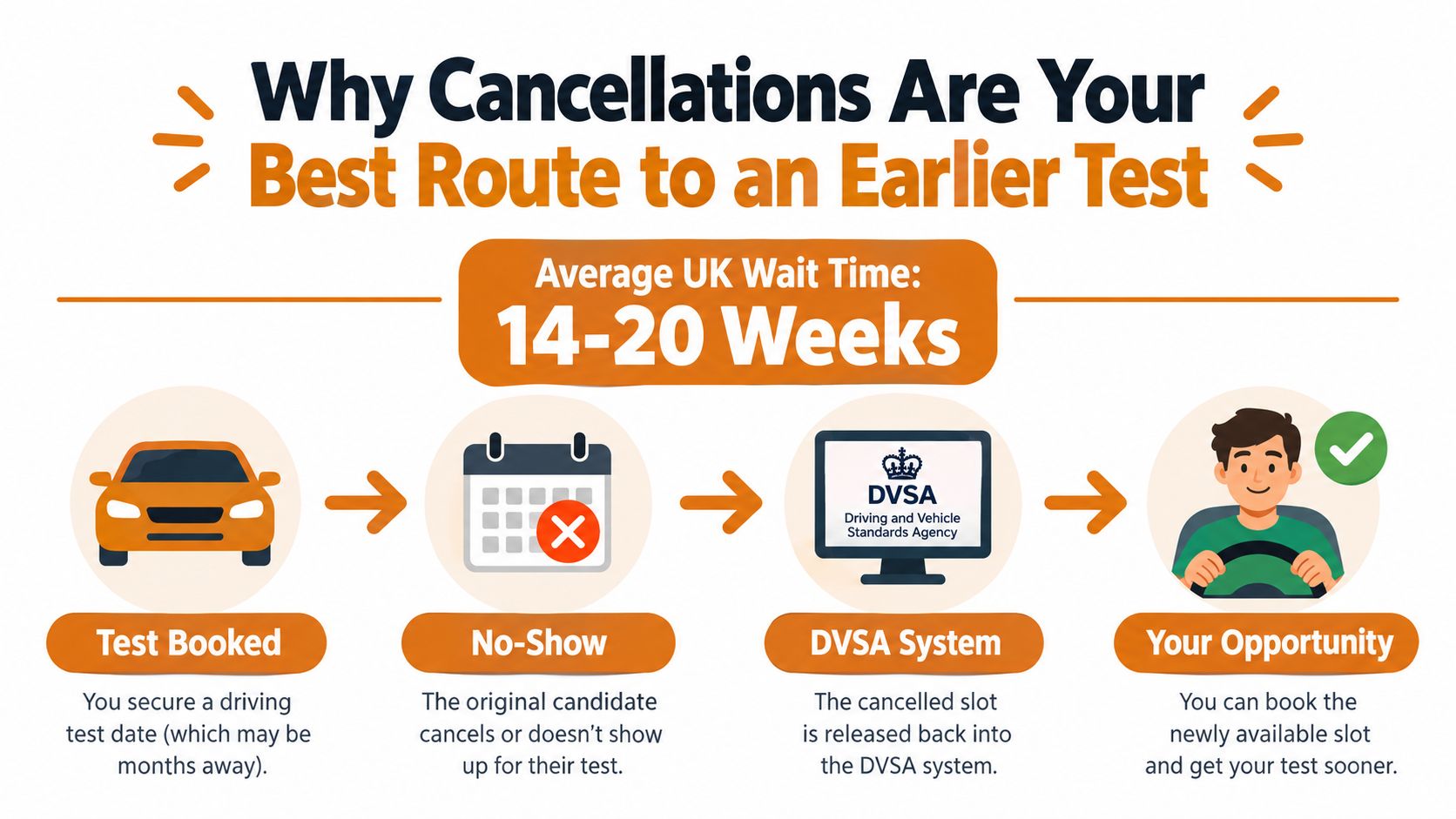
That means “earlier” usually means weeks saved, not a test tomorrow. A learner who finds a date several weeks before the original booking gains more than convenience. They may avoid a theory certificate deadline, keep lessons aligned with the test, or fit the appointment around work and college.
The National Audit Office also recorded that DVSA lost 257,662 tests in 2024–25, equivalent to 13% of the 1.96 million tests provided. Learners cancelled 84,901 of those tests through the booking system, so released appointments are a material part of how availability re-enters the pipeline.
A cancellation is an opportunity, not a guarantee
Regional and centre-level variation still matters. An alert for a distant centre may be useless if your instructor can't take you there, and a date that looks earlier may leave too little time to prepare. The practical question isn't, “Can I find a slot?” It's, “Can I accept this slot without creating a new problem?”
A sensible monitoring setup starts with the centres you can use, then keeps your existing booking until a replacement is confirmed. The Driving Test Cancellations guide to how the service works explains that distinction clearly. You're looking for a workable improvement within the DVSA rules, not chasing every appointment displayed online.
DVSA Rules You Must Follow When Rebooking
The 2026 rules make preparation more important because each change has consequences. GOV.UK says learners can make only two changes to a driving test booking. After using both, you must cancel the test and book a new one, rather than continuing to move the same booking. The same GOV.UK guidance on changes to driving test booking rules says a full refund is available only when you cancel at least 10 full working days before the test date.
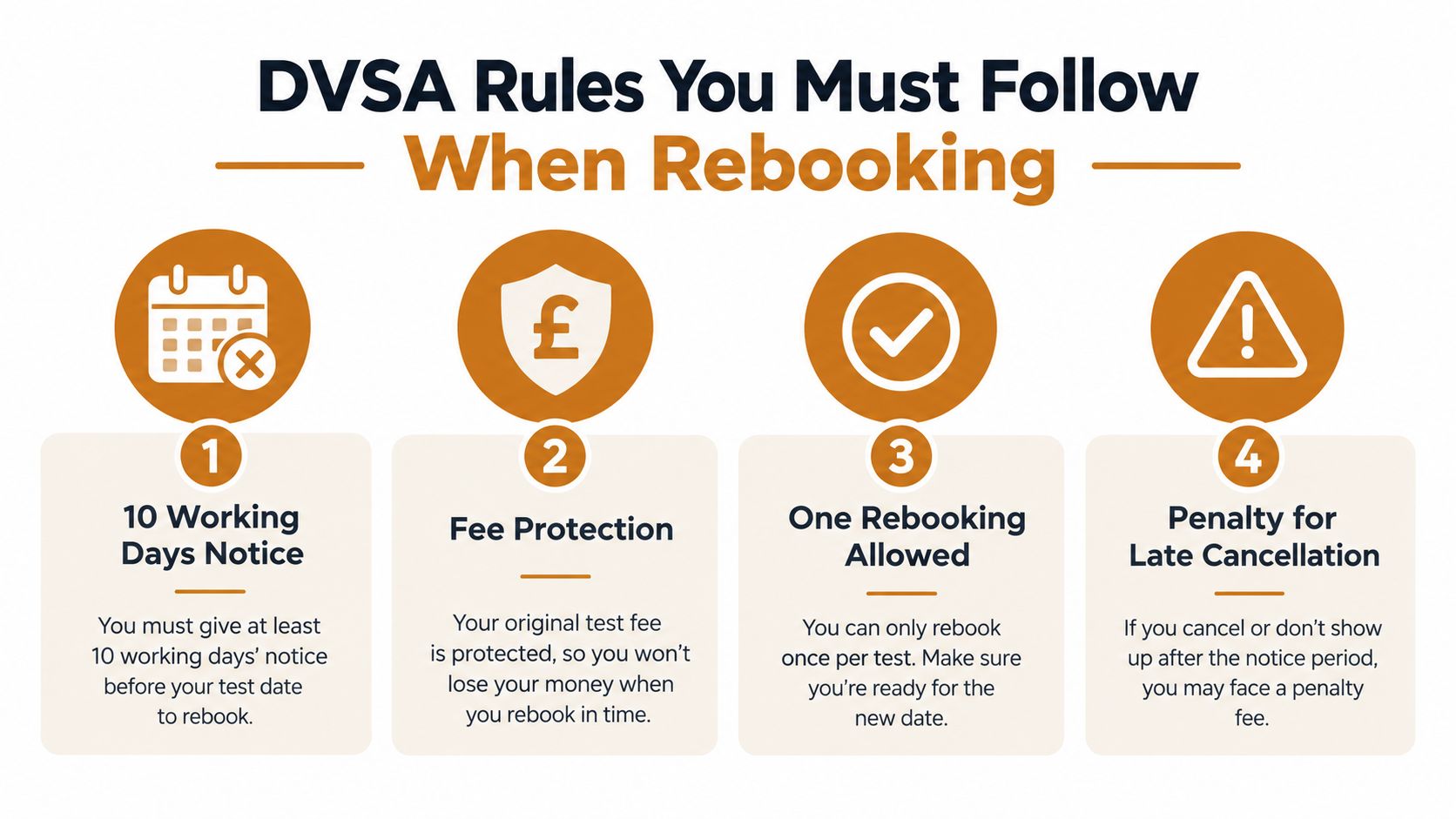
Before accepting an alert, check four things:
- The change allowance: Know whether you've used none, one or both permitted changes. Don't spend a change on a date you haven't checked properly.
- The centre restriction: From 9 June 2026, a booked test can only be moved to one of the three centres nearest to the original booking, according to the 2026 driving test waiting-time guidance. A service may show an appointment, but that doesn't mean your booking can be moved to it.
- The notice deadline: Changing or cancelling without losing the fee requires 10 working days' notice under the current rule. A late move can leave you without the original appointment and without a full refund.
- The account holder: Since 12 May 2026, unofficial services that search the DVSA system on a user's behalf are banned. A compliant notification service can alert you, but you must complete the booking change yourself through DVSA.
Practical rule: Treat every alert as a prompt to check eligibility, not as permission to click immediately.
GOV.UK also says there isn't a waiting list or cancellation list for driving tests at most centres. Earlier appointments appear when another learner cancels or changes a booking, so the normal route is to monitor availability rather than join an official queue.
Keep your booking reference, licence details and instructor's availability accessible. The rules reward learners who decide in advance which centres and times they can accept. They punish speculative swaps made in a rush.
Manual Checks Versus Automated Cancellation Alerts
Manual checking costs nothing, but it demands attention at the precise moment a suitable appointment appears. You log in, search the allowed centres, inspect the available dates and repeat the process later. That can work for a learner with flexible time, but repeated refreshing is difficult alongside lessons, work or study.
Automated alerts take a different approach. A notification-only service monitors the selected criteria and sends a time-stamped SMS when a possible match appears. You still log into DVSA, check the details and complete the change yourself. Since the 2026 restrictions, that separation is essential. The service must notify you, not book, cancel, change or swap the test on your behalf.
| Feature | Manual Checking | Automated SMS Alerts |
|---|---|---|
| Cost | No monitoring charge, although it requires your time | Usually paid after any available trial or guarantee |
| Coverage | Limited to the moments you personally check | Repeated monitoring while the service is active |
| Speed | Depends on how often you refresh and how quickly you respond | A time-stamped message gives you a prompt to act |
| Centre choice | You search within the centres permitted for your booking | You can set preferred centres, but DVSA eligibility still applies |
| Compliance | You make the booking change directly | The notification service alerts you, while you rebook through DVSA |
| Best suited to | Learners with time to check frequently | Learners with work, study, deadlines or limited online availability |
The key trade-off is time versus money. Manual checking is reasonable if your original date is acceptable and your schedule lets you monitor consistently. Alerts make more sense when an earlier date matters, especially if your instructor can only offer lessons around specific working hours.
Driving Test Cancellations is one notification-only option. It monitors DVSA availability, sends SMS details for matching slots and allows users to monitor up to three preferred centres. It doesn't provide the initial test booking, and the learner must use the DVSA website to make the change.
What automated monitoring cannot solve
No alert service can make an unsuitable centre practical, override the two-change limit or bypass the three-centre restriction. It also can't decide whether you're ready to test. An earlier appointment only helps if your instructor can support it and your driving is at test standard.
ADI dashboards can be useful for instructors managing several pupils because they put multiple monitoring tasks in one place. The learner still needs to understand the booking rules and approve the final move. A dashboard reduces administration, but it doesn't transfer responsibility for a compliant rebooking.
What to Do the Moment an Earlier Slot Appears
An alert is useful only if you can act without making a rushed mistake. GOV.UK says earlier appointments can appear whenever another learner cancels or changes a booking, and the online service is available from 6am to 11:40pm, as set out in the GOV.UK guidance on changing a driving test.
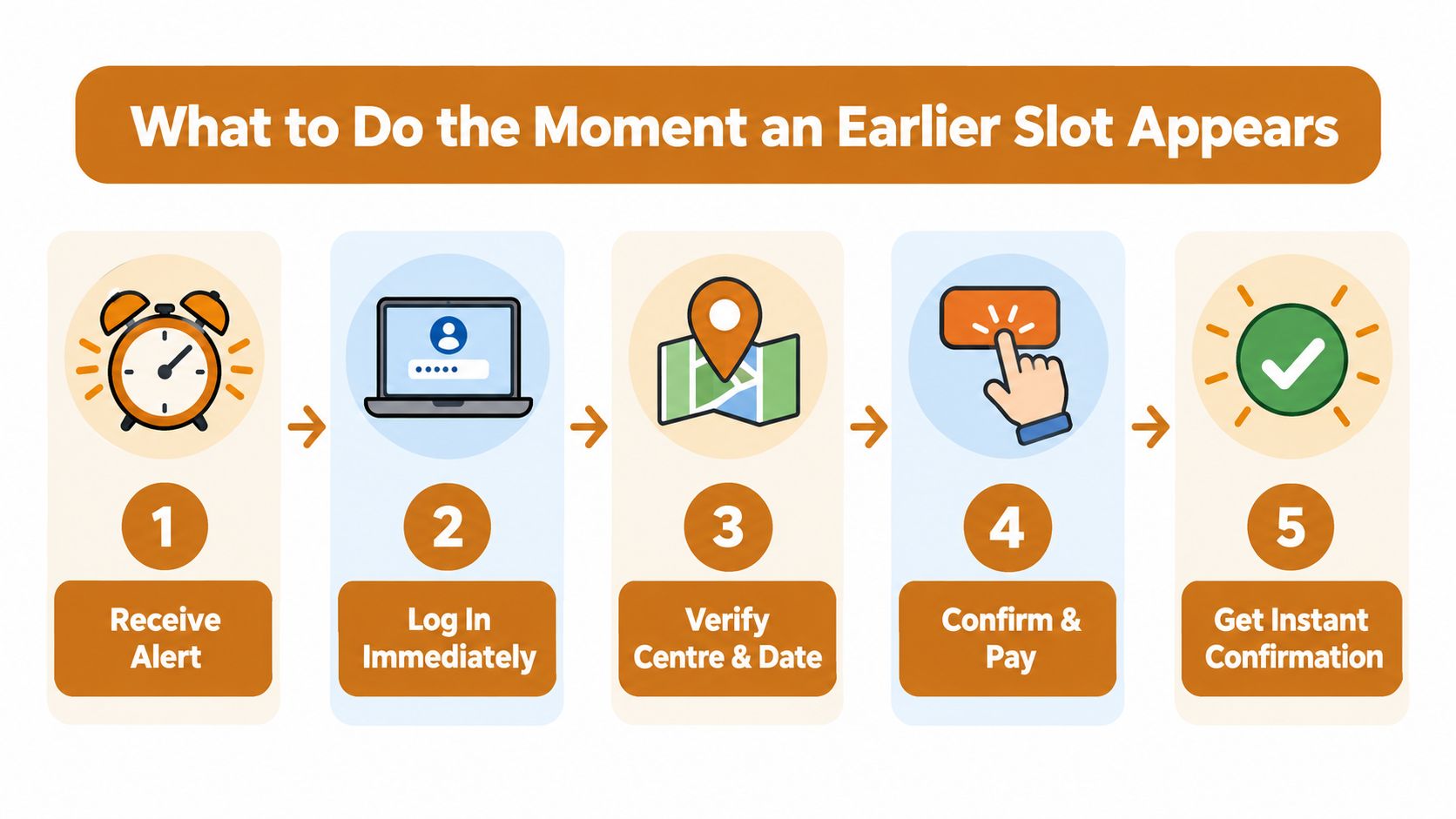
Use this sequence:
- Read the alert fully. Check the proposed date, time and centre before opening DVSA. Don't assume that “earlier” means suitable.
- Log in straight away. Go to the official DVSA booking service during its available hours. Have your booking details ready rather than searching for them after the alert arrives.
- Confirm the centre is allowed. Compare it with the three-centre restriction attached to your original booking. If it falls outside that permitted group, don't waste a change trying to force it through.
- Check your real availability. Consider your instructor, car, work, college and travel time. If your instructor can't attend, an earlier date may be a poor trade.
- Confirm the change and save the evidence. Wait for the DVSA confirmation, then record the date, time and centre in your calendar.
The learner driver guide to booking a driving test is useful to review before you start monitoring, not while a scarce appointment is on screen. The aim is to remove uncertainty before the alert arrives.
When keeping the original date is wiser
Suppose an alert offers a date three weeks earlier, but it falls during a week when your instructor is away. You might have enough time to find another instructor, but changing without confirming that support creates unnecessary risk. The same applies if the date is earlier but your preparation is incomplete.
Don't ask your instructor to approve every possible alert before you act if that means losing the slot. Agree a clear range beforehand, such as acceptable centres, days and minimum preparation time. Then you can make a decision quickly without treating every alert as an emergency.
Timing and Centre Tactics That Improve Your Chances
High-frequency monitoring matters because availability moves when learners cancel, change or fail to attend. A June 2026 BBC report said 64,500 tests were no-shows in the previous year, wasting 3.2% of all booked tests, as reported in the BBC coverage of driving test waiting times. The wider lesson is that timing and access rules matter as much as the total number of tests offered.
Choose your centres before monitoring starts. Under the current restriction, a broad national search isn't a realistic strategy for an existing booking. Pick the centres your instructor can reach, confirm the route is suitable, and rank them by preference. A slightly later appointment at a familiar centre may be more useful than an earlier one that needs unfamiliar roads and a different car.
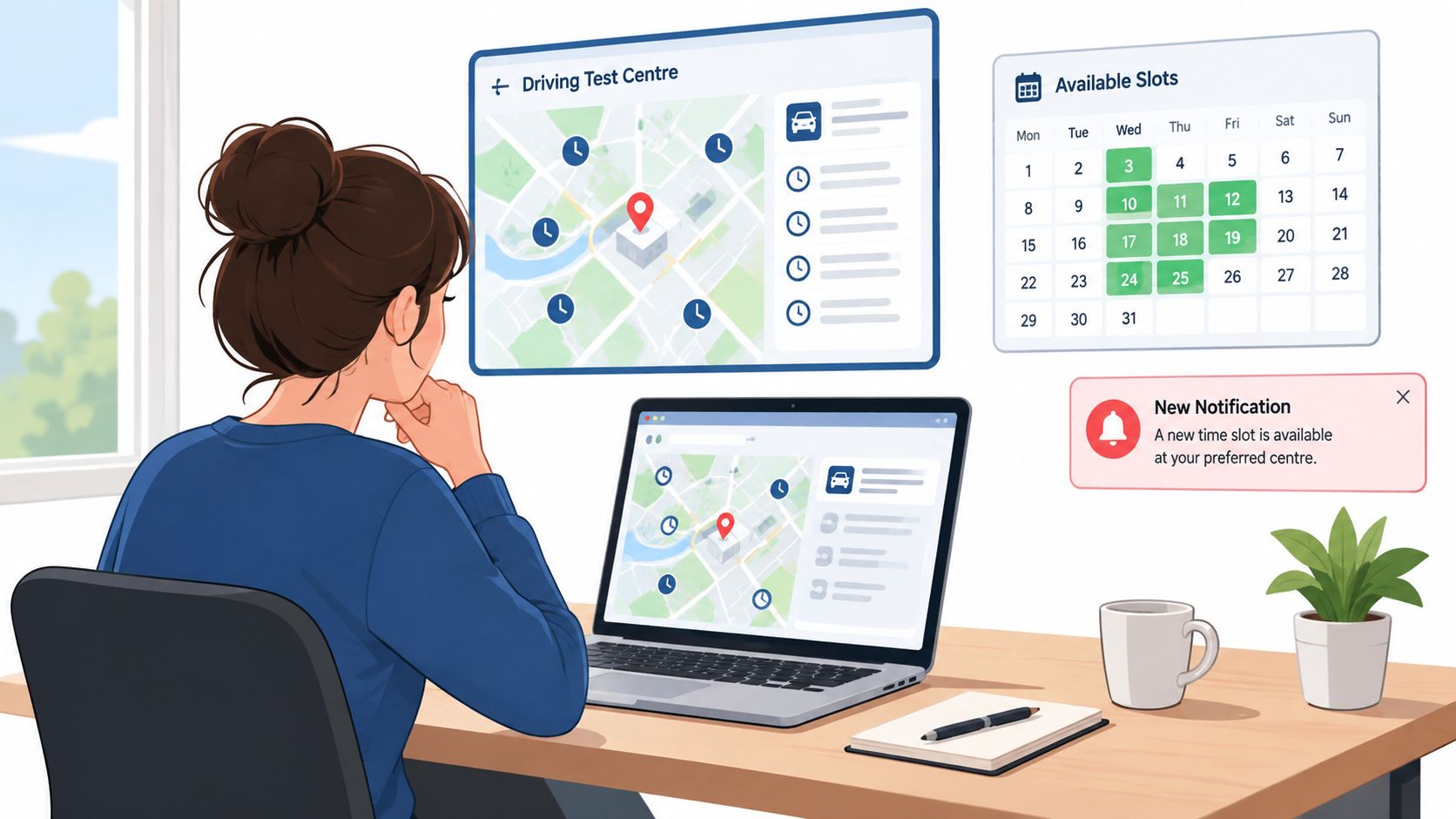
Plan around the post-booking queue
The queue isn't uniform. DVSA data for August 2026 showed a 20-week wait for the point at which at least 10% of weekly appointments remained available, while the median period between booking and taking the test was 11.1 weeks. The same data showed 29.8% of tests took place more than 21 weeks after booking, so an earlier cancellation may still be months away rather than immediately available.
Regional variation changes expectations too. In August 2026, Scotland had a median wait of 16 weeks, compared with 7.3 weeks in Wales, according to the BBC report linked above. That doesn't mean moving region is a sensible solution. Instructor availability, travel, road familiarity and booking eligibility all limit the value of a distant slot.
Check the guidance on the best time for a driving test, but don't build your whole plan around an alleged magic hour. The strongest approach is an organised one: keep lessons going, tell your instructor the acceptable window, monitor the permitted centres and protect enough preparation time for the date you eventually accept.
Choosing the Right Approach and Avoiding Costly Mistakes
Start with the urgency of your situation. If your current test date is workable and you have plenty of flexibility, manual checking may be sufficient. If your theory deadline, work pattern or instructor's availability makes an earlier date valuable, an alert service can save repeated checking, provided you understand that it only notifies you.
Before paying, check what the service does. Look for clear information about monitored centres, alert delivery, cancellation terms and whether you must complete the DVSA change yourself. A free trial or money-back guarantee may reduce the commitment, but it doesn't remove the need to respond quickly or follow the booking rules.
Avoid these expensive errors:
- Cancelling before a replacement is confirmed: Keep the existing appointment while you search.
- Using both changes speculatively: Move only when the date, centre and preparation plan work.
- Ignoring the notice deadline: Late cancellation can affect your refund.
- Assuming a service can book for you: Since the 2026 rule changes, compliant services notify you, and you complete the transaction through DVSA.
- Taking an earlier date before you're ready: A shorter wait isn't useful if it leads to an avoidable test failure.
Keep your instructor involved, but agree the decision rules in advance. Monitor only centres you can realistically attend, check every alert against your remaining changes, and keep practising until the new date is confirmed.
Driving Test Cancellations monitors suitable DVSA availability and sends time-stamped SMS alerts, while you rebook directly through the official DVSA service. If you want a practical way to watch up to three preferred centres within the 2026 rules, visit Driving Test Cancellations and choose the monitoring option that fits your deadline and budget.