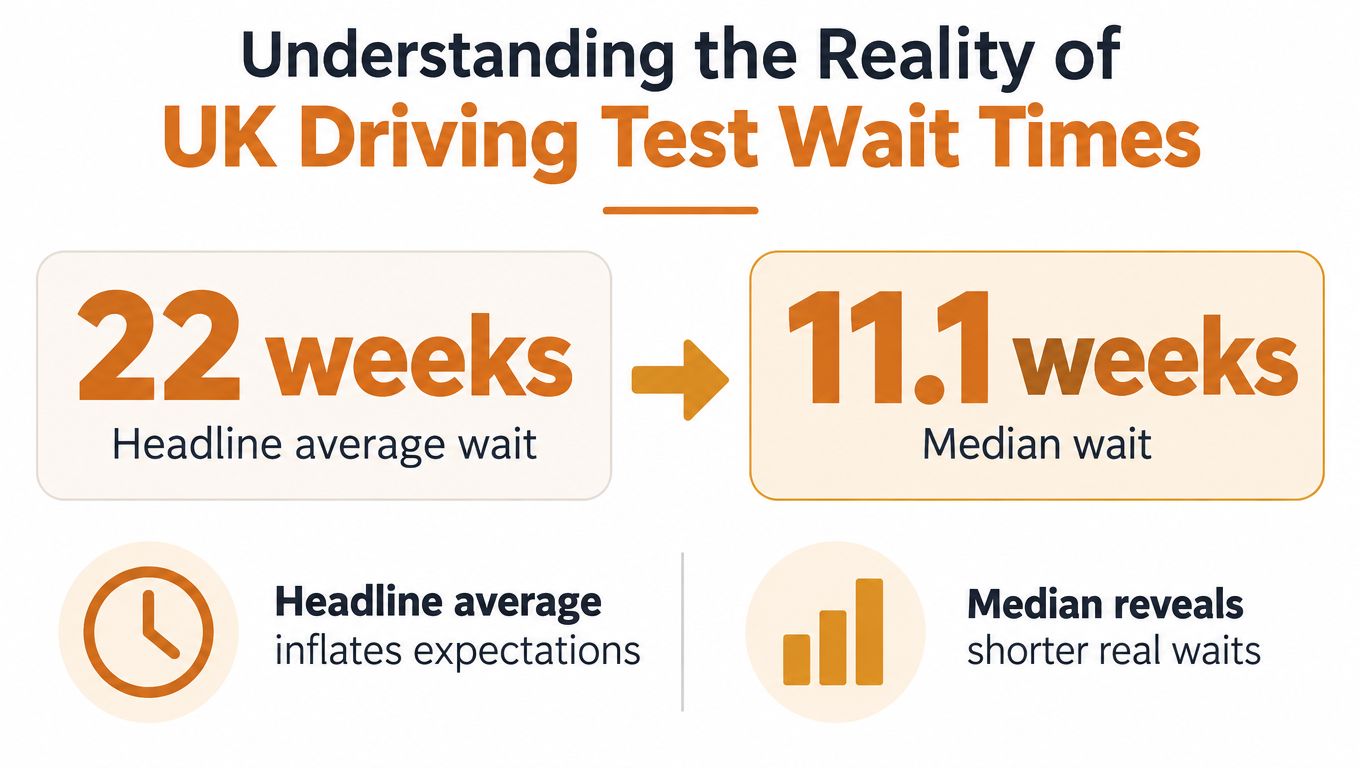
A 22-week average wait for a car practical test in Great Britain sounds like a fixed sentence, but it is not. The median wait between booking and taking a test was 11.1 weeks in August 2026, which tells you that a large gap exists between the headline availability figure and what some learners achieve by finding released appointments. (BBC reporting on official waiting-time data)
That gap is where early dates for driving tests are found. You won't get one by relying on the first date the GOV.UK booking page offers. You need to understand how the DVSA system measures availability, watch for cancellations, search more than one centre and act quickly without breaking the booking rules.
Table of Contents
- Understanding the Reality of UK Driving Test Wait Times
- Mastering Manual Monitoring and the DVSA Booking Window
- Leveraging Automated Cancellation Monitoring Tools
- Expanding Your Search Radius with Multi-Centre Monitoring
- Navigating the Post-May 2026 Rule Changes for ADIs
- Conclusion - Why Speed Pays Off in the Current Market
Understanding the Reality of UK Driving Test Wait Times
The headline figure is useful for showing how pressured the system has become, but it isn't a personal prediction. In September 2025, the average waiting time for a car practical driving test in Great Britain was 22 weeks, while 70% of DVSA's 240 permanent test centres were operating at the 24-week maximum. (National Audit Office investigation into car driving test waiting times)
That figure describes the availability point used by the booking system, not necessarily the time every learner waits. The newer median measure records completed tests and identifies the middle waiting time. If that median is shorter than the headline figure, learners are securing appointments through cancellations, newly released slots and dates that were already available before the booking system's headline threshold.
Why the headline figure can mislead
DVSA's published waiting-time measure isn't a straightforward average. It shows the number of weeks until at least 10% of weekly appointments at a centre remain available to book, so a centre showing a long wait can still have occasional appointments earlier in the window. (DVSA explanation of driving test waiting-time measures)
That distinction changes how you should behave. A learner who checks once, sees a distant date and stops looking has accepted the least useful interpretation of the data. A learner who keeps a valid booking while watching for an earlier cancellation has access to a second supply of appointments.
The booking window itself extends up to 24 weeks, or six months, ahead. New appointments are added 24 weeks in advance, and the system doesn't operate a general waiting list or cancellation list. (GOV.UK guidance on driving test appointment release dates)
The system has always managed demand
The pressure around test appointments isn't a recent quirk. Voluntary driving tests began on 16 March 1935 under the Road Traffic Act 1934, followed by compulsory testing on 1 June 1935 for drivers and riders who started driving on or after 1 April 1934. The separate written theory test arrived on 1 July 1996, replacing Highway Code questions asked during the practical test. (GOV.UK history and appointment guidance)
The staged introduction in 1935 was designed to prevent a rush of candidates before compulsory testing began. Appointment pressure, in other words, has been part of the licensing system from its earliest days. Today's split between theory and practical tests adds another formal checkpoint, while the limited number of practical appointments makes timing a serious part of your preparation.
If you want a practical explanation of how the figures affect your search, see this guide to UK driving test waiting times. The useful conclusion is simple: treat the first available date as a foothold, not as the final answer.
Mastering Manual Monitoring and the DVSA Booking Window
Manual checking still works, but only if you treat it as a disciplined routine rather than random refreshing. The GOV.UK online service operates from 6am to 11:40pm, so attempts outside those hours waste time because the booking service isn't available. (GOV.UK guidance on cancelling or changing a driving test)
Start with a booked test, even if the date is later than you'd like. That gives you something to protect while you search. Log in during the service hours, check your chosen centre and look at nearby centres that you could realistically reach. If an earlier appointment appears, read the date and time carefully before changing anything.
Use the refund deadline as your safety line
For a full refund when cancelling or changing a car test, you need to give 10 full working days' notice. Monday to Saturday count as working days, while Sundays and public holidays don't. That rule should control your decisions, especially when a cancellation appears close to your existing appointment.
Don't focus only on the earlier date. Check whether you can attend it, whether your instructor has the time and whether the change leaves enough working days to protect your original test if you decide not to proceed. A slot that looks perfect can become expensive if you abandon the old booking without meeting the notice requirement.
Practical rule: Never change a secure test simply because a slot is earlier. Confirm the date, centre, instructor availability and refund position first.
A sensible manual routine looks like this:
- Keep your current appointment: It acts as a safety net while you search.
- Check within service hours: Use a repeatable morning, afternoon or evening routine rather than relying on memory.
- Record acceptable centres: Decide in advance how far you're willing to travel.
- Move only when the slot is workable: Speed matters, but an unusable appointment isn't progress.
- Review the confirmation immediately: Make sure the new centre, date and time are correct.
If you're supporting several learners, repeated manual checking quickly becomes an administrative job rather than a teaching task. Businesses that need to keep calls and appointments organised may also find guidance on always-on booking for your business useful, although the learner must still control their own DVSA test booking.
The GOV.UK process and the practical steps involved are set out in this guide to DVSA practical test booking. The main lesson is that manual monitoring is viable for a focused learner, but it demands attention at the exact moment another candidate releases a suitable appointment.
Leveraging Automated Cancellation Monitoring Tools
Manual refreshing has one unavoidable weakness: you need to be looking at the page when another learner changes or cancels. An automated cancellation monitoring service approaches the problem differently. It watches for released availability and sends a notification, leaving you to complete the booking yourself through the DVSA website.
That distinction matters. A notification service doesn't give a third party permission to take control of your test. It just reduces the time you spend checking the page and tells you when a potentially useful appointment has appeared.


What an alert actually needs to tell you
A useful message should give you enough information to make a quick decision. Date, time and test centre details are more valuable than a vague message saying that availability has changed. You can then compare the appointment with your work, lessons, travel plans and the refund deadline before opening the official booking service.
The trade-off is straightforward:
| Manual monitoring | Automated monitoring |
|---|---|
| You repeatedly open the booking service | You receive a notification when a possible cancellation appears |
| You must remember when to check | The service monitors while you're away from the page |
| You may miss a slot between checks | You can decide quickly after receiving the alert |
| You complete the booking yourself | You still complete the booking yourself |
No alert guarantees that the slot will remain available. Someone else may take it first, or the appointment may not fit your requirements. You still need your GOV.UK login, booking reference and payment details ready, and you must make the final change under your own learner account.
The useful advantage isn't magic access to hidden appointments. It's replacing a long refresh loop with a prompt that gives you a chance to act.
For learners comparing tools, a free app for driving test cancellations can help you assess whether notification-based monitoring suits your routine before you commit to a longer search. Check what the service monitors, how it sends alerts and whether it books on your behalf. The last point is essential under the current rules.
The right choice depends on your circumstances. Manual checking costs time but no service fee. Automated monitoring costs money or requires an account, but it can be more practical for learners who work shifts, study full-time or can't keep a booking page open throughout the day. Neither option removes the need to judge whether you're genuinely ready to take the test.
Expanding Your Search Radius with Multi-Centre Monitoring
A single test centre gives you a narrow stream of opportunities. If that centre is heavily booked, you may wait for a suitable cancellation while an appointment in a neighbouring town appears and disappears without ever reaching you.
Start by dividing centres into three groups. The first is your preferred local centre. The second consists of centres you can reach without making test day unreasonable. The third includes locations that might work only if the earlier date justifies extra travel. Be honest about the route, lesson time, traffic and whether your instructor can take you there.
Choose the centre before the alert arrives
The worst time to decide whether you can travel is after an alert appears. Agree your search radius with your instructor in advance, then set clear boundaries. A centre that takes longer to reach may be a sensible choice if it brings your test forward, but only if you can practise there properly and arrive calm rather than rushed.
Use this decision test:
- Travel: Can you reach the centre reliably at the available test time?
- Practice: Can your instructor give you enough experience of the local roads and manoeuvre areas?
- Diary: Can you and your instructor attend without cancelling another important commitment?
- Readiness: Would you still be prepared if the appointment appeared tomorrow?
- Fallback: If the slot disappears, can you keep your current test while continuing the search?
The aim isn't to book the first appointment anywhere in the country. An unfamiliar centre can create its own problems if you have no opportunity to practise there. The aim is to widen the area enough to expose you to more released appointments while keeping the test realistic.
Three centres create three opportunity streams
Monitoring several suitable centres means you aren't waiting for one local learner to cancel at one local time. Availability is released across the network, and each centre has its own pattern of demand. A slot at your first choice may be preferable, but a workable alternative can be more valuable than another month of waiting.
Tell your instructor exactly which centres you're considering. If you receive an alert while they're teaching, you need a pre-agreed answer rather than a long exchange of messages. Decide whether you can book first and arrange a location-specific lesson afterwards, or whether the centre must be ruled out immediately.
Don't widen the radius just to claim that you've searched widely. An earlier date only helps if you can get to the centre, train for its roads and attend with a suitable car. Good monitoring produces more choices. Good judgement filters those choices quickly.
Navigating the Post-May 2026 Rule Changes for ADIs
From 12 May 2026, it became against the law for anyone other than the learner driver to book, change or cancel a car driving test. That includes an Approved Driving Instructor, parent or third-party service. The learner must make the transaction themselves, although another person can still provide support. (GOV.UK guidance on the 2026 driving test booking rules)
For ADIs, this changes the workflow completely. You can no longer see a cancellation, take a pupil's details and secure the appointment on their behalf. You also can't treat a third-party dashboard as a booking desk. Your role is to help the learner decide what is suitable, then make sure the learner is ready to act through their own booking account.
Separate coaching from the transaction
A compliant process has three parts:
- The instructor sets the criteria: Agree acceptable centres, dates, test times and travel limits with the pupil.
- The learner receives the information: A notification can identify a possible earlier appointment, but it must not complete the booking.
- The learner makes the change: The pupil signs in and books, changes or cancels the test personally.
This approach still gives an instructor useful coordination without crossing the legal boundary. You can advise whether a centre is sensible, check your teaching diary and help a learner prepare for unfamiliar roads. You can't enter the final booking action as though you were the candidate.
Learners are also limited to two changes. After that, they need to cancel and rebook if they want another date. (GOV.UK rules on changes to driving test bookings) That makes careless experimentation particularly damaging. An instructor should help a pupil set a firm search policy before alerts begin, rather than encouraging them to accept every earlier slot and reconsider later.
A workable ADI system
For a cohort, create a simple record for each pupil with their current test date, acceptable centres, earliest realistic date and instructor availability. Give each learner responsibility for their own login and booking details. When an alert arrives, the pupil can check the criteria and complete the transaction while you remain available for advice.
A dashboard can help an ADI organise alerts for multiple pupils, but it must remain a coordination tool, not a proxy booking facility. The system should show which learner needs attention, while the learner handles the official change. That division protects the pupil's booking and keeps the instructor's support within the rules.
Don't promise pupils that you can “grab” a cancellation for them. Tell them exactly what you can do, which is set sensible criteria, monitor progress, advise on centres and respond when they ask whether an appointment fits. They still need to be the person who books it.
Conclusion - Why Speed Pays Off in the Current Market
A standard booking keeps a learner progressing, but passive waiting still creates avoidable pressure. Extra lessons may be needed while the pupil waits, instructor availability can stop matching the appointment, and a theory test deadline may narrow the options. Once the learner is ready, an earlier suitable date has practical value.
The National Audit Office investigation into car driving test waiting times shows how little visible supply reaches the booking system: the investigation recorded only 5% of slots visible in September 2025, down from 15% a year earlier, alongside 84,901 learner cancellations during 2024 to 2025. That gap explains why theoretical availability is not the same as an actionable appointment.
Treat every alert as a three-part check. Is the learner ready for the test? Can the instructor support that date? Can the learner reach the centre without creating an unrealistic travel or lesson problem? A slot passes only when all three answers are yes. This filter prevents the common mistake of chasing an earlier date that cannot be used.
Speed matters after that decision, because a suitable cancellation may disappear before the learner finishes checking it. Keep booking details ready, agree the search limits in advance and respond through the official GOV.UK process. Alerts are useful because they reduce wasted checking, but they do not remove the learner's responsibility to choose and complete the change.
Driving Test Cancellations monitors DVSA availability for earlier practical test appointments and sends alerts with the date, time and centre details, while you rebook directly through GOV.UK. Visit Driving Test Cancellations to set up a cancellation search.