A standard DVSA car practical test takes about 40 minutes, but the booked time slot represents your start time, so you must arrive well before the clock starts. In August 2026, the national median wait between booking and taking a test was 11.1 weeks, while the broader headline average was about 20 weeks, so finding the right slot remains a separate challenge. DVSA's official guidance explains the current measurement.
You may be standing in a test centre car park, watching the clock on your booking confirmation and wondering whether you've got ten minutes or nearly an hour left. The confusion is understandable. The time printed on the confirmation isn't the length of your appointment. It's the scheduled start time for the examiner to begin the test process.
That distinction matters. Arrive late and you may lose the appointment altogether. Arrive early, settle your nerves and complete the checks properly, and the day becomes much more manageable.
Table of Contents
- Understanding Your Booked Slot and Test Duration
- The Exact Timeline of a Practical Test Day
- DVSA Waiting Times and Availability: What the Data Shows
- Strategies for Finding an Earlier Test Date
- Current Booking Rules and Test Swapping Limits
- Final Preparation and Day-of Checklist
Understanding Your Booked Slot and Test Duration
You book a time slot, not just 40 minutes of driving. If your confirmation says 10:14, that's when you need to be ready for the examiner at the test centre. It isn't the time to pull into the car park, switch off the engine and start looking for your licence.
A practical car test normally takes around 40 minutes on the road. Before that, the examiner needs to meet you, check your licence, carry out the eyesight check and ask the “tell me” vehicle safety question. After the drive, there's a return to the centre, a result and feedback. The booking system has to allow the examiner to complete those parts and prepare for the next candidate.
Treat the appointment time as a readiness deadline
Plan to be at the centre well before your booked time. A sensible approach is to arrive with enough time to park, use the toilet, find the waiting area and take a few calm breaths. The exact journey time depends on traffic and the centre, so rehearse the route rather than relying on a sat-nav estimate on the morning.
Your instructor should know where candidates wait and where the examiner normally approaches the car. Don't sit in a nearby café until the final minute. The examiner may call your name promptly, and you need to be available.
Practical rule: The clock on your booking confirmation is the time you must be ready, not the time you should arrive.
The examiner won't extend the appointment because you were delayed by traffic, couldn't find the entrance or needed to clear snow from the car. A late arrival can mean the test can't go ahead, particularly when the examiner has another candidate booked afterwards.
Why the slot is longer than the drive
The DVSA schedules more than the driving element. The examiner must confirm your identity and entitlement to take the test, check the vehicle is suitable and legal, assess your eyesight and explain what will happen. The result and feedback also form part of the appointment.
A flight offers a good comparison. The time in the air is only part of the airport experience. Your booked driving test time marks the start of an organised process, and the 40-minute drive sits inside it.
Your own preparation should follow the same logic. Leave home early enough to cope with a slow route, arrive composed and have your documents ready. Don't create an avoidable problem before you've even moved off.
The Exact Timeline of a Practical Test Day
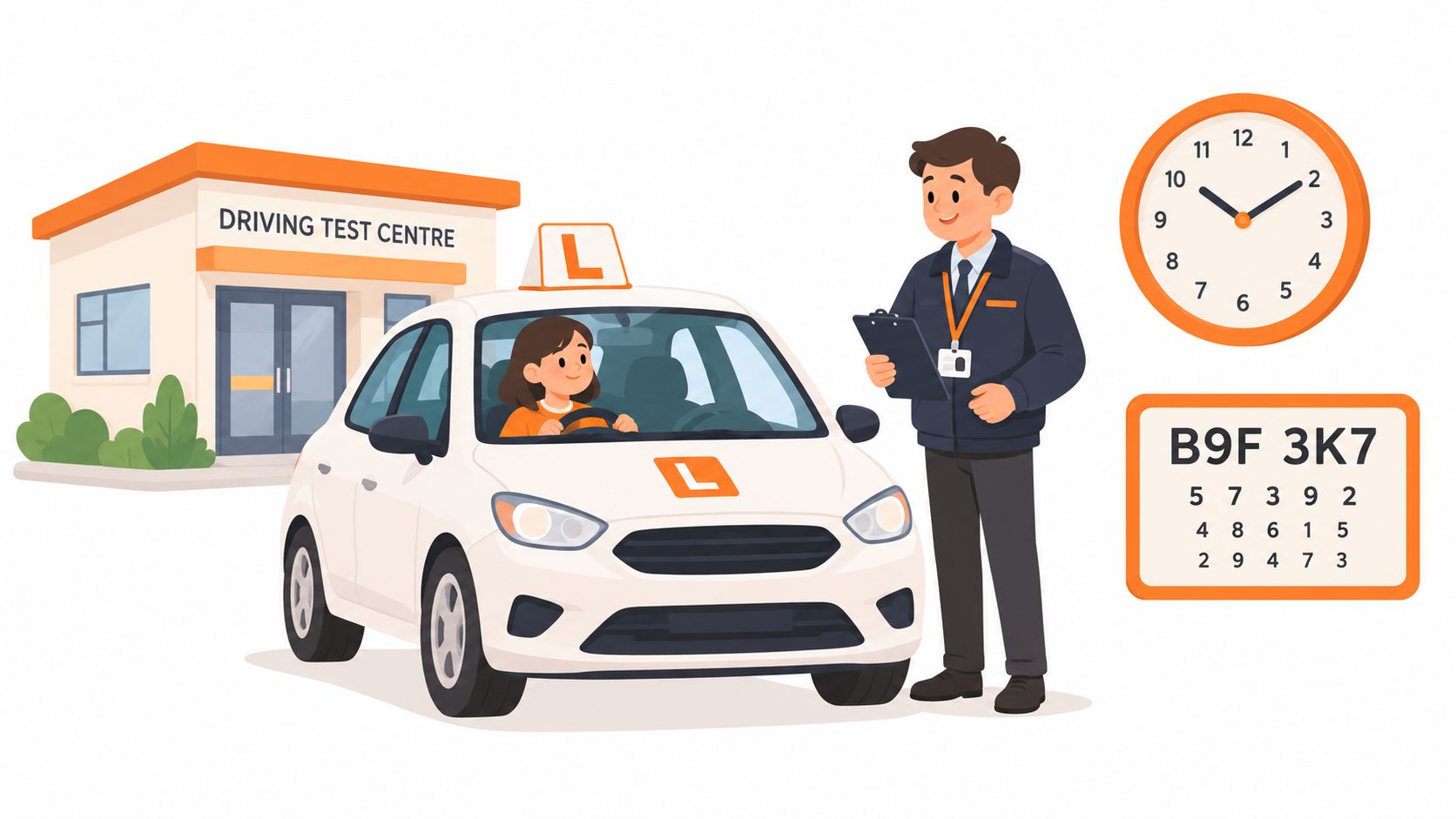
A learner called Sam arrives at the centre with an instructor shortly before the appointment. The car is parked legally, the learner has their photocard licence ready and the instructor stays quiet enough to let Sam focus. That first few minutes matter because rushing into the waiting area unsettled can affect concentration before the test begins.
Before the car moves
The examiner calls the candidate from the waiting area and checks the necessary details. The candidate then walks to the car. The examiner asks the eyesight question, which involves reading a number plate at the required distance. If you can't meet the eyesight requirement, the test can't continue.
Next comes the vehicle safety question. You may be asked to explain how you'd carry out a check, such as confirming that the brakes work or checking the engine oil. This is the “tell me” question. You're explaining the process, not performing a full roadside inspection on the spot.
The examiner will then explain the general format and ask you to start when safe. Take a moment to adjust the seat, mirrors and controls. That small pause is better than driving away with poor visibility.
The driving section
The road drive lasts around 40 minutes. It includes normal driving, following directions and responding safely to traffic. You'll also complete independent driving, where the examiner asks you to follow signs, a series of directions or another method of navigation.
You might be asked to carry out a reversing exercise. An emergency stop is possible, although it isn't included on every test. Listen carefully to the instruction and ask for it to be repeated if you haven't heard it. Asking for clarification is safer than guessing.
The examiner isn't looking for a perfect drive with no minor faults. They're assessing whether you can drive safely and make sensible decisions without continual prompting. A missed turn isn't automatically a fail, provided you respond safely and follow the new direction.
Returning to the centre
At the end, you drive back to the test centre and park as instructed. The examiner records the result, then explains whether you've passed or failed and discusses the main points from the drive. This is why you shouldn't arrange to leave immediately after the scheduled time.
From arriving in the car park to walking away, the whole visit can feel close to an hour. The driving itself is only one part of the appointment. Build that wider period into your plans, especially if you've booked work, college or another lesson afterwards.
Keep your attention on the next safe decision. Don't start analysing a possible mistake while you're still driving.
DVSA Waiting Times and Availability: What the Data Shows
Booking the test can take longer than preparing for it. In Great Britain, the average wait for a practical car test reached 22 weeks in September 2025, compared with just over five weeks in February 2020. The National Audit Office described this as roughly a fourfold increase over about five and a half years. It also reported that 70% of the DVSA's 240 permanent test centres were operating at the 24-week maximum waiting time in September 2025. The National Audit Office summary reported that the DVSA did not expect to reach its seven-week target before November 2027, according to its projection.
Read the figures carefully. The current official measure is the median wait between booking and taking the test, rather than a simple average. In August 2026, that median was 11.1 weeks, so half of the learners who took a test that month waited no more than 11.1 weeks. The broader headline average was about 20 weeks, showing how strongly long waits at some centres affect the national figure. Use our driving test waiting-time breakdown to examine the monthly figures in more detail.
Location changes the strategy
National figures show the size of the backlog, but they do not tell you which centre to choose. In April 2026, DVSA-reported figures put England at 22.7 weeks, Scotland at 22.9 weeks and Wales at 17.3 weeks. That gap is large enough to affect whether you stay local or check another centre. BBC reporting on the regional figures demonstrates why centre selection belongs in your plan from the start.
The newer monthly publication includes national, regional and individual-centre data. DVSA updates the figures on the second Wednesday of each month. They include the median wait, examiner overtime tests and appointments still available within the next 24 weeks. Check centre-level results instead of relying only on the national headline.
| Region or test centre | Average wait in weeks | Strategic takeaway |
|---|---|---|
| Great Britain, August 2026 | About 20 | The national headline hides major centre-level differences |
| Cardigan, August 2026 | 4.1 | A much shorter wait may justify checking a neighbouring area |
| Carmarthen, August 2026 | 4.5 | Centre choice can materially change the time to test |
| Bradford, Thornbury, August 2026 | 23.4 | A heavily congested centre may require cancellation monitoring |
| Bolton, August 2026 | 23.3 | Staying local may mean accepting a long queue |
The centre examples and monthly availability figures appear in this driving test waiting-time analysis. Treat them as evidence of variation, not a promise that a particular centre will have the same wait when you check.
A nearby centre can reduce the queue sharply, but book there only if you can practise on its roads and reach it reliably. A shorter booking wait is useless if unfamiliar routes increase your risk or the journey makes you late.
Strategies for Finding an Earlier Test Date
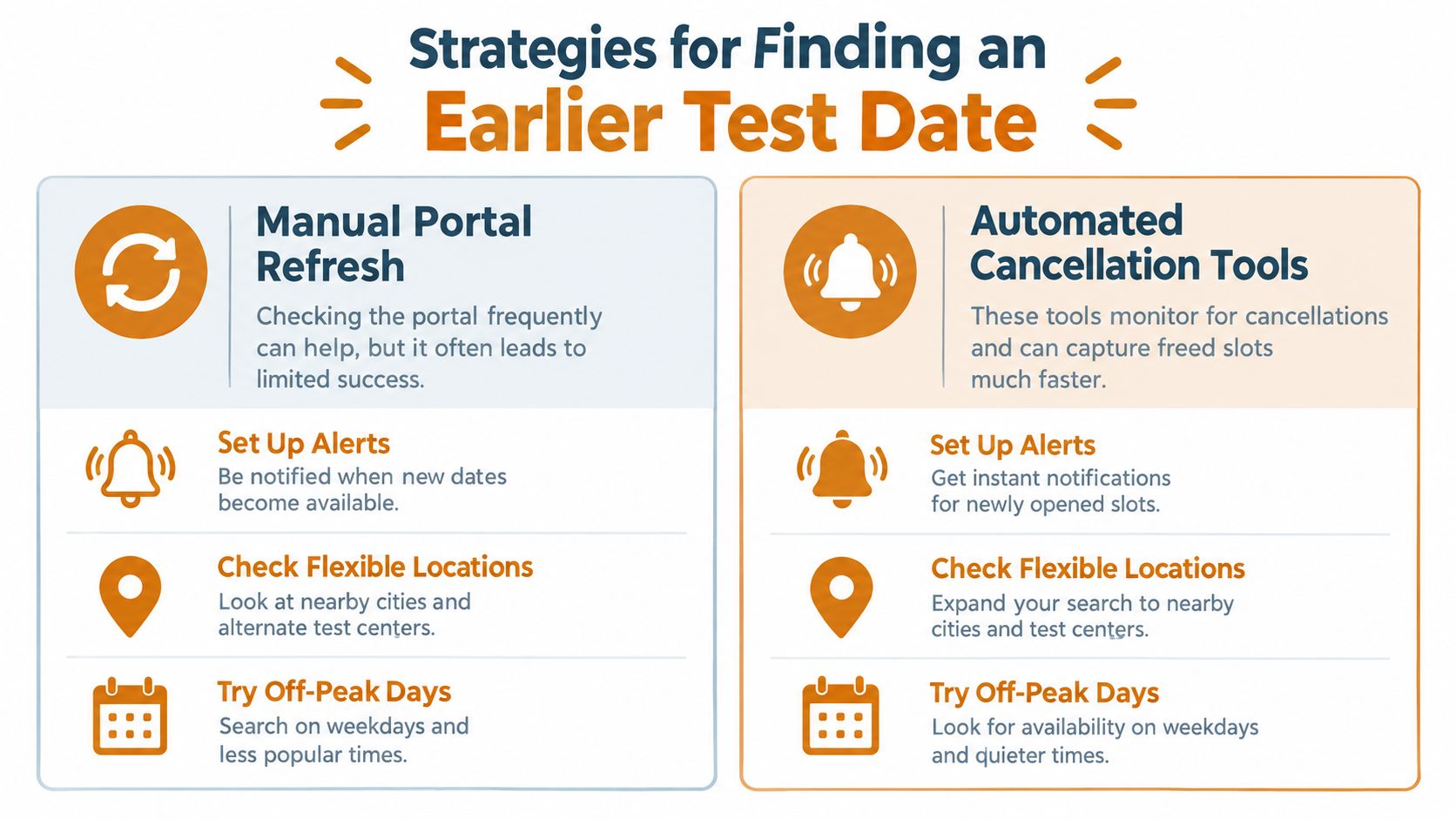
Once you've booked a test, the practical question is how to move it forward. Manually refreshing the DVSA booking service can work, but it demands attention at the moment a suitable cancellation appears. You may see a date that conflicts with your instructor, click through too slowly or find that another learner has already taken it.
Automated monitoring changes the process. A notification service scans availability and sends an alert when an earlier slot appears, but you still make the change yourself through the official DVSA website. That distinction matters under the current rules.
Compare the main options
Manual checking costs nothing, but it works only when you're available to check. It's most useful if your instructor has given you a clear range of acceptable times and you can respond quickly. Don't spend hours refreshing without a plan. Check the centres you can use and keep your licence and booking details ready.
Centre flexibility often offers the biggest practical advantage. Add neighbouring centres only when you can arrange lessons there and know the local road layout. The DVSA data shows why restricting yourself to one congested centre can unnecessarily extend the wait.
Cancellation monitoring is useful when work, study, instructor availability or a theory certificate deadline limits your options. Driving Test Cancellations monitors DVSA practical test availability and sends time-stamped alerts with the date, time and centre details. You then rebook directly with DVSA, rather than giving a third party control of your appointment. Its practical test date guidance explains how earlier-slot monitoring fits into the rebooking process.
Use any alert promptly, but don't accept a date you can't safely attend. Moving a test forward only to cancel it again wastes time and may leave you with a worse appointment.
Here's the video explanation to watch alongside your search strategy:
Choose the earliest appointment you can realistically practise for, reach on time and attend with a suitable car.
Current Booking Rules and Test Swapping Limits
The booking rules changed on 12 May 2026. From that date, only the learner taking the car practical test can book and manage it online. The DVSA says instructors, unofficial cancellation services and other third parties can't book, change, cancel or swap tests for a learner through the online business service. The DVSA's booking-rule update explains the change.
That doesn't stop an instructor helping you decide which centre or date is suitable. It means you must complete the booking action yourself through the permitted DVSA route. Be cautious with any service promising to take control of your appointment or log in and make changes for you.
What a valid swap requires
Swapping isn't a general way to exchange any two appointments. The DVSA allows a learner to swap their own car driving test with another learner only when both candidates want the exact same date, time and test centre. If even one of those details differs, the proposed exchange doesn't meet the rule.
The request must be made at least 10 full working days before the earlier of the two tests. Monday to Saturday count as working days. Sundays and public holidays don't count. The official DVSA swapping guidance sets out those conditions.
Check the details before agreeing
Suppose you have a Wednesday appointment and another learner has a different centre on the same day. You can't exchange just because the dates are similar. The centre and time must also match, and the request must be early enough under the working-day rule.
Write down both appointments and count backwards carefully. Don't assume that ten calendar days is sufficient. A public holiday or Sunday changes the calculation, and the relevant test is the earlier one.
For most learners, searching for cancellations and rebooking your own test is more straightforward than trying to arrange a swap. If you do find another learner, confirm every detail before submitting anything. Guidance on changing a driving test date can help you check the permitted route without relying on unofficial intervention.
Final Preparation and Day-of Checklist
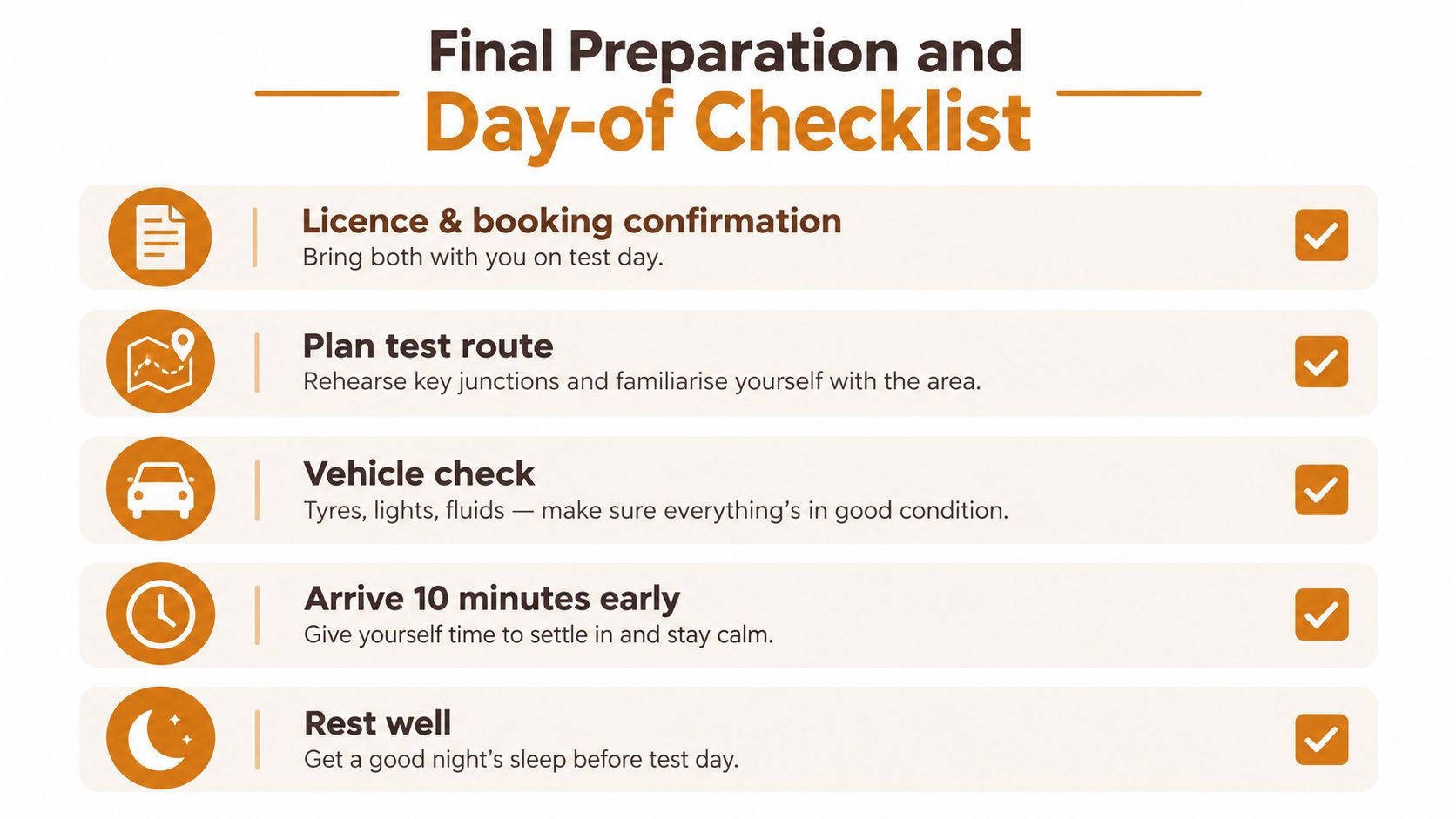
The best preparation starts with the booking details, not just the driving. In the week before the test, confirm the centre, appointment time, route and car. If you've moved to an earlier cancellation, make sure your instructor knows immediately and that you can complete suitable practice before test day.
The week before
- Confirm your licence: Check that you have the correct photocard licence and that the details match the booking.
- Check the car: Your instructor should confirm the tyres, lights, mirrors, seatbelts, warning lights and fluids. A vehicle fault can end the test before your driving is assessed.
- Rehearse the route: Visit the centre at a similar time if possible. Practise the junctions, roundabouts and speed changes that commonly demand extra concentration.
- Agree the timing: Ask your instructor exactly where to meet and when to arrive. Build in time for traffic and parking rather than aiming to reach the entrance at the appointment time.
- Protect your sleep: Avoid an unnecessarily late night. You need alert observation and steady decisions, not another final burst of rushed practice.
On the morning, eat something familiar, keep your phone available for essential contact and avoid cramming every possible manoeuvre into your head. A short, calm warm-up drive is more useful than an exhausting lesson that leaves you tense.
Parents and instructors should keep the pressure under control. Ask practical questions, help with the route and give the learner space to concentrate. Don't turn every minor error into a prediction about the result.
The test lasts around 40 minutes on the road, but your job begins when you arrive. Be ready for the examiner, listen to each instruction, and recover safely if something doesn't go perfectly. A missed turn or awkward moment needs a sensible response, not panic.
Driving Test Cancellations monitors DVSA practical test availability and sends alerts with earlier dates, times and centres so you can rebook directly through the DVSA website. If you're trying to reduce a long wait or fit a test around your instructor's diary, visit Driving Test Cancellations and check whether its cancellation monitoring suits your search.