You're staring at a practical test date that feels miles away, and the frustrating part is that you've probably already done the hard bit, booked it, built your lessons around it, and still ended up with a date that sits deep in the diary. That isn't you being unlucky. It's the DVSA system showing you exactly how stretched it is.
A long wait used to feel like bad timing. Now it's part of the structure. If you want an earlier slot, you need to understand where those openings come from, what the booking system is showing you, and which habits waste time.
Table of Contents
- Why Your Practical Test Date Is So Far Away
- How the DVSA Booking System Works
- What Creates Earlier Practical Test Dates
- Strategies for Finding a Sooner Slot
- New Booking Rules That Affect Your Options
- How Cancellation Alert Services Work
- Common Mistakes That Cost You Time and Money
Why Your Practical Test Date Is So Far Away
A learner books, refreshes the confirmation page, and sees a date so far out it might as well be next season. That reaction is common because the delay isn't a one-off glitch, it's the result of a system that has been under severe pressure for years. The National Audit Office said the average wait in Great Britain was 22 weeks in September 2025, up from just over five weeks in February 2020, and that 70% of DVSA's 240 permanent test centres were sitting at the 24-week maximum waiting time NAO report on driving test delays.
That tells you two useful things. First, the problem is spread across the network, not just a couple of stubborn centres. Second, the old idea that you can “try another week” and get a decent date doesn't hold up any more.
The backlog is system-wide, not personal
In plain terms, the queue is long because test capacity, examiner availability, and booking demand haven't lined up for a long time. DVSA's annual report showed the car practical test average wait rising from 16.1 weeks on 31 March 2024 to 21.9 weeks on 31 March 2025 DVSA annual report and accounts 2024 to 2025. That is a serious jump in one year, especially when learners were still trying to book inside the standard window.
Practical rule: if your date is far away, treat it as a network problem, not a sign you booked too late or your centre is uniquely hopeless.
I'd also urge you to read a good overview of the wider queue before you start chasing slots, because the scale of the issue changes how you should think about it. This waiting-time guide gives a useful broader picture, driving test waiting times, without pretending the system behaves like a normal queue.
How the DVSA Booking System Works
The official booking system only shows appointments inside a rolling 24-week window. You are never seeing the full future, only the next six months, and anything beyond that stays hidden until the window moves. DVSA also says its published waiting-time figure measures the number of weeks until at least 10% of weekly practical test appointments at a centre are still available to book, which is not the same thing as “how long everyone waits” DVSA waiting-time explanation.
That matters because a centre can look booked solid and still release a few usable appointments. If you only check now and then, you will miss them.
Why the 10% measure confuses people
The headline figure is a pressure signal. It shows how far ahead a centre has to look before enough appointments remain to matter. It does not mean the earlier weeks are empty. DVSA's own explanation makes that clear, and it started publishing centre-level breakdowns from 18 June 2026, which gives a sharper view of local bottlenecks than the old national summary DVSA waiting-time explanation.
That centre-level view is the bit many learners needed years ago. National averages are too blunt for a practical test date search. One centre can be clogged, another can move faster, and the gap between them is where the better openings appear.
Centre data beats guesswork
If you want an earlier slot, stop thinking about “the UK waiting list” and focus on your own centre, plus any nearby alternatives that fit your life. The booking system changes all the time. Slots return to the portal when someone cancels, when a centre reshuffles, or when DVSA releases available space.
A centre showing long waits is still worth checking because long waits do not mean zero openings.
That is why finding a practical test date is a monitoring job, not a one-off booking task. The people who do best check regularly and move fast, rather than assuming the first date they see is the only one that matters.
What Creates Earlier Practical Test Dates
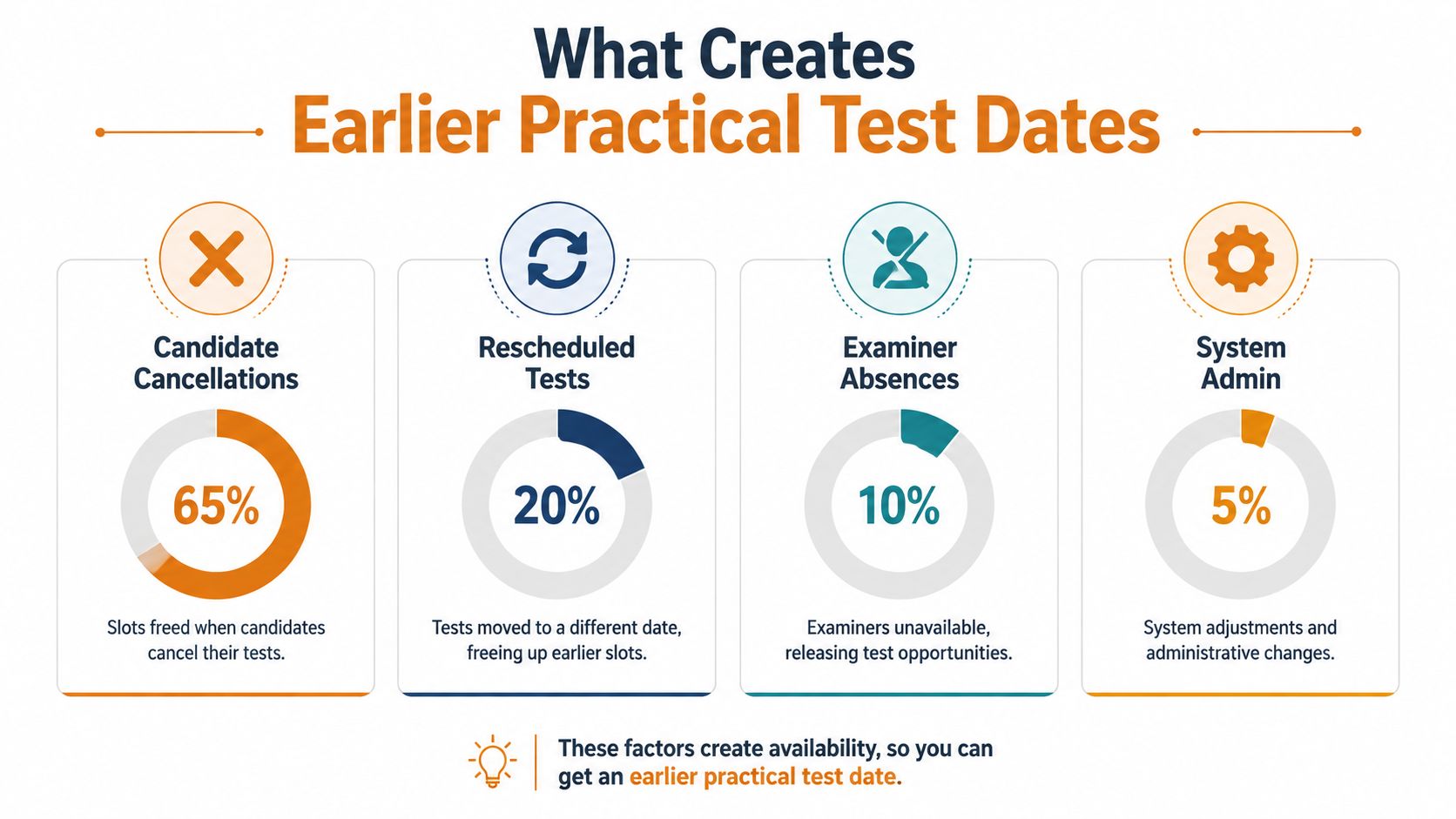
Earlier slots come from churn, not magic. Every sooner practical test date is usually the result of someone else giving up a slot, DVSA moving capacity around, or the booking window rolling forward and exposing fresh space. Once you understand that, the market makes more sense.
The biggest source is ordinary candidate behaviour. People cancel, reschedule, or change their plans, and those slots go back into the system. Examiner absences can also free up appointments in some places while creating shortages in others. One industry report in August 2026 said more than 60,000 driving tests were cancelled due to examiner medical absences, and 101,423 tests were cancelled between April 2025 and March 2026 industry report on examiner medical absences.
That mix creates the market most learners never see. Some days look dead. Then a centre suddenly has a handful of openings, often for a short time, and they're gone before the average learner even thinks to check.
The main opening points
- Candidate cancellations: Someone changes plans, loses confidence, or decides to move after all. That slot goes back into the system and can be snapped up quickly.
- Rescheduled tests: A learner shifts their booking and frees up a date inside the 24-week window.
- Examiner absences: Staffing disruption can release or reshuffle appointments, which is why local availability can change without warning.
- Rolling window churn: As time moves on, more dates come into view. That doesn't create a miracle slot, but it does create fresh inventory.
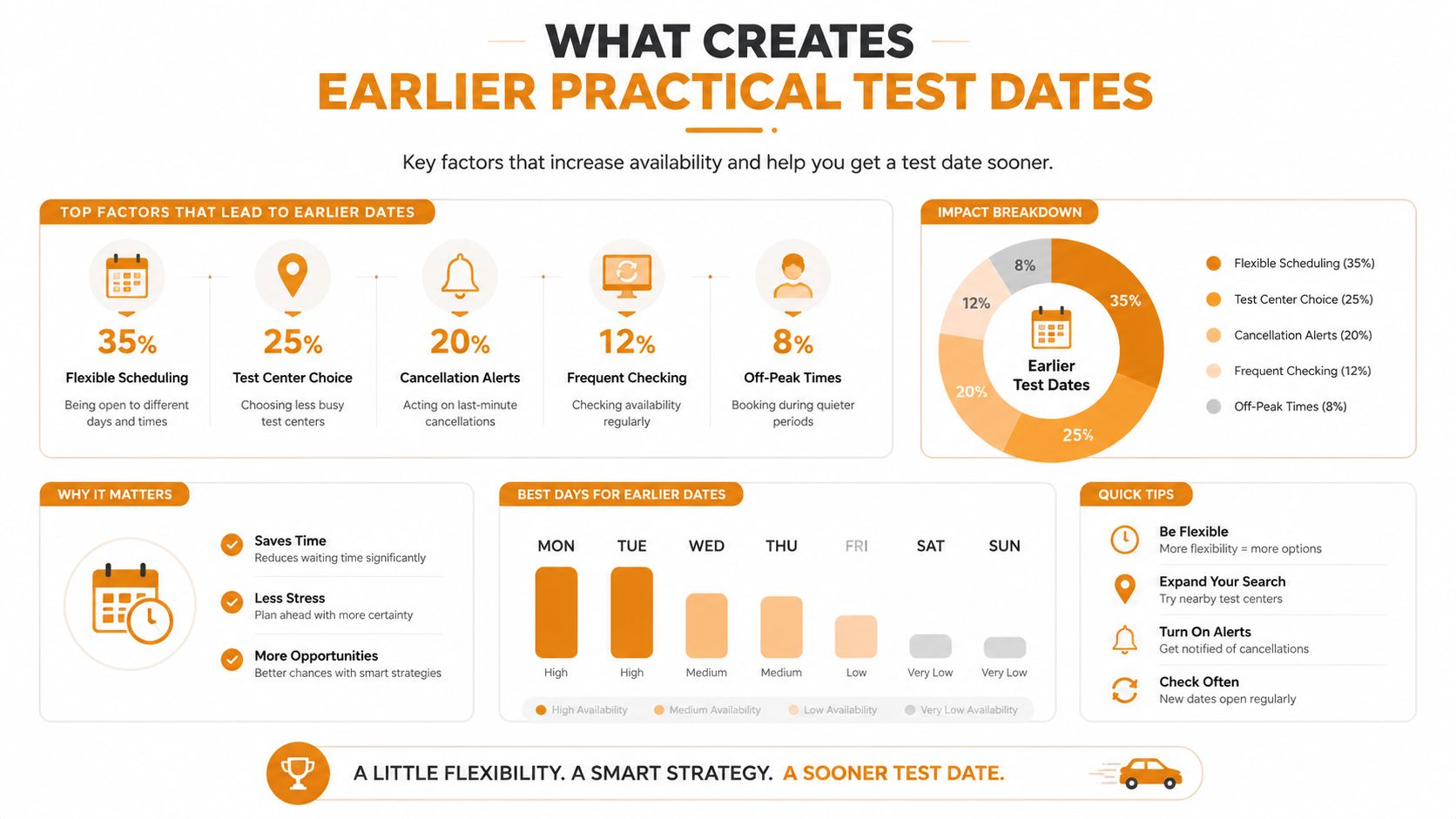
The important thing is that these openings are often local and brief. A generic wait-time page won't always catch them at the right moment. That's why the work is monitoring specific centres and acting fast when a slot appears.
Why disruption can help and hurt at the same time
Examiner absences are a good example of the contradiction in this market. They can cause cancellations and make a centre feel worse in the short term, but they also create sudden reallocation opportunities. That's why learners who only glance at headline waits miss the practical reality, the scarcity is concentrated in specific centres and time bands.

If your theory test is close to expiring or your instructor's diary is tight, you don't need a perfect system. You need a slot that appears fast enough to be useful. That's the whole game.
Strategies for Finding a Sooner Slot
Some people try to brute-force the DVSA site by hand. Others lean on their instructor, widen the search area, or use a cancellation alert service. The right answer depends on how urgent your situation is, but there's no prize for stubbornly refreshing a page at random times.
The most honest comparison is simple. Manual checking costs nothing but time. Wider searching gives you more options but can mean awkward travel. Alert services cost money, but they cut the delay between slot appearing and slot being claimed. If you're under pressure, speed matters more than pride.
| Strategy | Effort Required | Cost | Speed of Response | Best For |
|---|---|---|---|---|
| Manual checking | High | No direct cost | Slow | Learners with plenty of time |
| Ask your instructor | Medium | Usually no extra service fee | Medium | Pupils who need a second pair of eyes |
| Wider centre search | Medium | No direct cost | Medium | Learners who can travel farther |
| Cancellation alerts | Low after setup | Paid service in most cases | Fast | Learners chasing an earlier date quickly |
For a sense of how tight dates can become against other deadlines, the exam date countdown guide is a useful way to think about timing pressure, especially if you're juggling lessons, work, or a theory certificate.
What works in real life
Manual checking only works if you're disciplined. Most learners aren't, and I don't blame them, because staring at the portal all day is a poor use of time. Your instructor can help by spotting viable centres and checking when you're in lessons, but they can't do the booking for you any more.
A cancellation alert service is the most practical option if you need a quicker outcome and can act immediately when a slot appears. Driving Test Cancellations test centres is one example of a centre-focused approach, but the value of any alert tool is the same, it reduces the lag between the release of a date and your response to it.
Best use case: if you've got a specific deadline, use alerts and manual checking together. Don't rely on hope and a browser refresh.
A note on timing pressure
If your test is tied to a holiday, a term start, or a theory deadline, you need a system that tells you about openings immediately. Waiting until you remember to check after tea is usually too late. Slot availability can be gone in minutes, not hours.
If you want a practical test date before a hard deadline, treat the search like a live booking task, not an occasional admin chore.
New Booking Rules That Affect Your Options
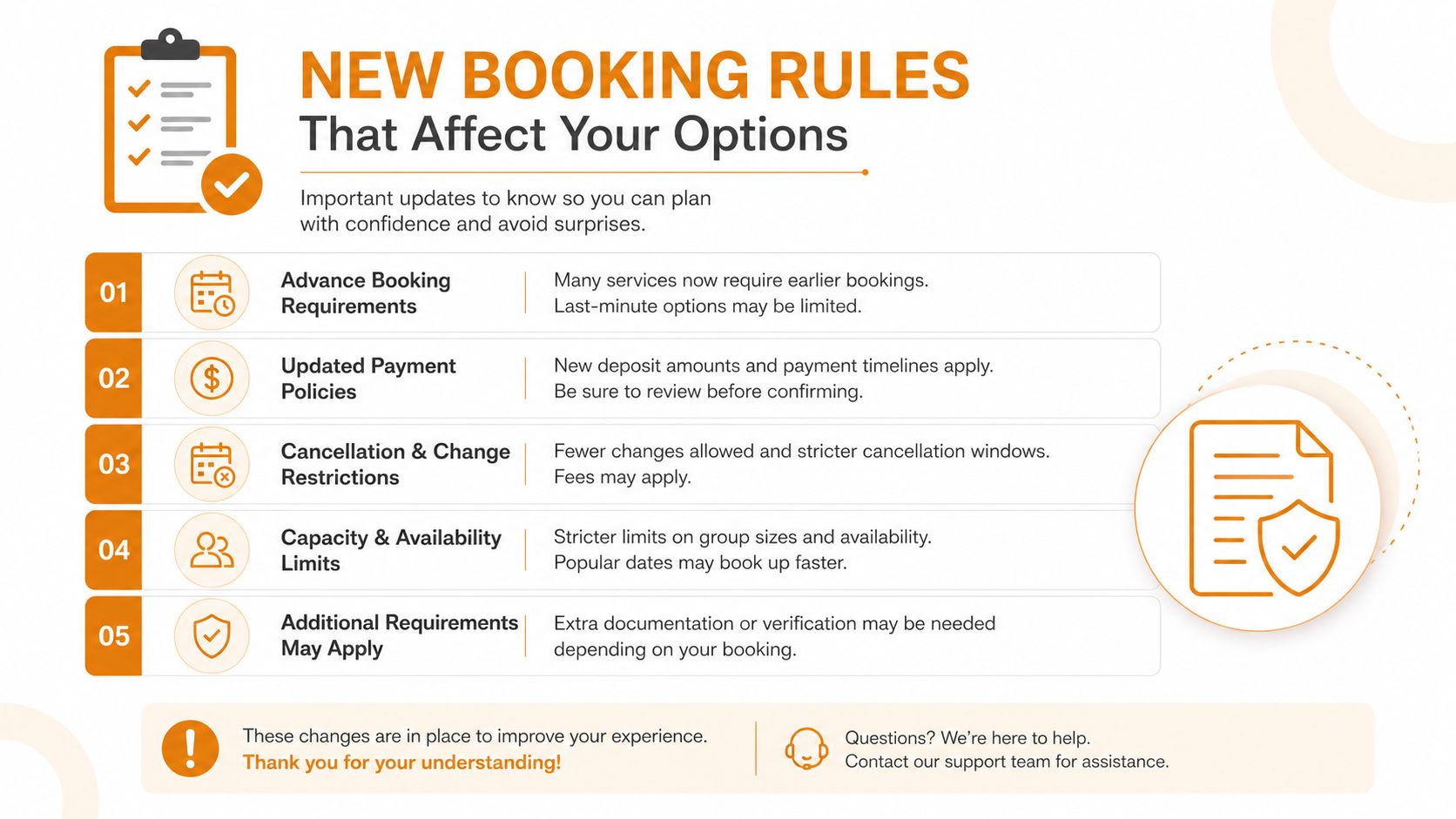
The rules around driving test changes are tighter now, and that has a real impact on how you handle an earlier practical test date. From 8 April 2025, learner drivers taking a car practical test in Great Britain need 10 full working days' notice to change or cancel without losing the fee GOV.UK rule change on cancellations and changes. That matters because a slot you can see isn't automatically a slot you can safely move into.
There's another restriction people still miss. From 31 March 2026, learners and pupils can change a driving test only twice before needing to cancel and rebook, down from six changes DVSA booking changes bulletin. From 9 June 2026, learners can move a booked test only to nearby centres. In other words, the system is less forgiving and less flexible than it used to be.
Why speed matters more now
Only the learner can book, change, swap or cancel a driving test using the booking service. That means instructors and third parties can't tidy up the booking for you in the background. If an alert arrives, the learner has to move quickly and make the decision themselves.
The practical effect is obvious. You've got fewer attempts to shuffle the booking, a narrower relocation range, and a deadline that can cost you the fee if you miss it. That's a bad combination for careless checking.
If you see a cancellation, act on it straight away. Half-measures waste one of your limited changes.
What to check before you move
Before you accept an earlier date, make sure the new centre works for the rest of your week, not just for the test itself. A short notice switch can be excellent, but it can also create diary chaos if the centre is awkward, the time is wrong, or you've already burned one of your changes.
The learners who get this right usually do one thing well, they decide in advance what counts as “good enough”. That stops them hesitating when a better slot appears.
How Cancellation Alert Services Work
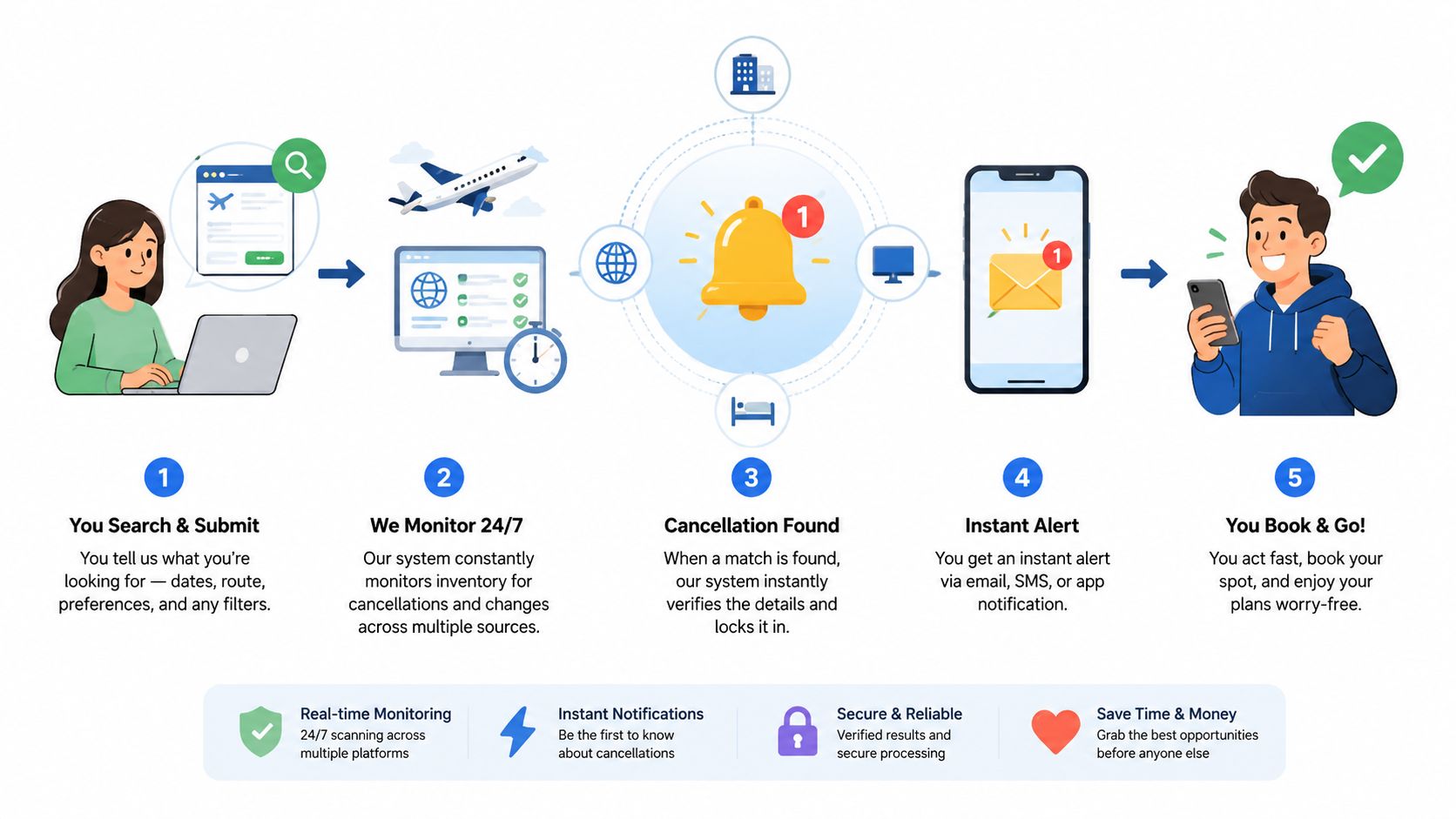
A cancellation alert service watches the DVSA booking system, spots earlier appointments as they appear, and sends a time-stamped alert with the date, time, and centre details. That's the job, nothing more, nothing less. It does not magic up new space, and it does not replace the official booking system.
The useful bit is speed. Good services scan continuously, which means they catch short-lived openings that manual checking misses. They're especially handy if you want to watch multiple centres, because a learner with a work pattern, a college timetable, or a tight instructor diary often can't afford to check one centre at a time.
What a sensible service actually does
The better services are notification-only. They surface the opening, then you log into DVSA and take the slot yourself. That model fits the current rules and keeps the process where it belongs, with the learner and the official portal. If a service claims it can book, move, or swap your test on your behalf, be very wary.
That's why I'd rather see a tool do one thing well than pretend it can solve every booking problem. The best use is simple, quick alerts, clear centre choice, and a learner who's ready to act.
Where this fits in a proper plan
Used properly, alerts sit alongside centre selection and deadline awareness. Used badly, they become another subscription you ignore after the first week. If you've already narrowed down your preferred centres and know what a workable date looks like, an alert can turn a frustrating search into a manageable one.
If you want to see how the monitoring side works in practical terms, the how it works guide is worth a look because it shows the difference between passive waiting and active slot tracking.
Common Mistakes That Cost You Time and Money
The biggest mistake is random checking. People refresh the DVSA site whenever they remember, then assume the lack of results means nothing is available. That's not how a rolling booking window works, and it's a good way to waste evenings.
Another bad move is using up your limited changes on tiny improvements. If you've only got two changes now, you need to save them for meaningful gains, not dates that barely help. Missing the 10 full working days cancellation deadline is just as costly, because it can wipe out the fee.
The errors I see most often
- Checking only one centre: Nearby centres can be quieter, and the data is centre-specific for a reason.
- Trying to manage it too late: If you wait for a convenient moment, the slot may already be gone.
- Paying for impossible promises: No one is allowed to book, change, swap or cancel for the learner.
- Forgetting theory expiry: If your theory certificate lapses, the practical booking is gone too.
The fix is discipline, not drama. Pick your centres, know your deadline, and use a system that alerts you quickly enough to matter.
If you want a quicker, more realistic way to spot earlier practical test dates, use Driving Test Cancellations to monitor the centres you care about and act when a usable slot appears. It's built for the exact problem learners face now, short-lived availability, tighter booking rules, and too little time to keep refreshing the portal by hand.