You've got a test booked, but the date no longer works. Maybe work has moved a shift, college has changed a timetable, your instructor's diary has shifted, or you've spotted an earlier slot and want to move fast before it disappears. In 2026, changing a driving test date is still possible, but it's no longer a casual tweak you make at the last minute and forget about.
The rules are tighter now, and that changes the way you should think about every rebooking decision. The practical question isn't just how to change the date. It's how to do it without losing your fee, wasting one of your limited changes, or boxing yourself out of a better slot later.
If you're trying to move a test sooner, the job is part timing, part strategy. GOV.UK still handles the official change, but DVSA's 2026 rules mean you need to count working days carefully, think about centre choice, and preserve your remaining changes for the right moment. That's the difference between a smart rebook and an expensive mistake.
Table of Contents
- Introduction to Changing Your Driving Test Date
- DVSA Rules for Changing Your Test Date in 2026
- How to Change Your Driving Test Date on GOV.UK
- Understanding Waiting Times and Centre Choice
- Finding Earlier Dates Without Constantly Checking
- Final Tips for Changing Your Driving Test Successfully
Introduction to Changing Your Driving Test Date
A learner rings their instructor on Monday morning and says the same thing I hear all the time, “I can't make that date now, but I've seen an earlier one.” The pressure is usually real. Shift patterns change, exam dates move, theory tests are running down, and some learners are trying to get a practical test done before university, a new job, or childcare starts to bite.
That's exactly where changing date of driving test decisions get awkward. The old habit of swapping around casually has gone. DVSA tightened booking rules after widespread test swapping and no-shows, and the process is now much more controlled than it used to be. The result is simple enough, but not always convenient, changing a test is still possible, yet each move now needs more care.
You can move a booking earlier or later through the official GOV.UK service, but you can't treat it like a free-for-all. You need to stay inside the notice window, respect the change limit, and work out whether the new slot helps you. That matters because the wrong move can cost you the fee, or use up one of the limited changes before a better appointment appears.
The safest approach is to confirm the new slot first, then change the booking, and keep the confirmation email.
By the end of this guide, you'll know what DVSA allows, how the official change process works, why centre choice matters, and how to hunt for an earlier date without making a mess of your booking.
DVSA Rules for Changing Your Test Date in 2026
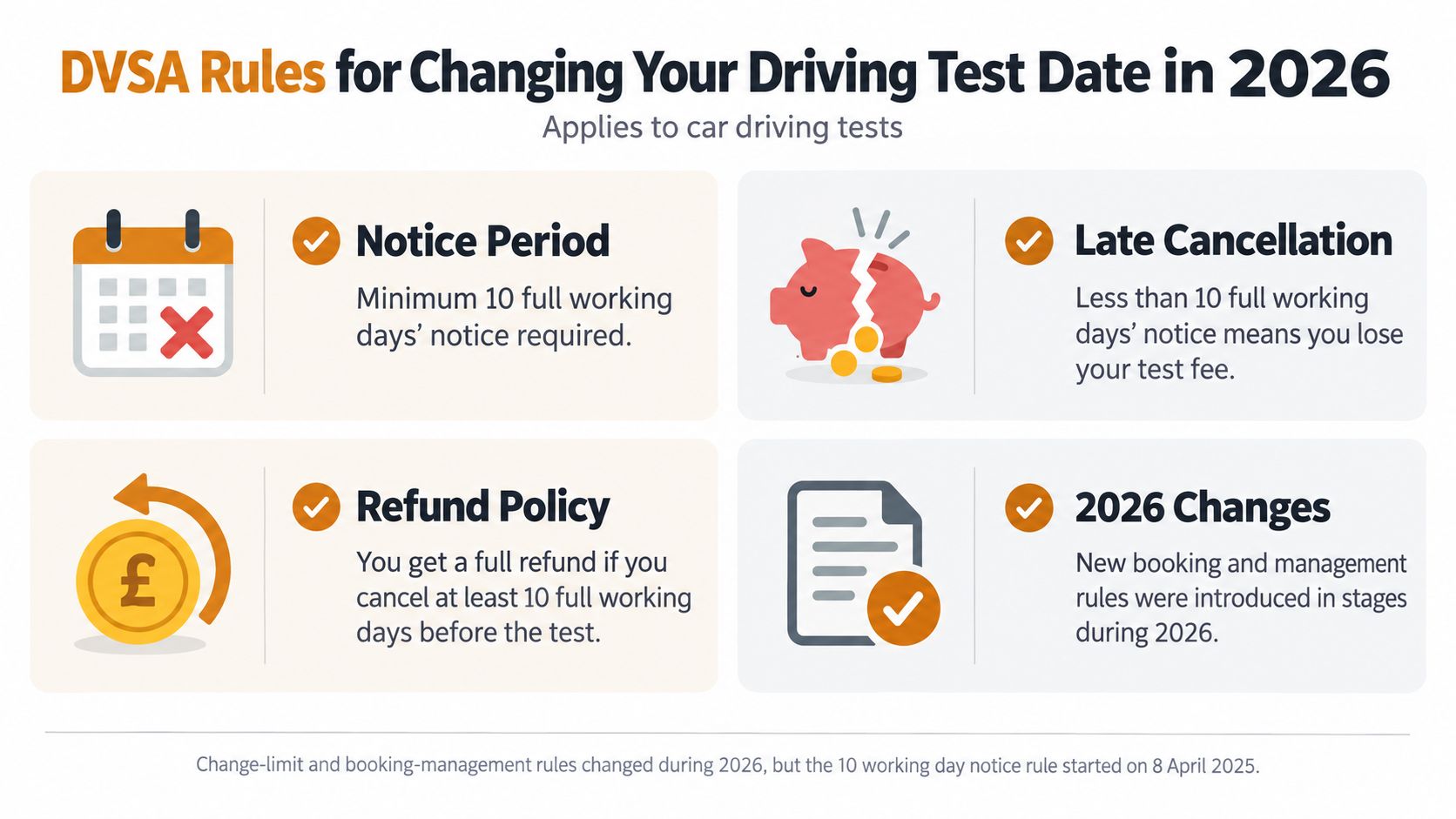
The first rule is the one that catches people out. DVSA now requires 10 full working days' notice to change or cancel a car driving test without losing the fee, as set out on GOV.UK. Working days exclude Sundays and public holidays, so don't count back loosely in your head. Count properly from the appointment date, because a single mistake can mean the fee is gone.
What counts as a change
DVSA's 2026 booking rules say you can make 2 changes to an existing booking, and changing the date, time and test-centre location together still counts as 1 change. That matters more than it sounds, because some learners waste a change by shifting only one detail, then discover the better slot comes up somewhere else.
If you've already made two changes, you can't keep shuffling the same booking forever. DVSA's guidance says the change counter resets if DVSA itself changes the test, and if a learner has already used both changes they can cancel and rebook, which starts a new booking and a fresh counter. That doesn't make the process casual. It just means you need to think before you act.
Who can manage the booking now
From 12 May 2026, only the learner can legally book or manage a car driving test, including changes and cancellations. That also applies to unofficial booking and cancellation-finder services, so an instructor or parent can help, but they can't take over the booking.
From 9 June 2026, learners can move a booked test only to one of the three nearest centres. That's a major practical limit, because it removes the old habit of jumping around the country for a random earlier slot. The new rule makes centre choice part of the decision, not just date choice.
If you're near the 10-day window, stop and check the calendar twice. Working days matter more than people think.
How to Change Your Driving Test Date on GOV.UK
The official route is the online DVSA change service on GOV.UK, not phoning around for a manual move. The service lets you move the test to an earlier or later slot, but the new date itself must be at least 10 working days away if you want to avoid losing the fee, as GOV.UK says on driving-test.
The cleanest workflow is straightforward. Log in with your driving licence number, theory test pass number, and test reference number, then search for an available date that fits your diary and your instructor's. Check the new appointment carefully before you confirm, because the safest order is to secure the replacement slot first and only then finalise the change.
Keep proof and avoid half-steps
Once the change goes through, keep the confirmation email. If there's ever a dispute about timing or what was booked, that message is the record you want. I've seen learners assume a screen change is enough, then realise later they never kept any proof.
A common mistake is making a small interim swap just to “hold something” while you keep looking. That often burns one of your two allowed changes for no real gain. If the appointment isn't better, leave it alone and wait for a slot that solves the problem.
If you need a broader refresher on booking the original test, the guide at how to book a driving test is useful background before you start moving dates around.
Understanding Waiting Times and Centre Choice
National waiting-time figures can be misleading if you don't know which measure you're looking at. DVSA said in June 2026 that the national median waiting time for tests taken in May 2026 was 9.7 weeks, while the 10% availability measure was 21.8 weeks. Those are both real, published figures, but they describe different parts of the queue, so the same system can look far better or worse depending on the metric you read. The DVSA explanation is worth reading in its waiting-time update.
That's why centre choice matters so much. The BBC reported that national waits were nearly 22 weeks in June 2026, and that regional waits in April 2026 varied widely, with England at 22.7 weeks, Scotland at 22.9 weeks, and Wales at 17.3 weeks. DVSA's later national breakdown also showed a lot of variation inside the UK, with regional medians including Scotland at 13.6 weeks, London at 11.7 weeks, the East Midlands at 10.3 weeks, Yorkshire and the Humber at 8.4 weeks, Wales at 7.4 weeks, and the South West at 7.1 weeks. Those figures came from the BBC's reporting on DVSA data: waiting-time coverage.
What the numbers mean in practice
The practical lesson is simple. If you can travel to another nearby centre, you may find a materially earlier slot. That doesn't mean every learner should chase the shortest queue in the country, especially once travel, instructor availability, and the new three-centre limit are factored in. It does mean you shouldn't assume your local centre is the only sensible option.
A good consumer habit is to compare your own centre against nearby alternatives before you commit to a move. That applies whether you're trying to beat a theory-test expiry or fit around a job start date. For a plain-English breakdown of queue patterns, the article on driving test waiting times is a useful companion read.
A shorter queue is only useful if you can actually attend it. The best slot on paper is useless if your instructor can't take you there.
The same kind of queue management shows up in other appointment-heavy services too. If you've ever seen an answering service for UK vets handle call pressure and prioritise urgent appointments, you'll recognise the same basic principle, good access depends on sorting demand against capacity, not just opening the calendar and hoping.
| Region | Median Wait | Implication for Rebooking |
|---|---|---|
| Scotland | 13.6 weeks | Worth checking whether a nearer centre has a shorter queue |
| London | 11.7 weeks | Some flexibility, but local demand is still heavy |
| East Midlands | 10.3 weeks | May offer better odds than the national pressure suggests |
| Yorkshire and the Humber | 8.4 weeks | Earlier dates can appear more often if you watch closely |
| Wales | 7.4 weeks | Can be worth comparing against nearby English centres |
| South West | 7.1 weeks | One of the stronger regions for earlier rebooking |
Finding Earlier Dates Without Constantly Checking
Manual refreshing works, but it's tedious and unreliable if you've got a job, lessons, or college to manage. You can sit on the GOV.UK booking page and keep checking, but cancellations appear and disappear quickly, and it's easy to miss a slot while you're doing something else. Automated alerts are the cleaner option for most learners, as long as you understand what they can and can't do.
From 12 May 2026, DVSA says only the learner can manage the booking, and third-party tools must not book, change, cancel, or swap the test on their behalf. That means a notification service can point you to an opening, but you still complete the change yourself on GOV.UK. The model is notice first, action second.
Manual checking versus alert services
Manual checking gives you full control, but it costs time and attention. Alert services reduce the need to refresh all day, and the better ones scan continuously, send time-stamped messages, and show the date, time, and centre so you can react quickly. If you're a learner balancing lessons and work, that can make a real difference.
Driving Test Cancellations is one UK service in that space, and its approach is notification-only, with learners still rebooking directly through DVSA. It also supports up to three centres, which fits the 2026 rules better than a scattergun search across the country.
For a practical look at the process behind that sort of service, see how it works. That's useful context if you're deciding whether to rely on manual refreshes or a live alert feed.
Why timing and coordination still matter
A fast alert is only useful if you can act on it. If your instructor is already booked, or you've already used up one change on a weak slot, you've still created a problem for yourself. That's why I tell learners to line up diary access before they start hunting, and to avoid impulsive swaps that eat through the 2-change limit.
Approved Driving Instructors face an extra layer of coordination when they're managing multiple pupils. A cancellation alert can help, but only if the learner is ready to take it and the instructor can support the new time. For learners preparing for a practical test in another system, the scheduling logic is similar to Florida road test prep from BDISchool, where timing and readiness have to line up before the appointment becomes useful.
The slot is only real when three things match, the learner, the instructor, and the notice window.
Final Tips for Changing Your Driving Test Successfully
The best decisions are boring ones. Count the notice period properly, keep your change capacity in reserve, and only move the booking when the new slot improves your position. If you're inside the 10 full working days window, don't guess. Check the calendar, check the fee risk, and make the move only when you're sure.
The second decision is whether to spend one of your 2 changes now or later. If you burn a change on a temporary swap, you may trap yourself when a better centre appears. I'd rather see a learner wait a few days for the right appointment than waste a change on a marginal one.
The third decision is centre choice. If you can travel, compare nearby centres before confirming anything, especially where regional waiting times differ by several weeks. Keep your instructor in the loop, check your theory test expiry if it's getting close, and save the confirmation email once you've moved the test.
A calm, methodical rebook usually beats a rushed one. That's the key lesson here.
If you want a live way to catch earlier practical test slots without sitting on the GOV.UK page all day, Driving Test Cancellations monitors DVSA availability and sends alerts so you can act when a better date appears. If your current booking needs to move, it's a practical way to keep watch while you stay within the current DVSA rules.