The DVSA doesn't run a formal waiting list for the practical driving test. Learners book a fixed slot up to 24 weeks ahead, and an earlier date is found by rebooking a cancelled slot, not by moving up a queue.
That's why the driving test waiting list UK problem feels so frustrating. The system is capped at 24 weeks, and many test centres are effectively saturated at the top of that window. You may see a test date available, book it, and still spend weeks checking for something sooner while other learners compete for the same returned appointments.
The practical answer is to treat your first booking as an anchor, then use centre choice, official data and careful cancellation checking to improve it. Don't pay anyone who claims they can place you in a secret queue or book on your behalf.
Table of Contents
- How the DVSA Booking System Actually Works
- Why Waiting Times Have Stayed So High Since 2020
- Where the Waits Are Shortest Right Now
- Booking Rules That Changed in 2026
- Common Misconceptions About the Driving Test Waiting List
- Myth one, you can join a formal queue by phone
- Myth two, instructors have a back-channel
- Myth three, paying a third party secures your date
- Myth four, the nearest centre is always the sensible choice
- Myth five, an alert guarantees a specific appointment
- Myth six, priority categories automatically bypass the 24-week window
- Finding Earlier Slots by Manual Checking vs Cancellation Alerts
- Picking the Right Test Centre to Cut Your Wait
- A Practical Plan to Get Tested Sooner
How the DVSA Booking System Actually Works
The DVSA booking service is self-service. You choose an available practical car test on GOV.UK, select a test centre and date, pay online, and receive a confirmed appointment. The booking service allows learners to book tests up to 24 weeks ahead, according to the National Audit Office investigation into driving test waiting times.
There's no official list that you can join by telephone or through your instructor. If someone cancels or changes their appointment, the released slot can appear in the public booking system. You then need to find it and rebook your own test through the official service.
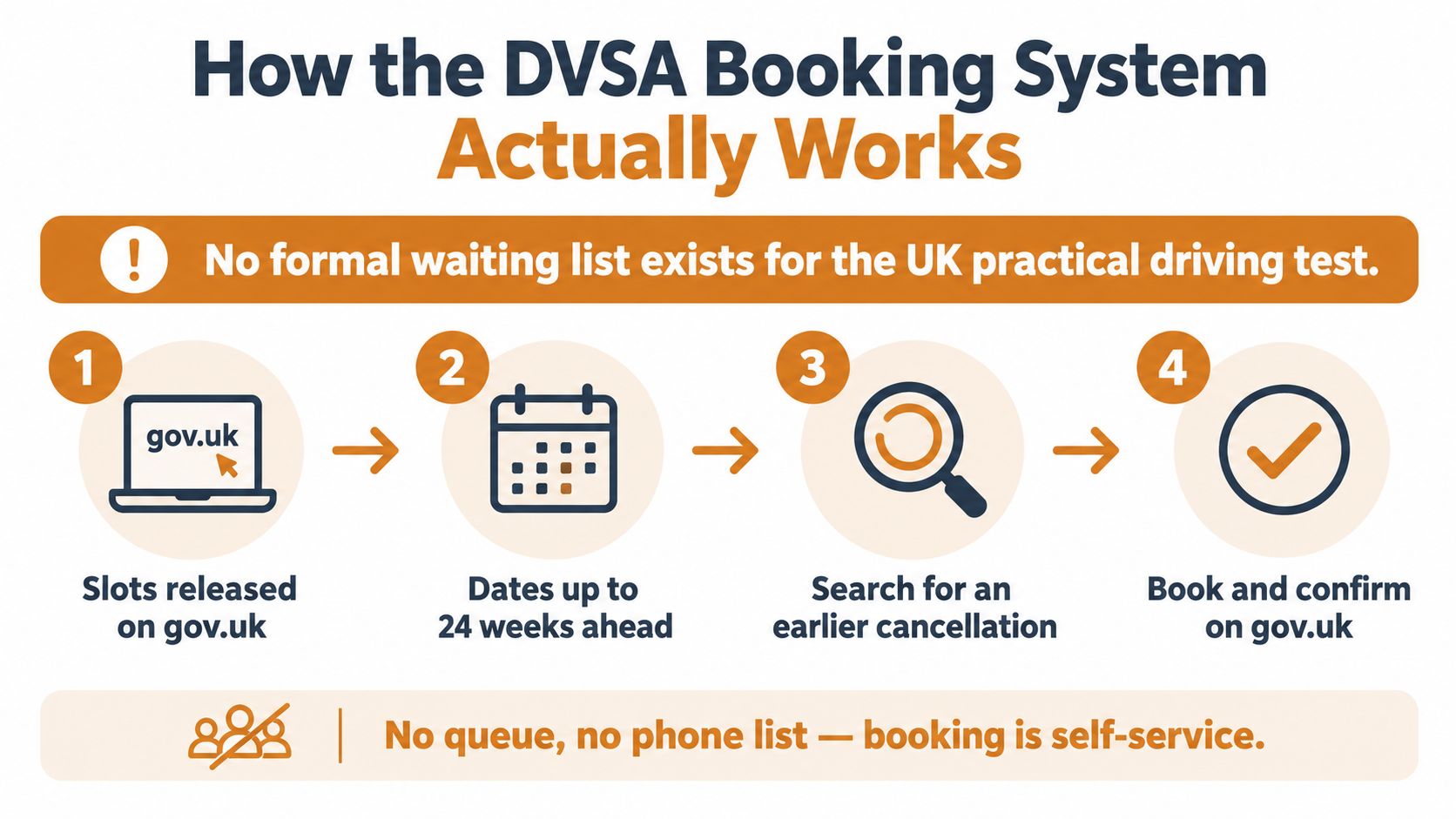
The four steps learners need to understand
- Check GOV.UK: Search the official practical test booking service for eligible centres and available dates.
- Book an anchor appointment: Take a date you can realistically attend, even if it's later than you'd like.
- Search for cancellations: Earlier appointments only become available when existing bookings are changed or cancelled.
- Rebook yourself: If a suitable slot appears, make the change through GOV.UK. A third party mustn't make the booking for you.
The bottleneck is capacity, not a hidden queue. A centre can show dates within the 24-week window while having no convenient appointments at all, particularly if you need a specific time, route area or instructor. The guide to dates available for a practical driving test is useful for understanding what the booking screen really shows.
Practical rule: Keep a confirmed appointment until you've checked that the replacement date, centre, vehicle and instructor all work.
Why Waiting Times Have Stayed So High Since 2020
The queue changed faster than the booking system could recover. In Great Britain, the average wait for a practical driving test was just over five weeks in February 2020. By September 2025, it had reached 22 weeks, according to the National Audit Office.
The pandemic stopped tests, then released a large pool of learners back into the system at the same time. Examiner numbers, test-centre capacity and appointment availability could not expand quickly enough to absorb that demand. More tests can improve the national position while leaving a busy urban centre with very few suitable dates.
| Year | Average wait | Key driver |
|---|---|---|
| 2020 | Just over 5 weeks | Pre-pandemic baseline |
| 2025 | 22 weeks | Backlog and constrained centre capacity |
Compare the measures before drawing conclusions. The 22-week figure was the average waiting time in September 2025. Later DVSA reporting uses the median time between booking and sitting a completed test. A lower median therefore does not mean that every learner can find an appointment soon.
Why the queue remains stubborn
Examiner availability sets a hard limit on the number of tests each centre can deliver. Demand is concentrated in populated areas, where learners often want the same centres, times and surrounding routes. Someone willing to travel to a quieter centre may face a better choice than a learner restricted to one busy location.
The National Audit Office reported that 70% of DVSA's 240 permanent test centres were operating at the 24-week maximum waiting time in September 2025. It also said DVSA did not expect to reach its seven-week target until late 2027. That timetable points to a capacity problem, not a short seasonal spike, as noted in the National Audit Office press release on driving test delays.
A booking only helps if the learner can use it. Pupils who choose a date before they are ready risk failing, cancelling or returning to the same restricted supply. Choose a centre and timing you can fully support, then treat preparation as part of the queue strategy. Finding any appointment is not the goal. Finding one you can attend and pass is.
Where the Waits Are Shortest Right Now
The national figure hides a lot. In the government's August 2026 data, half of learners waited no more than 11.1 weeks between booking and taking their test. 40% waited less than seven weeks, while the remaining 60% waited seven weeks or longer, as reported in the National Audit Office update on driving test delays.
Regional differences are substantial:
| Region | Median wait in August 2026 | Reading the figure |
|---|---|---|
| Scotland | 15.6 weeks | Longer than the national median |
| England | 11.1 weeks | Same as the national median |
| Wales | 7.6 weeks | Shorter than the national median |
| London | 14.7 weeks | Longest English region |
These figures are medians between booking and sitting a completed test, not promises for a new booking. The GOV.UK waiting-time guidance now publishes the measure monthly at national, regional and test-centre level, which makes local comparison far more useful than relying on a single UK headline.
How to use the regional data
Start with the centre where you normally learn, then check the nearest alternatives shown by the DVSA service. Look for a centre below the national median, but don't treat a lower regional figure as proof that a specific appointment is available today.
Wales can look attractive for learners who live close enough to travel, while Scotland's national median is longer despite some rural centres offering a different local picture. London is a difficult market because demand is concentrated and convenient centres can be heavily contested.
I wouldn't choose a centre solely because a website labels it “quiet”. Check the current official availability, confirm your instructor can take you there, and make sure you know the roads. A theoretically earlier test is useless if you can't practise the route or reach the centre reliably.
Booking Rules That Changed in 2026
The rule reset is straightforward, but mistakes now cost more. From 12 May 2026, learners must book and manage their own practical driving test. It's against the law for a third party to make a booking for someone else, including an unofficial cancellation-finder service, according to the GOV.UK announcement on unofficial booking services.
From 31 March 2026, DVSA reduced the number of changes allowed from six to two. After those changes, a learner must cancel and book again if they need a further alteration. The updated DVSA booking rules also state that a full refund is available only when cancellation happens at least 10 full working days before the test date.
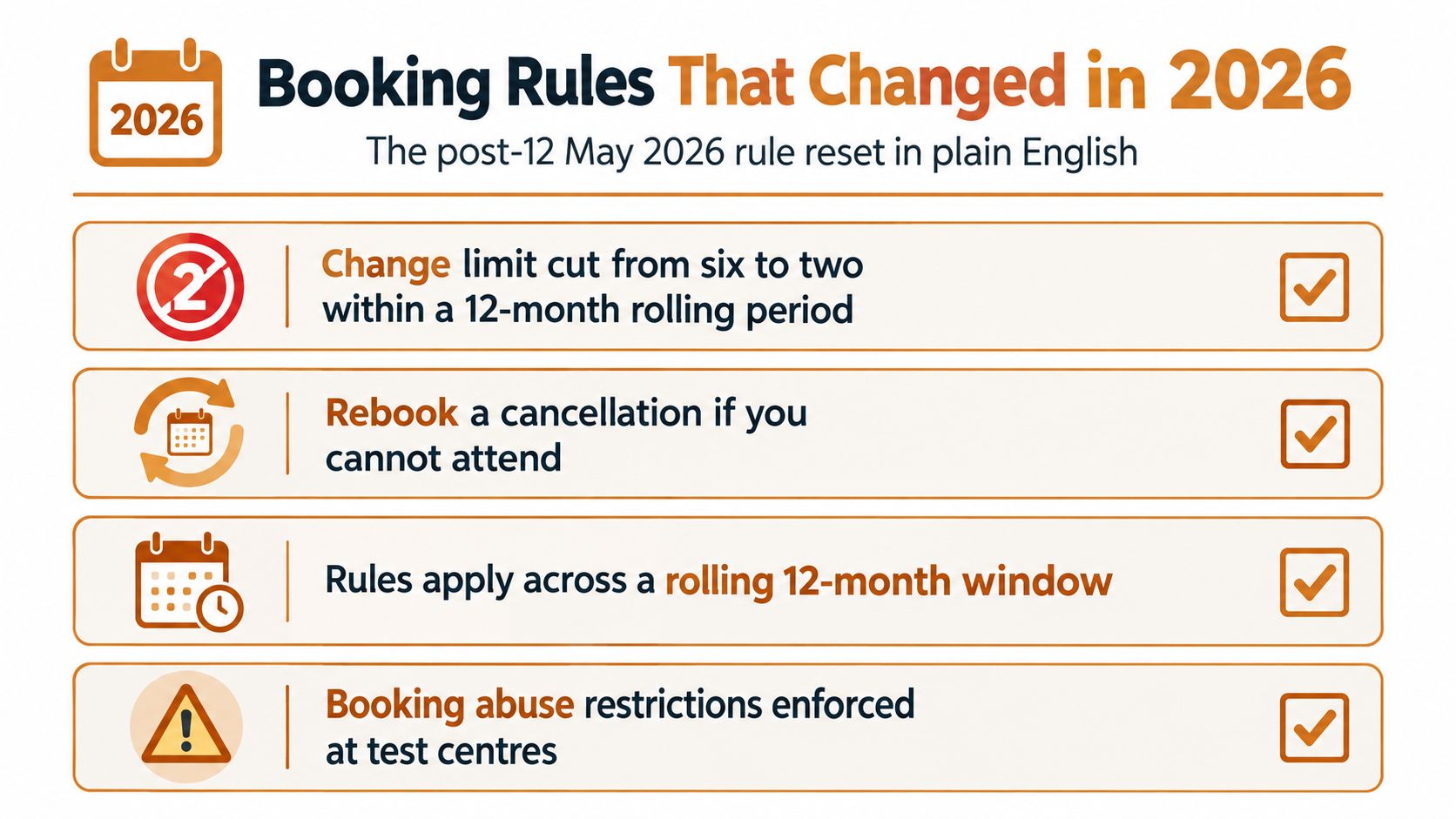
Check before changing anything
- Count your changes: Confirm how many changes you've already made before accepting a new date.
- Check the notice period: If you're inside the 10-full-working-day window, changing or cancelling may leave you without the normal refund.
- Book through DVSA: Alerts may tell you that a slot exists, but you must complete the change yourself on GOV.UK.
- Confirm readiness: Don't take a short-notice appointment that your instructor, car or preparation can't support.
- Keep evidence for exceptions: If you believe a medical or bereavement circumstance applies, check the current DVSA process and retain relevant documentation. Don't assume an exception is automatic.
The safest approach is to make a change only when the replacement is clearly better and usable. A rushed swap can consume one of your two opportunities without improving your position.
Common Misconceptions About the Driving Test Waiting List
The phrase “waiting list” encourages the wrong behaviour. Learners often spend money trying to access a queue that doesn't exist.
Myth one, you can join a formal queue by phone
You can't. The practical test booking service is online, and earlier dates come from returned appointments. Calling DVSA won't place you ahead of learners using the booking system.
Myth two, instructors have a back-channel
A good instructor can tell you which centres and times are practical. They don't have priority access to hidden appointments. Treat claims of insider access as a warning sign.
Myth three, paying a third party secures your date
Since 12 May 2026, learners must manage their own bookings, and third parties can't book tests for them under the new rules. A legitimate notification service can alert you, but you remain responsible for signing in and making the change.
Myth four, the nearest centre is always the sensible choice
Distance matters, but it isn't the only factor. A nearby centre with saturated availability may be slower than an alternative you can reach and practise properly.
Myth five, an alert guarantees a specific appointment
It doesn't. An alert can identify a possible match, but the slot may disappear before you complete the official booking process, or it may not suit your instructor.
Myth six, priority categories automatically bypass the 24-week window
Don't assume the cap disappears because of work, study or personal pressure. Check the official rules for your circumstances and plan around the dates publicly available.
The useful test is simple: if a service says it can guarantee a date or bypass DVSA controls, walk away.
Finding Earlier Slots by Manual Checking vs Cancellation Alerts
Earlier appointments come from returned slots, so learners have two practical ways to find them: check the official service themselves or use a notification service that monitors availability. Neither method creates new test capacity. The choice is between controlling the search and saving time.
Manual checking costs attention rather than a service fee. Sign in repeatedly, search your eligible centres, and move quickly when a workable date appears. You see every result directly, but the method fails easily if work, study or lessons prevent frequent checks.
Cancellation alerts reduce the refreshing burden; our guide to cancellations for the practical driving test explains how returned slots surface in the DVSA system. A service such as Driving Test Cancellations monitors the booking system and sends matching appointment details. You still decide whether the date fits and complete the change yourself through GOV.UK.
| Factor | Manual checking | Cancellation alert service |
|---|---|---|
| Cost | No additional service cost | Service fee may apply |
| Effort | Repeated searching by the learner | Monitoring is automated |
| Control | Direct view of every search | Filters depend on your settings |
| Speed | Depends on when you check | Notification can arrive soon after a match is detected |
| Booking | Learner changes the appointment | Learner changes the appointment through DVSA |
| Main risk | Missing a suitable slot | Paying for alerts that do not match your needs |
Choose manual searching if your schedule lets you check often and your availability is flexible. Choose alerts when your centre, date range or instructor's diary leaves little room. They can save time, but they cannot guarantee a suitable appointment, and a notification may arrive after another learner has taken the slot.
Check the service model before paying. It should not request your DVSA login or promise a specific date. Notification only is the compliant approach, while you remain responsible for signing in and booking the replacement appointment.
Picking the Right Test Centre to Cut Your Wait
Centre choice is the biggest lever most learners control. An app can help you notice a cancellation, but it can't make a crowded centre produce more tests. Choosing a realistic alternative can change the quality of opportunities you see.
Use the official DVSA data to compare your home centre with nearby options. The monthly figures now include national, regional and test-centre median waiting times, plus appointment availability by booking window. A centre below the national median deserves investigation, especially if your instructor can support the travel.
A practical centre filter
- Start locally: Record your usual centre and the alternatives the DVSA service permits.
- Compare the medians: Prefer centres that sit clearly below the national figure, but verify live availability.
- Test the logistics: Confirm your instructor, car, route practice and travel time before switching.
A quieter centre can be several journeys away, and that trade-off matters. Fuel, lesson time and unfamiliar roads may wipe out the benefit of an earlier appointment. Don't book a centre you've never practised at just because one date appears.
| Test-centre choice | Local evidence to check | Verdict |
|---|---|---|
| Usual local centre | Current official availability and instructor diary | Use if the date is practical |
| Nearby alternative | Median wait and live booking dates | Strong option if route practice is possible |
| Rural or coastal alternative | Travel time, vehicle access and test-route preparation | Consider only with proper preparation |
| Busy urban centre | Centre-level data and appointment availability | Avoid if alternatives are genuinely workable |
My three rules are blunt. Don't choose the closest centre automatically. Don't travel farther than your instructor can support. Don't switch unless the earlier appointment is usable in real life.
A Practical Plan to Get Tested Sooner
Start with readiness, not the booking screen. A test taken before you're prepared can leave you searching again, so ask your instructor for an honest assessment and use mock tests to identify any remaining weaknesses.
Then follow this sequence:
- Choose a workable centre: Compare your local centre with the permitted alternatives using the latest DVSA waiting-time data.
- Book an anchor date: Take the earliest appointment you can attend within the 24-week booking window.
- Add a search method: Check GOV.UK manually, use alerts, or combine both approaches.
- Review periodically: Recheck your centre choice and instructor availability rather than assuming the original booking remains optimal.
- Protect your preparation: Keep lessons, mock tests and your theory certificate aligned with the appointment.
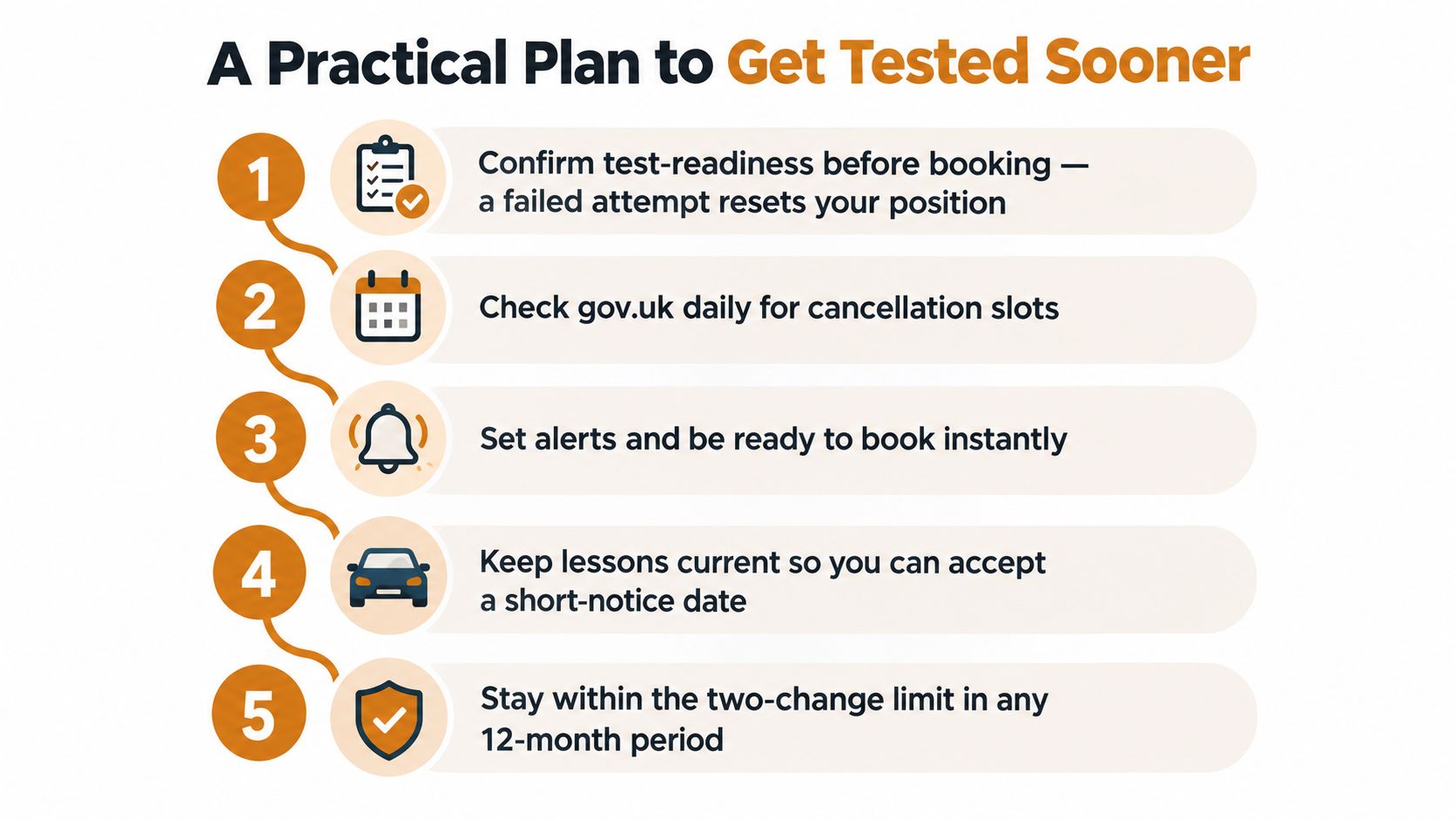
The two-change limit makes discipline essential. Don't accept a date just because it's earlier. Check the centre, time, instructor, vehicle and your readiness before confirming the swap.
A good routine beats frantic refreshing. Keep your anchor appointment, monitor realistic alternatives and act only when the replacement improves your position without creating a preparation problem.
If you want to reduce repetitive checking, Driving Test Cancellations monitors DVSA availability and sends alerts when earlier matching appointments appear. You still make the booking change yourself through GOV.UK, but the service can help you spot suitable cancellations without refreshing the booking page throughout the day.