You log into GOV.UK expecting to find a practical driving test next month. Instead, the calendar offers nothing useful, or the first realistic date is more than 20 weeks away. You refresh the page, try another time, and wonder whether you've missed a hidden trick.
That frustration is understandable. Dates available for a practical driving test can disappear quickly, particularly at busy centres, and the official booking calendar doesn't explain why some dates are absent or why an earlier appointment might suddenly appear later. The rules have also changed, so older advice about asking an instructor or cancellation service to move your test may now be wrong.
This guide explains how DVSA availability works in Great Britain, how to search the official GOV.UK service, and why cancellations are often the most useful source of earlier appointments. It also covers the changes introduced during 2025 and 2026, including the 10-working-day cancellation rule, the limit of two booking changes, and the restriction to the three nearest test centres.
You'll also learn how to compare centres sensibly, avoid using up a permitted change unnecessarily, and decide whether regular manual checking or notification-only monitoring suits your situation. The aim isn't to promise a date that may not exist. It's to give you a practical way to search, respond and rebook within the rules.
Table of Contents
- Why Finding Dates Available for a Practical Driving Test Feels So Hard Right Now
- How to Check Dates Available on the Official DVSA Booking Service
- New DVSA Rules That Change How You Can Book and Move Your Test
- Proven Tactics to Find Earlier Dates and Cancellations
- Manual Checking Versus Automated Cancellation Alerts
- What to Do Next to Secure Your Earlier Test Date
Why Finding Dates Available for a Practical Driving Test Feels So Hard Right Now
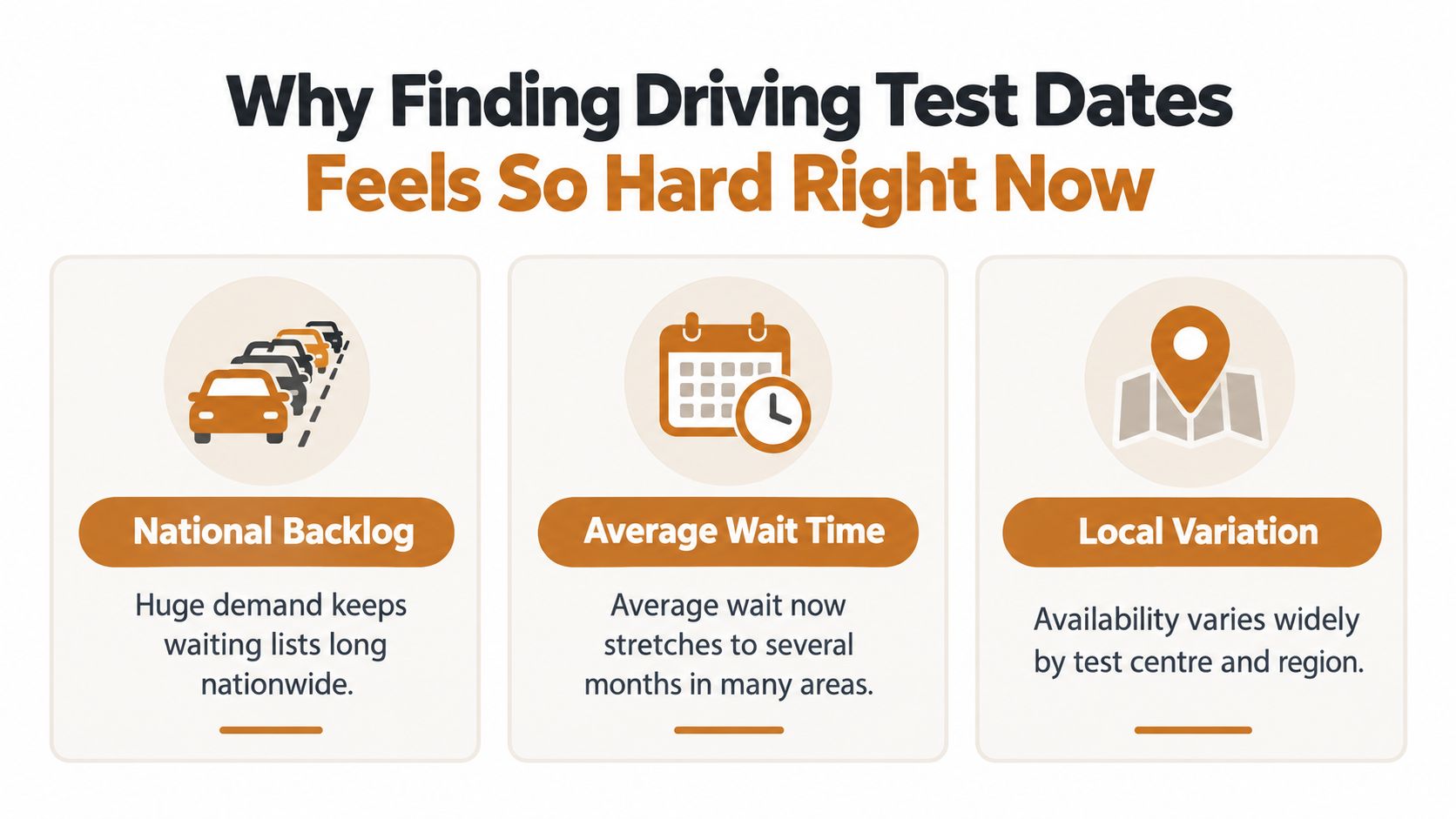
You pass your theory test, open the practical booking calendar and find the first usable appointment more than five months away. Refreshing the page does not reveal a hidden reserve of dates. The difficulty comes from a large backlog, limited appointment supply and released slots being claimed quickly.
The pressure has affected test centres across Great Britain, rather than only a handful of busy towns. Many centres have been operating close to the maximum booking window, so the calendar can look empty even when further appointments may appear later. The official figures are easier to understand alongside this explanation of driving test waiting times, which distinguishes the published averages from the experience at an individual centre.
The national figure doesn't tell the whole story
Later figures still showed limited supply. DVSA-reported data put the average wait in Great Britain at 20 weeks in August 2026, compared with 20.2 weeks in July. The median wait between booking and taking the test was 11.1 weeks, and the Independent's report on the August 2026 figures described the monthly improvement as marginal.
Those measures describe different parts of the experience. The average suggests how far ahead learners may need to search for a reasonable choice of appointments. The median describes the middle waiting experience among completed tests. A learner who checks regularly, accepts a cancellation and can reach a suitable nearby centre may test much sooner than someone who keeps the first ordinary appointment.
Centre choice can change the result sharply. BBC-reported DVSA figures placed April 2026 waits at 22.7 weeks in England, 22.9 weeks in Scotland and 17.3 weeks in Wales, with examples ranging from around 3.6 weeks at Bodmin to 27.1 weeks at Bedford. These figures show why searching only one centre can give a misleading impression of availability.
The booking rules introduced during 2025 and 2026 make the search more deliberate. The 10-working-day cancellation window affects how late you can cancel without losing the fee. The two-change limit means an unsuitable swap can use one of your permitted changes. The three-nearest-centre restriction also limits where you can move the booking. These rules turn date hunting into a planning exercise, not repeated trial and error.
Practical rule: treat the first date you see as a starting position, not necessarily your final test date.
Earlier appointments usually come from released slots. A learner cancels or changes a booking, or a centre adds availability, and another learner can take that opening. The date may be short-notice, inconveniently timed or at another eligible centre, so check the travel, lesson timing and remaining booking changes before accepting it.
How to Check Dates Available on the Official DVSA Booking Service
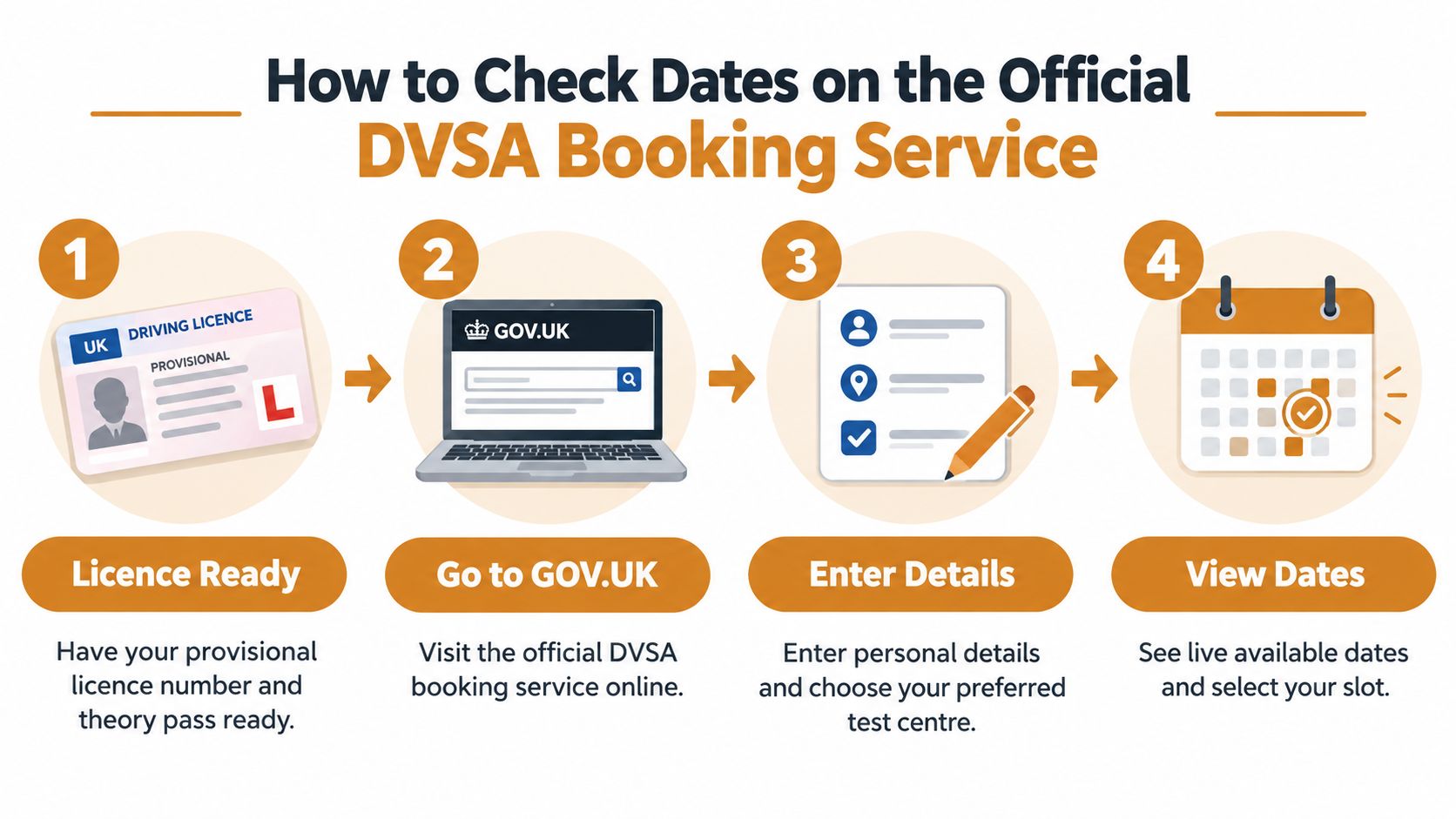
You find a suitable test date, but the time clashes with a lesson or the centre is too far away. The official GOV.UK booking service lets you check the alternatives, provided you have your provisional driving-licence details and theory-test pass information ready. If you are changing an existing appointment, keep the booking reference and current test details nearby.
The search itself is simple. The decisions around each result need more care.
Search method that avoids wasted changes
Open the DVSA service yourself. Start through GOV.UK, not an old bookmark or unofficial booking page. Changes, cancellations and swaps must be completed through the official service.
Enter the learner details carefully. Check every character in your licence and theory-test information. One error can prevent the service from finding the correct booking record.
Select a test centre and inspect its calendar. Begin with your current centre, then check nearby centres you could reach for both lessons and the test. “No dates available” describes the current search result. It does not mean the centre will never release another appointment.
Compare the full appointment before choosing it. Consider the date, time, centre, travel and instructor availability together. An earlier slot is only useful if you can reach it, prepare for it and attend with the right support.
The calendar is a viewing window, not a promise that every future slot is visible. DVSA availability has generally been presented within a maximum search period of 24 weeks, as noted in official reporting on driving-test waiting times. A centre showing no appointments across that window may still receive a cancellation or newly released slot later.
Read the messages literally
“Limited dates” means appointments are available, but they may not suit your preferred time or centre. “No dates” means the service has found nothing under the conditions you selected. Neither message rules out a later cancellation.
Check on different days and at times you can realistically manage. Before accepting an earlier appointment, confirm your instructor's availability, travel time and preparation level. The 10-working-day cancellation window, two-change limit and three-nearest-centre restriction mean a rushed swap can create a practical problem or use one of your permitted changes. Date hunting now works more like fitting pieces into a timetable than repeatedly pressing refresh.
If a result looks promising, pause before confirming it. Compare the whole journey, not just the calendar date.
The following video provides a visual introduction to the official booking journey.
New DVSA Rules That Change How You Can Book and Move Your Test
Older cancellation guides often assume that an instructor, parent or third-party service can manage the whole booking for you. That assumption no longer fits the current rules.
From 12 May 2026, only the learner named on the booking can book, change, swap or cancel their own car practical test through GOV.UK. DVSA says third parties can't carry out those actions on a learner's behalf, and learners must confirm a declaration when booking or managing a test. Bookings made through the DVSA customer service centre require the terms to be agreed verbally, as explained in the DVSA bulletin about learner-only booking control.
The cancellation window is now wider
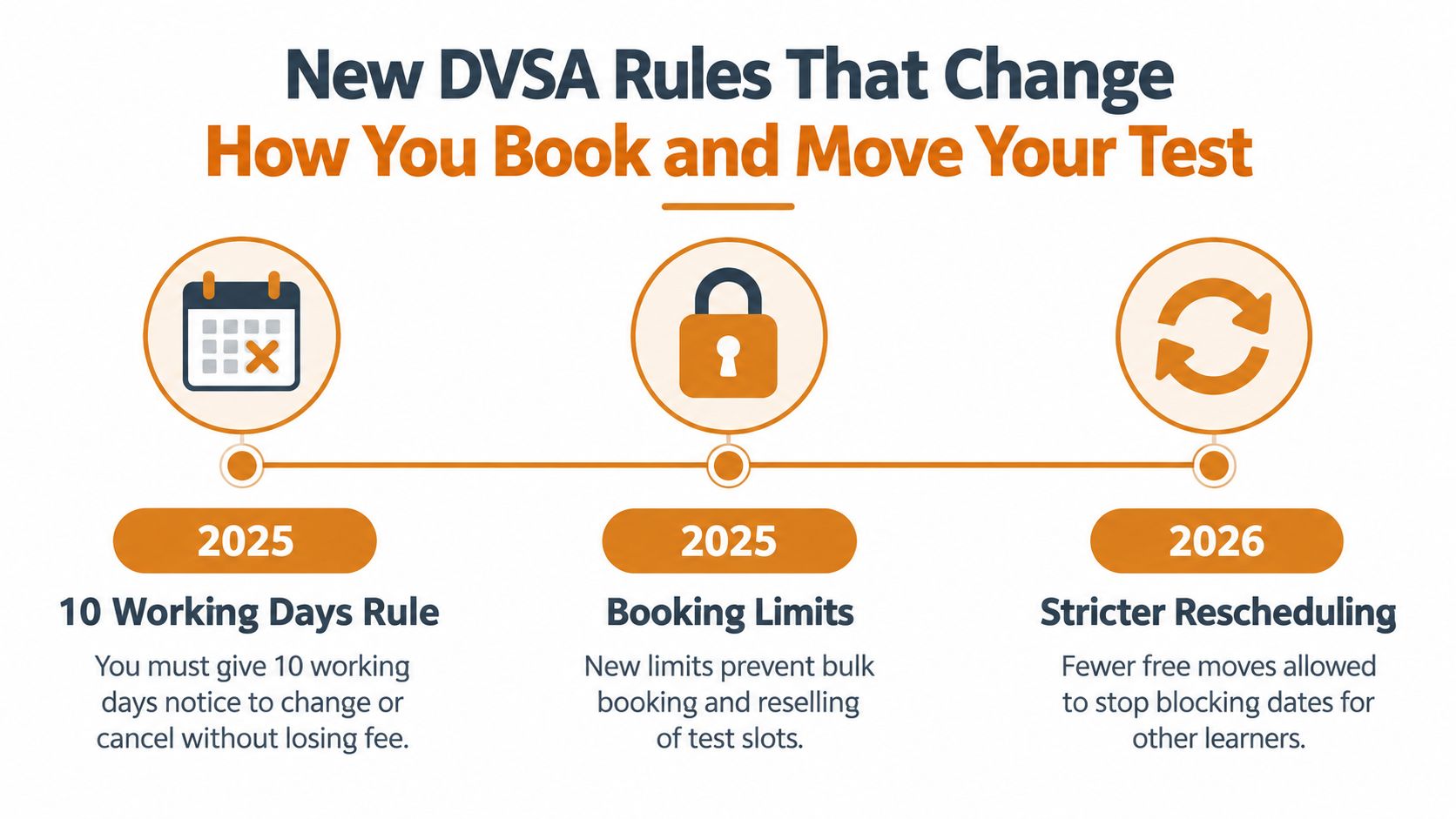
From 8 April 2025, the cancellation rule changed from three full working days to 10 full working days. The DVSA announcement about test changes and cancellations explains the updated notice requirement.
In practical terms, holding a slot “just in case” carries more risk. If you can't attend, cancelling too late may mean losing the test fee. It also means that a learner considering an earlier appointment should check their instructor's availability before moving, rather than accepting first and sorting out the lesson later.
The change limit is separate. From 31 March 2026, learners can change a practical-test booking only two times, rather than six. The limit covers alterations to the date, time or test centre. If DVSA changes or cancels the appointment, that change doesn't count, and DVSA says the learner receives a reset allowing two further changes, according to the DVSA booking-rules recap.
What the nearest-centre restriction means
From 9 June 2026, a learner can move a test only to one of the three nearest test centres. This prevents a learner from holding a booking in one area and shifting it elsewhere to search for opportunities around the country.
For example, if your current booking is linked to a particular centre, the GOV.UK service may show only the three centres DVSA treats as nearest for a permitted move. Your instructor can help you decide whether a centre is practical, but they can't log in and rebook the test for you. A cancellation-alert service can tell you that an earlier slot exists, but you must complete the rebooking personally through DVSA.
Proven Tactics to Find Earlier Dates and Cancellations
An earlier test date usually appears because another learner has released an appointment. Your approach should therefore focus on speed, flexibility and realistic centre choices, rather than repeatedly expecting the standard queue to shorten.
Begin by deciding what you can accept. A learner whose theory pass is approaching expiry may prioritise the earliest suitable date. Someone working shifts may need a particular part of the week. Another learner may be limited by an instructor who works at only a few centres. Write down those constraints before searching so you don't make a rushed change that uses one of your permitted moves.

Search wider, but stay within the rules
Compare the centres DVSA allows you to use, then check the journey, local roads and your instructor's familiarity with each area. The three-nearest-centre restriction means you can't treat every centre in Great Britain as interchangeable. A centre that looks attractive on the calendar may create extra lesson time and unfamiliar-route problems.
Cancellations can appear at awkward times, so flexibility helps. If you can move your lesson diary, accept a broader range of days, or travel slightly farther within the permitted centre group, you'll have more usable opportunities. Don't choose an appointment you can't attend because it's earlier.
A practical booking explanation, including the normal process for securing a test, is available in this guide to booking a driving test.
Respond quickly without acting carelessly
Manual checking can work if you're able to visit GOV.UK regularly and keep your login details ready. The weakness is that you may miss a slot between checks. Automated monitoring can reduce that repeated effort by scanning availability and sending an alert, but the alert isn't the booking itself.
Driving Test Cancellations monitors DVSA practical-test availability and sends time-stamped notifications containing the date, time and centre details. It operates as a notification-only service, so the learner still signs into GOV.UK and completes the change in line with DVSA's rules.
An alert gives you an opportunity. It doesn't remove your responsibility to check the appointment and confirm the move yourself.
If you receive an alert, check four things before proceeding: the centre is permitted for your booking, your instructor can attend, the date leaves enough preparation time, and you haven't already used your available changes. Then act promptly if the slot works.
Manual Checking Versus Automated Cancellation Alerts
Manual checking costs nothing beyond your time and gives you direct control. It can be perfectly adequate for a learner with a flexible schedule who can check the GOV.UK calendar often. The drawback is that you'll only see what's available during each visit, and repeated refreshing becomes difficult alongside work, college or driving lessons.
An automated alert service takes a different approach. It watches for matching availability and notifies you, while you still carry out the rebooking on GOV.UK. That distinction matters under the current DVSA rules, because a service shouldn't book, change, swap or cancel the test on your behalf.
| Feature | Manual Checking on GOV.UK | Automated Alert Service |
|---|---|---|
| Effort | Requires you to return to the official booking service and search yourself. | Monitors availability for you and sends a notification when a matching slot appears. |
| Speed | You may see a slot only when you happen to be checking. | A prompt alert can tell you about a release without waiting for your next manual search. |
| Centre coverage | You search each permitted centre during each session. | Some services let you monitor multiple preferred centres at the same time. |
| Rebooking | You complete the change directly through DVSA. | You still complete the change directly through DVSA. |
| Compliance | Uses the official service and keeps control with the learner. | A notification-only model can support compliant rebooking, provided it doesn't act for you. |
The Driving Test Cancellations service explanation sets out how notification monitoring works. For an individual learner, manual checking may be enough when the date is flexible. For someone facing a narrow theory-expiry window, limited instructor availability or several suitable centres, alerts can save repeated searches and help surface short-notice opportunities.
Approved Driving Instructors may also prefer a monitoring system when coordinating multiple pupils, but each learner remains responsible for managing their own booking under DVSA's rules.
What to Do Next to Secure Your Earlier Test Date
Start with your existing appointment rather than cancelling it. It gives you a safety net while you look for something earlier, provided you can still attend and you keep the cancellation conditions in mind.
Then make your search specific. Confirm which centres DVSA allows you to use, ask your instructor which dates and routes are realistic, and decide how much flexibility you have on time and day. Don't spend one of your two changes on an appointment that looks earlier but creates a practical problem.
A sensible next step checklist
- Check your booking details: Keep your licence, theory-pass and current test information ready.
- Agree your limits: Confirm the centres, days and times your instructor can support.
- Search GOV.UK: Look at the official calendar and compare the permitted centres.
- Choose carefully: Check travel, preparation time and attendance before confirming a change.
- Monitor released dates: Use regular manual searches or a notification-only service if repeated checking isn't realistic.
- Act promptly: When an alert arrives, verify the details and rebook yourself through DVSA.
- Track your changes: Remember that date, time and centre amendments count towards the two-change limit.
The useful mindset is simple. You're not waiting passively for a national queue to reach you. You're keeping a valid booking while watching for a suitable appointment released within the centres and rules available to you.
Driving Test Cancellations monitors DVSA availability across selected test centres and sends SMS alerts with the date, time and centre when an earlier slot appears. Visit Driving Test Cancellations to see how the notification service works, then rebook your test yourself through GOV.UK when a suitable date becomes available.