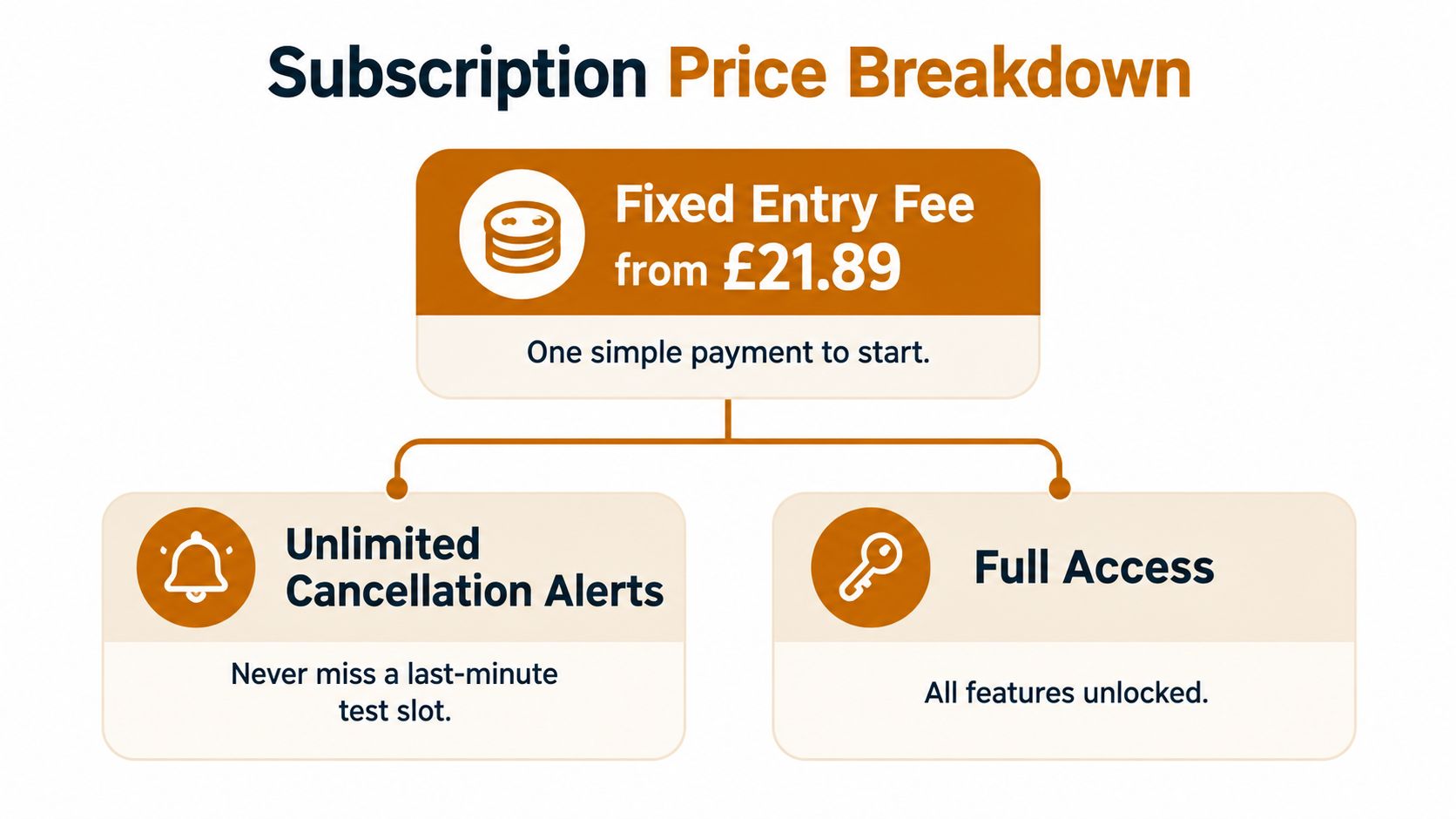
The subscription price starts from £21.89, a fixed one-off fee for unlimited alerts rather than a confusing monthly bill. That's less than the cost of a single hour of driving tuition, which commonly costs £35 to £50 in the UK.
You've passed your theory test, booked a practical test and then discovered that the next useful appointment is weeks away. Your instructor's diary is filling up, work or college won't move around easily, and every refresh of the DVSA booking page shows the same problem. Waiting isn't free. You may pay for lessons just to stay ready, hire an instructor's car for a test that's still far away, or lose income by taking time off at short notice.
A cancellation alert service can be sensible in that situation, but only if you understand what the fee buys. It buys an opportunity to find an earlier appointment. It doesn't buy a guaranteed test, a guaranteed pass or someone else making the booking for you.
Table of Contents
- What Waiting for a Driving Test Actually Costs You
- Breaking Down the Subscription Price and Included Features
- Comparing Manual Checking Versus Automated Monitoring
- Calculating the Financial Break-Even Point
- How the Service Works and Legal Compliance
- Who Should Consider a Subscription
- Frequently Asked Questions
What Waiting for a Driving Test Actually Costs You
Your chosen centre may offer a test date weeks later than you need. Your instructor might schedule another lesson to keep you ready, even though the extra practice is caused by the delay. A clash with work can mean rearranged shifts, lost income or a costly gap in training.
The centre makes a measurable difference. At Darlington, headline availability was 13 weeks, while the median learner wait was 6.7 weeks. At Banbury, the median wait reached 24.3 weeks. These figures show why a national average is a poor basis for deciding whether monitoring is worthwhile. Check the position at the centre you can reach using DVSA's waiting-time information.

Practical rule: Compare the fee with the next cost created by delay, such as another lesson, vehicle hire or time away from work.
The starting subscription price is £21.89. For a learner facing a long wait, one earlier cancellation could avoid part of an extra lesson and make the fee worthwhile. That is the break-even question to ask at your own centre: how much will waiting cost before an earlier slot becomes cheaper?
A short median wait, flexible work and no planned extra training weaken the case for paying. A long wait, limited availability and an instructor whose diary is filling up strengthen it. Do the calculation before subscribing, rather than treating the fee as a harmless convenience charge.
Use this guide to practical test prices to list tuition, vehicle use, travel and time away from work alongside the DVSA booking charge. If those delay costs exceed £21.89, monitoring is a sensible purchase. If they do not, keep the money and wait.
Breaking Down the Subscription Price and Included Features
The £21.89 starting fee is a fixed entry price for unlimited cancellation alerts. You're paying for monitoring during the purchased period, not for each text message. That distinction matters because a low headline fee can become poor value if every alert carries another charge.
The service is designed around a specific task, finding an earlier slot at centres you can reach. The stated features include:
- Unlimited alerts: You can receive cancellation notifications without paying per message.
- Up to three centres: You can monitor three preferred test centres at the same time, which widens your chances without forcing you to accept a centre you can't use.
- SMS details: Notifications include the available date, time and test-centre information, so you can decide quickly.
- ADI dashboard: Approved Driving Instructors can manage multiple pupils from one account rather than checking every learner separately.
- Free trial: Sample alerts let you understand the process before paying.
- Money-back guarantee: If no cancellations are found within the initial monitoring period, the fee is returned, subject to the service's stated conditions.
What the fee should make clear
A transparent pricing page should tell you whether the payment is one-off or recurring, how long access lasts, what counts as an alert and how the guarantee works. Check the wording before entering card details. A free trial reduces the risk of buying blindly, but it doesn't remove your responsibility to understand any conversion or renewal terms.
That control matters across the UK subscription market. Barclays reported that 88% of UK adults held at least one subscription in March 2025, while 61% were concerned about the cost of digital content and subscriptions. The same research found that 28% had reviewed their subscriptions, and 20% had cancelled or planned to cancel one because it was too expensive. Those figures are from Barclays' subscription spending report, and the lesson is straightforward. Familiar recurring payments still get scrutinised.
For broader context on how businesses structure recurring products, Fintrack subscription pricing offers a separate pricing reference. For this driving-test service, the useful question remains local and practical: will monitoring save more than it costs?
Read the provider's driving test cancellation pricing information before subscribing. Confirm the fee, monitoring period, guarantee conditions and whether you can stop access without an unwanted renewal.
Comparing Manual Checking Versus Automated Monitoring
Manual checking looks free because there's no separate monitoring fee. It still has a price, though. You give up repeated chunks of your day to log in, choose a centre and refresh the official booking system, often when you should be working, studying or taking a lesson.
DVSA says standard new practical appointments are released 24 weeks ahead at 6am every Monday. Earlier appointments are different. They appear whenever another learner changes or cancels, and there's no official waiting list or cancellation list. The GOV.UK guidance on changing a driving test explains why cancellations can arrive at any time rather than following a neat weekly pattern.
| Feature | Manual Checking | Automated Service |
|---|---|---|
| Time required | You must choose when to check and keep checking | Monitoring runs without repeated manual visits |
| Speed of response | You may see a slot only when you happen to be online | An SMS can flag the date, time and centre |
| Cost type | Variable cost in your own time, plus possible delay costs | Fixed subscription price |
| Centre coverage | You check centres one at a time | Up to three preferred centres can be monitored |
| Booking control | You complete the booking yourself | You still complete the booking yourself |
| Guarantee | No guarantee that repeated checking finds a slot | No guarantee that a suitable slot will appear |
The automated option doesn't create capacity. It changes who watches for a cancellation. That's useful when your availability is narrow, but it doesn't make a poor centre choice suddenly workable.
A notification may also arrive after another learner has taken the slot. You still need access to the DVSA system, a suitable instructor and enough flexibility to act. The fixed fee buys a faster signal, not priority over everyone else.
Calculating the Financial Break-Even Point
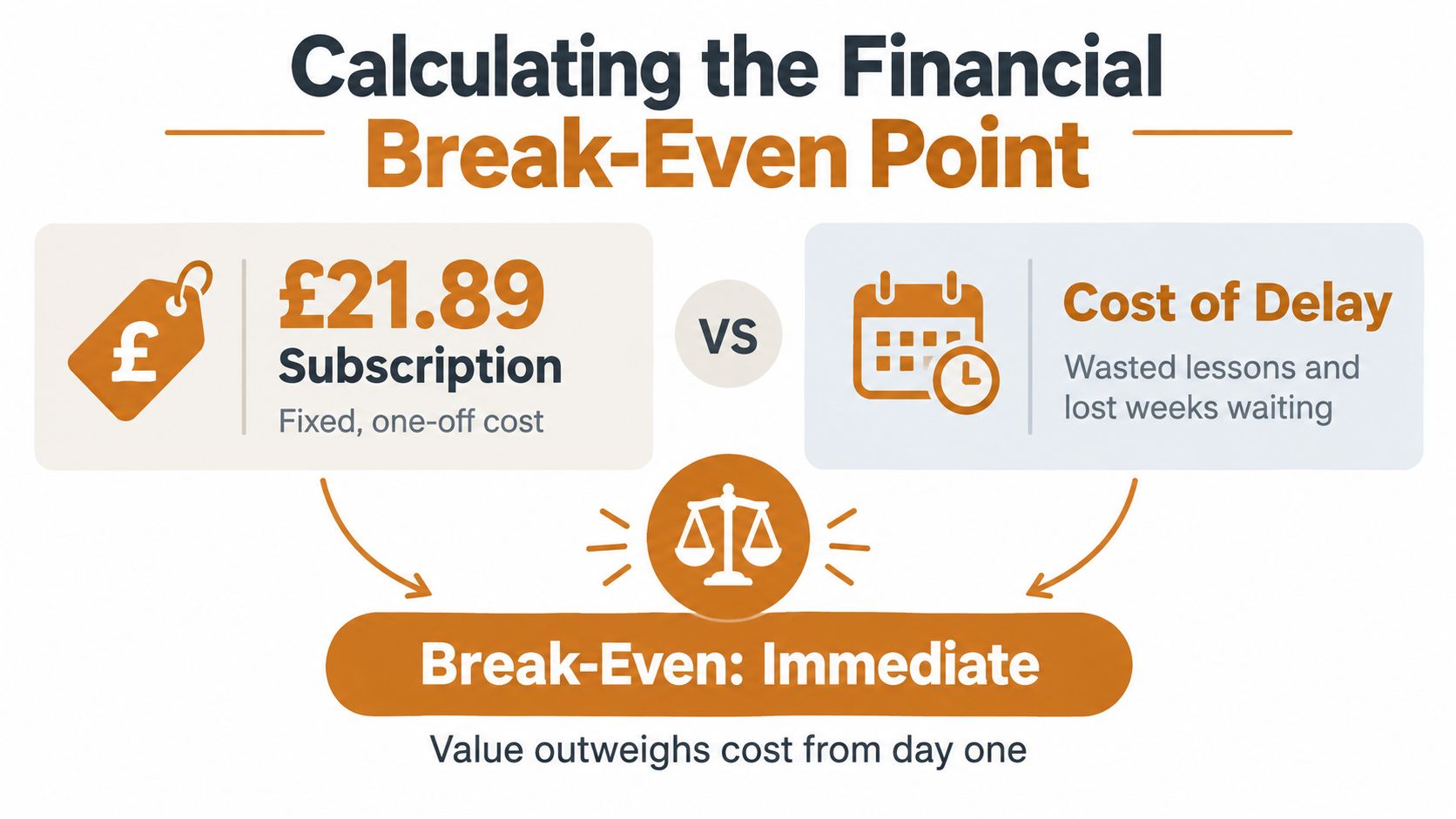
The subscription makes financial sense when delaying your test costs more than the monitoring fee. Calculate that point using your own test centre, instructor, travel needs and deadline, rather than judging £21.89 in isolation.
At the £35 to £50 hourly range used earlier, two extra keep-sharp lessons would cost £70 to £100, more than three times the monitoring fee. That does not guarantee an alert will prevent those lessons, but it shows how quickly waiting can become the more expensive option.
Test-day vehicle hire adds another cost. Using an instructor's car for the practical test can cost approximately £50 to £90. You may pay that amount regardless of the appointment date, yet a long delay can require extra preparation, create scheduling problems and prolong uncertainty.
Use your own centre and deadline
A centre-specific calculation gives you a clearer answer than a generic price comparison. Check the typical wait for your chosen centre, then work through four practical questions:
- How many extra lessons will I book while waiting? Multiply the hours by your actual lesson rate.
- Will my instructor have the right car and time? A cancellation has no value if your instructor cannot attend.
- What does a missed work or study day cost? Use your actual lost income or rearrangement cost.
- Can I reach another centre? Monitoring up to three centres helps only when you can travel there and your instructor accepts the location.
Using the DVSA waiting-time data cited earlier, Darlington had a 6.7-week median wait, while Banbury had a 24.3-week median wait. The same subscription therefore offers different value depending on location. A Banbury learner with limited instructor availability has a stronger financial case for monitoring than someone who can take a nearby Darlington appointment without disruption.
The service scans for openings and sends an alert, but it does not reserve the appointment. From 12 May 2026, only the learner can book, change, cancel or swap a practical car test. Include the risk of missing a slot while signing in or confirming arrangements.
Your break-even point is reached when one avoidable lesson, travel problem or work disruption costs more than the monitoring fee.
A notification creates an opportunity, not a guaranteed earlier test. If you can act quickly and your local wait is causing real costs, the subscription is a sensible purchase from the first useful alert.
How the Service Works and Legal Compliance
The service watches for cancellations at your selected DVSA centres and sends a time-stamped notification when a possible slot appears. You then check the details, sign in to the official booking system and decide whether to change your appointment.
The legal boundary is clear. From 12 May 2026, only the learner driver can book, change, cancel or swap a practical car driving test. Driving instructors, driving schools and third-party services can't carry out those actions for a pupil. Candidates must manage their own booking through GOV.UK or by calling DVSA on 0300 200 1122, as set out in the DVSA practical-test business terms.
DVSA says allowing another person to manage a category B test is against the law. An Approved Driving Instructor may tell a pupil when an appointment becomes available, but the learner remains responsible for making the change. That's why a notification-only service is materially different from a booking intermediary.
Check the change limits before acting
A car practical-test booking can be changed twice under the 2026 rules. A change includes moving the date or time, changing the centre or swapping with another learner. After both changes have been used, you must cancel the existing test and book another one.
DVSA also requires 10 full working days' notice for a full refund when cancelling or changing a car test. Check your instructor's availability, travel route and proposed centre before confirming an alert. Don't use a permitted change just to experiment with a date you can't properly attend.
For a plain explanation of the notification process, see how the cancellation alert service works. The sensible approach is simple: let software watch, let the learner decide and let DVSA process the booking.
Who Should Consider a Subscription
A subscription is most defensible when waiting has a clear financial or practical consequence.
Consider it if your theory test is already passed and your practical date is too far away, particularly when your instructor has limited availability. It also makes more sense when you need a particular centre because of work, study, caring responsibilities or travel limits. Someone facing a long local median wait has more to gain than a learner who can accept any nearby date.
Your own budget still comes first. Ofcom reported that 26% of UK households, approximately 6 million, had difficulty affording communications services in May 2025. Among households using subscription video-on-demand or pay-TV, 12% reported difficulty affording those services. The Ofcom affordability tracker shows why recurring charges should be treated carefully, even when the amount looks modest.
Buy monitoring for a defined scheduling problem, not because every learner needs another subscription.
You may not need it if your centre's wait is short, your instructor can fit you in at short notice and you're happy to keep checking yourself. ADIs managing several pupils have a different calculation. A dashboard and centralised alerts can reduce administration, but each pupil must still make their own legal booking change.
The common mistake is assuming payment transfers responsibility. It doesn't. The learner receives information and remains the person who checks, chooses and rebooks.
Frequently Asked Questions
Does the service guarantee an earlier test? No. It alerts you when a cancellation appears, but another learner may take it first.
How long does access last? Check the plan terms before paying, including the monitoring period, renewal wording and guarantee conditions.
What if I miss an alert? The appointment may no longer be available, so act quickly and verify it through DVSA.
Does the price include VAT? Check the checkout and pricing terms for the applicable tax treatment.
The subscription buys time and opportunity, not a guaranteed appointment or a driving-test pass. Compare the fee with your centre's waiting time and the cost of extra lessons, vehicle use and missed work before deciding.
Driving Test Cancellations monitors DVSA practical-test availability and sends alerts with the date, time and centre so you can rebook directly yourself. If waiting is costing you extra lessons or creating a narrow scheduling window, visit Driving Test Cancellations and compare the fixed price with your own likely cost of delay.