You've booked your practical test at Melton Mowbray, but the appointment is later than you'd like. You may also be wondering whether the centre's strong pass rate makes it a sensible place to test, what the surrounding roads are like, and whether a cancellation alert can move your test forward. The short answer is yes, Melton Mowbray has a notably strong record, but preparation and quick action still matter far more than the centre's headline statistics.
Table of Contents
- Finding the Centre and Getting There
- Centre Performance and What the Numbers Mean
- Test Routes and What to Practise
- Booking Rules, Fees and Notice Periods
- The 12 May 2026 Rule Change and What It Means Here
- How Cancellation Alerts Help and What They Cannot Do
- Day-of-Test Checklist and Verdict
Finding the Centre and Getting There
Arriving at an unfamiliar test centre already puts unnecessary pressure on you. You don't want your first decision of the morning to be finding Phoenix House, looking for a parking space or discovering that you need to locate a toilet elsewhere.
Melton Mowbray Driving Test Centre is at Phoenix House, Nottingham Road, Melton Mowbray, Leicestershire, LE13 0UL, according to the DVSA practical test-centre dataset. The site has parking, but only staff toilets are available. Candidates are directed to facilities at a nearby supermarket, so use the toilet before checking in rather than assuming the centre will provide one.
If you're driving into town, plan the final approach in advance. The A606 brings you towards Melton Mowbray from the west and south-west, while the A607 approaches from the north-east and Leicester direction. Your exact route will depend on where you start, but the sensible approach is to use a sat-nav for the broad journey and then practise the Nottingham Road area with your instructor. That removes the distraction of unfamiliar lane choices on the morning.
Leave room for small delays
If you're travelling by train, Melton Mowbray station gives you access to the town, but you'll still need to allow time for the onward journey to Nottingham Road. Bus services also serve the town and surrounding areas, although the practical timing depends on the route and appointment time. Check the current service before setting off, and don't plan to arrive with only a few minutes in hand.
Aim to be early enough to park, use nearby facilities, check your licence and settle your breathing. You'll perform better if you start calmly instead of rushing from the station, bus stop or car park.
Practical rule: Visit the centre area before test day, preferably during a lesson. Knowing where Phoenix House is means your test starts with driving, not last-minute searching.
You can also use this Melton Mowbray test-centre guide to familiarise yourself with the location and surrounding arrangements. Don't treat the centre address as a route to memorise. Treat it as the starting point for practising the kinds of roads you'll meet nearby.
Centre Performance and What the Numbers Mean
Melton Mowbray is a strong-performing centre by any sensible comparison. During the 2025–26 DVSA financial year, from April 2025 to March 2026, it recorded 1,984 car practical tests and 1,382 passes, giving a 69.7% pass rate according to the reported Melton Mowbray centre results.
That result was 19.6 percentage points above the reported Great Britain average of 50.0% for the same period, placing the centre 13th among 317 car test centres in Great Britain. Those figures make Melton Mowbray a relatively high-performing location, but they don't turn the test into an easy option for an unprepared driver.
The longer record matters
The centre's recent result didn't appear from nowhere. Its pass rate has generally remained above the UK-wide average across the available historical series, although the yearly figures have moved around.
| Year | Tests | Passes | Pass rate |
|---|---|---|---|
| 2017–18 | 2,267 | Not stated | 55.4% |
| 2018–19 | 2,203 | Not stated | 56.0% |
| 2019–20 | 1,960 | Not stated | 58.6% |
| 2020–21 | 479 | 279 | 58.2% |
| 2021–22 | 1,873 | Not stated | 62.7% |
| 2022–23 | 2,159 | Not stated | 61.9% |
| 2023–24 | 2,427 | Not stated | 59.8% |
| 2024–25 | 2,486 | 1,589 | 63.9% |
| 2025–26 | 1,984 | 1,382 | 69.7% |
The historical figures are available in the Melton Mowbray driving-test pass-rate series. From 2017–18 to 2025–26, the pass rate rose by 14.3 percentage points, while the 2020–21 activity level shows how sharply test provision can be disrupted.
Don't confuse performance with availability
The latest year also brought a fall in throughput. Melton Mowbray conducted 502 fewer tests than in 2024–25, a reduction of about 20.2%, while successful candidates fell by 207. The pass rate still increased by 5.8 percentage points, but fewer tests can affect how quickly suitable appointments appear.
That's why I wouldn't assume a high pass rate means you'll find an early booking. It tells you something useful about the centre's historical results, not how many cancellations will appear this week. For a wider explanation of why appointment supply changes, see this guide to driving-test waiting times.
Test Routes and What to Practise
Don't waste lessons trying to memorise one alleged Melton Mowbray route. The DVSA doesn't publish fixed public test routes, and an examiner can assess you on a selection of roads that test the same core skills in different places.
Independent route material commonly identifies local-road environments around Scalford Road, Norman Way, Thorpe Road, Sherrard Street, Leicester Street, Wilton Road and Asfordby Road, with some routes extending towards Asfordby Hill and rural connections. Use those roads as a training map, not as a promise of what you'll drive.
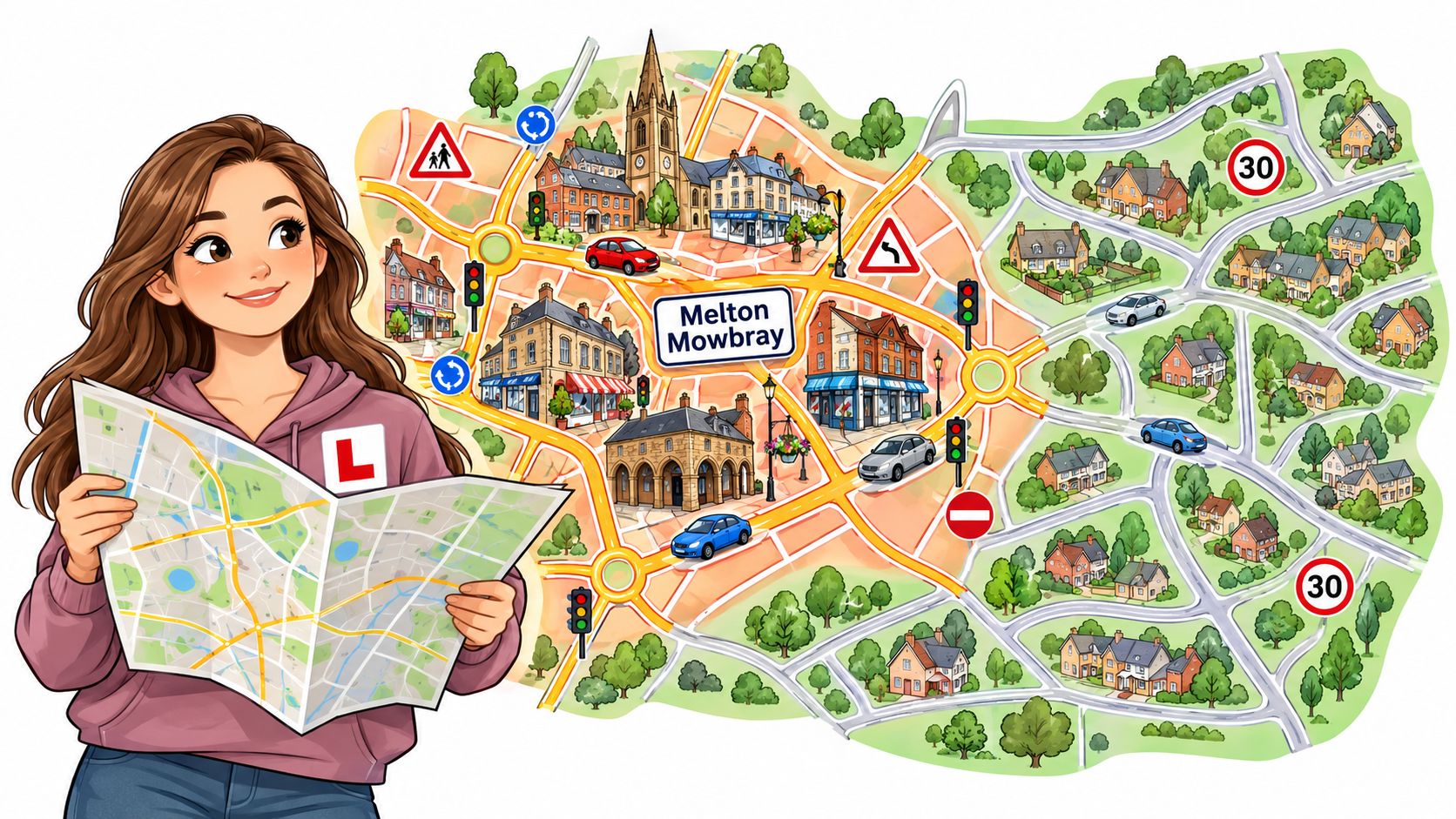
The challenge comes from moving between different road types. Compact-town traffic systems create frequent decisions about mirrors, signals, lane position and gap selection. Once you leave the built-up area, rural bends and higher-speed roads give you fewer visual cues and less margin for late braking or poor positioning.
Practise transitions, not a single circuit
Ask your instructor to use a transition drill whenever a lesson moves from town roads towards the edge of Melton Mowbray:
- Set your speed from signs and road shape. Don't wait until a bend or junction forces you to brake.
- Scan beyond the next junction. Look for pedestrians, cyclists, parked vehicles and changing traffic patterns early.
- Check mirrors before changing position. This matters before signalling, moving around parked cars or choosing a lane.
- Choose gaps calmly. A safe gap is better than a rushed decision made because you think you're holding someone up.
- Reassess after every major change. Rural roads, traffic-light approaches and one-way layouts each demand a fresh reading of the road.
Practise signalised junctions, roundabouts, pedestrian activity, narrower residential streets and rural bends. Include independent driving and sat-nav work so you can recover sensibly if you take a different road. A safe deviation isn't automatically a driving fault. The examiner is looking for controlled, observant driving, not perfect route recall.
Route lists are useful for showing you where to practise. They aren't official DVSA itineraries, so don't let them narrow your preparation.
The independent Melton Mowbray route material is best used to identify road environments and recurring junction types. Your instructor should then vary the approach, direction and traffic conditions.
A video can help you recognise the general local layout, but watching one isn't a substitute for driving it. Use it before a lesson, then spend the lesson explaining what you saw and testing your decisions in real traffic.
Booking Rules, Fees and Notice Periods
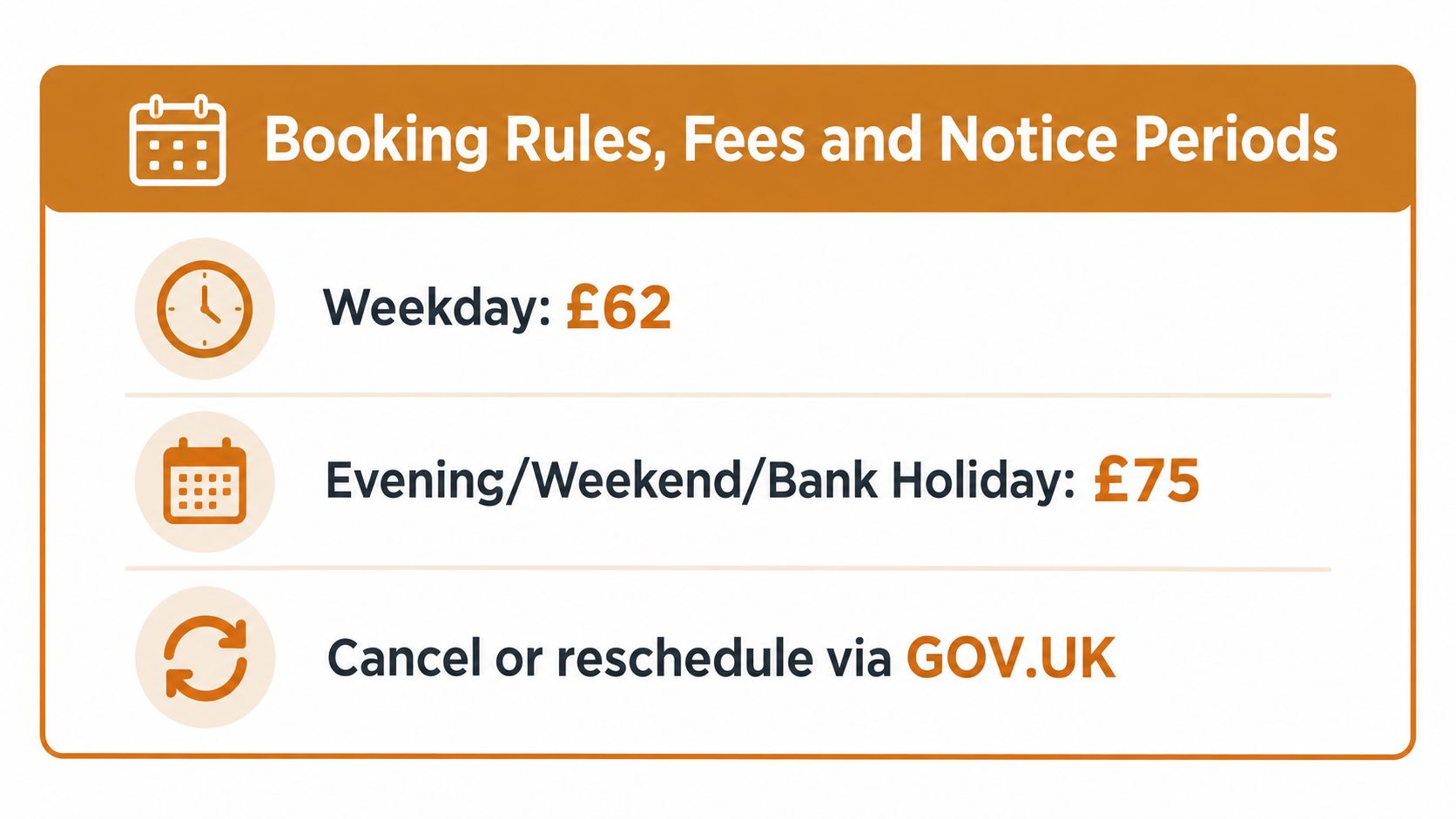
The official test fee depends on when your appointment takes place. A weekday car practical test costs £62, while an evening, weekend or bank-holiday appointment costs £75, as set out in the DVSA guidance on unofficial booking services.
That money goes to the DVSA. It isn't a fee paid to a cancellation-alert service, and an alert provider shouldn't present itself as the organisation issuing your test appointment.
Give yourself the full notice period
Changing an appointment is free when you give the DVSA at least 10 full working days' notice. Mondays to Saturdays count as working days, but Sundays and public holidays don't. The same notice requirement matters when cancelling if you want to protect the refund.
Leaving the change too late can mean losing the fee or paying again for a replacement booking. That makes appointment decisions more than a simple search for the earliest available date.
Before moving a Melton Mowbray booking, check three things:
- Your readiness: An earlier date only helps if you can drive safely at test standard.
- Your instructor's availability: Confirm that lessons and the test car can be arranged around the new appointment.
- The appointment cost: Out-of-hours slots carry the higher official fee, even if the date is more convenient.
You can book online through GOV.UK or call the DVSA on 0300 200 1122. The DVSA practical-test booking guide is useful for checking the process, but the final appointment remains an official DVSA transaction.
The 12 May 2026 Rule Change and What It Means Here
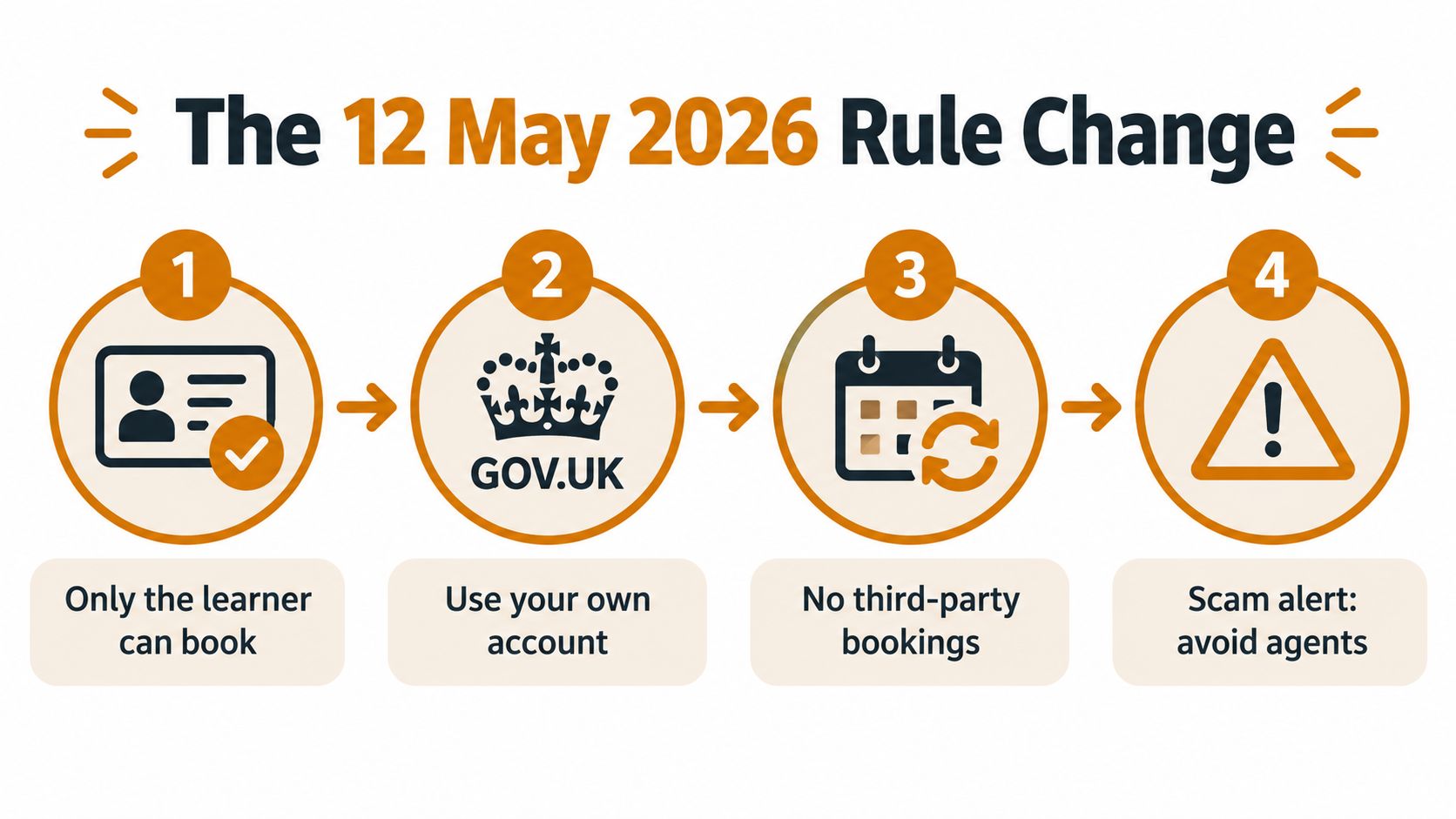
From 12 May 2026, only the learner taking the car practical test can book, change, cancel or swap the appointment, according to the DVSA changes to driving-test booking rules. Driving instructors, driving schools and third-party services can't carry out those actions for the learner.
That changes the practical routine for anyone waiting for an earlier Melton Mowbray slot. Your instructor can tell you that a suitable appointment is available, and an alert service can notify you that one has appeared, but you must sign in to GOV.UK and complete the rebooking yourself.
The important distinction is notification versus access
A notification tells you that you may want to act. A prohibited service accesses your booking and changes it for you. The DVSA says unofficial services that scan its booking system for appointments, including cancellation-finder websites or apps, aren't allowed under the booking rules, so check exactly how any service operates.
The safe arrangement is straightforward:
- You hold the booking in your own DVSA account.
- You receive information that an earlier appointment may be available.
- You sign in to GOV.UK yourself.
- You change the appointment through the official process.
An Approved Driving Instructor or parent can still help you decide whether a date works. They can't complete the category B booking action on your behalf after the rule change. The DVSA practical-test business terms confirm that instructors and driving schools can no longer book or manage those tests for pupils.
That means you should keep your GOV.UK login details available and know the rebooking steps before an alert arrives. Speed matters when appointments are released, but compliance matters more.
How Cancellation Alerts Help and What They Cannot Do
There are two sensible ways to look for an earlier Melton Mowbray appointment. You can check manually, or you can use a notification service that tells you when a possible cancellation appears.
Manual checking gives you direct control and costs nothing beyond your time. You sign in, search for availability and repeat the process when you can. The weakness is obvious: cancellations appear unpredictably, and refreshing at the wrong time means you may never see a useful slot.
An automated alert service takes over the monitoring task, not the booking task. The service scans for availability and can send an SMS containing the date, time and centre when a slot appears. You then make the change yourself through your DVSA account.
Compare the two approaches
| Approach | What it does well | Where it falls short |
|---|---|---|
| Manual checking | Gives you direct control and requires no alert subscription | Takes repeated effort and depends on when you happen to check |
| Cancellation alert | Monitors availability while you're working, studying or sleeping | Doesn't guarantee a suitable slot or complete the rebooking |
| Monitoring several centres | Gives you more options if you can practise in each area | Only makes sense where you can reach the centre and prepare properly |
The 2026 rules make the boundary clear. A notification can help you spot an opportunity, but a service must not book, change, cancel or swap the test for you. If a provider asks for control of your booking or promises to complete the process on your behalf, avoid it.
An alert can save you from constant refreshing. It can't make you ready for an earlier test, and it can't replace the official DVSA rebooking step.
You may choose to monitor a small number of preferred centres if you are able to practise there. Don't widen the search so far that you end up accepting a date at a place where the roads, junctions and instructor arrangements are unfamiliar.
Day-of-Test Checklist and Verdict
On the day, keep the routine simple. Arrive at Phoenix House with enough time to park and use the nearby supermarket facilities, because the centre has parking but only staff toilets. Have your licence and booking details ready, and avoid adding a last-minute errand to an already tense morning.
Use the lesson before your test as a warm-up around the surrounding roads. Ask your instructor to include town junctions, lane changes, roundabouts and a rural section rather than driving one familiar loop repeatedly. You want your observation and planning working, not just your memory of a route.
Keep this short checklist in mind:
- Arrive settled: Build in time for traffic, parking and the walk to the centre.
- Check the essentials: Bring the required licence and make sure the test car is suitable.
- Warm up intelligently: Practise decisions and transitions, not just manoeuvres.
- Stay flexible: A different road from the one you expected isn't a problem if you drive safely.
- Act through GOV.UK: If an alert arrives, sign in and complete the change yourself.
Melton Mowbray is a credible choice for a practical test. Its 69.7% pass rate in 2025–26, strong longer-term record and position above the Great Britain average make it a high-performing centre, but those figures don't remove the need for local practice. The centre's annual test volume also changed substantially, so a good pass rate won't solve appointment availability on its own.
My verdict is clear. Practise the local road mix properly, keep your booking flexible where possible, and use an alert only as a prompt to act. The alert can find the opportunity. You still have to be ready, sign in and rebook it yourself.
Driving Test Cancellations monitors DVSA availability and sends alerts when earlier Melton Mowbray appointments appear, while leaving the official rebooking in your hands. Visit Driving Test Cancellations to check the service and start watching for a date that fits your preparation and instructor availability.