If you're staring at a theory pass, a few lessons behind you, and a test date that still feels too far away, you're in the most common part of the process. The hard bit is rarely the driving itself on a quiet lesson road. It's knowing when you're ready, how to keep the skills sharp while you wait, and what to do when the DVSA slot you want keeps drifting out of reach.
The best how to prepare for driving test advice is less about cramming and more about timing. You need enough practice to make the basics automatic, enough mock tests to show what still falls apart under pressure, and a plan for the weeks when you're waiting on an appointment rather than driving every few days. That balance matters because the theory test is valid for 2 years (GOV.UK guidance on driver and rider testing), and because the practical test itself is only one short appointment, not a test of how much you can remember in the car park beforehand.
Table of Contents
- Setting Up Your Preparation Timeline
- Bridging Theory Knowledge and Practical Skills
- Mastering the Critical Fault Areas
- Managing Test Booking and Vehicle Readiness
- Navigating the Test Day Experience
Setting Up Your Preparation Timeline
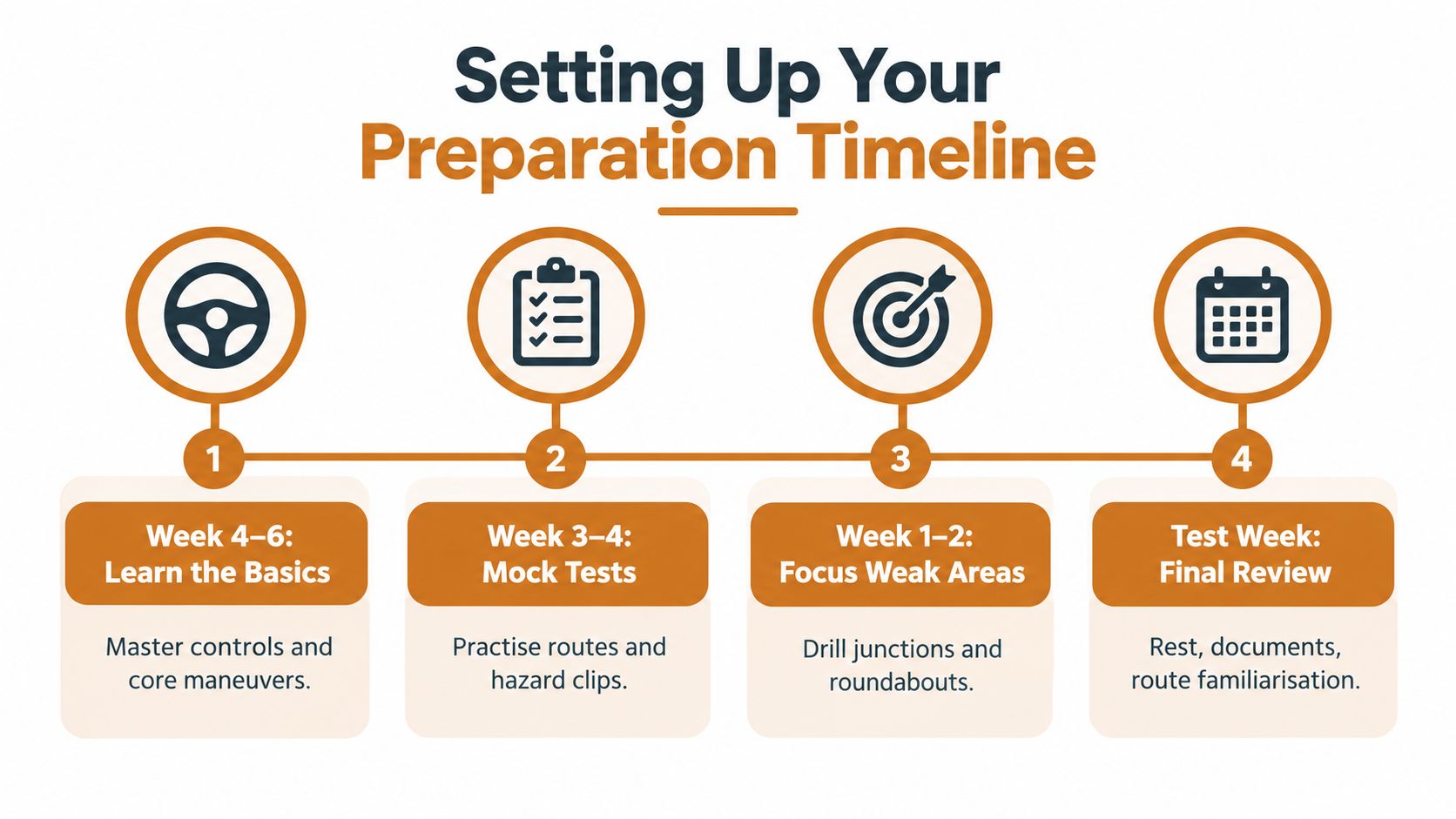
A lot of learners talk about the test as if booking it is the finish line. It isn't. Booking is just the point where your preparation becomes more disciplined, because the clock starts running on your readiness as well as on your theory certificate.
Work backwards from the date you want
If you already have a slot, build your plan around that day instead of around vague confidence. Keep the early part of preparation focused on controls, junctions, moving off smoothly, and the kind of decisions that tend to wobble when nerves creep in. Later, shift the balance towards mock tests and the routes, signs, and situations you keep getting wrong.
If you don't yet have a slot, the wait itself becomes part of the plan. DVSA waiting times can vary a lot by centre, so a test date shouldn't be treated as fixed until it's close enough to trust. For that reason, many learners find it useful to keep checking earlier options rather than assuming their first booking is the only one that matters, and a practical way to track that is to look at current waiting-time patterns such as the latest driving test waiting times overview.
Practical rule: the more uncertain your appointment date, the more your preparation should be based on repeatable drills rather than on “I'll be fine on the day”.
Use the waiting period properly
Weeks between lessons can drain confidence. Skills that felt solid on Tuesday can feel rusty by the following weekend, especially if you're not driving regularly. That's why a good timeline mixes instructor time with supervised practice and short, deliberate refreshers rather than long gaps followed by one big push.
A useful rhythm is simple. Keep lessons regular enough that faults don't get forgotten, add private practice where that's safe and legal, and use the last few sessions to tidy up the things that keep coming back. If the waiting time drifts, don't just keep booking more of the same. Change the emphasis so the final weeks are about test readiness, not learning brand-new habits.
Bridging Theory Knowledge and Practical Skills
Passing theory first is compulsory, but theory on its own doesn't keep a car steady at a junction when a gap appears and disappears in seconds. The actual job is turning rules into reactions that happen without hesitation. That's why strong theory knowledge matters, but only as the base layer for what you do with your hands, eyes, and feet.
Know the rule, then practise the action
A learner can often explain a rule perfectly and still miss it in motion. Road signs are the obvious example. You may know what a sign means, but the practical question is whether you spot it early enough, interpret it fast enough, and then choose the correct position without overthinking. That's where repetition matters more than rereading.
The same applies to hazards. Theory test revision should sharpen hazard perception, road sign recognition, and rule recall, but those things only become useful when you've linked them to physical routines. Check your mirrors before changing direction. Glance ahead for the developing risk, not just the obvious one. Make the decision while there's still room to act.
A useful extra read on the mirror side of this comes from safer driving tips from T1A Auto, which is handy if blind spots and mirror discipline are still catching you out.
Turn knowledge into muscle memory
The learners who do best usually don't sound the most knowledgeable. They look the most settled. That's because they've reduced the number of decisions they need to make under pressure. A right-of-way rule you've only memorised is fragile. A right-of-way rule you've practised in different road layouts starts to become automatic.
That's also why broad, unfocused revision doesn't help as much as people hope. The Highway Code is worth knowing, but the test rewards the ability to apply it without freezing. Use theory revision to spot where your decision-making is weak, then ask your instructor to recreate those moments on the road until the reaction is boringly consistent. For structured revision and practice materials, the theory test guidance page is a sensible starting point.
Passing the computer test doesn't prove you're road-ready. It proves you can answer questions. The practical test asks whether you can use those answers while a car, a junction, and another driver are all demanding your attention at once.
Mastering the Critical Fault Areas
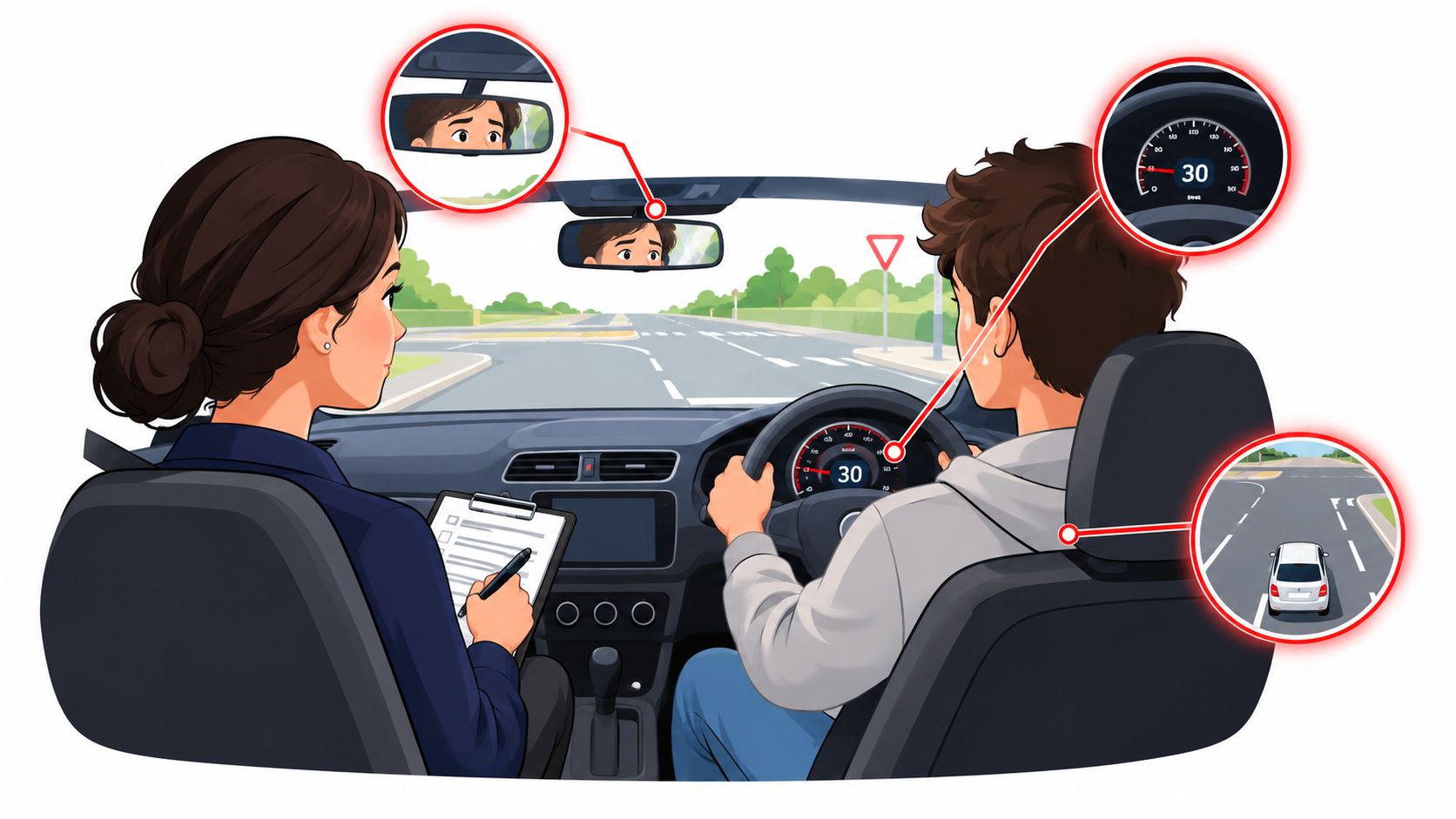
The top fail points in Britain aren't mysterious. They're the things learners repeatedly get wrong because they're small, easy to underestimate, and easy to forget when the examiner is sitting beside them. Junction observation, mirror use when changing direction, and safe moving off deserve the most attention because they keep appearing in DVSA fault patterns and they show up in the decisions that decide whether a drive looks safe or rushed. The practical test result itself allows 15 or fewer minor faults and no serious or dangerous faults (GOV.UK driving test result guidance).
Build a fixed junction routine
Junctions punish hesitation and overconfidence in equal measure. The safest pattern is to make your checks boringly consistent. Scan mirrors, judge your road position, assess the gap, then move only when the space is clearly safe. If you do that every time, you're less likely to rush one junction and overthink the next.
The point isn't to drive slowly everywhere. It's to use the same mental sequence every time the road opens up or narrows down. Roundabouts, turns, lane changes, and emerging from side roads all need the same discipline. Once that sequence is stable, the road feels less like a series of surprises.
Treat mirrors as a habit, not a rescue tool
A mirror check after the mistake is too late. The examiner wants to see the check before the change, before the turn, and before the car shifts position in a way that affects someone else. That's why mirror discipline needs drilling until it's automatic.
Use lesson time to rehearse one movement at a time. Ask yourself out loud what you checked, what you saw, and what you decided. If you can't explain it clearly, you probably haven't made the habit strong enough yet. That's where focused mock tests help, because they expose the exact moment your sequence breaks rather than just telling you that you “need more practice”.
Don't ignore move-off safety
Moving off safely is one of those areas that looks easy until nerves make it messy. You can stall, drift, forget your blind spot, or pull out too quickly. Practise it from both the kerb and parked positions until the routine is smooth. A proper check, a clean signal if needed, and a calm pull-away matter more than trying to impress anyone.
The practical value of this approach is simple. If a fault keeps appearing in the same category, don't widen your practice. Narrow it. Work on the high-frequency error until it stops appearing in consecutive mocks, then move on.
Managing Test Booking and Vehicle Readiness
Getting ready to drive well is one problem. Getting a usable test slot and a compliant car is another. If either one goes wrong, you can lose the day before you've even moved off from the centre. That's why booking strategy and vehicle prep deserve the same attention as steering and junctions.
Think about the slot, not just the booking
DVSA waiting times can be uneven by centre, so your local experience may be very different from the national picture. That matters if you're trying to line up lessons, private practice, and theory expiry without wasting time. A flexible plan gives you room to jump on an earlier slot when one appears, rather than being locked into a date that no longer fits your progress.
If the centre you want is consistently busy, prepare as if the date could move. Keep your strongest routines fresh, keep an eye on availability, and avoid the trap of assuming you've got plenty of time just because the calendar says so. For a more detailed look at how wait times affect planning, the driving test tips for nerves article is useful because nerves often rise when the date feels unstable.
Check the car before the day arrives
If you're using your own car, it has to meet DVSA rules. It must be roadworthy, taxed, insured for test use, and have a current MOT if it's over three years old. It also needs no tyre damage, legal tread depth, the ability to reach at least 62mph, an officially fitted mph speedometer, L-plates front and rear, and an extra interior rear-view mirror for the examiner (GOV.UK rules for using your own car).
That list sounds administrative, but it's really about avoiding embarrassment and cancellation. A forgotten mirror, a damaged tyre, or a missing plate can end the day before it starts. The same goes for the basic items you need to bring, including your UK driving licence and theory test pass certificate if you have it (GOV.UK what to take to your driving test).
Don't leave the car fit-out until the morning
Test cars need to feel familiar, not newly adjusted. Make sure seat position, mirrors, and controls are set the way you'll use them. If your instructor is supplying the car, still arrive early enough to settle in and check everything properly. If it's your own vehicle, do a full walk-round the day before rather than assuming all the small things are in place.
A lot of avoidable test-day stress comes from tiny vehicle problems that should've been sorted the night before, not from the drive itself.
Navigating the Test Day Experience
The test feels bigger in your head than it is in the car. Once it starts, it follows a predictable pattern, and most of it is about whether you keep driving safely while being watched. The appointment normally lasts 38 to 40 minutes in total, with a minimum on-road driving element of 30 minutes for a standard car test, according to DVSA examiner guidance (GOV.UK examiner guidance).
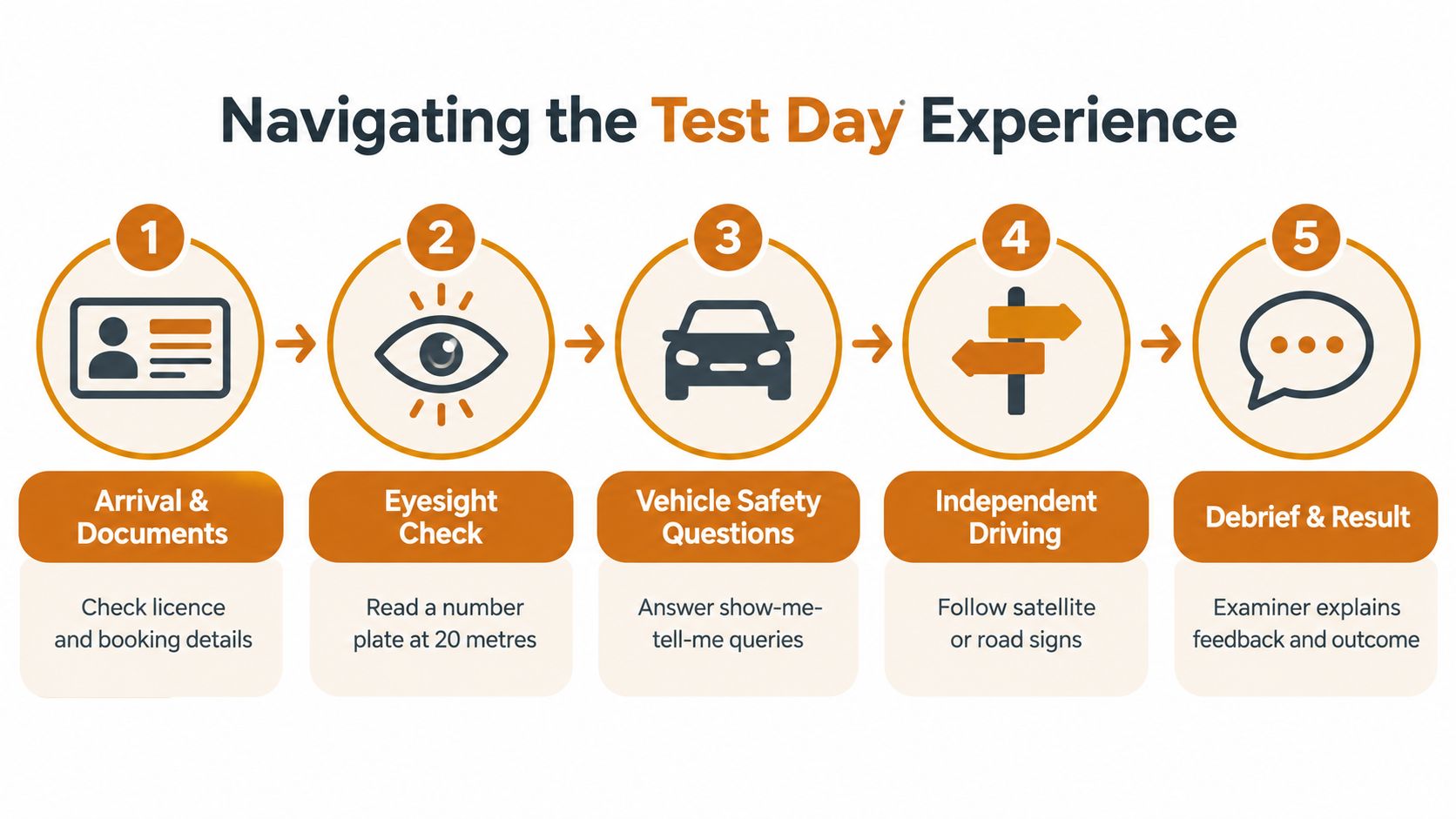
The first thing the examiner checks is the paperwork and the car. Then comes the eyesight test, where you must read a number plate from 20 metres away, roughly the length of five parked cars (GOV.UK eyesight rules). If you can't read it correctly, the test stops there.
After that, the examiner will ask vehicle safety questions and then send you out on the road. The independent driving part is there to see whether you can follow directions and stay composed without needing constant help. Sometimes that means following sat-nav directions, sometimes road signs. Either way, the standard is the same, keep it safe, legal, and calm.
What a minor mistake actually means
One bad moment doesn't automatically end the test. A candidate can make a small error and still pass if the overall drive remains safe. What tends to cause trouble is a mistake that shows poor judgement, repeated hesitation, or unsafe positioning. That's why the right response after a wobble is to settle your breathing, refocus on the next instruction, and keep the car tidy.
A useful way to think about the independent section is that it's not a memory test. It's a concentration test. Miss a sign and then recover safely. Take a wrong turn and follow the road correctly. That sort of recovery often tells the examiner more than trying to pretend the mistake didn't happen.
Keep your focus on safety, not on the examiner's pen
Learners often fixate on the examiner writing notes. That's a distraction. The examiner has to record the drive as they go. Their pen moving doesn't mean you've just failed. Keep your eyes on the road, not on the paper.
If nerves usually spike for you, rehearse the test-day flow before the appointment. Arrive early, sort the documents, breathe properly, and keep your first few minutes calm rather than over-precise. The goal is to drive like the person you are on a good lesson, not the person your nerves try to invent.
If you need an earlier practical slot, quicker updates on cancellations, or help reducing the time spent refreshing booking pages, visit Driving Test Cancellations. It's a practical way to keep your test plans moving while you keep your skills sharp.