48 out of every 100 driving tests were failed in Great Britain during July 2026, and 1 in 10 people who fail say nerves were the main reason. The most effective response is realistic preparation combined with simple ways to lower physical tension, not an attempt to eliminate nerves completely.
You may know how to deal with roundabouts, meeting traffic and reversing manoeuvres perfectly well in lessons, then arrive at the test centre early with tense shoulders, shallow breathing and a sudden conviction that you've forgotten everything. That reaction is common. It doesn't automatically mean you're unprepared.
The aim is to make nerves manageable enough to keep making safe, deliberate decisions. These driving test tips for nerves follow the journey from becoming familiar with the test area to checking your standard, rehearsing pressure, protecting your energy and handling the final moments in the car. They also distinguish anxiety management from driving competence, because breathing exercises can't replace safe observation, appropriate speed or reliable vehicle control.
Table of Contents
- 1. Practise the exact test route beforehand
- 2. Use controlled breathing techniques during the test
- 3. Protect your sleep before the test
- 4. Complete a realistic mock test with your ADI
- 5. Plan the logistics so the morning stays calm
- 6. Treat the assessment as a driving check, not a verdict on you
- 7. Ask your ADI for an honest readiness checkpoint
- 7-Point Comparison of Driving Test Nerves Tips
- Turn Your Preparation Into a Calm Test-Day Routine
1. Practise the exact test route beforehand
Unknown roads create extra work for an already busy mind. Practising around your chosen test centre lets you concentrate on driving safely instead of processing every junction, lane change and roundabout as a new problem.
Ask your Approved Driving Instructor (ADI) which roads and situations commonly feature around the centre. The DVSA guidance on finding an earlier driving test explains how appointments work, but your instructor remains the best person to help you understand the local roads and likely challenges.
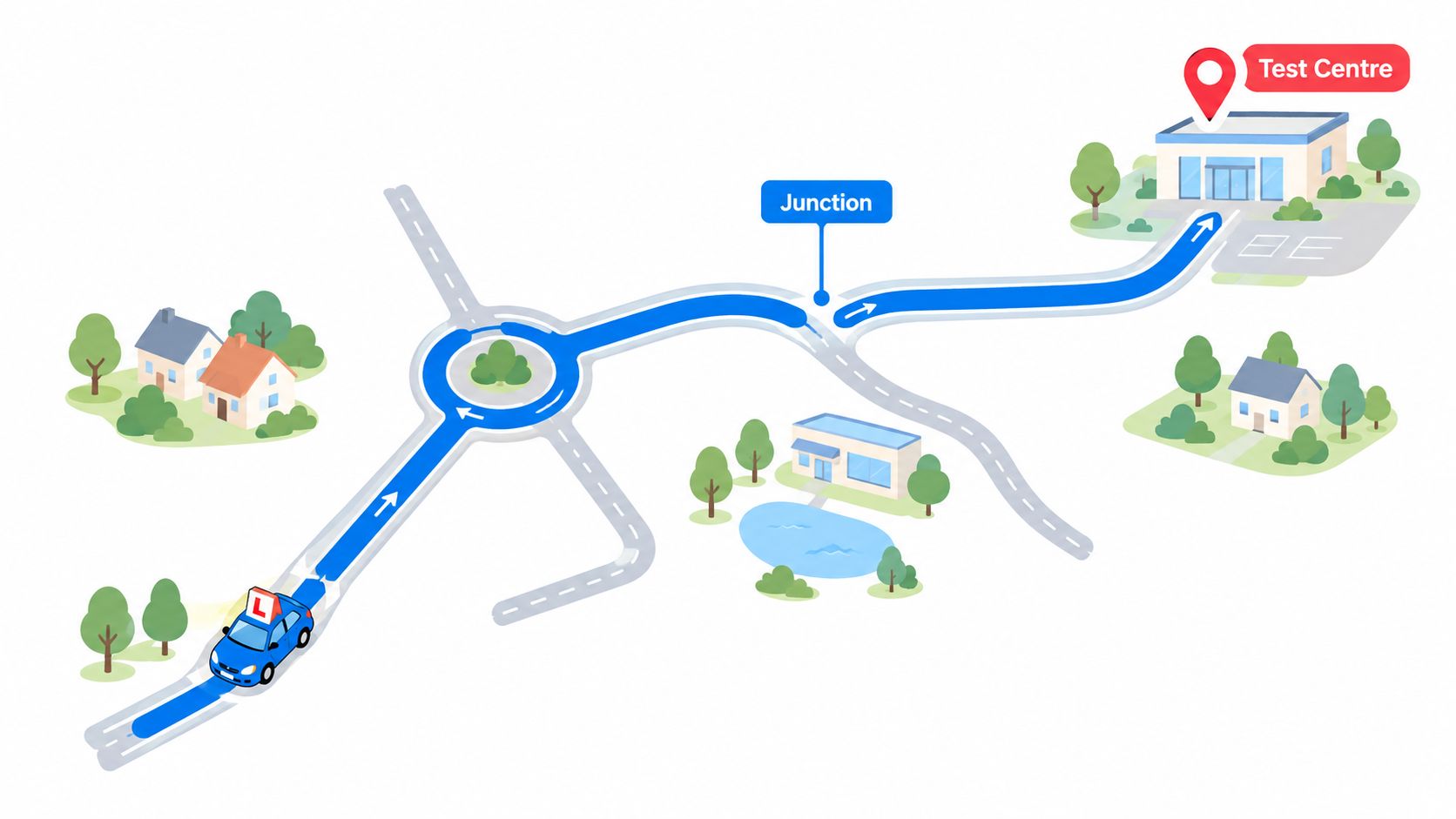
Build variety into your practice rather than repeating one quiet journey. Drive the area in heavier traffic, in different weather where possible, and at the time of day closest to your appointment. Pay close attention to complicated junctions, lane markings, hill starts and the quieter roads where manoeuvres may be completed.
Make the final run independent
On your last route session, ask your ADI not to give you routine directions or hints. Treat it as a genuine assessment. Follow road signs, make your own observations and recover calmly if the route differs from what you expected.
Practical rule: Learn the area, but don't memorise a route so rigidly that an unexpected road closure unsettles you.
If you use a cancellation-alert service to move to another centre, practise that location before the test. A new centre can bring a shorter wait, but it also introduces unfamiliar parking, traffic patterns and road layouts. Familiarity should reduce pressure, not create a false sense that knowing the roads is the same as being test-ready.
The following video can help you think about preparation around the test route, but use it alongside supervised practice rather than instead of it.
2. Use controlled breathing techniques during the test
Nerves often show up physically before they become obvious thoughts. You grip the steering wheel harder, lift your shoulders, rush your actions or notice that your breathing has become shallow. Deal with those signs early, before tension begins to interfere with normal routines.
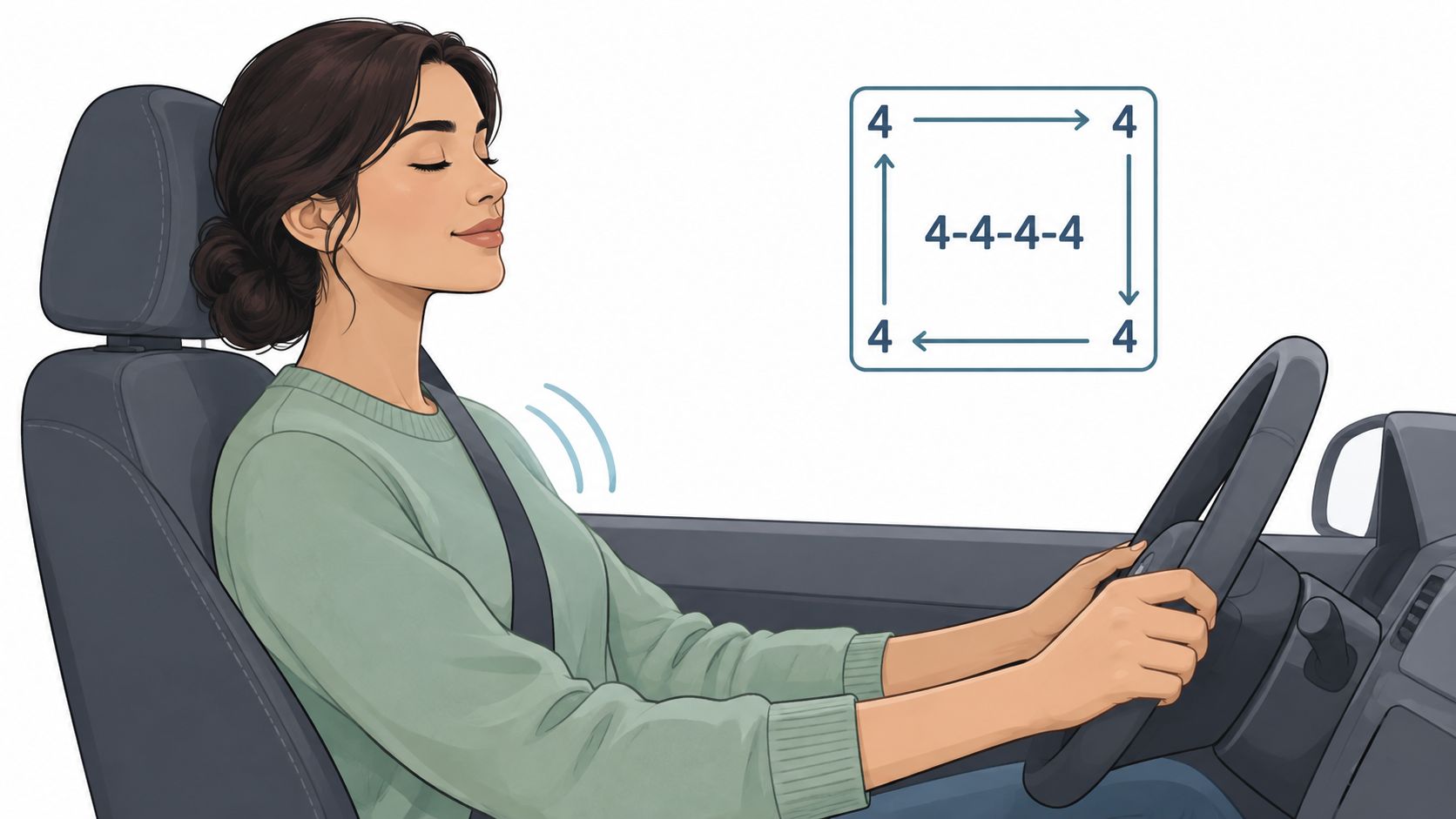
Try box breathing during lessons: breathe in for four counts, hold for four, breathe out for four and hold for four. If four counts feels uncomfortable, use three. The exact count matters less than keeping the rhythm steady and making the exhalation controlled.
Practise this well before test day. Use it while sitting in stationary traffic during a lesson or while waiting in the test centre, so it feels familiar rather than like a new task introduced under pressure. You can also use a slow out-breath when you're driving, provided it doesn't distract you from observation and vehicle control.
Use the technique as an early warning system
Don't wait until you feel panicked. Start when you notice the first signs of tension.
- Soften your grip: Keep both hands controlled but avoid squeezing the wheel.
- Drop your shoulders: A more relaxed posture makes steady breathing easier.
- Slow the exhalation: Let the breath out smoothly, without forcing a deep inhale.
- Use a short phrase: Repeat something grounded, such as “I've prepared well”, as you breathe out.
Breathing won't correct a missed observation or unsafe decision. It can, however, give you enough physical control to return attention to the next task. If anxiety is persistent beyond driving situations, consider discussing it with a qualified professional, such as through interactive counselling for anxiety, rather than expecting your ADI to provide mental-health treatment.
3. Protect your sleep before the test
A learner who stays up revising will not master a new manoeuvre overnight. Tiredness can make familiar decisions feel less automatic and can make physical nerves harder to manage during the DVSA test. Protecting your energy supports concentration, but it cannot replace the driving competence your ADI has assessed.
Keep your usual routine during the days before the appointment. Go to bed at a sensible time, give yourself enough opportunity to rest, and keep the morning predictable. Avoid trying to “bank” sleep through a dramatic change the night before.
Match the appointment to your normal rhythm where possible. If you have an early test, adjust your routine several days beforehand. If you work nights, an afternoon appointment may leave you more alert. Choose the time that lets you arrive fed, awake and able to concentrate. This guide to the best time for a driving test can help you compare traffic, energy levels and your normal schedule, but your ADI's view of when you drive reliably should carry more weight.
Remove avoidable morning decisions
Prepare the basics before bed:
- Set out suitable clothing: Wear comfortable clothes and shoes that allow natural pedal operation.
- Prepare water and food: Have a light, familiar breakfast so you are neither hungry nor overfull.
- Check travel time: Allow for traffic and parking, while avoiding an unnecessarily long wait at the test centre.
- Keep your routine familiar: Do not try unfamiliar supplements, medication or unusually large amounts of caffeine.
If worry keeps you awake repeatedly, treat it as an anxiety or sleep concern, not a driving technique problem. Resources on anxiety insomnia for executives explain how persistent anxiety can disrupt sleep. Consider professional support alongside an honest conversation with your ADI about readiness. Freshness may improve your focus, but only practice and safe performance establish whether you are ready.
4. Complete a realistic mock test with your ADI
A normal lesson can feel reassuring because your instructor talks you through problems and helps you recover. A mock test removes that safety net. That difference matters because the actual assessment asks you to manage the drive independently while listening to the examiner's instructions.
Book a full mock test with your ADI within the week before the appointment, but leave enough time to respond to the result. Many instructors will recreate the practical test structure, including independent driving, manoeuvres and a realistic level of silence. Ask for honest feedback, not encouragement designed to protect your feelings.
The result should answer two separate questions:
- Can you drive safely to the required standard?
- What happens to your driving when you feel watched?
A learner might handle roundabouts well in ordinary lessons but hesitate under pressure. That points towards test-specific confidence work. If mirror checks become inconsistent or speed control deteriorates, the solution is targeted practice, not just repeating general routes.
Use the mock as evidence, not a verdict
A disappointing mock is useful when it identifies a fixable pattern. Ask your ADI to write down the specific areas that need attention and use your remaining lessons deliberately. Don't book the mock so close to the actual test that one poor session becomes your only memory of preparation.
“I need to know what changes when the pressure rises.”
That is a more useful request than asking whether you'll pass. Your ADI can assess your driving, explain the risks and tell you whether more practice is sensible. You still need to make the final decision about booking and attending, but you shouldn't base it on vague reassurance.
If your test date changes, repeat the mock at the new centre where possible. The purpose is to recreate the conditions you'll face, not to collect a flattering result on familiar roads.
5. Plan the logistics so the morning stays calm
Last-minute stress can make ordinary nerves feel much bigger. Searching for the test centre, worrying about parking or discovering that an important document is missing leaves less mental space for driving.
Check the centre's postcode, entrance, parking arrangements and waiting area in advance. If it's unfamiliar, travel there during a lesson. Time the journey under realistic conditions, then allow room for traffic and a short delay without turning the morning into a race.
Aim to arrive around 15 minutes early. Arriving five minutes before the appointment leaves little margin, while arriving excessively early can give anxiety too much time to build. Use the waiting period for a quiet routine rather than repeatedly discussing every possible mistake.
Put the practical details in one place
The night before, organise:
- Your photocard licence: Check that you have the correct driving-licence document.
- Your booking information: Keep the appointment details accessible on your phone or in print.
- Your travel plan: Save the postcode and know where you'll wait.
- Your vehicle arrangements: Confirm the car, insurance and any instructor collection time.
- Your food and water: Choose familiar food that won't leave you uncomfortable.
Check the latest DVSA requirements rather than relying on an old list from a friend. If you're using an earlier appointment at a different centre, visit the location before confirming the change if you can. A cancellation can solve a scheduling problem, but it shouldn't create a rushed journey or unfamiliar test-day logistics.
Don't try to control every possible event. Prepare the parts you can control, then focus on arriving rested and able to drive.
6. Treat the assessment as a driving check, not a verdict on you
A practical test assesses whether you can drive safely to the required standard at that time. It doesn't measure your intelligence, character or future potential as a driver.
That distinction matters because catastrophic thoughts consume attention. “If I fail, everyone will think I'm useless” is not a driving instruction. It pulls your mind away from mirrors, signs, speed and planning. Replace it with a statement that directs you back to the task: “The examiner is checking whether I'm safe. I only need to deal with the next decision.”
Separate ability from the result
You can be a capable learner and still make a serious mistake under assessment pressure. A fail means that the required standard wasn't demonstrated on that attempt. It doesn't prove that you're incapable of learning or that your lessons have been wasted.
Use a short reminder before the drive:
“This test shows whether I'm ready today. It doesn't define me.”
During the test, avoid replaying an error. If you stall safely, recover, follow the examiner's instruction and continue. Don't decide that you've failed before the drive is over. The examiner assesses the whole performance, and your job is to keep making safe decisions.
If you do fail, ask for the serious or dangerous fault information, discuss it with your ADI and turn it into a specific practice plan. Shame adds no useful information. A clear diagnosis does.
The same approach helps if money, family expectations or work commitments are adding pressure. A difficult consequence can be real without becoming a judgement about you. Focus on what can be prepared, changed or practised.
7. Ask your ADI for an honest readiness checkpoint
Many learners hide the full extent of their nerves because they fear that admitting anxiety will make them sound unprepared. Tell your instructor plainly. Your ADI can't remove every worry, but they can help distinguish ordinary test pressure from a genuine driving gap.
Ask for specific evidence. “Do you think I'm ready?” is useful, but follow it with questions such as:
- What do I do consistently well?
- Which faults appear when I'm under pressure?
- Which manoeuvre or road situation needs more practice?
- Are my nerves affecting safety, or mainly making me uncomfortable?
- What would you want to see in my final lessons before test day?
Your instructor may say you're ready but still need strategies for tension. They may also recommend more lessons because your observations, planning or vehicle control aren't reliable enough. Listen to the reasoning, not just the conclusion.
Agree a clear decision point
Set a checkpoint with your ADI before the test. Review the mock result, route practice and the areas that still feel difficult. If the appointment is moved earlier, tell your instructor immediately so they can assess whether the new date leaves enough preparation time.
The ADI support and information page can also be useful for instructors coordinating learners and scheduling practice. A cancellation alert may change availability, but it doesn't change your driving standard.
If nerves affect you in every lesson, cause you to lose concentration or feel unmanageable outside driving, say so. Your ADI should support driving preparation, while a GP or mental-health professional can help with anxiety that needs broader care.
7-Point Comparison of Driving Test Nerves Tips
| Strategy | 🔄 Implementation complexity | ⚡ Resource & time required | ⭐ Expected effectiveness | 💡 Ideal use cases | 📊 Key advantages / impact |
|---|---|---|---|---|---|
| Practice the exact test route beforehand | Medium, requires coordinated lessons and repetition | High, several paid lessons; time for multiple runs (different times/conditions) | ⭐⭐⭐⭐, strong reduction in navigation anxiety and improved performance | Late-stage learners near test date; anyone taking a test at a familiar centre | 📊 Lowers cognitive load; builds muscle memory; fewer route/navigation errors |
| Use controlled breathing techniques during the test | Low, simple technique but needs rehearsal to feel natural | Very low, free; short daily practice sessions | ⭐⭐⭐, rapid, short-term calming effect when used correctly | High-anxiety learners; moments of acute stress (waiting room, manoeuvres) | 📊 Immediate physiological calming; improved focus and steadier control |
| Ensure adequate sleep in the nights before your test | Low, behavioral change, planning required | Low, no monetary cost but requires schedule adjustment across days | ⭐⭐⭐⭐, substantial benefit to reaction time, decision-making and emotional control | All learners, especially those with early tests or shift-work schedules | 📊 Better hazard perception and emotional resilience; consolidates learned skills |
| Do a final mock test with your ADI within a week of the real test | Medium, needs realistic test conditions and honest scoring | Moderate, one full paid mock (≈40 min) plus feedback time | ⭐⭐⭐⭐, excellent predictor of readiness; builds confidence or highlights gaps | Learners 7–10 days before test who want objective assessment | 📊 Reveals weak areas under pressure; targeted final lessons; normalises examiner presence |
| Plan your test day logistics to eliminate last-minute stress | Low, planning tasks done ahead of time | Low, ~20–30 minutes planning (route, parking, documents) | ⭐⭐⭐⭐, prevents avoidable stressors that undermine performance | Anyone taking a test; especially those traveling to unfamiliar centres | 📊 Reduces risk of lateness/missing documents; provides time to settle and use calming techniques |
| Reframe the test as a practical assessment, not a judgment of you | Medium, requires cognitive practice and habit change | Low, time for reflection/conversation; possibly journaling or talks with ADI | ⭐⭐⭐, lowers catastrophic thinking and reduces anxiety impact | Perfectionists; learners who tie self-worth to results | 📊 Lowers perceived stakes; improves emotional recovery and task focus |
| Discuss your nerves with your ADI and agree a readiness checkpoint | Low, honest conversation and agreed criteria | Low, one lesson or part of a lesson; structured feedback | ⭐⭐⭐⭐, high value from expert external assessment and clear guidance | Learners unsure if nerves reflect real unreadiness | 📊 Provides objective readiness check; targets final lessons; increases accountability and reassurance |
Turn Your Preparation Into a Calm Test-Day Routine
Start with an honest readiness conversation with your ADI. Complete a realistic mock test early enough to act on the feedback, practise the roads around your centre, and repeat the situations that make you hesitate. Protect your sleep, prepare your documents and travel arrangements, and remove as many avoidable decisions from the morning as possible.
Before you drive, use the breathing pattern you've already practised. Keep your posture relaxed, listen carefully to the examiner and focus on the next safe action rather than trying to predict the result. Nerves may still be present. That's acceptable. You can feel tense and still check mirrors properly, choose a safe speed, respond to instructions and continue after a minor mistake.
The DVSA's information about driving-test nerves confirms that nerves are a recognised reason some candidates give for failing. The figure doesn't mean anxiety is the only issue, and it doesn't promise that breathing or positive thinking will produce a pass. It shows why test-day preparation should include both actual driving competence and a plan for managing physical tension.
If you want an earlier appointment, Driving Test Cancellations can be used as an optional scheduling aid. It monitors DVSA availability and sends alerts, but you rebook manually through the DVSA system in line with current booking rules. A sooner test is useful only if your ADI agrees that you're ready and you can prepare properly for the new centre or time.
Driving Test Cancellations monitors the DVSA booking system for earlier practical-test slots and sends notifications with the date, time and centre details. If waiting is adding pressure, visit Driving Test Cancellations to see whether its alerts could help you find a suitable appointment and plan your final preparation with less uncertainty.