You've got a Skipton test booked, but the date feels a long way off. You keep checking for cancellations, wonder whether another centre would be quicker, and worry that the local roads will catch you out. That uncertainty is understandable, but the useful decision isn't merely “Is Skipton busy?” It's whether the centre, its routes and your available date fit the way you've trained.
The Skipton driving test centre is an established DVSA practical test site in North Yorkshire at Foundry House, Carleton Road, Skipton, BD23 2BE. The official DVSA location data lists the centre at 53.9536437, -2.0229888, with car-test facilities, wheelchair access and male, female and disabled toilets in the published centre information (DVSA practical test-centre data). The pass rate is respectable, the waiting picture needs interpreting properly, and the routes demand more than memorising a few turns.
Table of Contents
- Sitting Your Test at Skipton Driving Test Centre
- Where the Centre Is and How to Get There
- Pass Rates and Waiting Times at Skipton
- Skipton Versus Other North Yorkshire Test Centres
- What Skipton Test Routes Actually Cover
- Rebooking Rules, Fees and Earlier Slots
- Test Day Checklist and What to Do Afterwards
Sitting Your Test at Skipton Driving Test Centre
You pull into the Carleton Road area with time to spare, yet the last lesson's minor mistakes suddenly feel important. Park, switch off and stop cramming. Your job now is to follow the routines you have already practised, not learn a new technique outside the test centre.
The official centre is at Foundry House, Carleton Road, BD23 2BE. Go inside, sign in at reception and wait in the small upstairs foyer. The examiner will call your name, check your licence and confirm your theory-test details before taking you to the vehicle.
Keep the first few minutes routine
The car check follows the standard practical-test procedure. Prepare for the eyesight check, answer the required vehicle-safety questions and complete the “tell me” question clearly. Do not turn it into a speech. Your instructor should have rehearsed the controls in the exact car you will use, including lights, demisters, tyres and fluid checks.
The waiting room will not improve your driving. Sit calmly, keep your breathing steady and ignore comparisons with other candidates. I recommend a quiet five-minute walk up Carleton Road before signing in, if the appointment schedule allows it. It gets you out of the parked car, settles your breathing and stops you watching the foyer clock.
Practical rule: Arrive organised, not excessively early. Allow enough time to park, walk inside and settle. Sitting tense in the waiting area for a long period usually makes nerves worse.
Once the examiner says, “I'd like you to drive to…”, listen for the destination and the first instruction. Then act on what you know. The pull-out is not a race. Check around the car, move away smoothly and build speed safely on Carleton Road.
If you miss a direction, ask for it to be repeated. A calm clarification is safer than guessing, and asking does not count as a driving fault. Keep scanning for pedestrians, cyclists, parked vehicles and changing speed limits as you leave the centre.
The marking standard is the same at every DVSA centre. Skipton tests your preparation through a mixture of town streets, roundabouts and faster roads, so practise decisions and observations rather than memorising a route.
Where the Centre Is and How to Get There
A test-day mistake here is arriving at the wrong part of town, then trying to find the entrance while the clock runs down. The official Skipton centre listing confirms the address as Foundry House, Carleton Road, Skipton, BD23 2BE (official Skipton centre listing). Save the postcode in your map app, check the final walking route and identify where you will leave the car before test day.
Foundry House has a small reception area and an upstairs waiting space. The building has a narrow staircase and no lift, although the DVSA listing identifies wheelchair access and standard toilet facilities. If you have significant mobility needs, contact DVSA before the appointment and confirm the arrangements for your booking.
Allow time for parking
Parking on Carleton Road becomes awkward when the morning gets busy. The small council-run car park is convenient, but spaces can disappear after the rush starts. If a parent or friend is driving you, arrange a nearby drop-off instead of circling while your appointment approaches.
Morrison's can provide a practical fallback for a drop-off and short walk, subject to its parking conditions. Do not leave this decision until the last minute. Arriving flustered after searching for a space uses the concentration you need for the test.
Use public transport sensibly
Check the journey from Skipton bus station against your actual appointment time. Services in the area include routes 75 and 580, plus the Skipton town circular, with stops on or near Keighley Road within a short walk of the centre. Timetables change, so verify the current service rather than following an old lesson plan.
From Skipton railway station, allow roughly 15 minutes on foot, with extra time to find the entrance. Walk the route once if you do not know the area. That removes a simple source of pressure on the morning.
My recommendation is straightforward: arrive organised, not excessively early. Allow time to park or walk in, locate reception and settle, then avoid sitting tense in the waiting area for a long period.
Pass Rates and Waiting Times at Skipton
Skipton's recent figures show a centre that performs comparatively well, but they don't make the test easy. A recent DVSA-derived dataset records 3,197 practical tests in the 2025/2026 period, an overall pass rate of 57.3% and a first-attempt pass rate of 55.5%. The same source places the national comparison at 50.0%, so Skipton's overall result was 7.3 percentage points higher (Skipton test-centre pass-rate data).
The dataset also records 19 first-time faultless passes. That's a small outcome within the wider total, but it shows why a good centre average shouldn't be confused with an effortless route. Another published summary reports a 54% pass rate for 2025/26, which reinforces the broad picture rather than changing the practical advice: Skipton has recently sat in the mid-50s, above the cited national average.
The more confusing issue is availability. One published measure shows Skipton at 23.8 weeks, while a separate DVSA-derived waiting-time snapshot reports a median actual wait of 11 weeks, compared with an 11.9-week national median (Skipton waiting-time data). Those numbers describe different things, so quoting only the longer figure gives learners a misleading impression.
Availability isn't the same as your waiting time
The availability measure can reflect the furthest appointment currently visible in the booking system. The median wait describes the typical time between booking and sitting the test within the relevant dataset. Cancellations, newly released appointments and changes to the booking pool can make the second figure materially shorter.
That doesn't mean you should expect an early slot on demand. It means a booking page showing a distant date isn't proof that every candidate waits that long. Published figures can also relate to different months, samples or methods. National reporting illustrates the same distinction, with a 11.1-week median wait to sit a test in Great Britain in August 2026 alongside a 20-week headline appointment measure (Skipton availability explanation).
| Metric | Skipton | National comparison |
|---|---|---|
| Overall pass rate | 57.3% | 50.0% |
| First-attempt pass rate | 55.5% | Not supplied |
| Median wait in cited snapshot | 11 weeks | 11.9 weeks |
| Published availability measure | 23.8 weeks | 20 weeks in the cited Great Britain comparison |
The sensible approach is to take the first workable Skipton booking, then monitor for an earlier cancellation. Keep your instructor's availability in mind before accepting a slot that looks attractive but can't be supported by lessons. Demand can still rise around popular booking periods, so don't assume every month behaves the same way.
For wider context on why headline availability and actual waiting time can differ, see this guide to driving test waiting times.
Skipton Versus Other North Yorkshire Test Centres
Switching centre only makes sense if the earlier appointment outweighs the extra travel and unfamiliar roads. Skipton's latest published profile is 57.3% from 3,197 tests, with a cited median wait of about 11 weeks (Skipton centre comparison data). That puts it in the middle of the practical decision, not in a category where every learner should travel there regardless of preparation.
The problem with comparing centres is that nearby figures don't always come from one matching dataset. Pass rates and waits can change by period, and door-to-door travel depends heavily on your starting point and traffic. Use the table as a decision framework, not as a promise of a particular slot or result.
| Test Centre | Pass Rate | Median Wait | Drive from Skipton |
|---|---|---|---|
| Skipton | 57.3% | About 11 weeks | Local |
| Keighley | Not supplied in the verified comparison | Not supplied | Nearby |
| Bradford, Heaton | Not supplied in the verified comparison | Not supplied | Further urban drive |
| Harrogate | Not supplied in the verified comparison | Not supplied | Longer cross-country drive |
| Northallerton | Not supplied in the verified comparison | Not supplied | Around 30 miles |
Make the switch on preparation, not hope
Stay with Skipton when your instructor knows the local roads, your booking is under 14 weeks, and you're already practising the route types you'll meet. A familiar centre with a realistic date is usually better than an unfamiliar centre with a tempting cancellation.
Keighley is the first place I'd investigate if you're at 16 weeks or more and need an earlier test. It may offer a faster opportunity, but you'll need proper practice there, not one rushed drive before the appointment.
Harrogate is worth considering only if you can train on its routes beforehand. Northallerton can look attractive when a slot appears, but the roughly 30-mile drive from Skipton can erase the advantage through travel, lesson time and unfamiliar junctions.
Use North Yorkshire driving test centres to check the available alternatives, then ask your instructor one direct question: “Can you prepare me properly for that centre before the test?” If the answer is no, keep Skipton.
What Skipton Test Routes Actually Cover
Skipton routes aren't a single loop to memorise. A route-mapping dataset identifies 31 distinct real test routes, 109 different roads, route lengths from 4.6 km to 24 km, and durations from 14 to 33 minutes (Skipton route information). Treat those figures as a reason to train by road type and decision, not as a list of turns to learn.
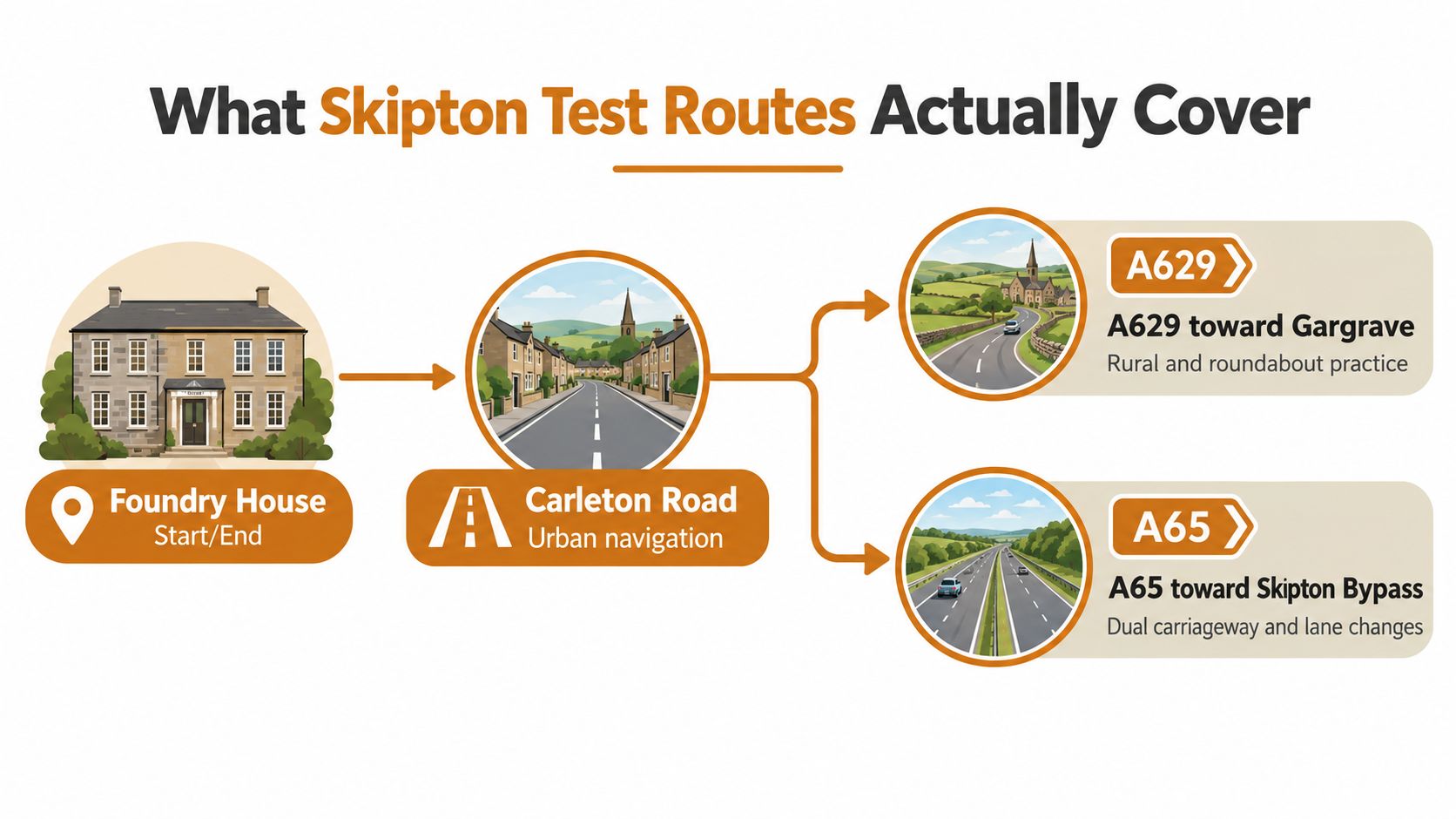
Routes commonly leave Foundry House through Carleton Road before joining faster roads such as the A629 towards Gargrave or the A65 corridor. You may encounter town navigation first, followed by roundabouts, lane discipline and changes in speed that expose rushed observation.
Train the decisions, not the map
Build practice around four local trouble spots:
- Roundabout positioning: Don't cut across the Skipton bypass roundabout. Choose the correct lane early, keep your position and check mirrors before changing direction.
- Dual-section observation: On the A65 sections, use mirrors before changing speed or position. The road can feel open enough to encourage lazy checks.
- Crossroads judgement: At Eshton Road, approach with a controlled speed and take time to assess the view. Hesitation caused by poor preparation is different from a safe pause.
- Canal-road stops: Rolling stops are still moving stops. Stop fully where required, then observe before proceeding through the canal-side 30mph stretch.
Independent driving is commonly sat-nav led for roughly 20 minutes. Practise listening while maintaining a safe speed, rather than staring at the screen. The A629 towards Colne and the Broughton Road loop are useful areas for building that skill, but your instructor should vary the route so you can respond to instructions rather than recite them.
Run two timed practice drives from Carleton Road, covering all four trouble spots. Include a manoeuvre on a residential cul-de-sac and practise recovering calmly after a wrong turn. The examiner wants safe, independent driving, not a perfect imitation of a rehearsed route.
Rebooking Rules, Fees and Earlier Slots
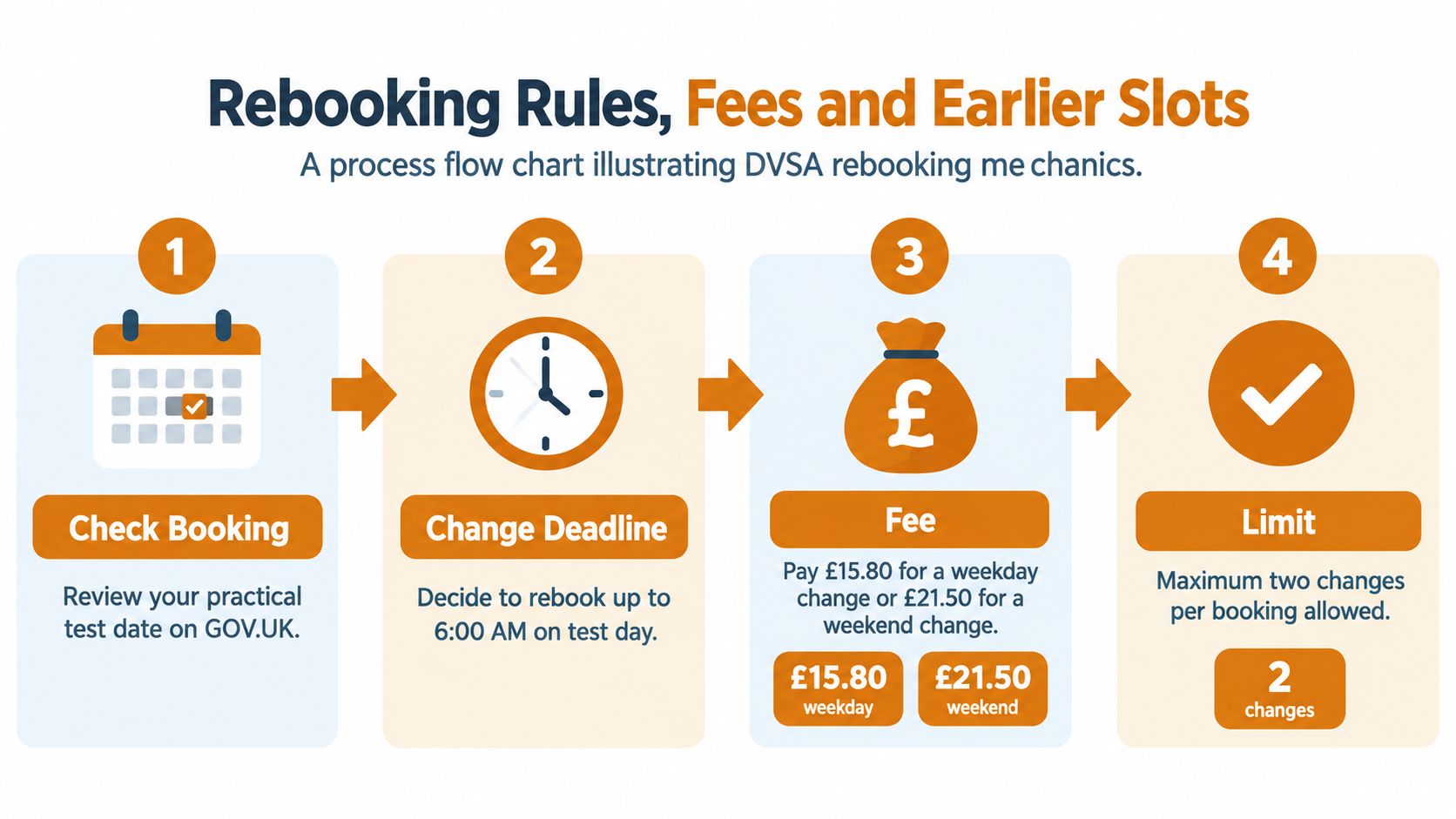
The booking rules catch learners out because changing and cancelling are treated as part of the same process. DVSA guidance says a practical-test booking is for the named candidate, changes normally need at least 10 working days' notice, and a booking can usually be changed twice before further action is required (DVSA booking-change guidance).
GOV.UK lists the practical car-test fee as £62 on weekdays and £75 on evenings, weekends and bank holidays (GOV.UK practical-test fee information). Check the current terms before changing anything, because the fee and deadline that apply to your booking matter more than advice copied from a forum.
Keep an active booking
Cancellation-alert services can notify you when an earlier Skipton appointment appears, but you still rebook through the DVSA website. The safe strategy is to keep your existing test while looking for a better date, then change it only when the new slot works for your instructor and travel arrangements.
Driving Test Cancellations monitors DVSA availability and sends alerts containing the date, time and centre details. You can use its guide to booking a driving test alongside the official booking process, but don't treat an alert as an automatic booking.
Check availability regularly rather than relying on one refresh. Earlier slots appear when other candidates change their plans, so an alert is useful when you can respond promptly. Never give up a workable booking just because a possible cancellation might appear later.
Test Day Checklist and What to Do Afterwards
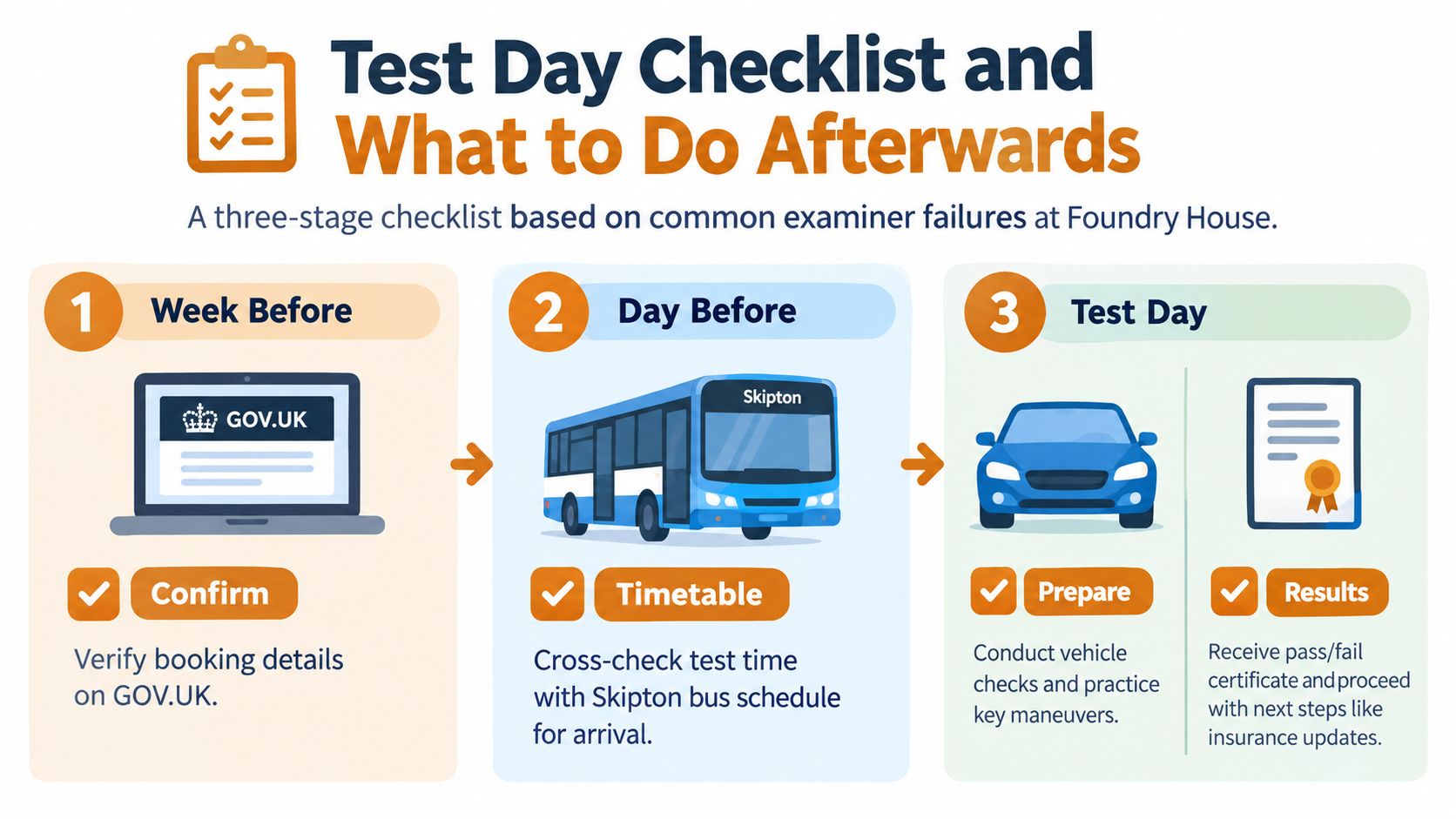
Use the week before the test to remove admin problems from the morning. Confirm the appointment on GOV.UK, check the journey against the current bus timetable, and put your provisional licence, theory-test certificate and correctly insured vehicle documents where you can find them. Finish with a mock test on the A629, including independent driving and one manoeuvre.
Three checks that prevent avoidable stress
Before the appointment: Confirm the time, route and vehicle. If you're using a family car, check the insurance and test requirements before leaving home, not at the centre entrance.
On the day: Arrive 15 minutes early, switch off your phone and use the final minutes for a short, controlled warm-up. Practise an independent-drive section rather than repeating a manoeuvre you already know. Tell the examiner about any medical concern before you set off.
After the result: If you pass, ask for the pass certificate before leaving and sort out your insurance so you can drive legally under the new licence arrangements. If you fail, don't turn the result into a vague judgement about your ability. Get the marking details, ask your instructor to identify the faults that affected the result, and book the next suitable appointment while the feedback is fresh.
After a fail: Don't book another test until you know which decisions caused the problem. A targeted lesson plan is more useful than simply adding hours.
The best post-test plan focuses on the actual weakness, whether that's roundabout lane choice, mirror timing, speed control on faster roads or independent navigation. Keep practising the Skipton road environment if you're staying booked there, and only switch centres when the new route can be trained properly.
If you're booked at Skipton and want an earlier appointment, visit Driving Test Cancellations to monitor DVSA availability and receive alerts when suitable slots appear. Keep your current booking in place, check that the new date works with your instructor, and complete the change yourself through the official DVSA service.