You've got the practical test booked, or you're trying to work out whether to keep chasing a slot at Leighton Buzzard Test Centre. That usually means the same thing on the ground, a date's been set, the pressure's creeping up, and you want the story on the site, the roads, the waits, and whether it's worth hanging on for an earlier cancellation.
Leighton Buzzard (Stanbridge Road) is the kind of centre that rewards preparation and punishes guesswork. It sits in Bedfordshire and serves learners across the local area and wider East of England network, so the questions people ask are rarely just about the address. They want the site layout, the likely driving environment, and a sensible view on whether to book, wait, or switch centres.
Table of Contents
- Introduction to Leighton Buzzard Test Centre
- Where to Find the Centre and What to Expect on Site
- Getting There and Parking Without the Stress
- How Busy Is Leighton Buzzard and What the Numbers Mean
- Common Test Routes and Roads Around Stanbridge Road
- Local Tips to Avoid Common Mistakes on Test Day
- Should You Wait or Look at Nearby Test Centres
- Quick Reference and Related Resources
Introduction to Leighton Buzzard Test Centre
A test day here starts with a simple job, get to the right place calmly, with enough time to settle. That matters because Leighton Buzzard (Stanbridge Road) isn't just a pin on a map, it's a busy DVSA location with a steady flow of learners, instructor cars, and the usual test-day nerves that come with a centre handling thousands of appointments each year test-centre summary.
The centre is used by learners who live in Leighton Buzzard itself, by drivers coming in from nearby Bedfordshire villages, and by instructors who build lessons around local junctions, roundabouts, and the surrounding road mix. It also matters to people who are deciding whether to stick with their current booking or chase an earlier date, because the local wait pattern isn't the same as the national norm waiting-time summary.
A lot of online coverage stops at the address and leaves it there. That's not much help when you're trying to plan your route, judge the site's parking, or decide whether a cancellation alert is worth using. The useful questions are more practical, where you go, what the building setup feels like, and how the local numbers affect booking strategy.
Practical rule: treat Leighton Buzzard as a centre where preparation has to cover both the test itself and the booking problem. The local wait pressure makes timing part of the test plan, not just an admin detail.
The quick-reference section at the end pulls the key facts together. Before that, the guide looks at the site, the journey in, what the road mix tends to demand, and what the waiting-time data really means for learners.
Where to Find the Centre and What to Expect on Site
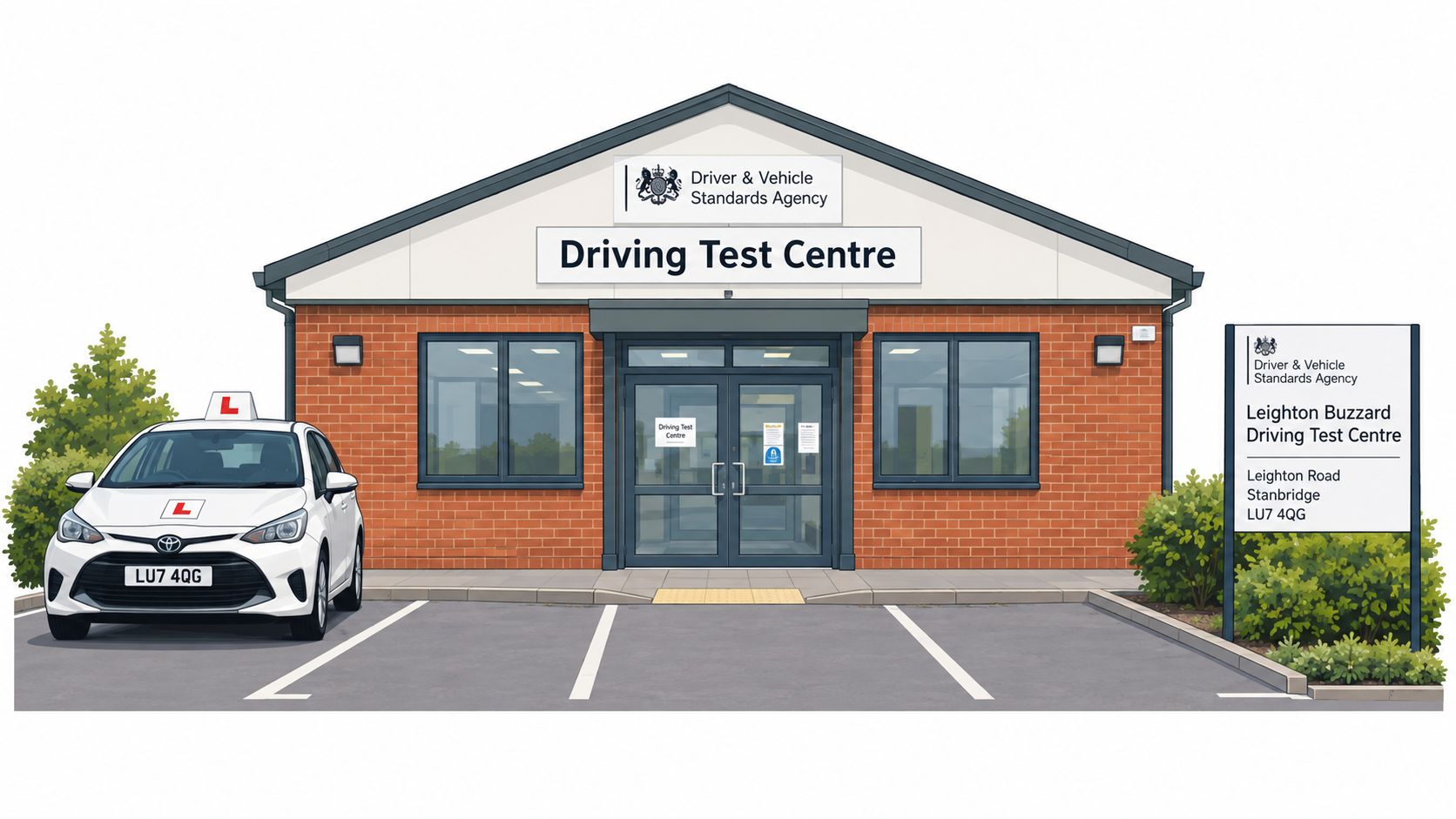
The official address is Leighton Road, Stanbridge, Leighton Buzzard, LU7 4QG, and you'll also see it referred to as Stanbridge Road in DVSA and test-centre listings DVSA practical.csv. That naming variation trips people up more often than it should, especially when sat navs and booking pages use slightly different wording.
The centre's contact line is 0300 200 1122 test-centre summary. On site, DVSA notes include male and female toilets, disability arrangements on request, and a one-way system around the building DVSA practical.csv. Those details matter because the test-day flow is easier when you know where you're going before you pull up.
What to do when you arrive
Park first if you can, then sort your paperwork and settle your nerves. The centre has limited parking and a waiting room, so don't arrive thinking you can circle casually and decide later waiting-time summary. If you're with an ADI, agree in advance whether the instructor will wait with you, drop you off, or leave and return.
Bring the things that matter and keep them easy to reach. You need your provisional licence and the confirmation details for the appointment. If you're late because you were looking for the right entrance, the day gets harder before the engine's even started.
The one-way system around the building is the other thing to respect. It's there to keep the site moving, not to make life awkward, but if you enter the loop clumsily you can end up blocking other cars or adding avoidable stress just before the test.
The calmest arrivals here are the ones that treat the site like a controlled space, not a spare car park.
Getting There and Parking Without the Stress
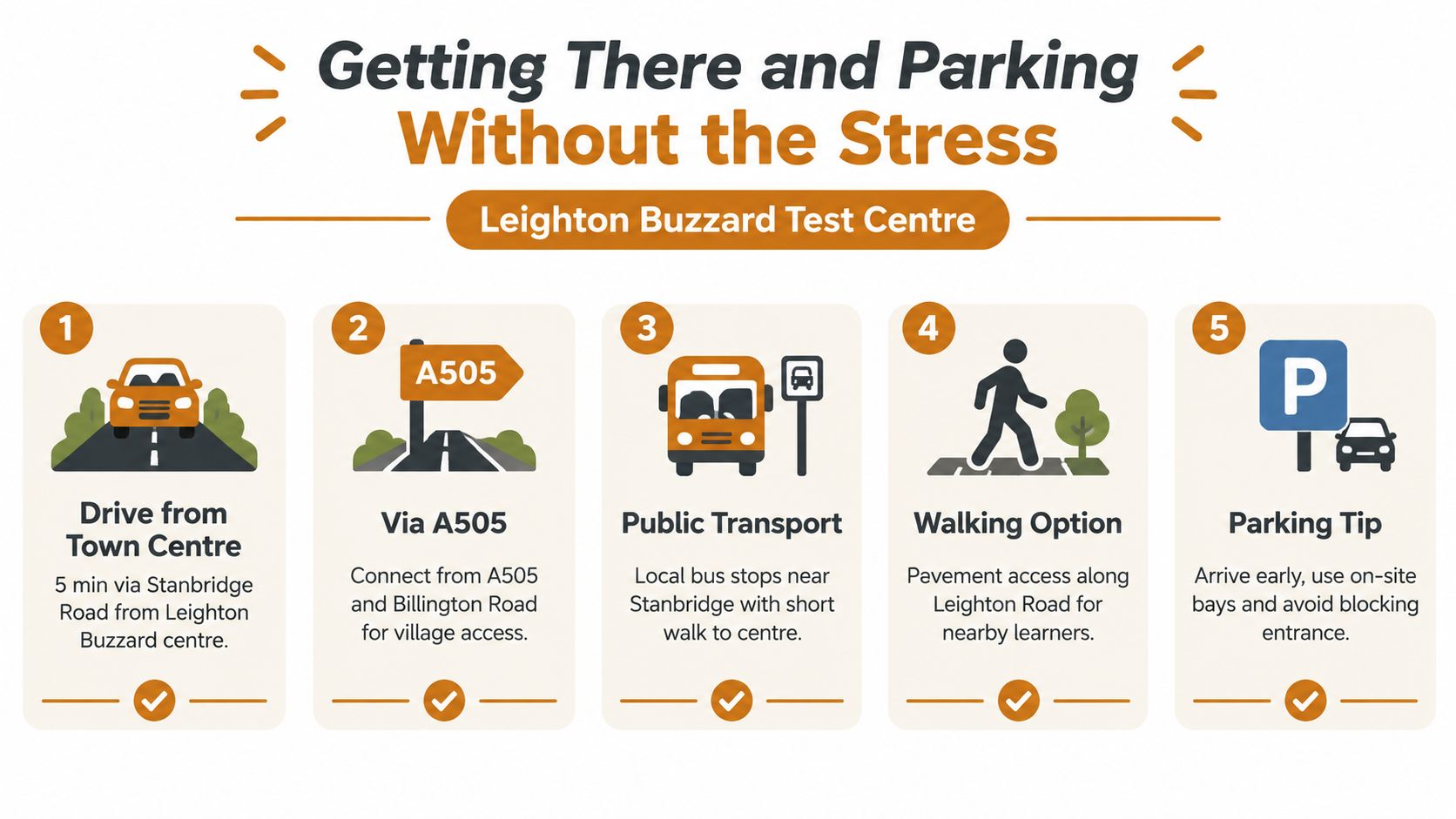
If you're coming from Leighton Buzzard town centre, the simplest approach is usually the local road network into Stanbridge Road rather than trying to be clever with side streets. The centre is close enough that some learners will only need a short drive, but short journeys can still go wrong if you leave too little time for the final approach, the one-way loop, and parking.
Drivers approaching from the A505 or nearby villages should plan the last few turns carefully rather than rely on memory alone. Once you're in the final stretch, the main risk isn't distance, it's arriving flustered and choosing the wrong entrance movement. That's why instructors often build the approach into the lesson itself, so the last five minutes feel familiar instead of improvised.
If you're using public transport, check local bus stops near Stanbridge and allow a proper walk in. Walking is also realistic for some nearby learners, but only if the route is familiar and you're not carrying extra pressure from being late. The site notes and local summaries both point to the practical reality, parking is limited and the building layout expects orderly arrivals waiting-time summary.
Parking and timing habits that help
- Arrive early: the one-way system and limited bays make rushing a bad trade.
- Use on-site space sensibly: don't block the entrance while you wait for someone else to move.
- Plan the drop-off: ADIs should agree the handover point before the journey starts.
- Avoid last-minute route changes: the final approach should be boring, not inventive.
For many learners, the biggest gain is removing the parking question from the test-day debate. The less time you spend wondering where to stop, the more headspace you keep for the actual drive.
How Busy Is Leighton Buzzard and What the Numbers Mean
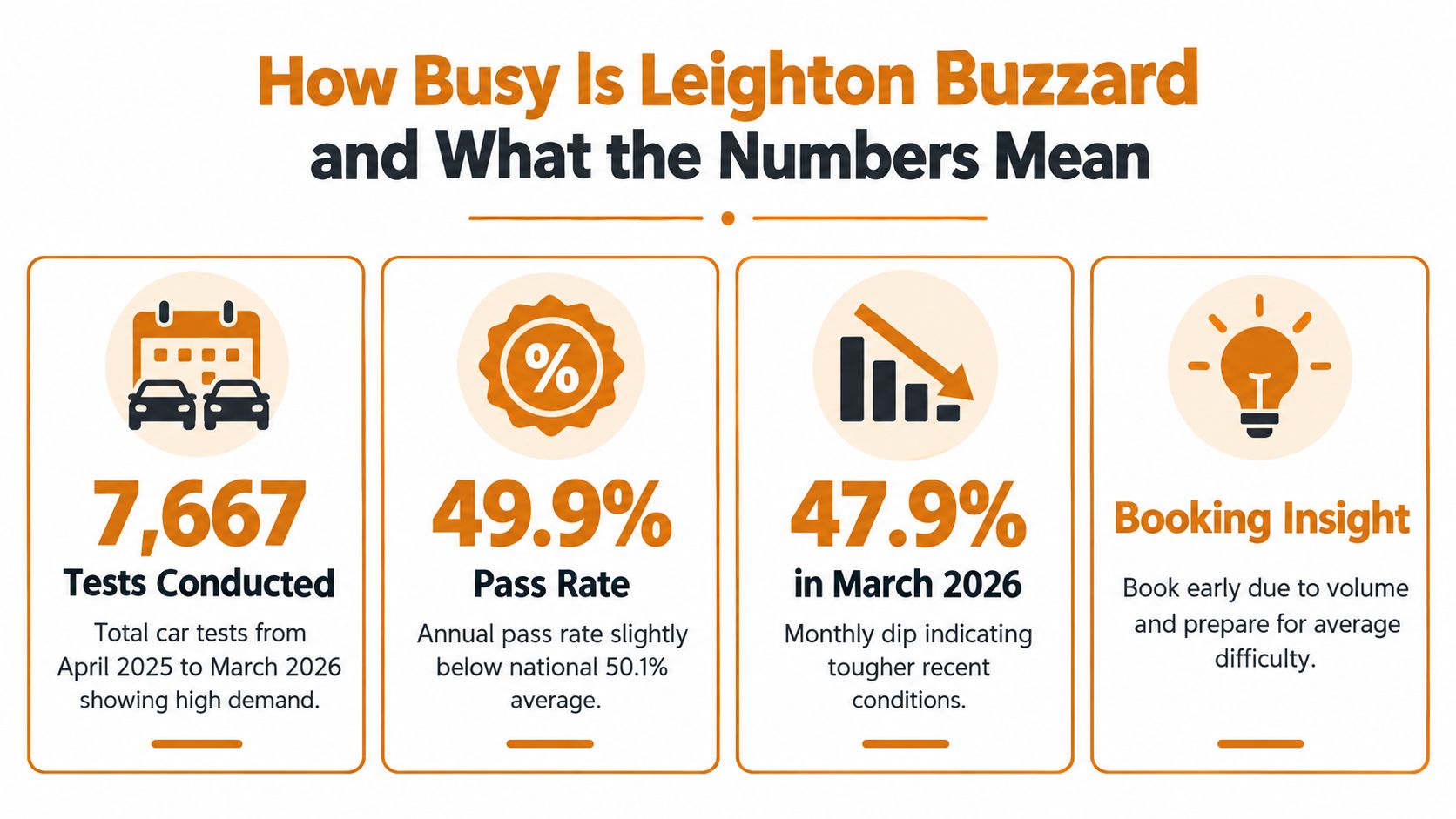
Leighton Buzzard is busy in a way that changes how you should book, not just how you should prepare. One independent centre summary says it handled 7,667 car tests in the April 2025 to March 2026 period, which works out at roughly 640 tests a month, so this is not a small or sleepy location test-centre summary. That volume matters because a centre with constant churn can feel full even when a few cancellations appear during the week.
The annual pass rate is where the local picture gets more interesting. Leighton Buzzard's car-test pass rate for that year was 49.9%, just 0.2 percentage points below the 50.1% national average test-centre summary. On its own, that looks close enough to shrug off. In practice, it tells you the centre sits around the national norm, but doesn't give learners much comfort if they're hoping for an easier-than-average test environment.
Why the monthly swing matters
The same source reported a 47.9% pass rate in March 2026 test-centre summary. That doesn't mean every month behaves the same way, and it's exactly why a single annual average can be misleading if you're choosing between dates. A centre can look stable over a year and still feel tougher in certain months.
Wait times tell the same story from a different angle. One independent tracker said the typical wait at Leighton Buzzard was 16.6 weeks in July 2026, compared with a 12.8-week national average, with only 1.3% of the 24-week booking window still free waiting-time summary. The NAO also reported that the average waiting time for a practical car driving test in Great Britain was 22 weeks in September 2025, and that 70% of DVSA's 240 permanent test centres were at the 24-week maximum at that point NAO press release.

That national shortage frames everything. Leighton Buzzard's waits may be shorter than the worst of the system, but they're still long enough to affect lesson planning, theory-test timing, and how many extra sessions a learner needs before test day. The DVSA booking system only lets learners book up to 24 weeks ahead, so chasing cancellations matters because the normal booking horizon has a hard ceiling NAO summary PDF.
Booking insight: if you're already near readiness, an earlier cancellation can be more valuable than a prettier booking date. If you're not ready, the earliest slot is just an expensive rebooking headache.
For readers comparing options, the key question isn't “Is Leighton Buzzard busy?” It clearly is. The better question is whether the local wait and the pass-rate wobble make a cancellation hunt worthwhile, or whether a different centre and a few more lessons make more sense.
Practical waiting-time guidance for learners
Common Test Routes and Roads Around Stanbridge Road
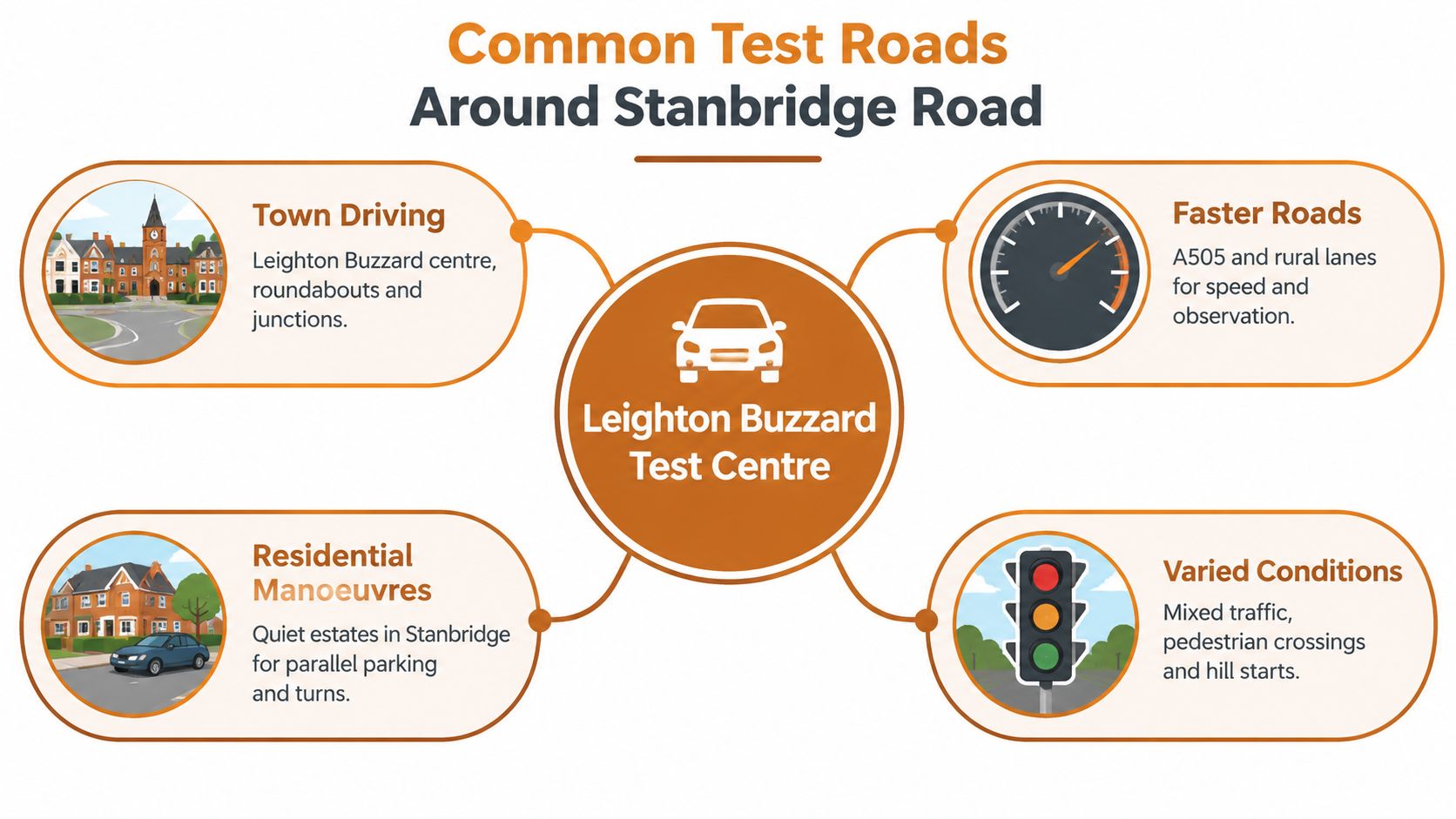
Leighton Buzzard tests tend to mix several road types rather than sticking to one predictable pattern. That's useful to know because examiners are looking for consistency across different conditions, not just neat driving on a single familiar road. The centre sits in a part of Bedfordshire where town traffic, faster connecting roads, and quieter residential stretches can all appear in the same session.
The road themes learners usually need to handle
- Town driving: expect junctions, roundabouts, and tighter decision-making around Leighton Buzzard centre.
- Faster roads: route planning often has to account for the A505 and similar stretches where observation and speed control matter.
- Residential manoeuvres: quieter estates and local side roads are where parking, turns, and low-speed accuracy get tested.
- Mixed conditions: pedestrians, changing traffic flows, and independent driving under pressure are part of the same test picture.
The point isn't to memorise a fixed route. DVSA route patterns can change, and they do change, but the skills being checked stay broadly the same. If you're comfortable moving between busier junctions and calmer side roads without dropping your standard, you're in the right zone.
What that means in practice
Town sections reward clear lane choice and early observation. Faster stretches punish hesitation when the road opens up and then tightens again. Residential areas expose sloppy steering and poor judgement more than speed, which is why learners who only practise main roads often get caught out.
The best coaching here usually blends all four themes into one lesson. That way, the learner stops treating each road type as a separate problem and starts driving them as part of the same test. The examiner sees that joined-up standard very quickly.
Local Tips to Avoid Common Mistakes on Test Day
The mistakes I see most often at centres like this usually happen after the learner thinks the hard part is over. They've survived the first few junctions, then lose concentration on the return to the site, especially if the road back involves the one-way setup around the building. That last stretch needs the same standard as the first.
The errors worth rehearsing properly
- Rushing the return loop: if the site uses a one-way flow, don't force a late turn or awkward stop.
- Underestimating narrow residential roads: keep your speed measured and your road position tidy.
- Switching off on rural transitions: the jump from built-up roads to quicker stretches needs alert scanning, not autopilot.
- Forgetting roundabout discipline: local roundabouts often expose poor mirror use and late signalling.
- Treating independent driving casually: if sat nav or verbal direction is involved, follow it cleanly and don't start second-guessing.
Bay parking is another one to practise with intent, especially because the centre has limited parking and the site flow is tighter than many learners expect waiting-time summary. If you've only practised bays in a big, empty supermarket car park, the test-day version can feel sharper than it should.
Waiting-room nerves are real, but they're manageable if your pre-test routine is simple. Sit somewhere quiet, avoid last-minute coaching overload, and don't let the other candidates set your mood. I've seen too many good drives spoiled by a learner who spent the waiting period mentally rehearsing every possible mistake.
Independent driving deserves specific practice here. If you're asked to follow directions or use sat nav, you need to stay calm when the road choices get messy. The objective isn't to be perfect, it's to recover quickly and keep the drive safe and legal.
The biggest local win is not fancy route knowledge, it's unhurried competence when the road changes character.
Should You Wait or Look at Nearby Test Centres
A learner who is nearly ready can still lose weeks at Leighton Buzzard if they wait for the right slot to appear. The centre's 16.6-week typical wait and the fact that only 1.3% of the 24-week booking window was still free show how tight it is waiting-time summary. That pressure makes a clear booking plan more useful than a simple wait-or-switch rule.
Leighton Buzzard sits inside the DVSA's 24-week booking limit, so earlier dates usually come from cancellations rather than from looking further ahead NAO summary PDF. The AA also placed it in the same high-wait group as other busy centres AA waiting-times report. In practice, the choice comes down to how much local road familiarity you already have, and how much extra waiting you can justify.
Leighton Buzzard Versus Nearby Centre Strategy
| Option | Best when | Trade Off |
|---|---|---|
| Stay with Leighton Buzzard | You know Stanbridge Road, the roundabouts, and the local test rhythm | You may need to keep chasing cancellations |
| Switch to a nearby centre | You want a sooner date and can handle a different road mix | You lose some local familiarity and may need fresh practice |
| Use a cancellation alert service | You are test-ready and can move quickly on a slot | You still need to rebook and stay flexible |
For ADIs, the cleanest approach is to compare readiness, route familiarity, and diary pressure before locking in one centre. If a learner still needs work on roundabout discipline, bay parking, or independent driving, extra lessons often deliver more value than a hurried booking.
Nearby centres such as those listed on our Bedfordshire guide give you a useful benchmark. If Leighton Buzzard is backed up but another Bedfordshire centre has a better wait profile, a move can make sense, especially for pupils who are not tied to one local route set.
Driving Test Cancellations also has a practical place in that decision. It can monitor DVSA availability and flag earlier appointments, which helps when you want to keep Leighton Buzzard in play without sitting on one date and hoping for the best.
Quick Reference and Related Resources
Leighton Buzzard Test Centre quick facts
- Address: Leighton Road, Stanbridge, Leighton Buzzard, LU7 4QG
- Contact: 0300 200 1122
- Facilities: male and female toilets, waiting room, limited parking, disability arrangements on request
- Annual car tests: a high-volume centre, as noted in the local summary
- Annual pass rate: 49.9% versus 50.1% nationally
- Typical wait: 16.6 weeks versus 12.8 weeks nationally
- Booking window pressure: only 1.3% of the 24-week booking window was still free
The 24-week booking window and the pressure around cancellations are covered above. The practical takeaway here is simple. If your learner is close to ready, keep watching for cancellations. If they still need work on roundabouts, bay parking, or keeping calm under pressure, add practice first, then book.
For a step-by-step booking refresher, see how to book a driving test. Driving Test Cancellations scans DVSA availability and sends SMS alerts for up to three centres, which helps when you want earlier options without losing sight of your original plan.