在英國,學員預訂 DVSA driving test centre 後,等候時間可能因地點而大幅不同。National Audit Office 報告指出,汽車實際路試的平均等候時間由 2020 年初略多於五週,升至 2025 年 9 月的 22 週。約 70% 的 DVSA test centres 已使用最長的 24 週預約窗口。當時的預測顯示,DVSA 可能要到 2027 年 11 月才達到七週等候目標,詳情見 National Audit Office。
因此,測驗中心不只是地圖上的位置。比較等候數據時,也要查看附近道路、現場設施,以及教練對常見路線的了解,像是先熟悉考場環境,能讓預約和考試當日更容易掌握。
Table of Contents
- Why Your Choice of Test Centre Matters More Than Ever
- How to Find DVSA Driving Test Centres Near You
- Understanding Test Centre Waiting Times
- What to Expect on the Day at the Centre
- Types of DVSA Driving Test Centres Explained
- Choosing the Right Test Centre for You
- Changing Your Test Centre or Appointment
- Frequently Asked Questions
Why Your Choice of Test Centre Matters More Than Ever
A long queue increases the cost of a poor booking decision. Choosing a centre without checking availability can leave you waiting for months, then reveal that its likely routes do not match your experience or that your theory certificate is nearing expiry.
The national situation explains why centre choice needs planning. The National Audit Office recorded waiting times rising from just over five weeks in early 2020 to 22 weeks in September 2025. About 70% of centres had reached the maximum 24-week booking window. The same report projected that DVSA would not reach its seven-week waiting-time target until November 2027.
That does not make the nearest centre the automatic choice. Compare the journey with the practical conditions you can prepare for:
- Availability: How soon is a suitable appointment available?
- Practice access: Can you practise nearby roads and junctions during normal lessons?
- Route demands: Does the area contain road types you can handle confidently?
- Instructor knowledge: Does your Approved Driving Instructor know the centre and common route patterns?
- Test-day logistics: Can you arrive calmly, park safely and locate the waiting area?
A centre should work like a rehearsal space. The more familiar the roads, layout and arrival routine, the fewer unknowns you face on test day.
Practical rule: Choose a centre where you can prepare properly, not just the one with the shortest distance from your front door.
Pass rates can provide context, but they need careful interpretation. A lower centre-level pass rate does not prove that examiners are harsher, while a higher rate does not guarantee an easier test. Candidate preparation, local traffic, road design and the mix of learners using the centre can all influence results. Treat the figure as one piece of evidence, alongside waiting times, practice opportunities and the facilities available on site. This approach gives you a more realistic basis for choosing a booking and can reduce avoidable test-day anxiety.
How to Find DVSA Driving Test Centres Near You
Start with the official GOV.UK service rather than relying on an old list or an unofficial map. Search for the car practical driving-test booking service, enter your details and use your town, postcode or preferred area to identify available centres.
The search should produce a shortlist, not an immediate decision. For each result, check the centre name, location and available appointment information. Look at the route from your home or lesson area, because a centre that's technically nearby may still be awkward to reach during normal traffic.
A practical search process looks like this:
- Search your immediate area. Begin with centres that your instructor can reach without losing a large part of a lesson to travel.
- Add realistic alternatives. Include nearby centres in surrounding towns if you can practise there regularly.
- Check the booking screen. Availability can change, so treat the result as a current snapshot rather than a permanent promise.
- Ask your instructor to review the shortlist. An ADI can tell you whether the roads around a centre match the skills you've already developed.
- Confirm the centre before booking. Check the exact location, parking arrangements and whether your instructor can bring the correct car at the chosen time.
You can also use a dedicated DVSA driving test centre directory to compare locations before returning to the official booking service. Use such directories for orientation, then confirm the appointment and centre through DVSA itself.
Don't choose based on a postcode alone. A centre may be close but surrounded by complex multi-lane junctions, fast roads or restricted parking. Another may take longer to reach yet provide routes you can practise consistently and confidently.
Your instructor's view is especially useful if you're considering a centre outside your normal lesson area. Ask whether the proposed centre would require extra familiarisation lessons, whether the journey is practical on test day and whether the likely roads expose gaps in your current driving.
Understanding Test Centre Waiting Times
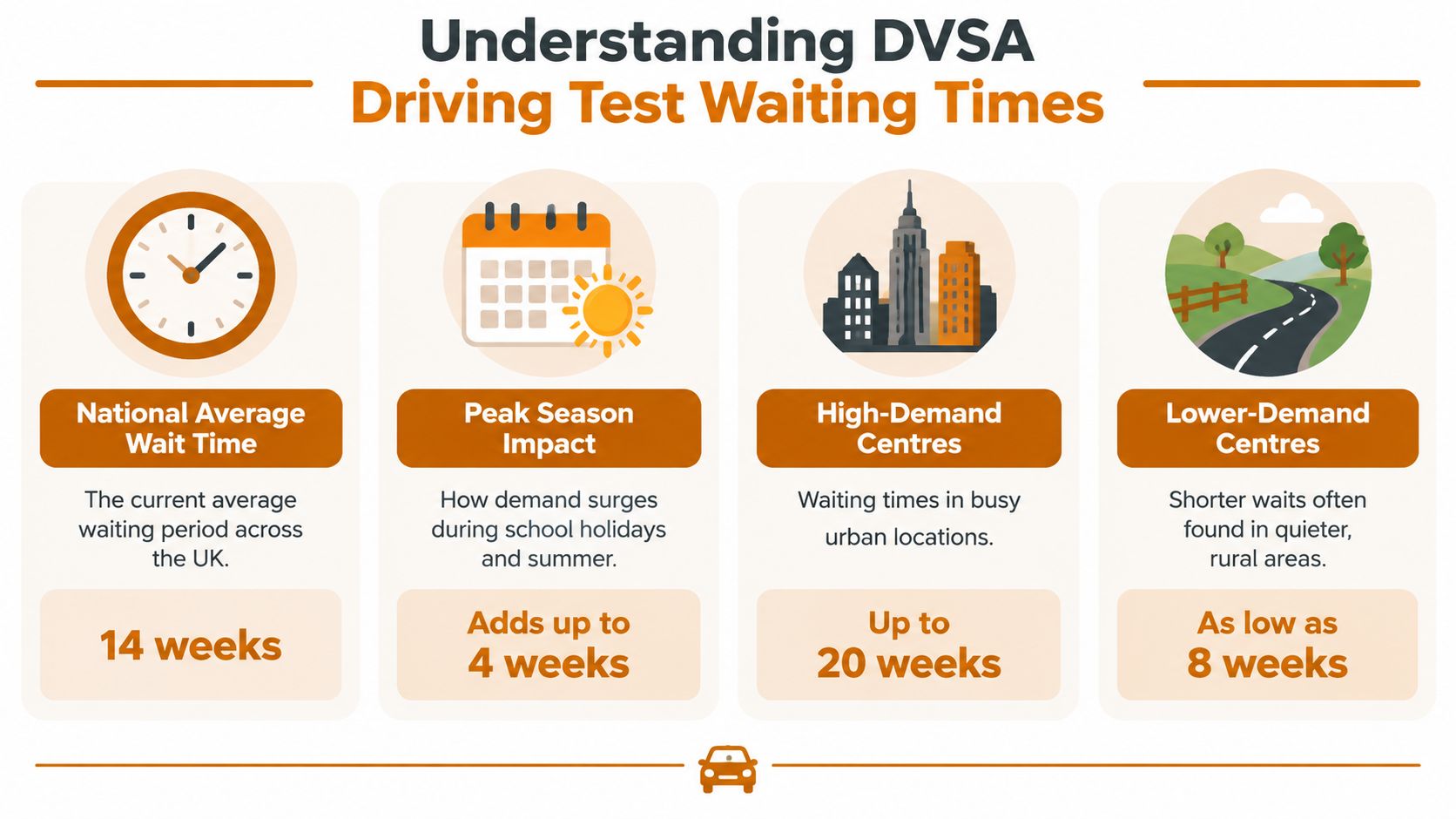
DVSA's waiting-time figures became easier to interpret in 2026 because the service began publishing more than one measure. The headline waiting time is now the median time from booking a test to taking it. The older availability measure answers a different question, namely how far ahead you need to search before at least 10% of a centre's weekly slots remain bookable. DVSA publishes these figures nationally, by region and by individual centre in Great Britain through its clearer waiting-time methodology.
The median describes completed tests. Arrange the waits from shortest to longest, and the median is the middle value. Half of the candidates waited less than that figure and half waited longer. It can therefore give you a more realistic sense of what recent learners experienced.
The availability figure describes the booking window. It tells you how far into the future you may need to look before the centre still has at least 10% of its weekly appointments available. It isn't saying that no appointments exist before that point. It measures how much bookable capacity remains, not the eventual wait experienced by every candidate.
For July 2026, DVSA-reported data showed a Great Britain median wait of 11.1 weeks, while the older availability measure was 20.2 weeks. The median was 14.7 weeks in London, 15.6 weeks in Scotland and 8.1 weeks in the South West, as reported in this July 2026 driving-test waiting-time analysis.
Why local figures beat national headlines
A national figure can hide a great deal. A centre in a busy city may have persistent demand, while a quieter centre elsewhere may show a different pattern. Regional figures also vary. BBC coverage of DVSA-reported data put average waits in April 2026 at 22.7 weeks in England, 22.9 weeks in Scotland and 17.3 weeks in Wales, while the July median figures showed 14.7 weeks in London, 15.6 weeks in Scotland and 7.6 weeks in Wales, according to the BBC report on regional driving-test waits.
Don't compare the figures as though they're identical measures. The April figures and July figures use different reporting measures and periods. The useful conclusion is that location matters, and you should inspect the centre-level data rather than relying on a single UK-wide headline.
Check several centres, then discuss the results with your instructor. If you can travel and practise elsewhere, geographic flexibility may open earlier appointments. But a shorter wait only helps if you're ready for the roads around that centre.
You can find further practical guidance on interpreting these figures in this driving-test waiting-time guide.
What to Expect on the Day at the Centre
Arrive with enough time to find the entrance, park or meet your instructor and settle yourself before the examiner calls your name. Don't assume every centre has a large car park or a spacious indoor waiting room. Some are compact, shared sites, so ask your instructor about the local layout during a lesson.
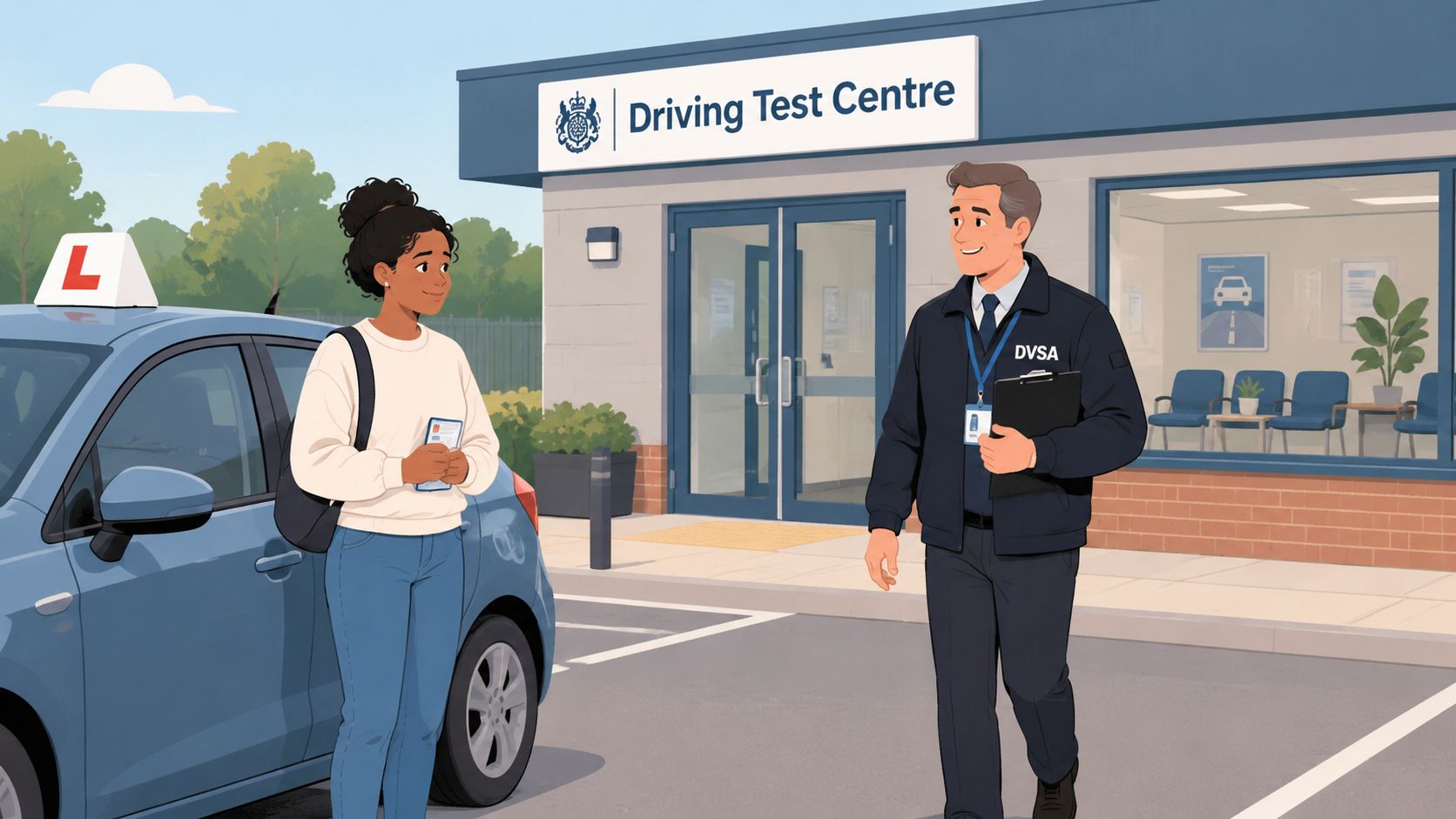
Before the appointment, check where you'll wait and whether toilets are available. Your instructor may know whether candidates normally park on site, use nearby public spaces or remain in the car until the examiner comes out. Don't park in a way that blocks other vehicles or access points.
At check-in, the examiner will normally confirm your identity and booking details before explaining the start of the test. Your instructor can usually sit in the back during the practical test if you want them to, although you should discuss this in advance. Some learners find it reassuring, while others concentrate better without an observer they know.
The test itself isn't a tour of the centre. Once the examiner has completed the initial checks, you'll move into the driving assessment. Listen carefully to the instructions, ask for clarification if you haven't heard something and avoid trying to predict what a particular road means for your result.
This video can help you become familiar with the general experience before the appointment:
The centre's physical environment should be familiar before test day. Ask your instructor to show you the entrance, parking area and nearby roads, rather than arriving for the first time under pressure.
Types of DVSA Driving Test Centres Explained
Test centres differ in size, setting and the facilities they provide. Those differences don't change the standard of the driving test, but they can affect your preparation.
Permanent centres
A permanent centre is an established DVSA site used regularly for practical tests. It may have a defined waiting area, marked parking and familiar access arrangements. The surrounding road network may include residential streets, urban junctions, dual carriageways or rural sections, depending on its location.
Regular use can make the area easier for instructors to teach, but don't reduce preparation to memorising routes. Examiners can vary the roads and instructions, and you need to demonstrate safe, independent driving rather than repeat a rehearsed sequence.
Multi-purpose centres
A multi-purpose test centre, often called an MPTC, may serve more than one testing function. That can mean a larger or more organised site, but it may also have more vehicle movements and a busier entrance.
Ask whether the centre offers convenient learner parking, where candidates wait and how your instructor should approach the site. The presence of other testing activity doesn't make the car test harder. It means you should understand the site layout beforehand.
Temporary or smaller centres
Temporary centres may be introduced to provide additional capacity, while smaller or remote centres can serve areas with fewer nearby alternatives. Facilities may be more limited, and the surrounding roads may change quickly from built-up streets to open country lanes.
A remote centre can be attractive if availability is better, but travel time and practice costs need consideration. You also need to be comfortable with the roads that lead to the centre. A learner who only practises urban driving shouldn't select a rural location without preparing for bends, speed changes and limited visibility.
A different centre can change the preparation required. It doesn't remove the need to meet the same driving standard.
Choosing the Right Test Centre for You
The best centre is the one that gives you a sensible balance between availability, preparation and confidence. The nearest site may be convenient, but it isn't automatically the strongest choice if you can't practise there properly or its surrounding roads expose weaknesses.
Begin with the practical constraints. Can your instructor reach the centre? Can you take lessons on the likely road types? Will the appointment time allow you to arrive without rushing from work, college or another commitment? A centre that requires a long journey may look attractive online but become difficult to prepare for.
Then assess the evidence. In 2024/25, 1,836,558 category B practical tests were taken across 327 DVSA centres in Great Britain, with a national pass rate of 48.7%, according to the 2024/25 practical-test pass-rate data. Outcomes vary significantly by centre, but a pass-rate figure doesn't tell you that one location is easy or that another is unfair.
Use pass-rate information as a prompt for questions, not as a guarantee:
- Compare broad patterns: Look at centre data alongside the type of roads and traffic you'll face.
- Ask your instructor for context: They may know whether the figures reflect local candidate preparation or unusual route demands.
- Review your own weaknesses: A centre with more complex junctions may be suitable once you've mastered them, but premature booking can create avoidable pressure.
- Value reliable practice: Regular lessons near the centre are often more useful than a speculative choice based on a single statistic.
- Keep availability in view: A centre with an earlier slot is only helpful if the date gives you enough time to prepare.
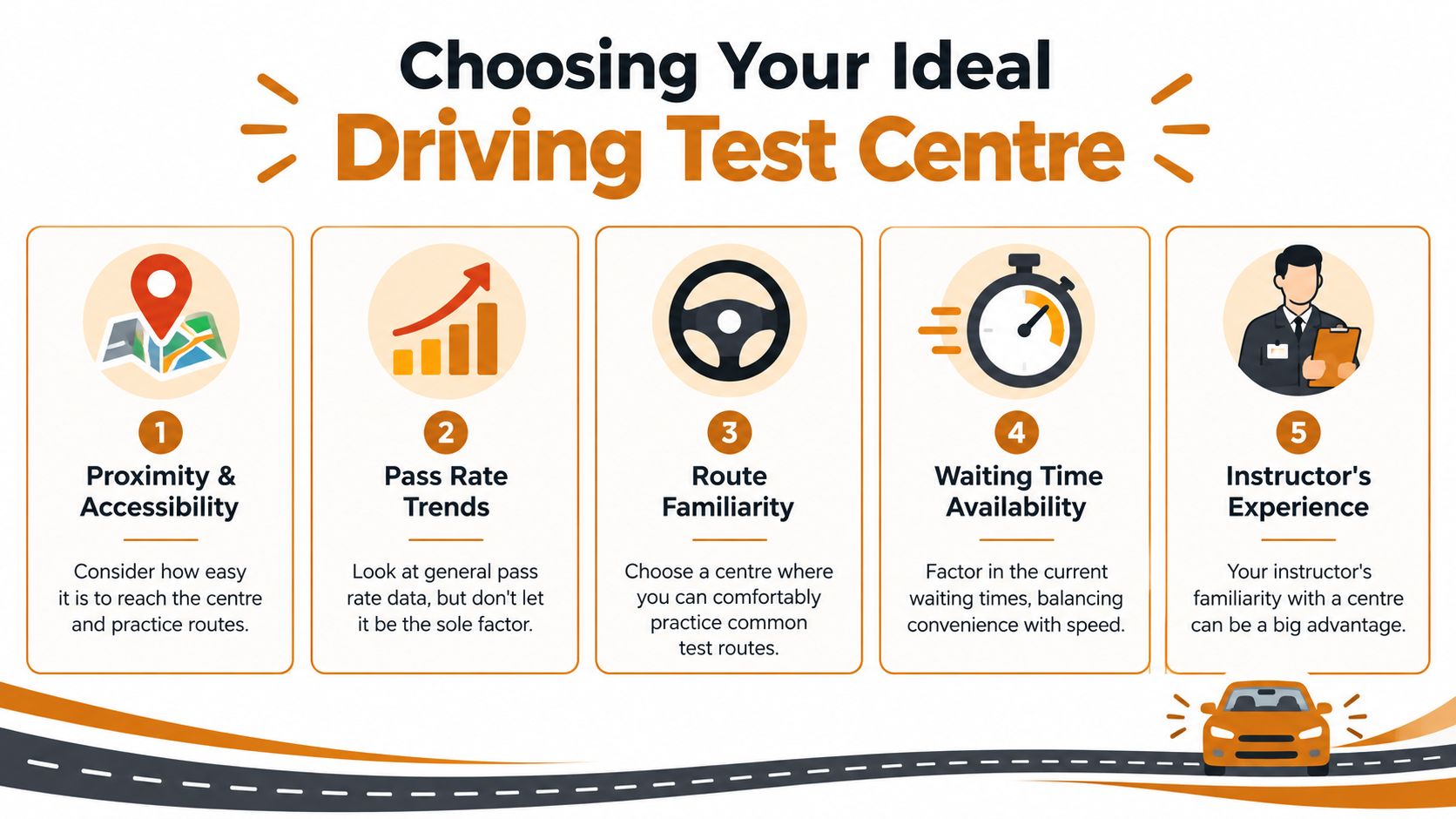
Your instructor's centre experience can be a genuine advantage because they can identify route types, difficult junctions and practical arrival problems. If you're choosing a driving school, reputation and learner feedback may also help you assess how well the instructor supports centre-specific preparation. For a separate way to understand how schools collect and manage customer feedback, see RecensioAI solutions for reviews from RecensioAI B.V.
Make a shortlist, visit or practise near each realistic option, then choose the centre where your preparation is strongest. A strategic booking isn't about finding an easy test. It's about selecting a fair opportunity that matches your actual driving ability.
Changing Your Test Centre or Appointment
You can change the date, time or test centre for a booked car practical test through the official DVSA service. You may also swap the appointment with another learner, provided the change follows the current booking rules.
The major restriction is the two-change limit introduced from 31 March 2026. After you've changed the booking twice, you can't keep moving it. You must cancel and rebook, which means losing your place in the queue, as set out in the GOV.UK guidance on changing a driving test.
From 12 May 2026, only the learner can book or make changes to their own car practical test booking. From 9 June 2026, a booked test can be moved only to nearby centres, according to DVSA booking guidance. These rules mean you should decide carefully before using a change.
A sensible process is:
- Check the booking details: Have your reference number and licence information ready.
- Review the available alternatives: Confirm the date, time and centre before committing.
- Count previous changes: Don't assume a cancelled or moved appointment leaves your change allowance untouched.
- Confirm only when certain: Check the new location and travel arrangements carefully.
- Record the new appointment: Save the confirmation and update your instructor immediately.
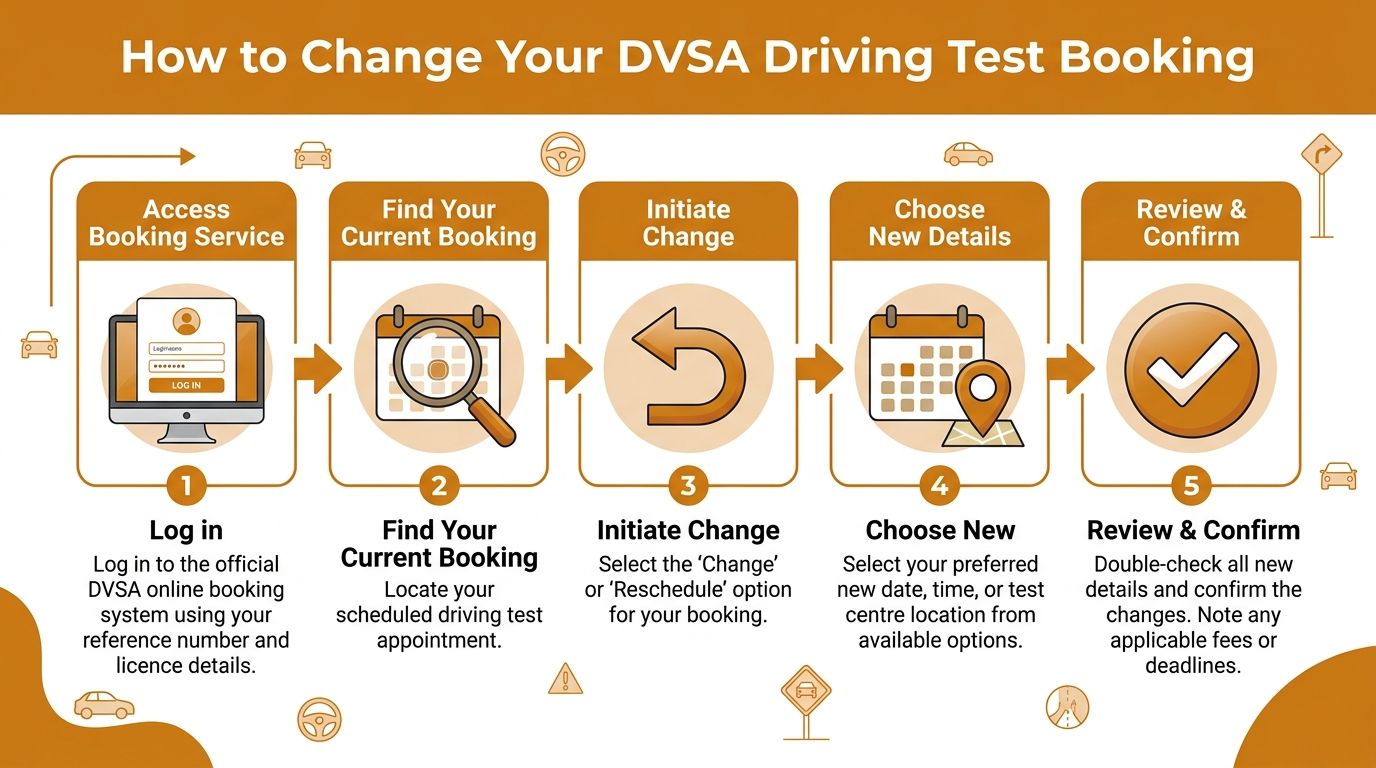
Don't cancel merely because you hope an earlier appointment will appear. First consider whether you can keep the existing booking while looking for a permitted alternative, and make any change manually through the DVSA website.
For the basic booking process, use this guide to booking a driving test.
Frequently Asked Questions
What happens if I'm late to the test centre?
Arrive early enough to find the site and complete the initial arrangements calmly. If you're late, speak to the centre or examiner as soon as possible, but don't assume the test can be delayed. A late arrival may mean the appointment can't go ahead.
Can my instructor sit in the back?
You can ask your instructor to sit in the rear of the car during the test. Discuss it beforehand. Some learners prefer the reassurance, while others find it easier to focus without their instructor present.
How long is my theory-test certificate valid?
A theory-test pass certificate is valid for two years from the test date, unless a court disqualification applies before then. The rule comes from the Motor Vehicles (Driving Licences) Regulations 1999. If it expires before you take your practical test, you'll need to pass the theory test again.
Should I choose a centre outside my area?
Only if you can reach it reliably and practise the surrounding roads. A different centre may offer a more suitable appointment, but the location still needs to fit your lessons, transport plans and driving ability.
What should I check before test day?
Confirm the exact centre address, appointment time, parking arrangements and meeting point with your instructor. Make sure the car is suitable and that everyone has the same booking details.
If you're already booked and want to look for an earlier appointment at a suitable DVSA driving test centre, Driving Test Cancellations monitors availability and sends alerts when matching slots appear. You can then review the notification and make any permitted change yourself through the official DVSA booking service.