You've already secured a practical driving test, but the date is too far away. A nearer appointment would fit your work, lessons or theory-certificate deadline, yet popular cancellations can disappear before you've finished opening the booking page. That's the problem a driving test cancellations app is designed to address.
These services monitor DVSA availability and notify you when an earlier slot appears. They don't replace the official booking process. Under current DVSA guidance, only the learner can book, change, swap or cancel a car driving test, and unofficial third-party services aren't allowed to do those actions for you. You should receive an alert, then complete the change yourself through GOV.UK's driving test service.
The comparison below focuses on what matters in practice: alert speed, centre coverage, notification channels, manual DVSA rebooking, pricing transparency, trial or refund terms, evidence behind performance claims and suitability for learners or ADIs. Published features are separated from marketing claims and community feedback. An alert can improve your chance of finding an earlier test, but it can't guarantee that a suitable appointment will still be available when you respond.
Table of Contents
- 1. Driving Test Cancellations
- 2. Testi
- 3. TestShift
- 4. Driving Test Cancellations 4 All
- 5. Find Me A Driving Test
- 6. Find a Driving Test
- 7. Beep Driving Cancellations UK
- 8. Test Hunter
- 9. DriveSooner
- 10. PassSlot
- Top 10 Driving Test Cancellation Apps, Features Comparison
- Choose the Tool That Fits Your Booking Strategy
1. Driving Test Cancellations
Driving Test Cancellations is built around a notification-only model for UK learners and Approved Driving Instructors. It continuously scans DVSA practical-test availability and sends time-stamped SMS alerts containing the date, time and test centre when an earlier appointment appears. That approach suits someone who can't spend the day refreshing GOV.UK, particularly where a cancellation may be claimed quickly.
Individual users can monitor up to three preferred test centres, while ADIs can use a dashboard to manage multiple pupils. The distinction matters. A learner usually needs a small set of realistic centres, whereas an instructor may care less about one pupil's ideal location and more about coordinating a workable diary across several bookings.
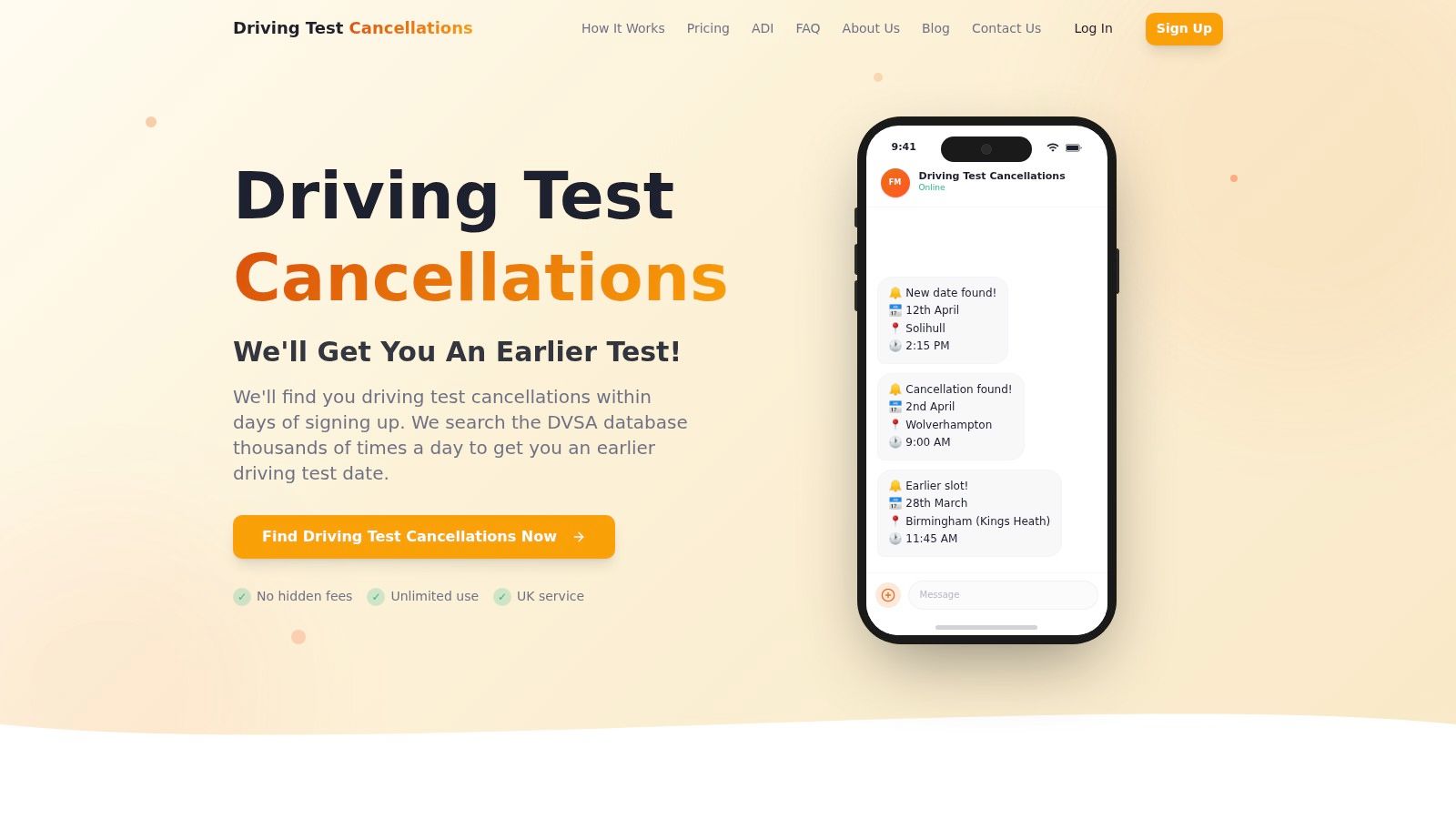
The service advertises 24/7 high-frequency scanning, a free trial that sends genuine sample cancellation alerts, and paid access with unlimited alerts. Its published pricing starts from £21.89, with a money-back guarantee if no cancellation is found during the initial sign-up period. Those terms are more useful than a vague “fast alerts” promise because they give a buyer something concrete to check before paying.
What the published evidence does and doesn't show
Driving Test Cancellations publishes performance indicators including over 50,000 tests found, a quoted 98% success rate, an average sign-up time of around 2 minutes, and an average claimed saving of £142 in lesson costs. These are the provider's published figures, not independently verified results, so treat them as marketing evidence rather than a guarantee for your centre or date.
The service says it follows the DVSA's post-12 May 2026 rules by notifying users only. It doesn't book, change, cancel or swap a test on your behalf. After an alert, you must act quickly and complete the booking change through GOV.UK. The provider's explanation of how the service works makes that hand-off clear.
Best fit: learners who want SMS alerts and transparent trial terms, or ADIs who need a central view of several pupils.
Trade-off: it's UK-only, and no notification service can create availability where a local centre has very few cancellations.
2. Testi
Testi is one of the better-known UK earlier-test notifiers. You add your DVSA booking details, select preferred centres and receive an alert when the service detects an earlier practical-test slot. It's available through iOS and Android apps as well as a web version, which makes it practical for learners who switch between a phone and a laptop.
The main convenience is the direct hand-off to GOV.UK. Testi can tell you that a slot has appeared, but you still need to enter the official booking service and make the change yourself. That distinction matters under the current rules, particularly if an app's wording makes the process sound more automatic than it is.
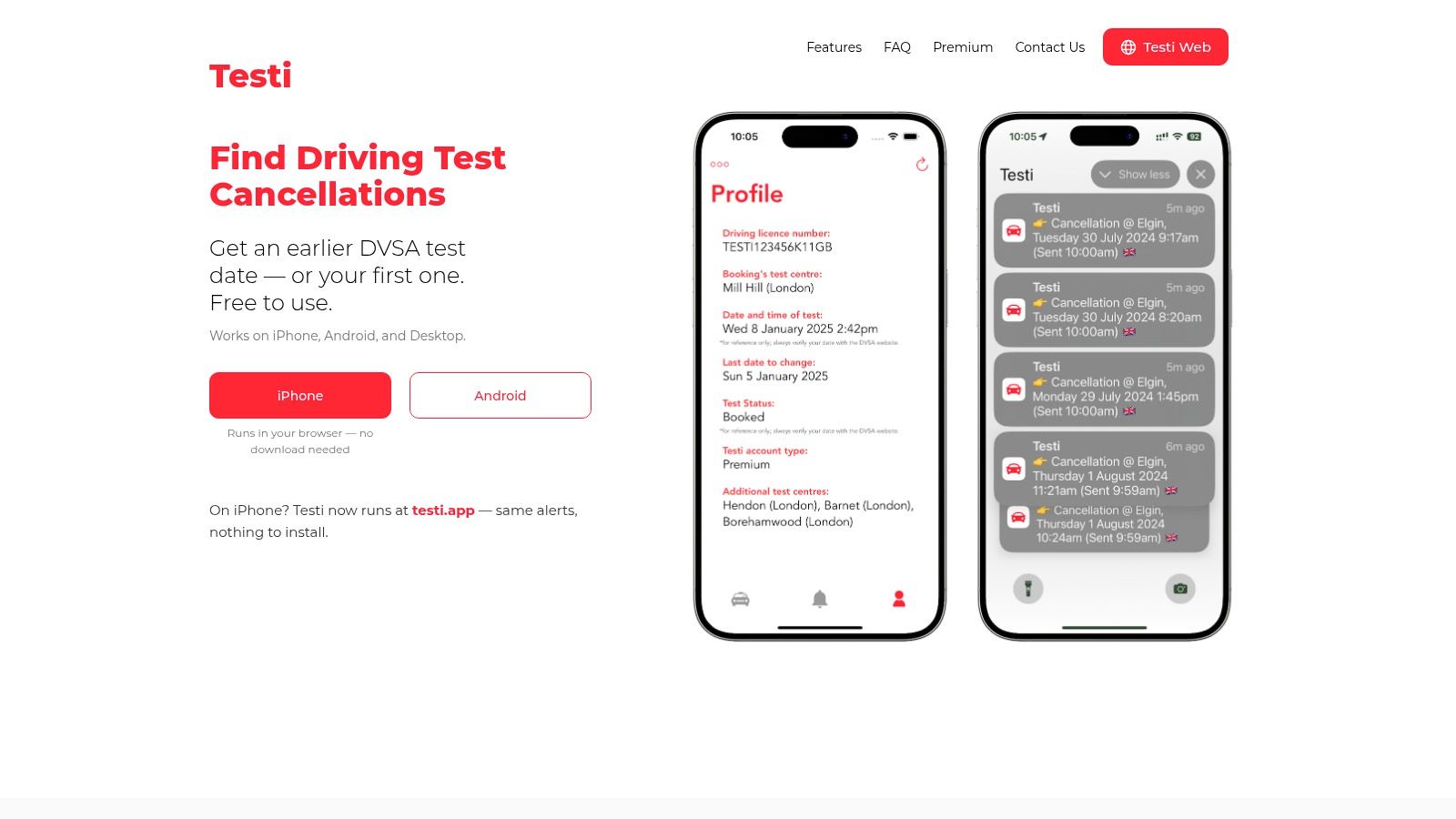
There's a free app, with a paid upgrade for advanced alerts. The large install base means plenty of user discussion and practical advice is available, although community feedback about alert frequency is mixed. That feedback shouldn't be treated as a controlled performance comparison. It does suggest that the experience can vary considerably depending on the test centre, notification settings and how quickly the user responds.
Best fit: learners who want an established app experience across mobile and browser.
Watch for: a popular cancellation may be gone by the time an alert is opened. Keep the GOV.UK booking page details ready and don't assume an alert equals a successful rebooking.
Visit Testi to check the current app and upgrade terms.
3. TestShift
TestShift runs in a browser, so learners do not need to install a mobile app. It scans DVSA availability and can send browser notifications when an earlier appointment matching their preferences appears. This suits people who work mainly from a computer, provided browser permissions are enabled and the device is available when an alert arrives.
Its published features include custom availability filters and monitoring for up to three centres. The service also claims to keep a detected slot available during a 15-minute reservation window. Current DVSA rules make that wording difficult to assess, because the booking authority remains with the official service. The claim therefore needs more scrutiny than a standard alert feature.
TestShift says the user stays in control and that the change happens only after manual acceptance. You should treat the notification as a prompt, open GOV.UK yourself and complete the booking change through the official process. A third-party reservation should not be treated as proof that the appointment is secured.
The site shows one-time pricing and states that refunds are available within 14 days. Check the conditions before paying, including the definition of an eligible refund and whether the reservation terms have changed. The available information supports a clear comparison on pricing, but does not establish faster alerts or better coverage at any particular centre.
Best fit: computer-based learners who want centre filters and a displayed one-off payment.
Trade-off: the reservation wording adds compliance uncertainty compared with an alert-only service. Read the current terms carefully at TestShift.
4. Driving Test Cancellations 4 All
Driving Test Cancellations 4 All, often shortened to DTC4A, is a long-running UK service offering cancellation alerts through SMS and email. It also has materials and widgets aimed at ADIs and driving schools, which gives it a different use case from a basic learner app. An instructor managing several pupils may value the business-facing resources even if each learner still has to make their own booking change.
The service has an established public review footprint and promotes trials and money-back policies. Those signals can help when comparing providers, but reviews don't establish that alerts will arrive faster at a particular centre. Local capacity and competition remain decisive.
A compliance check is essential. Some legacy wording on ADI pages refers to changing tests “on your behalf”. That language conflicts with the current position that only the learner can manage a car driving test. Retail users should therefore treat DTC4A as a notification service and complete every change through GOV.UK.
Practical rule: if a service page suggests it can change your car test for you, check the latest terms before signing up and make the change yourself through DVSA.
The strongest reason to consider Driving Test Cancellations 4 All is its combination of SMS, email and instructor-oriented tools. Its main weakness is the need to distinguish current operating practice from older wording that may still appear on parts of the site.
5. Find Me A Driving Test
Find Me A Driving Test monitors up to three preferred centres. Users enter their existing booking details and receive time-stamped SMS alerts when an earlier cancellation appears. The service offers a free trial, a fixed-price plan with unlimited alerts and a money-back guarantee described on its pricing pages.
The three-centre limit suits learners who can travel between a small group of nearby locations. It can reduce coverage in high-demand areas, where a wider search may offer more opportunities. However, expanding the search also affects lesson arrangements, transport and test-day planning, so centre coverage should reflect realistic travel options rather than alert volume alone.
Find Me A Driving Test tells users to complete the rebooking themselves through DVSA. Learners should keep their licence number and booking reference ready, then follow the official process explained in this guide to how to book a driving test. The service therefore provides alerts, not automatic booking or manual rebooking on a learner's behalf.
A trial can confirm whether messages reach your device and whether your chosen centres are covered. It cannot show that a suitable slot will appear, so compare the plan's refund wording with your own deadline before subscribing.
Review the published features alongside the practical trade-offs: SMS alerts may suit learners who do not want a dedicated app, while the centre limit may matter more to ADIs managing pupils with different travel constraints. For further details, review Find Me A Driving Test.
6. Find a Driving Test
Find a Driving Test, operating through FindADrivingTest.co.uk, is a web-based checker aimed at learners and ADIs. Its published features include automated monitoring, a free trial, paid plans and a money-back policy. The site also claims to check more than a thousand times each day. That figure is marketing information, not independent evidence of scan frequency, alert speed or success rate.
For practical comparison, the important question is what happens after an alert. Frequent checks may identify opportunities sooner, but a slot can disappear before the learner opens the message. Centre coverage, notification reliability and the learner's ability to act manually may therefore matter more than the advertised checking frequency. This makes the service easier to assess through a trial than through scan claims alone.
The UK focus and straightforward sign-up may suit learners who prefer a browser to a dedicated mobile app. Instructor-facing messaging gives ADIs a possible monitoring role, but it does not transfer responsibility for changing a pupil's booking. The learner still has to complete the official rebooking process through GOV.UK.
A free trial can test whether notifications reach your devices and whether the available centres match realistic travel plans. Read the refund conditions carefully, since “money back” does not necessarily describe an unconditional refund.
Best fit: learners wanting a simple web-based checker with a trial.
Evidence caution: assess the alerts you receive, the centres covered and the current terms. Treat high-frequency monitoring as a provider statement rather than proof of better results.
See the current offer at Find a Driving Test.
7. Beep Driving Cancellations UK
Beep is a browser-based web app with push notifications. It can be used across devices and installed on an iOS Home Screen, so it occupies a middle ground between a conventional website and a native app. Login is designed to be lightweight, using Google or an email code rather than a more involved account process.
Its FAQ explicitly says that Beep doesn't book a test for you. You must follow the notification to GOV.UK and complete the change yourself. That clear statement is valuable because the official rules leave little room for ambiguity around third-party booking activity.
Beep Pro is marketed as a low-cost, one-time lifetime option. The pricing model may suit someone who wants to avoid a recurring subscription, but a low upfront fee shouldn't be confused with a higher chance of finding a suitable slot. App Store snippets include positive reports of quick results in some cases, while community anecdotes about reliability and alert frequency are mixed.
A low-cost alert is still only a prompt. Keep your existing booking until the new appointment has been confirmed on GOV.UK.
The browser format is convenient if you don't want another app, but push notifications depend on device permissions and browser settings. Check those before judging the service's speed. Beep is most suitable for learners who value a lightweight interface and a one-off payment.
8. Test Hunter
Test Hunter is an iOS app that monitors cancellations and sends push notifications when earlier dates appear. Its app listings mention preference settings, filters and checks across multiple centres. This “set and forget” approach suits learners who prefer background monitoring to repeatedly refreshing a booking page.
Pricing transparency varies: Test Hunter's main website obscures costs that are clearly published on some competitor sites. The app is free to download, while its store listings describe an optional one-off premium purchase lasting until the user passes. Store prices may differ by region, so compare the current listing with services that show a fixed price and refund terms on their own websites.
The available evidence is spread across the company site, Trustpilot and app-store reviews. Examine recurring comments about missed alerts, login difficulties and centre coverage rather than relying on individual success stories. Results will still depend on local demand and how quickly a learner responds.
An alert remains a prompt to open GOV.UK. Rebook manually through the official service, then check the new date, time and centre before treating the change as complete.
Best fit: iPhone users who want push notifications and a one-off premium option.
Weak point: the main website gives limited pricing detail, while reviews contain mixed reports about reliability. Check the current store listing and terms at Test Hunter.
9. DriveSooner
DriveSooner offers UK learners a cancellation-alert service with centre searches and notifications by SMS and email. Its website states that it operates independently from DVSA and expects users to make booking changes themselves.
That operating model matters. Alerts reduce repeated checking of the official booking page, while the learner still controls the final rebooking decision. DriveSooner describes coverage across UK DVSA centres, but users should confirm their chosen locations during sign-up rather than rely on the national description.
Public information about plan structure and refund terms is limited. DriveSooner's older reply-based “BOOK” workflows predate the May 2026 rule changes and should be treated as outdated guidance. This language may confuse readers. Follow the current instructions for manual rebooking and do not assume that replying to a message completes the change.
Centre flexibility remains a practical consideration. Waiting times can vary sharply between test centres, so learners able to travel may have more opportunities than those restricted to one location. The driving test waiting-time guidance can help assess that trade-off before setting alerts.
DriveSooner's published features are clear enough to describe its alert function, but the available material provides limited evidence for alert speed or successful bookings. Check the latest terms at DriveSooner, particularly the pricing and refund conditions, before paying.
Best fit: learners who want SMS or email alerts and will rebook manually.
Weak point: limited public pricing detail and outdated booking language require careful checking.
10. PassSlot
PassSlot is a newer entrant that markets a scan cadence of every 60 seconds, support for up to 10 centres and a “success-or-refund” policy. Those features target learners who can travel between several locations and want broad monitoring rather than a narrow search around one centre.
The site says users must already have a DVSA booking and that they rebook themselves through the direct link supplied after an alert. That is the right operating model under the current rules. Its coverage of car, motorcycle, LGV, PCV and ADI test categories may also make it relevant beyond standard car learners.
The scan-frequency and refund statements are provider claims. They don't establish that PassSlot will find an appointment at your preferred centre, or that a detected slot will still be available when you open the link. A broad search can improve the number of possible opportunities, but it can also create practical problems if the centre is too far away or the time clashes with lessons and work.
Before paying, read the conditions attached to the promoted refund and check whether “earlier slot” means earlier than your current date at an acceptable centre. Then keep the official GOV.UK page ready so you can complete the change yourself.
PassSlot may suit flexible learners who value multi-centre monitoring, but its aggressive speed and success language should be assessed as marketing rather than independent proof.
Top 10 Driving Test Cancellation Apps, Features Comparison
| Service | Core features | Reliability / UX (★) | Price / Value (💰) | Target audience (👥) | Unique selling point (✨) |
|---|---|---|---|---|---|
| 🏆 Driving Test Cancellations | 24/7 high‑frequency scans; time‑stamped SMS; ADI dashboard; monitor up to 3 centres | ★★★★★ (50k+ tests found, 98% quoted) | 💰 Free trial → from £21.89; money‑back guarantee | 👥 Learners, parents, ADIs (multi‑pupil) | ✨ ADI dashboard, published performance metrics, 100% free trial |
| Testi | App + web alerts; one‑tap handoff to GOV.UK; multi‑centre prefs | ★★★★☆ (large user base; mixed recent feedback) | 💰 Free app; paid upgrade for advanced alerts | 👥 Learners & instructors who want apps | ✨ Wide install base & community tips |
| TestShift | Browser notifications; claims 15‑min "reservation" window; 3 centres | ★★★☆☆ (compliance‑sensitive reservation claim) | 💰 Transparent one‑time pricing; 14‑day refunds | 👥 Learners wanting browser-only tool | ✨ Browser‑based real‑time alerts, clear compliance messaging |
| Driving Test Cancellations 4 All (DTC4A) | SMS & email alerts; ADI widgets; money‑back offers | ★★★★☆ (established brand; legacy wording risk) | 💰 Free trial + refund policies | 👥 ADIs & learners preferring established brand | ✨ Long‑running service with ADI tooling & public reviews |
| Find Me A Driving Test | Monitor up to 3 centres; time‑stamped SMS; free trial | ★★★★☆ (transparent pricing & guarantees) | 💰 Free trial; fixed‑price plan with unlimited alerts | 👥 Learners seeking simple, transparent service | ✨ Clear refund/guarantee messaging |
| Find a Driving Test | Automated frequent checks; free trial & paid tiers | ★★★☆☆ (marketing claims; performance varies) | 💰 Free trial + paid plans with refund framing | 👥 Learners & ADIs wanting straightforward checking | ✨ Instructor‑aware messaging; UK focus |
| Beep: Driving Cancellations UK | Browser push + installable PWA; Google/email login | ★★★★☆ (lightweight; low one‑time fee) | 💰 Low one‑time cost (Pro lifetime option) | 👥 Cost‑conscious learners wanting browser push | ✨ Installable web‑app with lifetime option |
| Test Hunter | iOS app push; multi‑centre checks; premium one‑time option | ★★★☆☆ (mixed reviews; app‑store footprint) | 💰 Free download; in‑app premium purchase | 👥 App users wanting "until you pass" pricing | ✨ Simple set‑and‑forget app experience |
| DriveSooner | Centre search; SMS & email alerts; DVSA disclaimer | ★★★☆☆ (simple flow; limited plan detail) | 💰 Free trial; unclear public plan detail | 👥 Learners wanting straightforward alerts | ✨ Clear non‑affiliation disclaimer; simple signup |
| PassSlot | High‑frequency scans (60s); supports up to 10 centres; SMS/email | ★★★★☆ (aggressive claims; broad coverage) | 💰 One‑time pricing; success‑or‑refund promoted | 👥 Users needing multi‑centre coverage & speed | ✨ 60‑second scan cadence, up to 10 centres support |
Choose the Tool That Fits Your Booking Strategy
There isn't a defensible universal winner because the useful feature depends on your booking constraints. A learner with one realistic test centre may value a dependable SMS alert and a free trial more than a service claiming to monitor a wider area. Someone who can travel may gain more from multi-centre support, while an ADI may care most about managing several pupils without maintaining separate searches.
For a straightforward learner setup, compare alert channels, trial terms and manual rebooking instructions first. Driving Test Cancellations, Find Me A Driving Test and DTC4A all present SMS or email-based options, while Testi and Test Hunter lean more heavily towards app notifications. Browser services such as TestShift, Find a Driving Test and Beep can be convenient, but you'll need to make sure browser permissions and push notifications work on the device you use.
Pricing transparency is another practical dividing line. Published fixed-price or one-time offers are easier to compare than plans whose cost appears only inside an app store or after sign-up. Test Hunter's website pricing is less explicit, while Find Me A Driving Test and Driving Test Cancellations put more emphasis on trial or refund protection. Those policies don't guarantee a cancellation will appear, so read the qualifying conditions and the relevant time period before subscribing.
Centre coverage should match your real travel limits. Monitoring more locations can broaden the search, but it doesn't make a distant test centre sensible if you can't practise there or reach it reliably. DVSA's monthly reporting now provides centre-level waiting-time information, and its July 2026 figures showed that half of learners who took a test waited no more than 11.1 weeks. That median is a benchmark, not a promise for your centre or booking.
Your deadline may also be more important than the alert provider. DVSA says you must take the practical test within the two-year life of the theory pass certificate, otherwise you'll have to retake the theory test. A cancellation service may help you find an earlier appointment, but it can't remove the need to plan around that expiry date, lesson availability or the consequences of making unnecessary booking changes.
The official booking restrictions make careful rebooking essential. A car test booking can be changed only two times, and from 31 March 2026 only the date or time, test centre, or a swap with another learner count as changes. If you need more changes, you must cancel and rebook. A full refund is available only when cancellation happens at least 10 full working days before the test, as explained in the 2026 booking-rule guidance.
Use this sequence:
- Keep your existing booking: Don't cancel a confirmed test while waiting for an alert.
- Set realistic centres and dates: Include only locations and times you can genuinely accept.
- Enable prompt notifications: Check SMS, email or browser permissions before relying on alerts.
- Respond quickly: Popular appointments may disappear while you're deciding.
- Confirm directly with DVSA: Complete and verify every accepted change on GOV.UK.
The best service is the one whose coverage, notification method and terms fit your actual plan. Treat claimed scan rates and success figures as evidence to investigate, not as a substitute for checking local availability and acting promptly.
Driving Test Cancellations offers 24/7 monitoring, time-stamped SMS alerts, a free trial and support for up to three preferred test centres, with an ADI dashboard for managing multiple pupils. If you want a notification-only service that leaves the final booking change with you on DVSA, visit Driving Test Cancellations and review the current trial and pricing terms.