You're sitting in the car with your instructor beside you. Your lessons are finished, your mock test went well, and you're ready to take the test. Then the DVSA booking screen offers a date 14 weeks away. The frustrating part isn't learning to drive anymore. It's waiting for permission to prove you can.
That delay can stall revision, force you to pay for lessons without a clear exam date, and leave work or insurance plans hanging. You might also be worrying about your theory certificate expiring, while friends pass their tests and move on. The sensible question isn't how to find a cancellation. It's whether chasing one is worth your time in the first place.
Table of Contents
- Waiting Months for a Test You're Ready For Today
- How DVSA Cancellations Actually Work
- The Real State of UK Test Waiting Times
- Manual Checking vs Cancellation Monitoring Services
- Smart Strategies for Landing an Earlier Test
- When Chasing a Cancellation Is Not the Answer
- Your Practical Next Steps
Waiting Months for a Test You're Ready For Today
A learner I'd expect to see in this situation has already done the hard preparation. They can deal with roundabouts, follow independent driving directions, complete manoeuvres safely and recover from the occasional mistake. Their instructor has said they're close to test standard, but the booking system has placed the exam months into the future.
That creates a strange gap. The learner is ready now, but the practical test is too far away to feel real. Lessons become maintenance rather than progress. Some people reduce their hours, then lose sharpness. Others keep paying for regular practice because they're worried that stopping will undo the work they've done.
The wider backlog makes this more than an isolated annoyance. In Great Britain, the National Audit Office's reported test waiting times showed an average wait of 22 weeks in September 2025, compared with just over five weeks in February 2020. The same investigation found that 83% of 240 permanent test centres had waits between 19 and 24 weeks, while only 73 centres were below the 24-week ceiling.
My advice: don't treat a distant booking as proof that you aren't ready. Treat it as a planning problem, then decide whether an earlier slot would genuinely improve your position.
The knock-on effects can be serious. A learner may have accepted a job that requires independent travel, but insurance arrangements only become useful after passing. A theory pass can also become a source of anxiety if the practical test keeps moving out. None of those pressures makes you more test-ready, and rushing into an unsuitable cancellation can create a different problem.
I'd split learners into two groups. If your centre has a very long wait and you're ready, cancellation monitoring deserves a planned trial. If you're still inconsistent on key skills, the booking date is useful breathing space. The rest of this guide helps you tell the difference, using the two DVSA availability measures rather than guesswork.
How DVSA Cancellations Actually Work
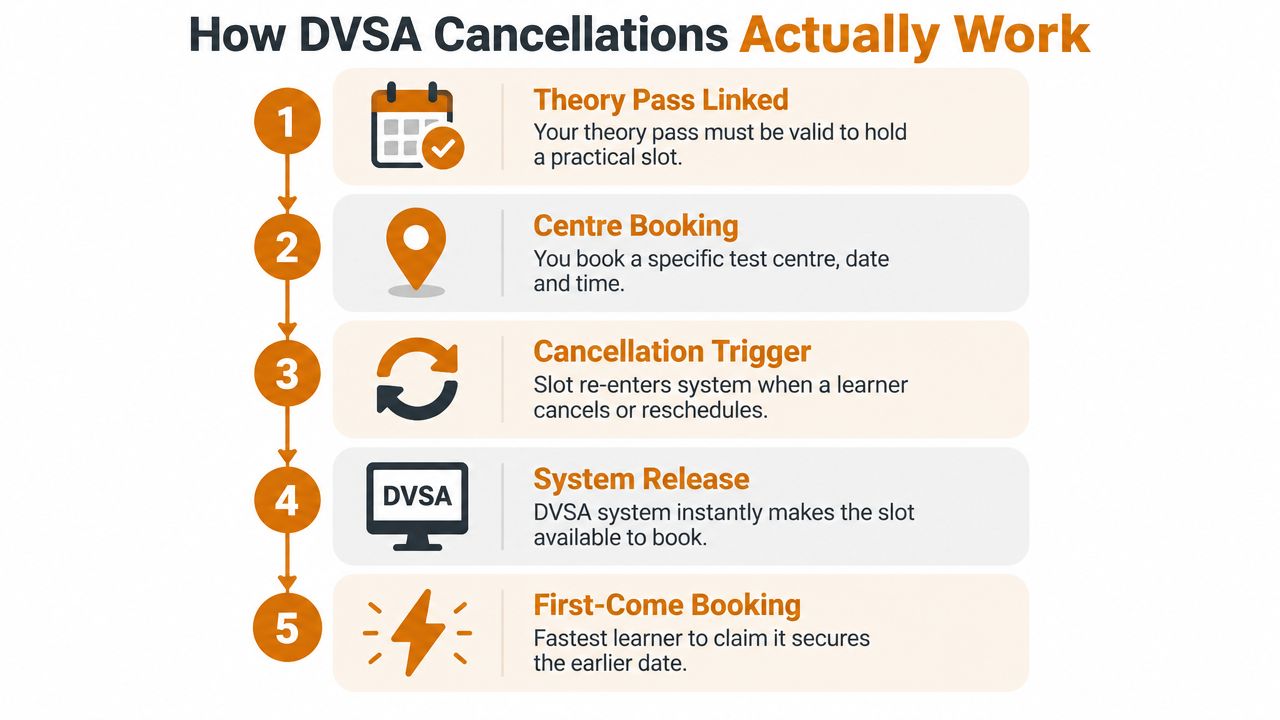
A practical test booking links your learner record, a valid theory pass, a chosen test centre and a particular appointment. When another learner changes or cancels, the released appointment may become available to someone else. DVSA's official position is clear, there's no waiting list or cancellation list, and earlier tests can appear when another learner changes or cancels through the booking service (GOV.UK earlier appointment guidance).
The process is easier to understand in stages:
- You need an eligible booking. Your theory pass must still be valid, and your practical booking must meet the relevant DVSA requirements.
- You select a centre and appointment. The system ties the test to a specific location, date and time.
- Another learner changes or cancels. That action can release the appointment, although availability also depends on how DVSA manages examiner capacity.
- The booking system updates. The slot may appear for another candidate, sometimes quickly and sometimes only after the system processes the change.
- A learner books it directly. You still have to complete the booking yourself through the official DVSA service.
What the cancellation notice rule means
DVSA changed the free cancellation period for car practical tests from 3 full working days to 10 full working days on 8 April 2025. The DVSA announcement about the cancellation rule says the change was intended to reduce waiting times by cutting last-minute losses of usable appointments.
That rule doesn't mean every cancellation will appear in the same way or at the same time. If a test is cancelled inside the required notice window, the appointment doesn't re-enter supply cleanly from the booking system's point of view. It can become lost capacity instead of a usable earlier slot.
You'll sometimes hear people talk about a “10-working-day rule” for cancellations returning to a pool, including claims about when slots appear online. Treat those claims cautiously. The practical point is that timing varies by centre and by the reason the appointment became available. Don't assume a cancellation made today will instantly be visible to every learner.
If you're changing your own appointment, use the official booking service and make sure you understand the notice conditions before giving up your current date. A slot isn't useful if you lose your existing booking and can't secure the replacement.
The Real State of UK Test Waiting Times
The UK does not have one meaningful wait time. Your experience depends heavily on the centre you choose, the appointments available there and how the published measure is calculated.
DVSA's updated reporting gives learners a clearer centre-by-centre view by showing both the median wait and the point at which at least 10% of weekly appointments remain available in the booking window. The DVSA waiting-time reporting explained through centre-level availability helps show why those measures shouldn't be treated as interchangeable.
The median wait answers a straightforward question: how long candidates typically wait between booking and taking a test. The 10% availability measure answers a different question: how far ahead you need to look before the system still has a meaningful share of appointments open. It doesn't promise that you personally will be tested on that date.
Read the two measures together
Suppose your centre has a long median wait, but the 10% availability point is close to it. That suggests the centre is releasing appointments across the booking window, so checking for an earlier date may be worthwhile. If the two measures are far apart, your search may depend on rare individual cancellations rather than a steady flow of open appointments.
Regional conditions are uneven. DVSA reported that half of learners who took a test in August 2026 waited no more than 11.1 weeks (GOV.UK guidance on changing a driving test). That median doesn't mean every learner had an 11.1-week experience. The same official guidance explains that earlier tests appear when candidates change or cancel, while examiner availability and local demand affect what each centre can offer.
| Centre type | Median wait | 10% availability date | Cancellation viability |
|---|---|---|---|
| High-demand urban centre | Long, often materially above the GB median | May sit much further out | Worth monitoring, but expect competition |
| Busy suburban centre | Variable and sensitive to local demand | Can move noticeably as bookings change | Viable if you can respond quickly |
| Rural centre | Often shorter than major urban locations | May be relatively close to the median | Manual checking may be practical |
| Alternative centre within travelling distance | Depends on local supply | Can offer a different availability pattern | Useful if the route is familiar enough |
The backlog remains substantial. DVSA's business plan said it had no date to return to its seven-week target, because its modelling couldn't confidently predict when that would happen (DVSA business plan 2025 to 2026). That's why cancellation alerts are a tactical option, not a cure for the national shortage.
For a fuller explanation of the numbers, see this guide to driving test waiting times. Judge your own centre first. Don't buy a monitoring service just because the national headlines are alarming.
Manual Checking vs Cancellation Monitoring Services
You are ready for your test, but your centre shows no suitable date. Manual checking gives you a free way to search for a cancellation, provided you can keep checking at the right times. Log into the DVSA booking service, enter your details, select your chosen centre and repeat the search when availability changes. At a busy centre, another learner may take a slot before you finish the next screen.
The cost is your time. Work, study and driving lessons make repeated searches difficult to sustain. Many learners check constantly for a few days, miss several appointments and then abandon the process because it starts to feel like another unpaid job.
What each option involves
| Factor | Manual checking | Monitoring service |
|---|---|---|
| Cost | No service charge | Subscription or other fee, depending on provider |
| Time | Requires repeated visits to the DVSA booking service | Sends an alert when matching availability is detected |
| Control | You choose exactly when to search | You set centres and preferences in advance |
| Response | You must notice the slot yourself | You still have to complete the booking yourself |
| Main weakness | Easy to miss short-lived availability | A notification doesn't guarantee a suitable appointment |
| Compliance check | Uses the official service directly | Must be checked carefully against current DVSA rules |
A monitoring service can watch selected centres and send an SMS or email when it detects a possible match. That removes the need to sit at the booking screen, but you still decide whether the date, travel distance, test time and your preparation make sense. An alert is an opportunity, not a confirmed booking.
Your local centre should decide whether paying for alerts is sensible. Check DVSA's median wait and 10% availability date before committing. A long median wait does not automatically mean a monitor will find a usable appointment quickly. If the 10% date is only slightly earlier, manual checking may be enough. If earlier appointments appear but disappear quickly, monitoring can save time, provided you can respond immediately.
A monitoring service is useful only when you can accept the centres and appointment types you select. Set narrow preferences and you may receive very few alerts. Set them too broadly and you could chase dates that create difficult travel, disrupt lessons or leave you underprepared.
The legal position still matters. GOV.UK says you can cancel a car practical test up to the moment it starts, but you need to give 10 full working days to avoid paying again. Monday to Saturday count as working days, while Sundays and public holidays don't. You must cancel the test yourself, and your instructor can't do it for you (GOV.UK cancellation guidance).
Check before paying: confirm whether the service only sends notifications or attempts to manage your DVSA booking. You should remain in control of the booking process under the current guidance.
Read the provider's cancellation policy, renewal terms and data requirements. Driving Test Cancellations describes a notification service that monitors DVSA availability and sends alerts, while the candidate completes rebooking through DVSA. Review its cancellation monitoring process before deciding whether the service fits your centre, schedule and readiness.
Smart Strategies for Landing an Earlier Test
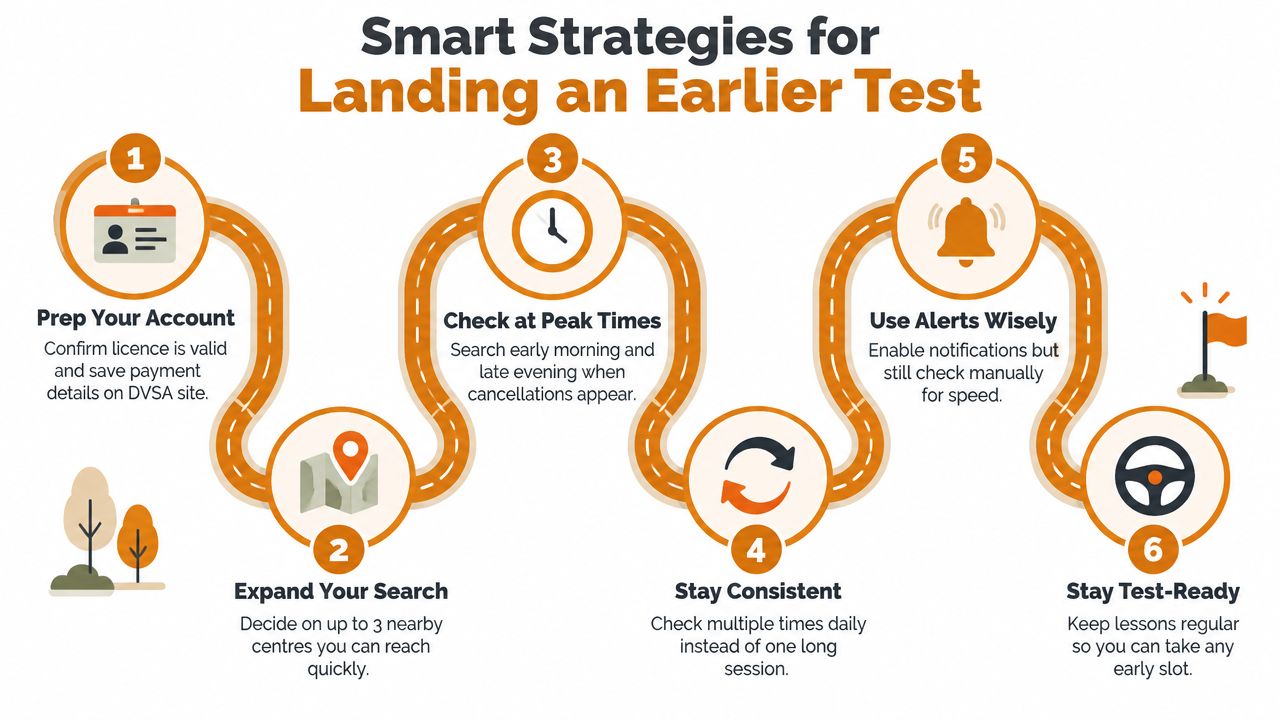
Start with preparation, not refreshing. Have your driving licence details, current booking information and DVSA login ready. Check that your licence and theory pass are valid, then decide which centres you can reach without turning test day into a long-distance expedition.
I'd begin with up to three centres. Choose one local centre, one realistic alternative and a third only if the journey, route and instructor availability make sense. A wider search is useful only when you'd accept the appointment.
Set up a search you can act on
Use these decisions before you start:
- Choose practical locations: include centres you can reach comfortably for a lesson and the test itself.
- Keep preferences flexible: a morning, afternoon or weekday slot may appear before the exact appointment you wanted.
- Ask your instructor about the car: make sure the earlier date works with the vehicle and their diary.
- Save booking details securely: you'll need to move quickly, but don't share passwords carelessly.
- Keep lessons going: an early slot is worthless if your standard drops while you wait.
The required image summarises a sensible setup, including account preparation, a wider centre search, regular checking and staying test-ready.
Respond quickly, but don't book blindly
An alert should prompt a decision, not an automatic click. Check the centre, date and time, then compare the appointment with your instructor's availability. If it's suitable, take it. Waiting for a perfect Saturday can leave you holding a much later booking.
I'd favour a realistic earlier weekday appointment over an ideal weekend date that arrives much later. But don't set a search radius so wide that you end up on unfamiliar roads with no opportunity for proper preparation. The right distance is the furthest centre your instructor can support properly, not the furthest one the website will display.
Check the official rules before changing a booking, because DVSA controls the process and the learner must complete the action. The GOV.UK guide to booking a driving test is a useful starting point for the booking steps, but confirm current requirements on GOV.UK before you act.
If you prefer visual reminders, this short video can reinforce the practical habits that make an earlier appointment useful rather than merely earlier.
Use a simple log for a week. Record which centres produce openings, whether the dates fit your instructor's diary and how quickly suitable appointments disappear. That evidence will tell you more than repeatedly guessing when cancellations happen.
When Chasing a Cancellation Is Not the Answer
You spot a cancellation for next week, but your instructor still sees serious faults on roundabouts, dual carriageways, meeting traffic or manoeuvres. Taking that slot could replace useful preparation with pressure. An earlier test only helps when you are ready to pass it.
I've seen learners treat cancellations as an emergency escape from a long wait. They book the earlier appointment, squeeze in extra lessons and then discover that the date is earlier, not better. Keeping the original booking can protect your confidence, lesson budget and chance of passing first time.
Compare the whole decision
A cancellation at a distant centre may look attractive on the booking screen. A test 40 miles away could save several weeks, yet the journey brings fuel costs, time away from work and an unfamiliar test area. Ask whether your instructor can give you enough practice there before the appointment.
The centre matters as much as the date. A satellite location may have different road layouts, traffic patterns and examiner availability from the centre where you trained. An unfamiliar location is not automatically easier because it offers an earlier slot.
| Hold your existing booking | Chase an earlier cancellation |
|---|---|
| Gives you more time to improve weak areas | Shortens the waiting period |
| Keeps your instructor's planned schedule intact | May require rushed lessons or extra travel |
| Avoids changing a suitable date for a small gain | Makes sense when the new date is substantially earlier |
| Builds confidence on familiar routes | May introduce unfamiliar roads and a new centre |
Before changing a booking, check the current cancellation rules and complete the change yourself. The GOV.UK cancellation guidance explains the working-day calculation and the responsibilities attached to cancelling.
Use DVSA's wait information properly. Compare the centre's median wait with its 10% availability measure. A reasonable median does not guarantee that a suitable slot will appear soon, while a weak 10% figure means chasing may consume weeks for little return. If both measures point to a long wait, a cancellation search has a stronger case. If the wait is already manageable, keep your booking and improve your preparation.
My rule is firm: chase only when the new appointment is at least six weeks sooner, within a reasonable travelling distance and approved by your instructor. Six weeks is a practical judgement, not a DVSA rule. A minor improvement rarely justifies disrupted lessons, travel or an unfamiliar centre.
Keep your date if you need more practice, cannot prepare locally, or would clash with work, college or your instructor's diary. Passing later is better than failing early because impatience overruled readiness.
Your Practical Next Steps
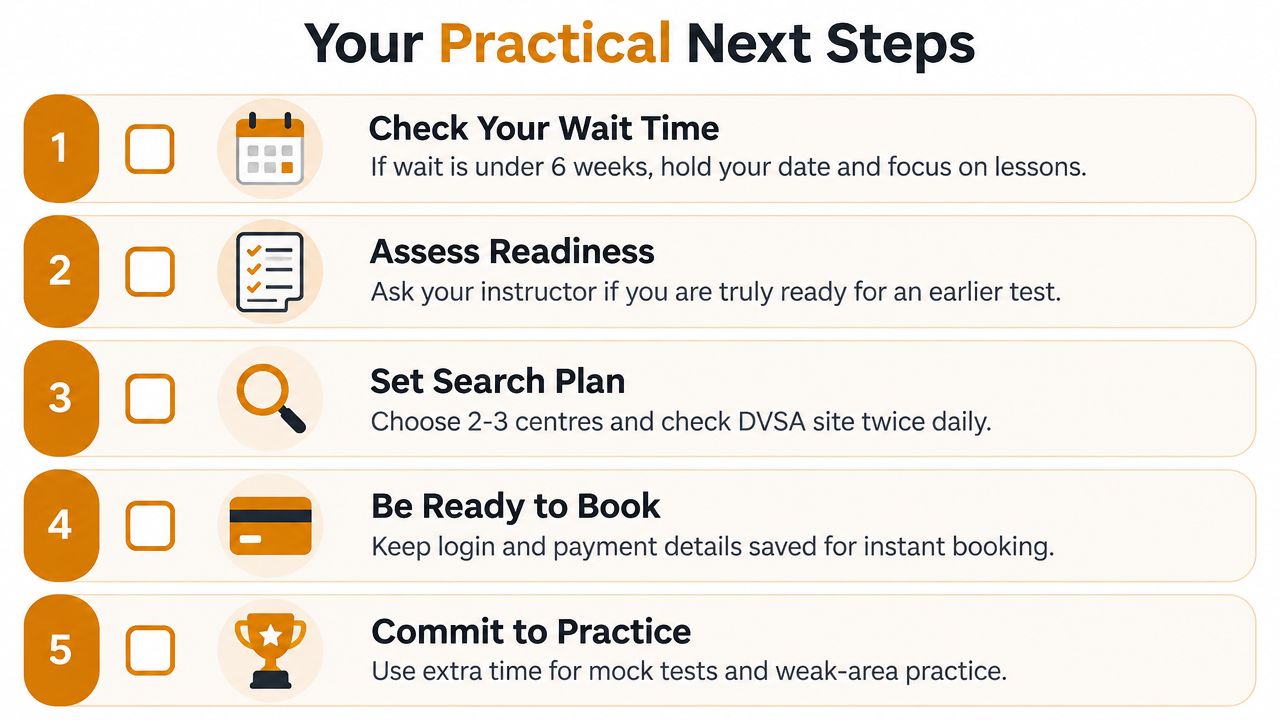
Make the decision within the next day rather than letting the booking worry sit in the background. First, look at your chosen centre's current wait and compare both available measures. If the wait is under six weeks, I'd normally keep the booking and use the time to improve lesson quality rather than chase a marginally earlier slot.
If the wait is longer, prepare a controlled search:
- Gather your details. Keep your driving licence number, booking reference and DVSA login information available.
- Choose realistic centres. Shortlist two or three centres you can reach within roughly a 30-minute drive and where your instructor can prepare you.
- Pick your method. Manual checking costs nothing. A monitoring service may save time, but check what access it requests and whether you remain responsible for the booking.
- Run a one-week trial. Check the official service at consistent times, such as 8am and 6pm, or assess the alerts you receive.
- Measure useful availability. Note how often slots appear, how quickly they vanish and whether any appointment works with your transport and lessons.
Don't measure success by the number of alerts. Measure it by suitable dates at sensible centres. An appointment that you can't reach, can't practise for or can't attend is noise, not progress.
Give the search two weeks. If no useful earlier test appears, keep your existing booking and put the effort into mock tests, manoeuvres, dual carriageways and whichever errors your instructor has identified. That approach avoids spending weeks chasing a slot that was never practical for you.
Driving Test Cancellations monitors DVSA practical test availability and sends time-stamped notifications for earlier appointments, while you remain responsible for rebooking directly with DVSA. If your centre has a long wait and you're ready to act quickly, visit Driving Test Cancellations to review the available monitoring options and decide whether they fit your search.