The cheapest app isn't always the best fit. Earlier DVSA practical tests are highly competitive, and cancellation tools work in noticeably different ways. Some send SMS or push alerts, some use browser-based monitoring, and others match learners who want to swap an existing appointment. None removes the need to act through GOV.UK, particularly after the 2026 rule changes.
These driving test cancellation app reviews compare seven UK services by alert speed and clarity, test-centre coverage, pricing transparency, reported reliability, compliance signals and the amount of manual DVSA action still required. The aim isn't to repeat promotional success claims as guarantees. It's to show which workflow suits a learner, parent or Approved Driving Instructor, and where the trade-offs sit. For wider thinking about how mobile products should handle time-sensitive user journeys, see this mobile app guide.
Table of Contents
- 1. Driving Test Cancellations
- 2. Testi
- 3. TestShift
- 4. Driving Test Cancellations 4 All
- 5. Driving Test Cancellations Now
- 6. Fast Pass Driving Tests
- 7. DrivingTests.co.uk
- Top 7 Driving Test Cancellation Apps, Feature Comparison
- Choose the Workflow You Can Act On Quickly
1. Driving Test Cancellations
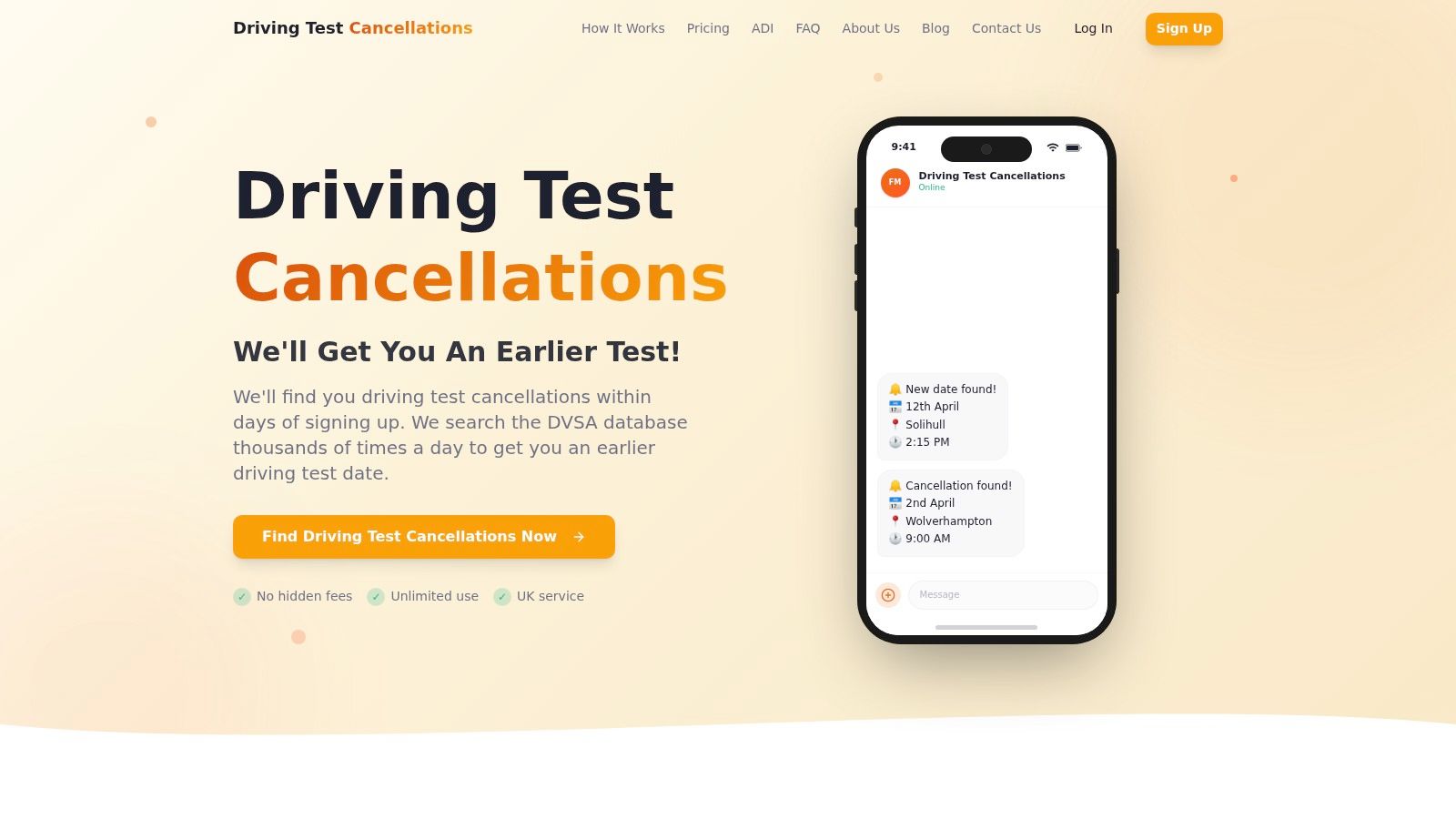
An alert service cannot secure a test by itself. Driving Test Cancellations is designed for learners who already hold a practical test and want an earlier date without repeatedly refreshing the DVSA booking page. Its stated workflow is notification-only: it scans DVSA availability and sends a time-stamped SMS when a suitable cancellation appears, including the date, time and test centre. The learner then changes the appointment through GOV.UK.
That manual step is central to assessing the service. From 12 May 2026, only the learner can book or manage a car driving test, and DVSA guidance includes unofficial booking or cancellation-finding services among activities third parties can no longer perform on a learner's behalf. DVSA's bulletin on the rule change therefore provides a stronger compliance reference than an app's headline promise. Driving Test Cancellations does not book, cancel, swap or change the appointment for you.
The company publishes 50,000+ tests found, a 98% success rate and an average sign-up time of about two minutes on its own website. These are business-reported indicators rather than independently verified results. They show what the service chooses to disclose, but they cannot establish that every subscriber will receive a suitable slot.
Best for learners and ADIs
Learners can monitor up to three preferred test centres, while ADIs have a dashboard for multiple pupils. This supports situations in which an instructor's diary, a learner's work pattern and several nearby centres must align. Published pricing starts from £21.89, with unlimited alerts on paid plans, a free trial that sends sample alerts and a money-back guarantee if no cancellations are found during the initial period, according to the service's stated terms.
The company also describes UK-based data handling and provides waiting-time information, theory-test guidance and test tips. Its workflow is most relevant to learners facing a long wait, approaching theory-test expiry, or working with an ADI who coordinates several pupils. These features may improve preparation, but they do not reduce the need to act quickly on GOV.UK.
Practical rule: An alert has value only if you can open GOV.UK and act immediately. Keep your booking details ready, and confirm that the proposed centre and time suit you before paying for a plan.
The main trade-off is manual response time. Frequent scanning can identify an opportunity, yet the learner still has to rebook it, and basic accounts may limit monitoring capacity. Coverage is restricted to UK DVSA test centres. Read the service's explanation of how cancellation alerts work before subscribing, then check its stated process against the current DVSA requirements. The result is a useful alert workflow, not an automated swap service.
2. Testi
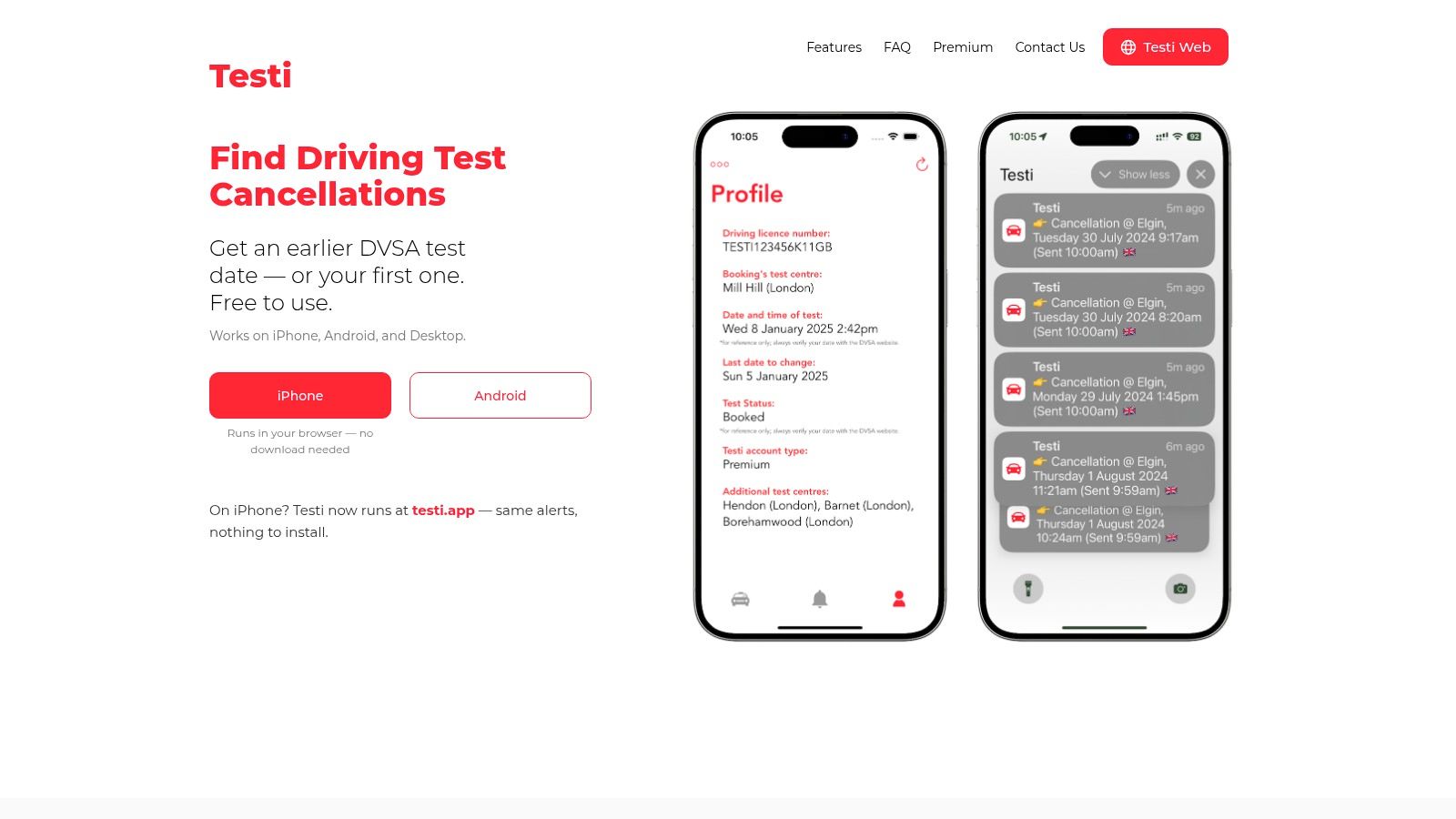
Testi takes a familiar app-based approach. It alerts users when an earlier DVSA appointment appears, then sends them back to GOV.UK to make the change themselves. The service has iOS and Android apps, as well as a Safari extension, so it suits learners who want notifications across more than one device rather than a browser tab left open on a laptop.
Push notifications provide the main alert channel. Premium users can monitor up to three extra test centres, which may improve the number of possible matches for learners willing to travel. The app also offers multi-device support and an ad-free option, with ongoing app updates listed among its product features.
Testi's clearest compliance advantage is that users don't need to share their DVSA password. That reduces the amount of account access handed to a third party, while preserving the official booking step.
The notification trade-off
Testi has broad consumer recognition and many anecdotal reports of successful rebooking, but those reports shouldn't be read as a predictable outcome. A Google Play listing for a driving-test-cancellation app shows 19.4K reviews and a 3.5/5 average rating, with visible complaints about notification quality and inconsistent success. That combination suggests strong demand, but also a user base that notices stale or late alerts.
A slot can disappear between detection and the learner opening the notification. Busy centres make that problem more acute, particularly when several people are watching the same appointment. Testi therefore makes most sense for someone who values app availability and device choice, and who can respond quickly.
- Strength: Straightforward mobile and Safari workflow.
- Watch point: Confirm the current plan details and make sure your use remains consistent with DVSA requirements.
- Best fit: Learners who want push notifications and don't mind handling every booking change on GOV.UK.
See the Testi app and service information for current device support and terms.
3. TestShift
TestShift's browser-first design changes the task more than its “AI-powered” scanner claim does. Learners can use the web app across devices, receive alerts without installing a native app, and complete the booking change themselves through GOV.UK. Its terms make clear that GOV.UK remains the system of record, so TestShift does not itself confirm a new test date.
That workflow gives TestShift a distinct position among cancellation services. It reduces installation and device constraints, but leaves the decisive manual step with the learner. A notification is useful only if the user opens the official booking flow quickly enough and the slot is still available.
What the wording means in practice
References to “reserving” slots require careful reading. They should not be treated as confirmed DVSA bookings. Only the official government booking process can change the appointment.
Reported experience is uneven. Some users describe the service as slow or less helpful at busy centres, while others find the browser interface convenient. These accounts show individual outcomes rather than a measured success rate. Centre demand and alert timing remain more useful decision factors than the promotional scanner description.
Pricing is also difficult to compare upfront. The amount is not prominent on the marketing pages and may appear at checkout, so the eventual cost can be unclear before account creation. Review the cancellation, refund and renewal terms before entering payment details.
For learners comparing seven services by how much action remains after an alert, TestShift is relatively hands-on. Its main advantage is access without installation. Its limitation is that the learner must monitor the web service and complete every official change.
Check TestShift for its current terms and checkout pricing.
4. Driving Test Cancellations 4 All
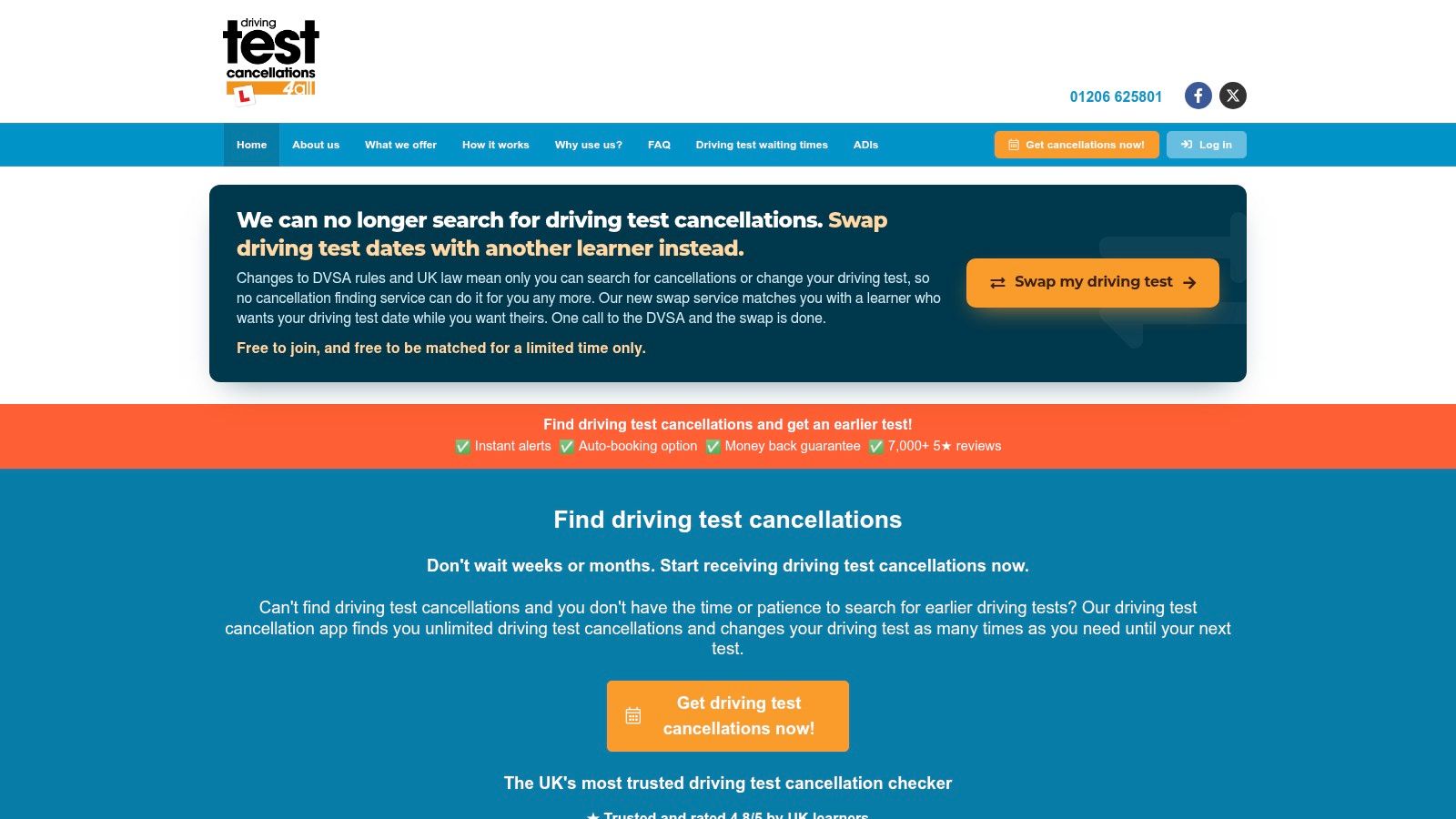
Driving Test Cancellations 4 All, often shortened to DTC4A, is a long-standing UK service built around alerts for earlier test dates. It supports email, SMS and app notifications, and promotes monitoring across multiple chosen centres. That combination gives users more ways to receive an alert than a single-channel service.
Its established presence may appeal to learners who prefer a recognisable provider with a longer consumer footprint. The service also presents information channels for ADIs and a contact route for an ADI partner, which could be useful for instructors who need to discuss several pupils rather than one booking.
Established doesn't mean guaranteed
Public feedback is mixed. Some users report receiving few or no matching alerts in busy areas, while others value the service's multi-centre approach. The difference may reflect local inventory more than a simple good-or-bad product verdict. A service can monitor several centres and still have little to offer where cancellations are scarce or disappear quickly.
Pricing and the exact package are shown during sign-up rather than clearly presented in the public plan information. That reduces upfront comparability with services that publish a fixed entry price. Ask what alert channels are included, how many centres can be monitored and what happens if no suitable cancellation appears.
The DVSA says practical-test waiting-time statistics are updated monthly, and the booking rules have changed, so older reviews may not describe the present workflow. DTC4A users still need to check the current government process and make any permitted change themselves.
A long track record can help with trust, but it can't compensate for an alert that arrives after another learner has taken the slot.
DTC4A is most suitable for users who value several notification channels and multi-centre monitoring, provided they're willing to investigate the current price and terms. Review the DTC4A website before committing.
5. Driving Test Cancellations Now
A low price does not necessarily make an alerts service practical. Driving Test Cancellations Now takes an app-first approach: users set preferences, receive push or SMS notifications about earlier dates, then attempt the change through GOV.UK. That limited workflow may suit learners who want alerts without instructor tools or extensive guidance.
The current entry price should be checked at checkout. User reports point in different directions. Some describe finding an earlier appointment soon after paying, while others mention usability problems and inconsistent results at busy centres. These accounts suggest that local availability and response speed may matter as much as the software.
The key test is how much attention the learner must give each alert. A notification has limited value if it arrives after the slot has gone, lacks enough detail to assess the appointment, or identifies a date the learner cannot accept. The official DVSA change remains the learner's responsibility, so the service does not remove the need to act quickly or understand the booking process.
Review evidence also appears mixed. The Google Play example cited earlier combines substantial adoption with a middling rating. That pattern makes alert freshness, precision and successful rebooking more relevant measures than notification volume alone.
A sensible assessment is therefore practical rather than promotional:
- Good match: A learner seeking an affordable, alerts-only tool.
- Check first: The current price, refund conditions and number of included centres.
- Weak fit: Someone who needs guaranteed availability or cannot respond quickly.
Check the current offer and Driving Test Cancellations Now terms before paying. The service may reduce the search burden, but it cannot guarantee that a suitable cancellation will appear or remain available long enough to book.
6. Fast Pass Driving Tests
Fast Pass Driving Tests centres its service on matching learners who want to exchange existing appointments. That workflow changes the practical question from “How quickly can I claim a released slot?” to “Can I find a compatible learner and appointment?” Both parties still complete the relevant change through DVSA, so the service coordinates a match rather than completing the official transfer for them.
The model suits a learner who already has a booking and wants a different date, centre or time. Someone without an appointment has less to gain, because a suitable exchange requires another learner with compatible requirements. Availability therefore depends on the size and relevance of the matching pool, not just the number of cancellation alerts.
Fast Pass separates its swap, cancellation and auto-booking terminology in its published information. It also states that its service fee is separate from the DVSA test fee. That distinction helps consumers assess the total cost rather than treating the advertised service charge as the full cost of taking the practical test. Review the Fast Pass Driving Tests pricing information before choosing a plan.
The booking rules add a practical constraint. From 31 March 2026, learners and ADIs could change a car-test booking only twice, down from six, and swapping a test between two learners counted as a change. The official DVSA guidance on the booking-rule changes takes priority over any provider description.
Fast Pass is therefore most relevant to learners who can offer an existing booking and respond to a credible match. Before paying, compare the stated workflow with the Fast Pass Driving Tests website, then confirm which steps you must complete through GOV.UK. Its documented distinctions improve transparency, but they do not guarantee a compatible swap or remove the learner's responsibility for the permitted change.
7. DrivingTests.co.uk
DrivingTests.co.uk addresses a different problem from a conventional cancellation scanner. It is a learner-led swap portal: you list a test you already hold, then wait for another learner whose appointment and requirements are compatible. Email or SMS alerts can indicate a possible match, but the learner must still verify the details and complete the change through the official DVSA process.
The workflow is transparent, though its usefulness depends on the matching pool. A UK-wide listing can widen the search, yet location, preferred times and instructor availability may leave few workable exchanges. A portal can identify an opportunity, but it cannot create a suitable appointment or guarantee that another learner will accept the swap.
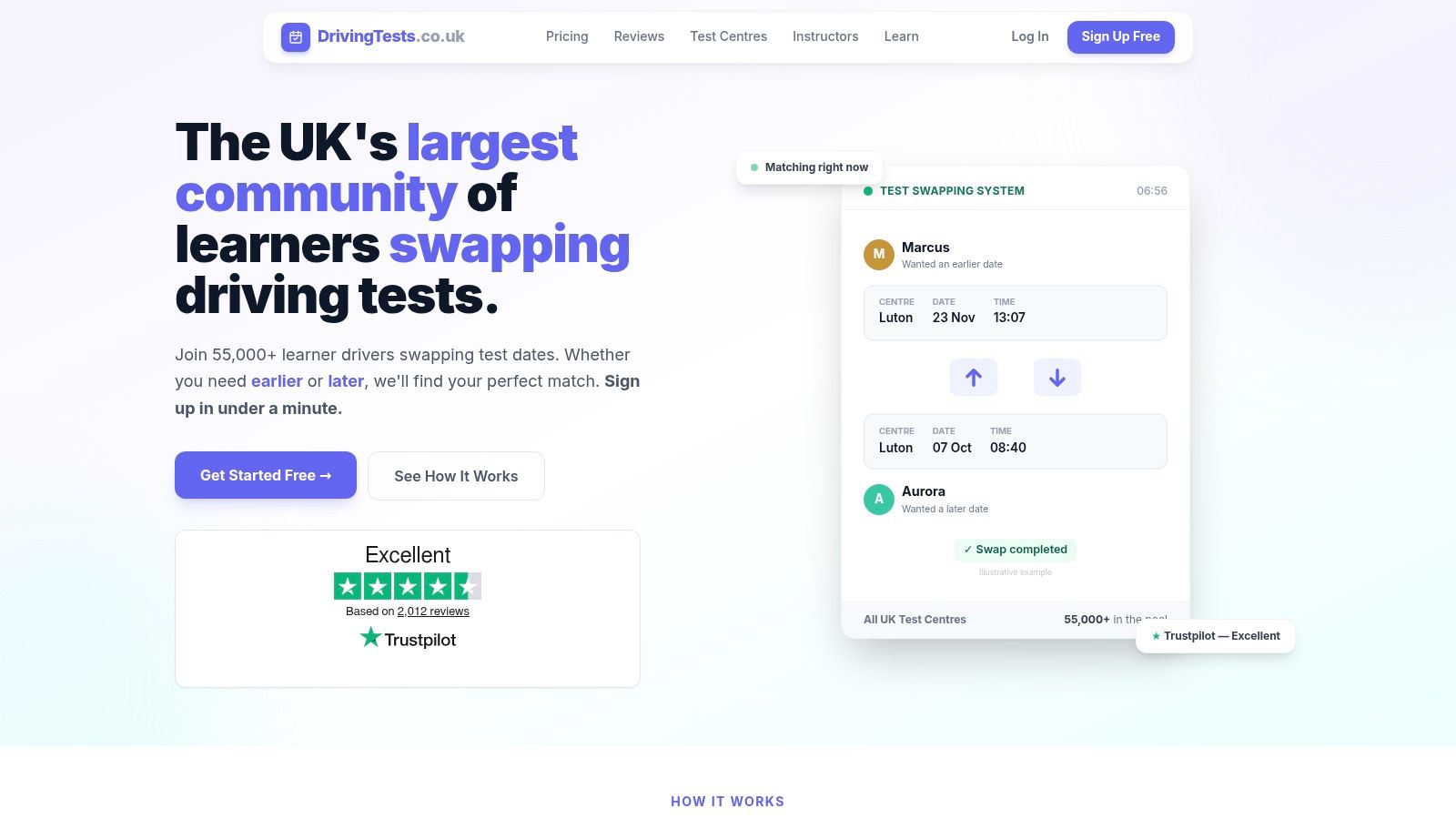
The pricing structure is relatively clear. The Basic plan allows users to list a test and seek a match, while the service describes payment only after a successful swap, including £34.99 per successful swap, alongside membership options. That reduces upfront exposure compared with a subscription, but it does not reduce the practical work required after a match appears.
This service suits a learner who already has a booking and wants to exchange it rather than compete for a newly released cancellation. It has little value for someone without an appointment. The DVSA process remains decisive: confirm that the proposed change is permitted, check that the new slot fits your circumstances, and complete the booking change through GOV.UK. A match is a lead, not a completed booking.
For the official process, consult this guide to booking a driving test, then review the current DrivingTests.co.uk swap portal terms before listing your appointment.
Top 7 Driving Test Cancellation Apps, Feature Comparison
| Service | Implementation Complexity 🔄 | Resource Requirements ⚡ | Expected Outcomes ⭐ | Ideal Use Cases 💡 | Key Advantages 📊 |
|---|---|---|---|---|---|
| Driving Test Cancellations | 🔄🔄🔄🔄, high-frequency scanner & ADI dashboard | ⚡⚡⚡, 24/7 server scans, SMS delivery | ⭐⭐⭐⭐⭐, 50,000+ finds; 98% success (published) | 💡Learners with an existing DVSA booking; ADIs managing pupils | 📊Published metrics; money-back trial; unlimited alerts on paid plans |
| Testi | 🔄🔄🔄, mobile apps + extension, mature codebase | ⚡⚡, mobile push + extension support | ⭐⭐⭐⭐, widely used; many anecdotal successes | 💡Mobile-first learners across England/Scotland/Wales | 📊No DVSA credentials; multi-device support; ad‑free option |
| TestShift | 🔄🔄🔄, web app with AI-marketing claims | ⚡⚡, browser-based real-time alerts, no install | ⭐⭐⭐, mixed user outcomes; variable at busy centres | 💡Users who prefer browser tools and cross-device access | 📊No-install web app; clear terms; GOV.UK guidance resources |
| Driving Test Cancellations 4 All (DTC4A) | 🔄🔄🔄, established multi-channel alerting | ⚡⚡, email/SMS/app with ADI contact options | ⭐⭐⭐, long track record but mixed feedback | 💡ADIs and learners wanting multi-centre monitoring | 📊Recognised brand; ADI support; multi-channel alerts |
| Driving Test Cancellations Now | 🔄🔄, app-first, simple workflow | ⚡⚡, lightweight app + push/SMS | ⭐⭐⭐, affordable; some quick wins reported | 💡Time‑pressured learners seeking low-cost alerts | 📊Low entry price; fast setup; alert-focused UX |
| Fast Pass Driving Tests | 🔄🔄🔄, swap-matching system, documented terms | ⚡⚡, matching platform; terms & fee handling | ⭐⭐⭐⭐, swaps can be more predictable than live races | 💡Learners preferring swap/exchange approach over scramble | 📊Swap-focused model; clear fee separation; documented policies |
| DrivingTests.co.uk (swap portal) | 🔄🔄, community swap portal (learner-led) | ⚡⚡, peer pool, email/SMS notifications | ⭐⭐⭐⭐, pay-on-success reduces upfront risk | 💡Learners who already hold a booked test and want to swap | 📊Free basic listing; pay-only-on-success; large UK pool |
Choose the Workflow You Can Act On Quickly
The best service depends less on the most impressive marketing claim and more on what you can do when an alert arrives. Choose a continuously scanned SMS service if speed, several preferred centres and prompt manual rebooking matter most. Compare established app options such as Testi if device support, push notifications and a familiar mobile workflow are your priorities. If you already hold a test and prefer a payment model linked to results, a swap portal may be more suitable than a cancellation scanner.
The waiting-time data explains why this choice is local rather than purely national. DVSA's official figures recorded an average car practical-test wait of 22 weeks in Great Britain in September 2025, while a later update put the August 2026 national median at 11.1 weeks, with the broader average still about 20 weeks. DVSA's car test data shows why averages and medians can tell different stories, and why an app that monitors the right nearby centres may be more useful than one that promises speed.
Before paying, check:
- Centre flexibility: Can you monitor the centres you'd accept, or only one location?
- Alert channel: Does it send SMS, push notifications, email or browser alerts, and are they time-stamped?
- Total price: Include subscription fees, swap fees and the separate DVSA test fee where applicable.
- Refund conditions: Find out what happens if no suitable cancellation or swap appears.
- Account limits: Check centre limits, pupil limits and whether ADI features require a separate plan.
- Manual action: Confirm that you'll make the permitted change yourself through GOV.UK.
Regional differences can be severe. In 2026, reported waits ranged from 22.7 weeks in England and 22.9 weeks in Scotland to 17.3 weeks in Wales in April, while later median figures were lower in some regions. BBC reporting on the regional position gives useful context, but you should still check your own test centre and the latest DVSA rules before subscribing.
Driving Test Cancellations is a practical option for learners and ADIs who want UK-focused monitoring, SMS alerts, up to three preferred centres for learners and a dashboard for multiple pupils. Its notification-only model is transparent, but you'll still need to be ready to act on GOV.UK.
Driving Test Cancellations continuously monitors DVSA availability and sends time-stamped alerts so learners can rebook earlier appointments themselves, while ADIs can coordinate multiple pupils from one dashboard. Visit Driving Test Cancellations to check the current trial, pricing and centre-monitoring options before choosing a service.