You've probably got the email somewhere, half remember the date, and now you're wondering if the booking is where you thought it was. That's normal. A lot of learners think checking a driving test appointment means one thing, when it really means two very different jobs: verifying the booking you already have and trying to move it to something earlier.
Those are not the same task, and DVSA rules now make that difference matter. If all you need is to confirm your slot, the official process is simple. If you're hunting for a cancellation, you need to be much more careful, because changing a test has stricter limits than many learners realise.
Table of Contents
- Verifying Your Booking on the GOV.UK Portal
- Interpreting Your DVSA Confirmation Details
- Checking Your Appointment by Phone
- Understanding the Limits on Changing Your Test
- Moving Beyond Manual Checking for Earlier Dates
- Your Complete Appointment Verification Checklist
Verifying Your Booking on the GOV.UK Portal
If you only want to confirm that your test is booked, start with the official change your driving test service on GOV.UK. The service is available from 6am to 11:40pm, and you'll need your UK driving licence number plus either your driving test reference number or your theory test pass certificate number.
What you need before you log in
Have these ready first:
- Driving licence number. Use the same one linked to the booking.
- Booking reference or theory pass number. Either should let you access the appointment.
- A quiet five minutes. Rushing is how people misread the centre or date.
If you haven't even secured a practical test yet, the process is different from checking an existing one. This guide on how to book a driving test covers the booking side.
The quickest way to verify it properly
Once you're in the portal, don't click around too fast. Read what's already there before you go anywhere near the change option.
Check these in order:
- Your name details. Make sure the booking is attached to the right learner.
- The date. Learners often remember the month correctly but get the exact day wrong.
- The start time. Morning and afternoon slots can affect lesson planning and travel.
- The test centre. Many mistakes show up here.
- The test type. You want to see the correct practical test booking.
Practical rule: If you're only checking driving test appointment details, stop once you've confirmed them. Don't keep clicking just because the service allows changes.
Why this matters
A verified booking gives you something solid to work from. You can plan lessons backwards from the test date, sort transport to the centre, and decide calmly whether the slot is good enough or whether it's worth looking for an earlier one.
That's also the point where many learners drift into the second task without thinking. They log in to confirm the booking, notice the date is later than they'd like, and then start trying to change it on impulse. That's where trouble starts, because changing is no longer something to do casually.
Interpreting Your DVSA Confirmation Details
The confirmation screen looks straightforward, but small details matter. A booking can be valid and still be awkward if the wrong centre, wrong time, or wrong test conditions catch you out on the day.
Read the centre name carefully
In larger towns and cities, learners sometimes assume the centre name means the place they practised near most often. Don't guess. Read the exact centre name shown on the booking, then check the route properly.
A common problem is mixing up centres with similar place names or assuming the test starts from the same area as a lesson pick-up point. The booking confirmation is the thing that counts, not memory, not a screenshot from weeks ago, and not what someone else told you.
What to check on the confirmation
Use this as a short review list when the portal opens your booking:
| Item on the booking | What it means in practice |
|---|---|
| Test centre | The exact place you must attend. Check the address and local route. |
| Date | Your actual appointment day. Put it straight into your calendar. |
| Start time | The time you need to be ready, not the time to begin travelling. |
| Test type | Confirms you're looking at the correct practical test booking. |
| Special notes | Any extra details linked to your booking or circumstances. |
If something looks wrong
Don't brush it off. If the centre shown isn't the one you thought you booked, deal with it early. That could mean you selected the wrong site at the time, someone else misunderstood the booking when passing details on, or you misremembered it.
If the confirmation doesn't match what you expected, trust the live DVSA booking screen first and your memory second.
Special requirements matter too. If your booking includes any note that affects how you attend or what arrangements are needed, sort it well before test day rather than leaving it until your instructor spots the issue.
Turn the confirmation into a test-day plan
Once the details are confirmed, do something practical with them. Work out:
- How you'll get there
- Where you'll meet your instructor
- How early you need to arrive
- Whether the test time clashes with work, college or school
- Whether the route and local roads need extra practice
This sounds basic, but it's where a simple booking check becomes useful. A confirmed slot is only helpful if you can use it properly.
Checking Your Appointment by Phone
Online is easier when you have all your details to hand. Phone checking still has a place, especially if you've lost access to the reference, need help untangling a booking issue, or have circumstances that are awkward to sort out through the website alone.
When phoning makes more sense
Use the phone route if:
- You can't get into the online service because your details aren't matching.
- You need clarification on something that doesn't look right on the booking.
- You have accessibility or personal circumstances that are simpler to explain to a person.
- You're worried the booking isn't active and want direct confirmation.
What matters most is being ready for identity checks. DVSA won't discuss a booking properly if the caller can't show they're the person entitled to manage it.
What to have ready before you call
Keep these beside you:
- Your full name
- Your driving licence number
- Your booking reference if you have it
- Your theory test pass details if that's what you still have
- Pen and paper or notes app, because you don't want to rely on memory halfway through a call
The same basic rule applies on the phone as online. Stick to verification first. Confirm the booking exists, check the centre, date and time, and only then decide whether any action is needed.
What the phone route is good for, and what it isn't
A phone call can clear up confusion quickly. It's useful when the issue is messy rather than technical. If your query involves unusual circumstances, speaking to someone can be simpler than trying to force the website to answer a question it wasn't built for.
What it doesn't do well is replace active searching for earlier dates. If your real aim is to find a quicker appointment, a one-off phone check won't solve that. It confirms what you've got. It doesn't create a queue position and it doesn't put you on a hidden list for a better slot.
That distinction matters more than most learners think.
Understanding the Limits on Changing Your Test
This is the part that catches people out. Learners often assume checking regularly is harmless because they can just move the test again later if something better appears. That used to feel low-risk. It doesn't now.
According to DVSA guidance on changes to driving test booking rules in 2026, a car driving test can only be changed twice, and from 31 March 2026 any further change means cancelling the booking and making a fresh one. The same guidance also says only the learner taking the test can change, cancel or swap the booking.
Why casual changing is a bad habit now
That means every move counts. If you use one change for a date that's only slightly better, then use the second on another compromise slot, you may trap yourself. After that, any further adjustment becomes a cancellation and rebook problem instead of a simple change.
There's another restriction many people miss. DVSA says you can only move a booked test to one of the three nearest test centres at that time, as set out in the published DVSA guidance on which driving test centres you can move your test to.
Warning: Don't spend your two changes chasing small improvements unless you're sure the new slot actually suits your training, work and travel.
If you want to understand the terms a bit more clearly before using a paid alert tool or similar service, it's sensible to read the cancellation policy carefully so you know where the service ends and where your own DVSA action begins.
Strategy matters more than speed
The best move isn't always the earliest date on the screen. Sometimes the smart choice is to keep a later slot for another week while you watch what appears, rather than jumping at the first cancellation and burning one of your changes.
Think about three things before changing:
- Readiness. Can you be test-ready by that date?
- Location. Is the centre one you can still work with practically?
- Commitment. Is this good enough that you won't regret using one of your two changes?
Checking once isn't enough if you want something earlier. But changing too quickly isn't smart either.
Moving Beyond Manual Checking for Earlier Dates
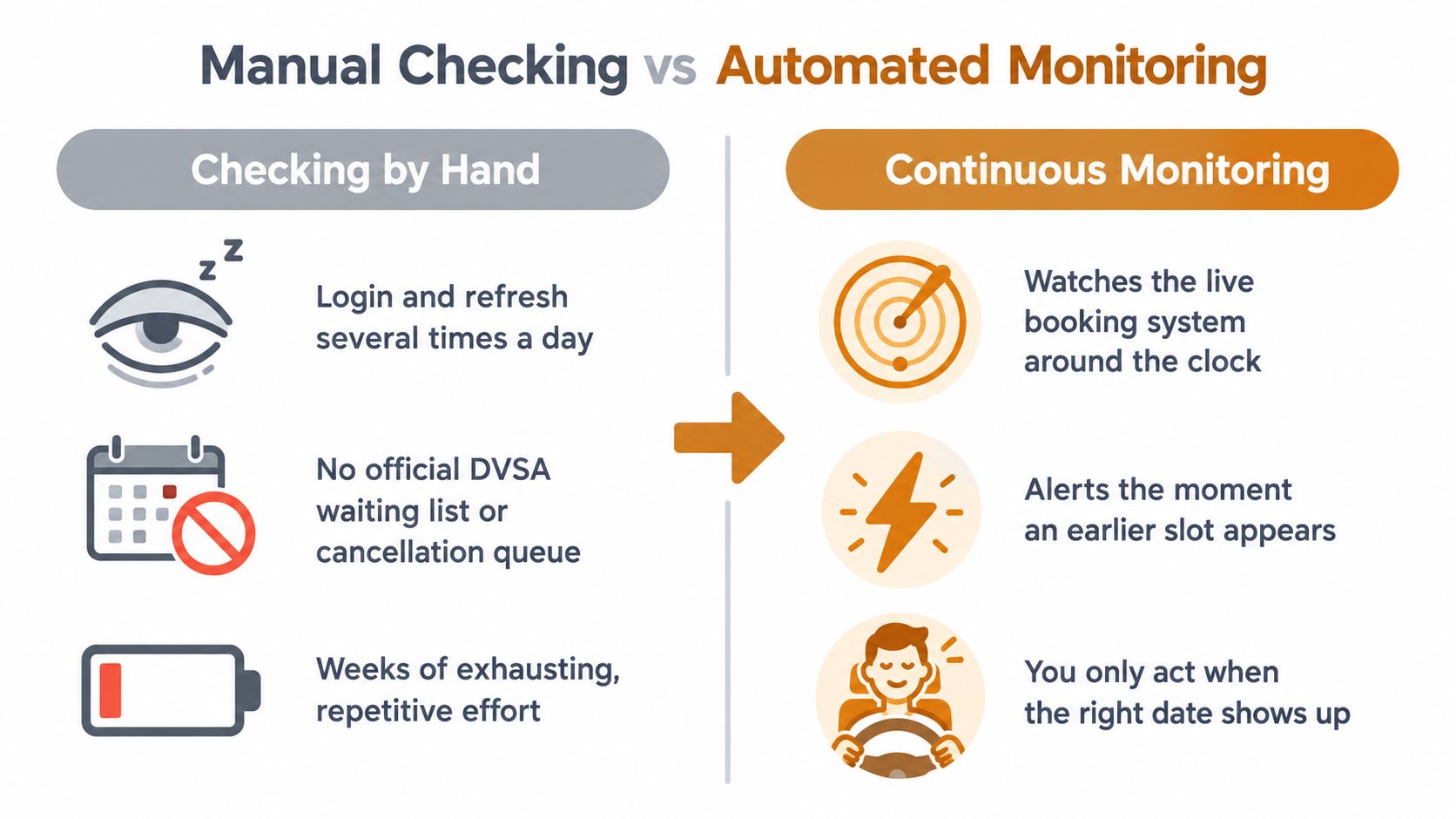
If you're trying to bring the test forward, checking driving test appointment options becomes a different job altogether. DVSA's own guidance says there is no waiting list or cancellation list for most test centres, so finding something earlier depends on repeatedly checking the live booking system rather than joining a queue, as explained on GOV.UK guidance about appointment release dates and finding earlier tests.
Here's the basic comparison.
What hand-checking gets wrong
Manual checking sounds sensible until you live with it for a while. You log in, refresh, check a few centres, see nothing useful, and repeat later. Then again in the evening. Then again the next morning.
That's tiring on its own, but the bigger issue is timing. Cancellations don't arrive when it suits your routine. They appear when someone changes or gives up a slot. If you're not looking at that moment, you miss it.
The pressure is worse because waiting times have stayed stubbornly high. Reporting in 2026 said learners in Britain were still facing around 20 weeks to book a practical test, while the median wait between booking and taking the test was 11.1 weeks in August 2026, according to BBC reporting on DVSA wait times. In practice, that means earlier opportunities matter.
Why automation makes more sense
An automated alert service doesn't change the DVSA rules. It handles the watching part better than a human can. Instead of refreshing yourself, the system monitors availability and alerts you when a matching slot appears.
A service such as Driving Test Cancellations monitors DVSA practical test availability, sends time-stamped notifications, and lets the candidate rebook directly with DVSA if the slot suits them. That's useful because the learner still controls the final decision, which matters now that changes are limited.
For many learners, the strongest setup is to monitor the allowed centre options rather than clinging to one exact site. This guide on current driving test waiting times is useful if you're trying to judge how realistic that is in your area.
A short walkthrough helps if you've never used this kind of monitoring before.
Don't confuse available with suitable
The trap is accepting any earlier date just because it exists. A cancellation is only valuable if it works for your training level, your instructor's diary, and your centre restrictions.
A useful alert setup narrows the field. It helps you act on dates you could take, not just dates that look good for five seconds on a phone screen.
Your Complete Appointment Verification Checklist
Once you've got a booking, the easiest way to stay out of trouble is to treat it like a running admin job, not a one-off click. Good learners and organised instructors do the same basic things every time.
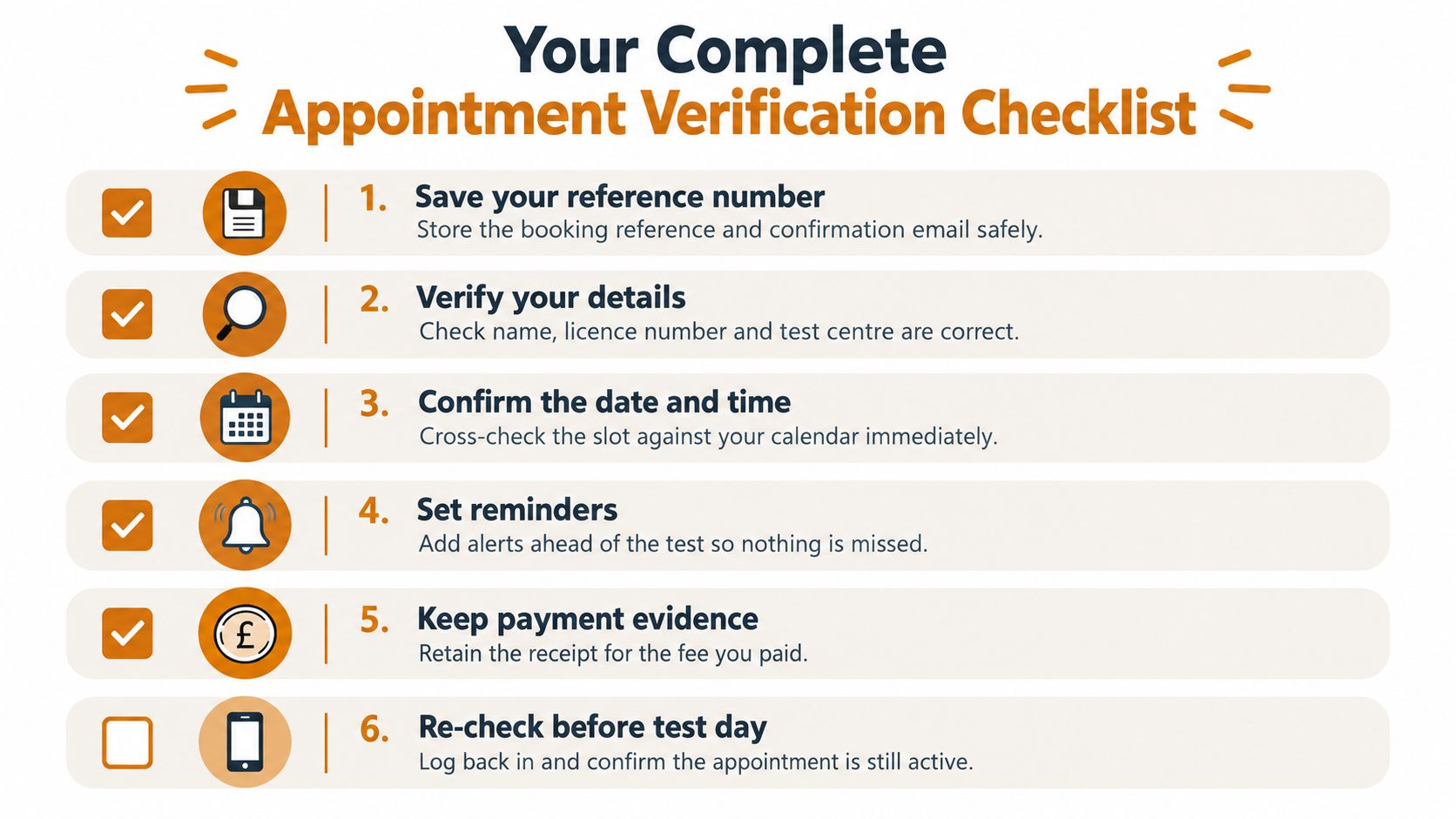
The six checks worth doing every time
- Save your key details. Keep your licence number, booking reference and confirmation email somewhere you can reach quickly.
- Verify the actual centre. Don't assume you remember it. Read the live booking details and map it properly.
- Check the date against real life. Work, college, holidays, instructor availability and car access all matter.
- Protect your two changes. Don't use them on weak options that you already suspect won't suit.
- Set up a sensible earlier-slot plan. If you want a sooner test, decide whether you'll check manually or use alerts.
- Re-check before test day. Log back in and make sure the appointment is still exactly what you think it is.
A note for instructors and families
Parents often help with reminders, but the learner needs to stay in control because DVSA says only the candidate can change, cancel or swap the booking. That makes good record-keeping important.
For ADIs, the workload multiplies fast when several pupils are waiting for practical tests at once. A dashboard that keeps pupil dates and alert activity in one place is far easier to manage than chasing screenshots, text messages and half-remembered dates.
Keep verification and cancellation hunting separate in your head. One is an admin check. The other is a strategy decision.
What matters most
If you take one thing from this, make it this: checking a driving test appointment is not the same as trying to improve it. Verify first. Read every detail. Then decide, carefully, whether using one of your limited changes is really worth it.
That approach saves learners from a lot of preventable mistakes.
If you've already got a test booked and want a practical way to watch for earlier slots, Driving Test Cancellations monitors DVSA availability and alerts you when a matching appointment appears. It's built for learners and ADIs who need help with the checking side, while still keeping the final rebooking decision in the learner's hands.