You've passed your theory test, told your instructor you're ready, and opened the DVSA booking service expecting a practical test in the near future. Instead, your local centre offers a date months away. That's frustrating, but it isn't the end of the process. The learners who get earlier appointments usually don't rely on one booking attempt. They secure a sensible date, then monitor cancellations, nearby centres and their own deadlines carefully.
The UK system rewards preparation and quick decisions. It also has rules that can cost you your fee or limit how often you move a booking. Here's how to book your driving test early without wasting changes, missing the notice period or chasing a date you can't use.
Table of Contents
- Why Early Driving Test Slots Are Harder Than They Look
- The DVSA Rules That Decide Whether You Can Move
- How to Find an Earlier Test Slot Yourself
- Using a Cancellation Alert Service Versus Checking Manually
- Timing Your Booking Around Real Deadlines
- Key Takeaways and Common Questions
Why Early Driving Test Slots Are Harder Than They Look
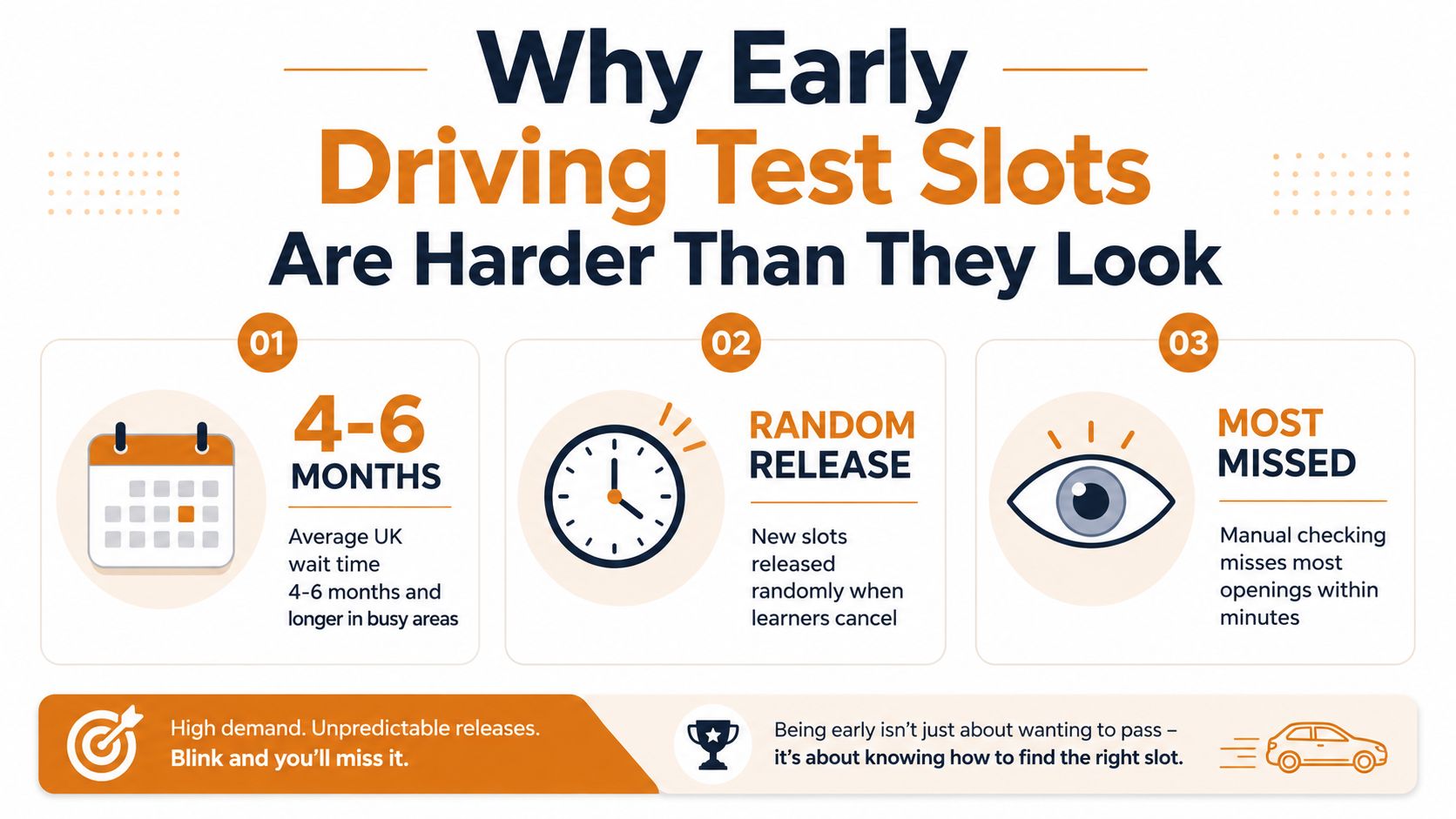
Driving-test availability remains tight across Great Britain. DVSA's figures reported by the BBC show regional waits in April 2026 of 22.7 weeks in England, 22.9 weeks in Scotland and 17.3 weeks in Wales. A separate DVSA update put the average wait at nearly 22 weeks in June 2026, while half of learners who took a car practical test in July 2026 waited no more than 11.1 weeks. Those figures appear contradictory until you understand what the booking headline measures and how cancellations change the outcome.
The booking window tells you when enough appointments are available for ordinary booking. It doesn't mean there are no earlier appointments at all. Learners cancel, move tests and release slots, often with little warning. That's why booking once and checking occasionally is a weak strategy. You need an original appointment to protect your place, then a system for spotting something better.
The two routes to an earlier date
First, look for cancellations at your preferred centre and nearby centres. DVSA's current waiting-time measure is based on how far ahead you must search before at least 10% of weekly appointments at a centre remain available to book. The measure is published nationally, regionally and by test centre, with monthly updates on the second Wednesday, as explained in DVSA's waiting-time guidance.
Second, widen the search. A centre a reasonable distance away may have a more useful date or a better time of day. Discuss the route with your instructor before changing centres. An earlier test is pointless if you haven't practised the roads, junctions and traffic patterns around it.
The cancellation market is substantial. DVSA recorded 101,423 cancelled car tests between April 2025 and March 2026, according to reported DVSA cancellation figures. Earlier appointments do exist, but they disappear quickly. Read more about the practical effect of the backlog in this guide to driving-test waiting times.
The DVSA Rules That Decide Whether You Can Move
Finding an earlier appointment doesn't automatically mean you can move to it safely. For a UK car practical test, DVSA requires 10 full working days' notice when you change or cancel without losing the fee. Monday to Saturday count as working days. Sundays and public holidays don't. The rule has applied to car tests since 8 April 2025, replacing the previous three-working-day period, as set out in DVSA's car-test change guidance.
Suppose your test is booked for a Friday and an earlier slot appears close to the date. Count backwards using working days, excluding Sundays and public holidays. If you're inside the protected period, changing the booking normally means paying again. A medical exception may apply in appropriate circumstances, but don't treat that as a fallback for ordinary diary problems.
There's another restriction that catches learners out. DVSA's business-service guidance says an appointment can be changed up to six times. After that, the test must be cancelled and rebooked. That makes casual swapping a bad habit, particularly if you keep moving between centres without checking your instructor's availability first.
| Rule | What It Means | Penalty If Broken |
|---|---|---|
| Ten full working days | Change or cancel a car practical test outside Sundays and public holidays within the protected notice period. | You risk losing the test fee and may need to pay again. |
| Six changes | The appointment can be changed up to six times through the permitted process. | After the limit, you must cancel and rebook. |
| Pupil confirmation | For instructor-managed bookings, pupil details must be confirmed by 9pm at least one clear working day before the test. | The booking may not be properly managed for the appointment. |
Practical rule: Don't move a test until you've checked the notice period, your remaining changes, your instructor's diary and the car you'll use.
Your theory certificate creates a separate deadline. GOV.UK says a theory-test pass remains valid for 24 months, and the practical test must be passed within that period. If the certificate expires, the practical booking cannot rescue it. Check the pass date before you start chasing cancellations, then set your own earlier target so you're not relying on the final part of the validity period.
Theory bookings have different rules again. GOV.UK's theory-test guidance requires at least three full working days' notice to change or cancel without paying again. Don't apply that shorter period to a car practical test.
How to Find an Earlier Test Slot Yourself
Start with the official DVSA booking service and your existing reference details. Search your original centre first, then add realistic alternatives. Your instructor should help decide which centres are suitable, because a test at an unfamiliar location may create more risk than the extra waiting time.
The national headline isn't enough for this decision. DVSA publishes centre-level information, and availability can differ sharply between nearby locations. Search by date and centre rather than repeatedly staring at one unavailable calendar.
A manual search that gives you a chance
Log in when you're ready to act, not when you're merely curious. Keep your licence details, theory pass information and booking reference to hand. If the service allows you to retain entered information, complete those fields before you begin searching so you're not typing while another learner takes the slot.
Cancellations can appear at different times for different reasons. Don't build your entire plan around one supposed release time. Check at sensible points during the day, particularly when learners are likely to review their own plans, and check several centres rather than refreshing one page endlessly.
Use this preparation list:
- Confirm your theory pass: Make sure the certificate is valid and the details match your practical booking.
- Check your licence: Have the correct licence information available before you search.
- Ask your instructor first: Agree which dates and centres are workable.
- Secure the car: Confirm that the training car or another suitable vehicle will be available.
- Set a stopping point: Don't accept a date you can't attend because it looks earlier.
When a suitable slot appears, move decisively. Read the date, time and centre carefully before confirming. A fast booking is useful only if the appointment fits your lessons and travel plans.

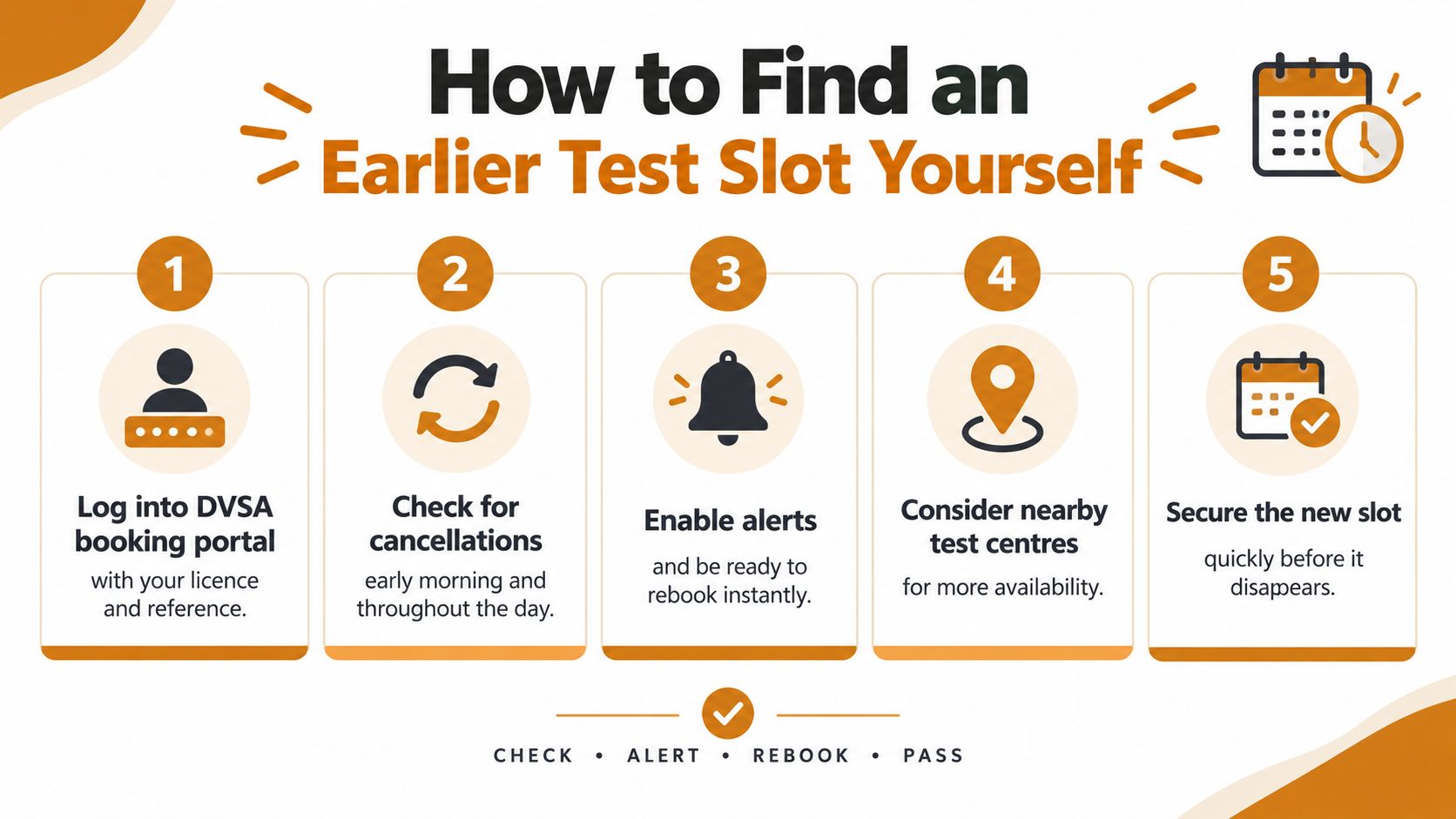
The key is consistency. Manual checking can work, but it demands repeated logins, accurate typing and the willingness to respond immediately. If you can't maintain that routine, use an alert service that leaves the final booking with you.
Using a Cancellation Alert Service Versus Checking Manually
Manual checking costs nothing beyond your time. You log into the DVSA service, search your chosen centres and complete the change yourself. That gives you direct control, but it's easy to miss a slot when you're working, studying, travelling or teaching.
Paid services monitor availability and send an alert when an earlier appointment matches your selected criteria. Examples available in the UK include SwapMyTest, Testi and Driving Test Cancellations Now. Driving Test Cancellations monitors DVSA availability, can send SMS notifications with the appointment details and allows users to watch up to three preferred centres. It's a notification service, not a replacement for the official DVSA booking process. You still rebook yourself and must follow the current rules.
| Factor | Manual DVSA rebooking | Paid cancellation alert service |
|---|---|---|
| Cost | No monitoring charge. | Paid plans vary, so check the current terms before subscribing. |
| Time | Requires repeated searches and logins. | Monitoring runs continuously, with alerts sent when a match appears. |
| Control | You see and choose the appointment directly. | You receive details, then decide whether to act. |
| Speed | Depends on when you happen to check. | Alerts can reach you while you're away from the booking page. |
| Rules | You remain responsible for DVSA requirements. | The service can't override notice periods or change limits. |
| Availability | You may miss short-lived openings. | You still need to respond quickly because other learners may be searching. |
No service can create an appointment that doesn't exist. It also can't make an unsuitable date workable, extend your theory certificate or remove the six-change limit. Treat alerts as an extra pair of eyes, not a guarantee.
A cancellation alert is useful only when your booking is ready to move and your instructor can support the new date.
Manual checking suits learners who have flexible time and are happy to keep searching. An alert service makes more sense if your work, school timetable or instructor's availability gives you a narrow window. It's also useful for an ADI managing several pupils, provided every learner's booking remains within DVSA's limits. The sensible verdict is simple: try manual checking first if your schedule allows it. Pay for monitoring when the time saved and improved responsiveness matter more than avoiding a subscription.
For a clear explanation of how notification-based monitoring works, see how Driving Test Cancellations operates.
Timing Your Booking Around Real Deadlines
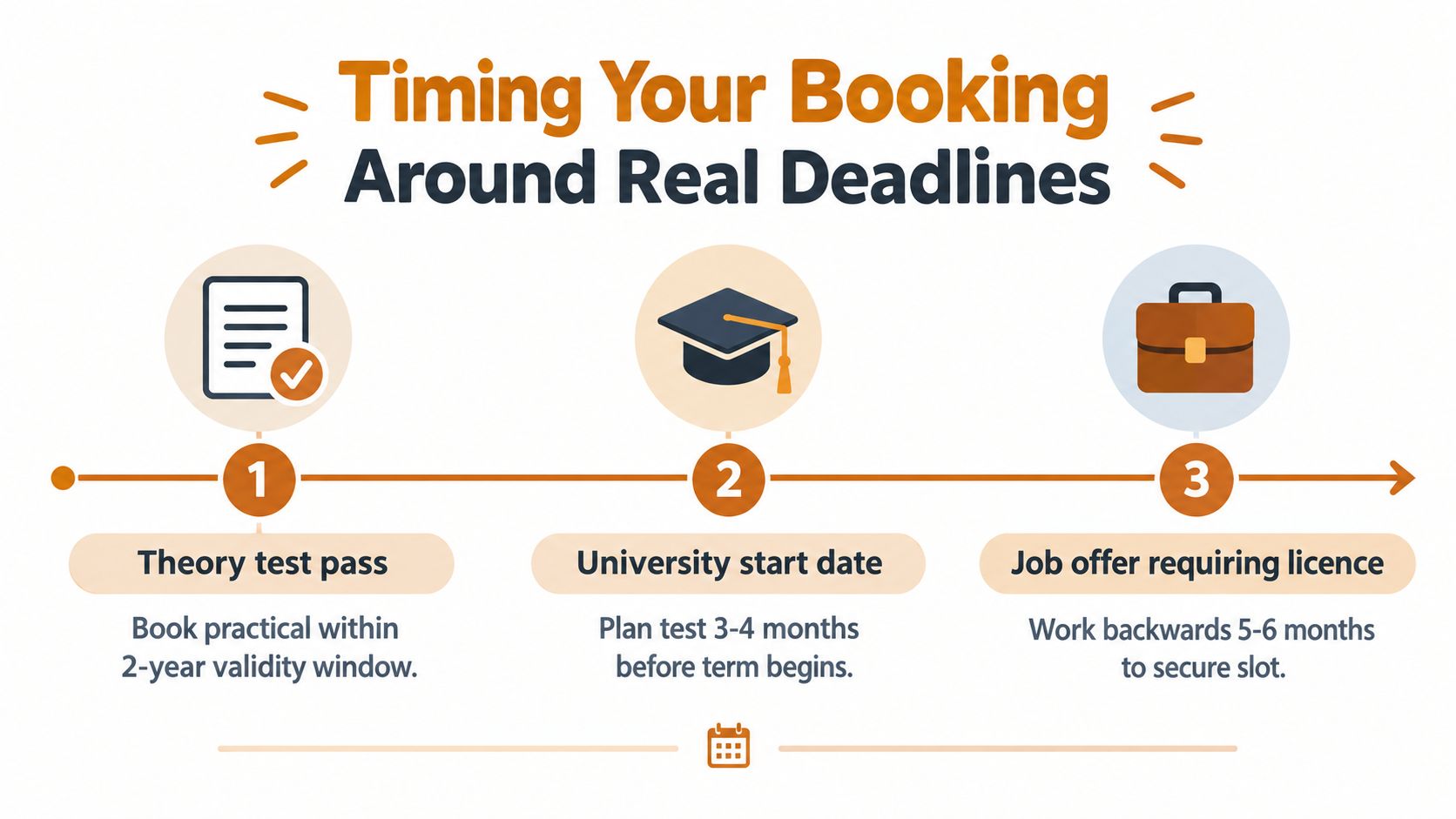
The best booking date depends on what you must protect. A learner with no external deadline can keep the first acceptable appointment and hunt for improvements. Someone approaching a theory expiry date, a new job or a university start needs a backwards plan.
Take a learner whose theory pass is approaching its 24-month validity limit. That learner shouldn't wait until the final weeks before looking for a practical appointment. Book a date inside the valid period, then set a personal cut-off before the certificate deadline. If no suitable cancellation appears by that point, keep the original booking rather than gambling on an uncertain opening.
Another learner may have an instructor who is unavailable during school holidays. The earliest DVSA slot isn't automatically the right slot. Ask the instructor for dates they can cover, identify the last safe appointment before the diary gap and search only within that workable range. A date without a car or instructor is not a real option.
A job or university deadline changes the calculation again. Start with the date you need to be independently mobile, then allow time for a failed test, further lessons or an administrative delay. The guide to choosing a suitable driving-test time can help you weigh availability against practical scheduling.
Work backwards before you move anything
Write down four points:
- The date you need the licence for, such as a job start or term date.
- The latest practical test date that still gives you breathing room.
- The dates your instructor and car are available.
- The date you'll stop chasing cancellations and accept the booked appointment.
That final point matters. Endless refreshing can make learners move into a date that looks attractive but leaves no time for preparation. Your instructor's readiness judgement still outranks the calendar.
DVSA data shows why centre selection deserves attention. In May 2026, the national availability measure was 21.8 weeks, while the median time between booking and taking the test was 9.7 weeks, according to published 2026 waiting-time analysis. The difference reflects learners securing appointments through rescheduling and cancellations. It doesn't promise the same result for every centre, so use it as a reason to monitor intelligently, not as permission to delay booking.
Key Takeaways and Common Questions
Book the first sensible practical date as soon as you're eligible and ready. Then keep looking for an earlier appointment from the first day, using either a disciplined manual routine or a notification service. Check the centre, date, instructor, car and notice period before making any change.
Don't waste changes on speculative swaps. A cancellation is valuable only if you can attend it and prepare properly. Keep your theory validity date visible, set a personal deadline for accepting the original booking and remember that no official waiting list or cancellation list exists for earlier appointments, as confirmed in GOV.UK's 2026 booking-rule guidance.
Common questions from learners
Does cancelling the first test count as a change?
Treat every adjustment cautiously. The DVSA practical booking system limits an appointment to six changes, after which you must cancel and rebook. Check the booking service and current DVSA guidance before taking action, particularly if you're close to the limit.
How long does a theory pass stay valid?
A theory-test pass remains valid for 24 months. You must pass the practical test within that period, so booking early protects your options but doesn't extend the certificate.
Can my driving instructor find an earlier slot for me?
An instructor can help monitor availability and manage pupil bookings through DVSA's business service, subject to the system's limits. Your pupil details must be confirmed by 9pm at least one clear working day before the test. Agree any centre or date change with the instructor before you accept it.
What happens if I don't attend?
You lose the appointment and risk losing the fee. The wider effect is wasted testing capacity. DVSA figures reported by the BBC recorded 64,500 no-shows, representing 3.2% of booked tests in the cited period. If you can't attend, change or cancel within the required notice period instead of leaving the slot unused.
The reliable habit is straightforward: book early, monitor from day one, act only when the date is usable and protect your remaining changes. Earlier slots come from preparation and speed, not from refreshing without a plan.
Driving Test Cancellations monitors DVSA practical-test availability and sends time-stamped alerts when earlier appointments appear, with support for up to three preferred test centres and manual rebooking through DVSA. If you want to stop checking repeatedly and respond quickly to a suitable opening, visit Driving Test Cancellations.